

Divided City Council approves building new Chelsea police station
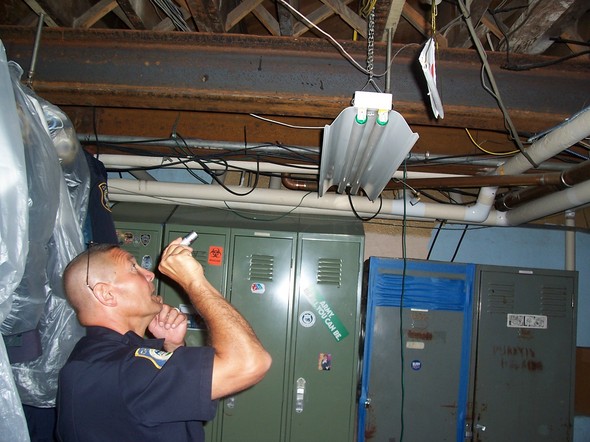
Chelsea Police Chief Ed Toth surveys the exposed wiring above the officers' basement locker room.
File photo.
The Chelsea City Council voted 5-2 Tuesday night to build a new police station for the city, but the resolution approved calls for it to be downsized from the $2.5 million, 9,000-square-foot facility that was proposed.
Council members Cheri Albertson, Frank Hammer, Kent Martinez-Kratz, Ann Feeney and Mayor Jason Lindauer voted in favor of building the station station, citing the dilapidated condition of the current station and favorable interest rates for financing the project.
“These are the lowest interest rates I’ve ever seen,” said Lindauer. “The cost of interest will go up and up. This needs to be taken into account.”
City Council members William Holmberg and Rod Anderson voted against the proposal.
During discussion, Anderson said that it was the wrong time to spend money on a new police station in the current economic climate.
The new station will be built on the corner of Summit and Main streets near city offices. It will replace the current station located at 104 E. Middle St., which has housed the police station since 1941. The building was built in 1901. Police Chief Ed Toth has said the building is unsafe and woefully inadequate for the Police Department's needs.
But plans for the station have been controversial and gave rise to citizen opposition that stalled the project earlier this year.
Martinez-Kratz said the current police station is too dilapidated to continue using.
“Something needs to be done,” he said. But he also said the proposed cost was too high and that the plans needed to be reduced in size. He suggested eliminating space for council chambers from the plan.
“I would like to see a smaller footprint. I would like to see us forgo council chambers. In this economy, we need an adequate police station,” said Martinez-Kratz.
Hammer also thought the proposed plan was too large. “I agree with Kent. I wouldn’t mind seeing it tweaked down,” he said.
Toth said during his report that there are problems with the current station that “can’t be fixed.”
“On July 29, we lost electricity to the panel for two minutes. If a 911 call had come in, it would have rung off the hook,” said Toth, adding that the problem was with the building’s electrical wiring, not because the city had lost power, which would have started up the building’s generator.
Previously Toth has said the building is unsecure and presents several safety hazards to the officers. Among other problems, the entire third floor is sealed off by plastic due to black mold, and the basement locker room has several exposed wires along the ceiling.
Several people, including Chelsea residents Warren McArthur, Lucy Silverio and Doug Worthington, spoke against building a new police station during the public comments section of the meeting “Earlier this year, 651 Chelsea voters signed a petition to have the police station issue put to a vote of the people,” McArthur said. The city … rejected those petitions because (of) certain technicalities.” He said those technicalities included things like the wrong font and paper size.
But City Manager John Hanifan said after the meeting that the petition circulated was invalidated due to several deficiencies.
“When dealing with election laws, it has to be specific, that’s the law,” he said.
The city was close to finalizing a plan earlier this year until citizens opposed to the scope of the project and the proposed location raised concerns. Residents went door to-door getting signatures on the petition.
Ultimately, the Planning Commission denied the city’s request to rezone the new property by a 4-3 vote. The City Council, which has the authority to ignore the recommendation, delayed a decision until after two public town hall meetings.
Hanifan said that the residents’ primary concerns at meetings held earlier this summer were over the size of the building, and whether the city could afford it at this time.
He outlined three options to the board, including canceling the project, moving forward with the current proposed design or altering the proposed design to reduce the size.
“The smaller version, with the elimination of council chambers would reduce 15 to 20 percent of the cost,” Hanifan said.
Lindauer said that he had looked at the drawings and conceded that the council chamber, if used about twice a month, was a waste of space.
“But it could be downsized,” he said, adding that the space could be used by other organizations when council was not in session.
“Some type of council chamber needs to be there,” he said.
Comments
RuralMom
Wed, Sep 1, 2010 : 4:47 p.m.
Oh and look, it was a Chelsea officer who caught today's bank robber. So much for not dealing with any "real" crime, only wayward teenagers. I am so thankful we have dedicated officers in Chelsea's Police department.
robyn
Thu, Aug 26, 2010 : 10:10 p.m.
I also support the plan for a new police department. My father was a part time officer after retiring from a large department back in the early 80's - that police station was pretty much obsolete back then. Even with improvements (mostly aesthetic) it was far too small and outdated for a growing community. Yes - we do have a very impressive police force, we have low crime rates and there is a very 'personal' relationship between our police officers and our community; however this is one of the reasons people choose to live in our community over other communities. Our police officers are not only our keepers of the law - they also play a key role in our community by going into our schools and holding programs for our kids. When something in our community happens - like the fire at the shopping center - our part time officers were out in the street directing traffic in street clothes. They didn't wait to serve the public - they just did it. This week we have the Chelsea Community Fair going on. I can allow my kids to go to the fair and NOT have to worry about them because the Chelsea Police Department is there - in force - and they really DO know the kids in this community. In many cases they have children in the same schools and classes with other parents here. They're not just guys in uniform, they're our friends and neighbors. I'm glad they're getting a new police department - I think it should be built with the future in mind - saving a few bucks right now could potentially cost a lot more in the future.
chelseami
Thu, Aug 26, 2010 : 11:17 a.m.
After reading the comments and have been living in Chelsea for 20+ years, I would rather see our money go towards a new police station than all the money that was spent on the new library. I would love to see this voted on by the residents.
AACity12
Wed, Aug 25, 2010 : 9:51 p.m.
You have to look at it like a car thats been in an serious accident. Sure the insurance company could pay to get it fixed. It might be cheaper then just paying for a new one. But the car will never be right again. It will always have problems and will be in for repairs constantly. They are better off just paying to get a new one. A building full of black mold and a 911 center with electrical problems is not a good thing. It will never be right. Everyone will be better off just starting from scratch and doing it right.
Forever27
Wed, Aug 25, 2010 : 1:21 p.m.
Finally you're talking about the actual issue RuralMom. Now, if you can provide some actual facts and not just "facts" about the real cost I'd be willing to reconsider my opinion. The article does not address whether it is more cost-effective to renovate or rebuild. Aside from all of this, lets consider the fact that the people who live on that street are strongly against it. I know Warren McArthur quite well, he usually makes principled stances on issues such as this. He's definitely not someone who should be brushed off as a reactionary. Their main concerns were aesthetics and cost.
RuralMom
Wed, Aug 25, 2010 : 1:02 p.m.
Forever27 you continue to ignore the facts! Here they are again! The building was built in 1901, building is unsafe and woefully inadequate for the Police Department's needs. The building is unsecure and presents several safety hazards to the officers. On July 29, we lost electricity to the panel for two minutes. If a 911 call had come in, it would have rung off the hook, said Toth, adding that the problem was with the buildings electrical wiring, not because the city had lost power, which would have started up the buildings generator There are problems with the current station that cant be fixed. Forever27 you seem to want to keep putting band aids on something that is in need of surgery. All those band aids add up over time, and do not meet the current needs of the department. I also doubt highly that restoring a historic building is as economically efficient as you are claiming. The cost of TRYING to remediate the Black Mold alone is astronomical. Not to mention if they were to try, where are the officers to conduct Police business out of? The building cannot be used while trying to remedy the situation, its a hazmat type procedure. You don't seem to have taken all the costs of a renovation into consideration.
Forever27
Wed, Aug 25, 2010 : 12:12 p.m.
@AA12, I agree. They shouldn't work in those conditions. But, rather than building an entire new structure, how about we fix the existing one? How is that worse? Unless the building is condemned, which it's not, it should be maintained.
Forever27
Wed, Aug 25, 2010 : 12:10 p.m.
Again, show me where I am wrong with my points. What I said was that the current building should have been fixed and the city has more police than needed. How is that construed as me being against the police? I've seen nothing but straw man arguments here that do nothing to address the issue at hand. People seem offended because they think that by me saying that there are more than enough resources already going to the public safety budget in Chelsea, that I'm anti-police. The police force is not in question here, the new station is. My original comment said that they are big enough, if not over sized, and that this new building was not necessary. Fix the old one.
AACity12
Wed, Aug 25, 2010 : 11:07 a.m.
A majority of the Chelsea police force is part time. I know a few retired cops that have gone to Chelsea to work. So you have a well trained police force and you don't even have to give them benefits. But for people to oppose this and make their public servants work in conditions like that is ridiculous. Absolutly absurd!! You should be ashamed of yourself if you belive its ok to make the people that out there protecting you work in such unfavorable conditions! This is Chelsea for crying out loud, not Detroit!
RuralMom
Wed, Aug 25, 2010 : 10:54 a.m.
The fact that Chelsea is small has what to do with giving our law enforcement officers the adequate buildings to work in? Oh and for the record, I was born in Detroit, raised in Saline, and raised my kids in Chelsea. I have nothing but positive things to say about Chelsea citizens, schools, law enforcement, etc. One thing your totally discounting is that between Ann Arbor and Jackson, (or Detroit and Chicago to expand your mind), there are a whole lot of issues that effect communities along the I-94 corridor. Remember it was our Police and Fire Chief who voluntarily took to the air to assist the State Police in 2006, and experienced a fatal crash of the helicopter. Our officers give a lot to our community and they deserve better than they have now.
Forever27
Wed, Aug 25, 2010 : 10:45 a.m.
Ruralmom, you can continue to argue with non sequiturs and ad hominem attacks, but the facts remain: Chelsea is a very small town, with an above average economic status as a population, with very limited crime. I'm not advocating getting rid of the police. I just think that there are better ways to spend the money that the city has.
RuralMom
Wed, Aug 25, 2010 : 10:35 a.m.
False conclusions? Here's the deal Forever27 we like our town the way it is, the police heavily contribute to that atmosphere along with us ordinary citizens and those officers need our support. Statistics can be slanted to support any position under the moon.
Forever27
Wed, Aug 25, 2010 : 9:56 a.m.
you guys are drawing false conclusions based off of spurious (at best) relationships between police force size and crime statistics in cities. While ignoring the many other variables involved with crime statistics (such as economic conditions, past history, etc) Here's a paper published on the exact topic we're discussing. http://searchtools.lib.umich.edu/V/JTK5IKNQJ36PADKLI2ILI9KQCDH7C8QXGU83BC1ULRDHUH4H56-39411?func=quick-3&short-format=002&set_number=001544&set_entry=000005&format=999 "Consistent with past research, the bivariate ARIMA analyses yield no evidence of a short-term association between police force size and crime."
RuralMom
Wed, Aug 25, 2010 : 8:58 a.m.
EXACTLY BornNRaised! We have the kind of town we have because we don't just talk the talk, we walk the walk! Forever27 if you want to work or live in an environment of Black Mold (good luck with the clean up) thats your perogative. However to continue to expose the officers or anyone in the community to this health risk, is just asking for a lawsuit down the road. Its to the officers credit now that they haven't walked off the job in those deplorable conditions.
BornNRaised
Wed, Aug 25, 2010 : 8:42 a.m.
Forever should run for Ann Arbor city council. He/she has the same ridiculous theory as Ann Arbor council and residents... "We have a lower crime rate, and lower incidents of houses burning to the ground. Therefore, we should cut all these services to the bone." Ever stop to think that you have a low crime rate BECAUSE there is such a strong police presence? Ever think that you get fewer news articles about homes burning to the ground because you that a FD presence to get there in time to STOP the fire from becoming disasterous? Funny how many people don't seem to understand the common sense behind cause/effect.
Forever27
Wed, Aug 25, 2010 : 8:39 a.m.
@Rural Mom, so clean the existing building. Also, there is a level of police that is necessary, I never said otherwise. However, there is also a threshold at which having more police than needed becomes a problem. Chelsea, has far too many police officers for the size of its population.
RuralMom
Wed, Aug 25, 2010 : 8:25 a.m.
@ Forever27, we have a low crime rate because the support the Police department receives from its Citizens, the ones who employ them to keep our town safe for everyone. The Chelsea PD does an excellent job of being good stewards to all of our residents. We support them, they keep us safe. Chelsea is between Ann Arbor and Jackson, we all have heard of the growing problem of home evasions due to the poor economic climate. Now is not the time to back down. Also NO ONE SHOULD HAVE TO WORK IN A BUILDING WITH BLACK MOLD!
chelseamom
Wed, Aug 25, 2010 : 8:06 a.m.
I was one of the 651 people that signed the petition but have since changed my mind. The police chief has done an excellent job of showing the citizens exactly why it is needed. He held 2 town meetings regarding the project and there was a lengthy article in the paper. I just hope they build it to last and not scale it down too much so that we will need another station in 20 years. About the city council chambers, we now have an empty elementary school could that be leased to the city and house the city council and chambers?
Forever27
Wed, Aug 25, 2010 : 8 a.m.
Yes, because the over sized police force of Chelsea needs more. The police-citizen ratio in that town has got to be the highest on record. I've never seen a town so small (with such a low crime rate) have so many police officers, essentially there to keep teenagers out of trouble.
Buzz
Wed, Aug 25, 2010 : 7:20 a.m.
I am glad to hear this. At least it won't have almost a million dollars worth of "art" on it. If the city can afford it, build it. It will give some people jobs.
RuralMom
Wed, Aug 25, 2010 : 7:03 a.m.
I realize we are in tough economic times, however this really needed to be done. Black mold, security issues, downed 911 lines, all spell future disasterous consquences for Chelsea otherwise. It may not be the "popular" thing to do right now, however our towns security is only as good as the support Law Enforcement receives from its citizens. We have to show them we have value for them and their lives, if we want them to take care of US citizens. It is a bonus that the interest rates are so low right now. KUDOS to those who took the controversial stand of approving the new station AND down sizing the council chambers at the same time.