

Churchill Downs residents blame city of Ann Arbor for basement flooding
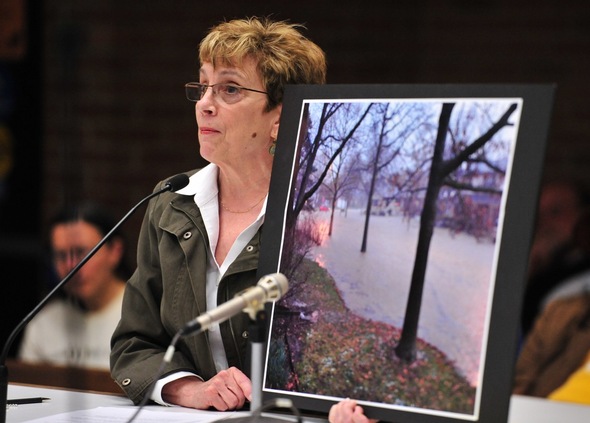
Ellen Fisher shows Ann Arbor City Council members a photograph of the flooding that occurred in front of her home last month.
Ryan J. Stanton | AnnArbor.com
But since 2000, they've suffered through three major floods — two of them within the last two years — and they blame the city of Ann Arbor for what has become an emotional and financial strain on their family.
"Three specific actions by the city appear to be responsible for the result that our home now serves as the neighborhood retention pond," Ellen Fisher said earlier this week, voicing her frustrations publicly before the Ann Arbor City Council.

Lowell Fisher, who appeared before council members in a wheelchair, said the floods are taking an emotional and financial toll on the family.
Ryan J. Stanton | AnnArbor.com
The Fishers live at the corner of Wiltshire Drive and Churchill Drive, just off Scio Church Road, near Interstate-94, on Ann Arbor's west side.
They say residential development north of Scio Church has resulted in additional waters streaming into their neighborhood during bad storms.
They claim those conditions were exacerbated in 1998 when the roads in their neighborhood — in particular, Wiltshire Drive and Churchill Drive — were resurfaced by the city.
"Instead of the older pavement being removed, a new layer of asphalt was merely placed on top of the original surface," Ellen Fisher said. "The result is a road surface significantly higher than the original design, leaving only about two inches of curb."
Instead of water being channeled along the street to the storm sewer as intended, the Fishers say any water deeper than two inches is now forced off the road onto their property and into their home.
"Ironically, after 26 years with no problems, just two years after the road was resurfaced we experienced our first neighborhood flood," Ellen Fisher said.
The third contributor to the problem, Ellen Fisher said, was participating in the city's footing drain disconnection program.
Footing drains are small 4-inch-diameter pipes located near the foundations of houses and are intended to keep rainwater from building up along the foundation or basement walls.
Historically, footing drains were connected to a house lead that carries the footing drain flow and wastewater from the house to the city's sanitary sewer system.
But the city became concerned several years ago that was causing the sanitary sewer system to become overwhelmed during storms, leading to sewage backups in home basements.
And so the city started a program of disconnecting footing drains from house leads and installing sump pumps to move water above ground into the storm water system, no longer channeling that flow to the city's sanitary sewer system.
Since the flood of 2000, Ellen Fisher claims, the city knew that the storm drains in her neighborhood were inadequate in bad storms.

Council Member Margie Teall, D-4th Ward, said she's planning to sit down with city staff to see if there's anything the city can do about the flooding problems.
Ryan J. Stanton | AnnArbor.com
And then last month's flood happened.
"My house became an island with water all the way around it — five to six inches all around the foundation," Ellen Fisher said. "Storm drain covers near us were blown off, geysers shot five feet into the air, and the street became a rapidly flowing river. Water flooded into our basement through our two city-required egress windows and our mandated sump pump."
According to the city's building permit system, the Fishers had basement egress windows installed in 2008. City officials maintain it's a requirement of Michigan building codes to install egress windows when finishing a home basement.
City officials called the March 15 storm a significant event. Data from the city's rain gauges show rain was falling at a rate of 2.4 inches per hour.
Craig Hupy, the city's public services administrator, said the footing drain disconnections do cause more water to flood the streets, but he called it a marginal difference.
"When we started the FDD program, we were concerned about the additional load on the stormwater system," he said. "And even in the largest events, the modeling we did showed that it was a fraction of an inch — between an eighth and a quarter inch more water in the street — so it's diminutive compared to the water falling in the big events.
"If we didn't have the FDDs in that rain event, we would have had basement backups downstream of them. We didn't have any," Hupy added. "Given the intensity of that storm, she would have had surface flooding whether we had done or not done FDD, so I feel very comfortable saying FDD did not have a material effect on the surface flooding."
A 1947 aerial photo of Ann Arbor shows the historic alignment of the Malletts Creek — today diverted through underground storm pipes — passes through the Fisher property, and so storm waters may be following the natural ground topography to the residence.
But the Fishers aren't the only ones mad. Ellen Fisher turned in a petition signed by 63 neighbors who want the city do something about the flooding problems.
"Although we have a fully functional sump pump, there was no place to pump the water," she said of last month's storm. "This would not have happened but for the city-mandated footing drain disconnection program. The city has attributed this to an act of God.
"Although the storm may have been an act of God, the flooding in my basement was an act of the city for which the city must accept responsibility."
On a short-term basis, she said, she'd like the city to solve the problem of water coming in through the city-mandated sump pump and to cover the costs of cleanup of the recent flood. In the long-term, she said, the city needs to address the flooding in the neighborhood.
Council Member Margie Teall, D-4th Ward, who represents the area of the city where the Fishers live, said it's not the only neighborhood experiencing the same issues.
Teall said she's planning to sit down with Hupy and City Administrator Steve Powers to see if there's anything the city can do about the problem.
"Part of my concern is with the increasing intensity of the storms we've had in the last couple of years. I think the storm events we've had have been very big ones," she said. "There are a couple of other neighbors dealing with the same kinds of issues and I'm in touch with the Fishers and with the city staff to try and see what we can do.
"It's something that no family should have to live through year after year or be afraid of, so we're just investigating what we can do," Teall added.
Teall said she's not sure whether the problems are being exacerbated by the footing drain disconnections, but she thought the Fishers made a strong case.
Lowell Fisher, who appeared before council members in a wheelchair, said the floods are taking a toll on the family.
"The value of our home has plummeted," he said. "We are afraid to restore our basement so we are left with a basement we can't use. Since I can't visit all my children, they travel to visit me. We need our basement to host our children and our grandchildren."
Two years ago, he said, the flood cost them $20,000. He said their claim for $5,000 for cleanup costs alone was denied.
"Nothing was done by the city to prevent another occurrence," he said. "These are not freak storms. There were storms for the past 26 years prior to our flooding problems. It is time for the city to take action."
Hupy said the footing drain disconnections and sump pump installations were approved by the state of Michigan.
"When we were having basement backups, the state came in and did an administrative consent order with us," he said, "and that was the prescribed method for removing it."
Ryan J. Stanton covers government and politics for AnnArbor.com. Reach him at ryanstanton@annarbor.com or 734-623-2529. You also can follow him on Twitter or subscribe to AnnArbor.com's email newsletters.
Comments
wlhneighbor
Sun, Apr 22, 2012 : 8:16 p.m.
First, why did the author think it was necessary to point out that Mr. Fisher appeared in a wheelchair? Irrelevant to the story. Second. I sympathize with the Fishers. I am not surprised, though, that their claim for damages was denied. I hope their homeowners' insurance helped. I recently filed a claim for a backup caused by a broken sewer pipe. I believe that a contractor doing directional boring for the City broke my pipe. It's pretty obvious when you see the pictures. It cost me $5,000 to have the damaged pipe dug up and repaired. The City denied my claim. I could not afford the $5,000; that really hurt. It would probably cost me even more to pursue it further.
lefty48197
Sat, Apr 21, 2012 : 6:29 p.m.
Having footing drains connected to the sanitary sewer system is stupid. It forces all of the ground water into the sanitary system where it has to be treated with all the waste. Rainwater and toiletwater are not the same thing! The city was right to demand that the footing drains be disconnected from the sanitary sewer system. Whether the existing storm sewer system is adequate or not is another question entirely. It is a fact that we had tremendous storms last spring that created flooding in many areas. We also had the big storm in March that led to more flooding. Anytime you get more than two inches of rain, you're probably looking at a storm sewer system that will be overwhelmed. That's why we need underground retention ponds like the one they just built at Pioneer High School. That's also why we need the water retention systems along our creeks like the one being built south of Washtenaw near Platt Rd.
BobbyJohn
Mon, Apr 23, 2012 : 7:22 p.m.
lefty the problem is the stupidity of the city to allow the footing drains to be connected to the storm sewer lines in the first place. Now we have a huge problem causing many residents to suffer. I don't understand why the work done on by Stadium and Pioneer haven't solved the storm drain problem
catladywbrit
Sat, Apr 21, 2012 : 1:11 p.m.
How much would changing our ideas about landscaping change all this? Would native landscaping (without lawn watering) and rain gardens help with any of this? Are there plants that would soak up all the water? Willow trees? How about rainwater catchment tanks like they use in Hawaii? Rice paddies? Reservoirs? How about BRAINSTORMING for the next RAINSTORM?
tim
Sat, Apr 21, 2012 : 11:56 a.m.
Instead of depending on drains ( that get overwhelmed ) the city needs to make homeowner build their houses higher above grade ( about 16").
Tony Livingston
Sat, Apr 21, 2012 : 1:18 a.m.
I agree with others that the council members do little to represent the constituency. I am looking at an email that I sent April 11 to our council rep. We've received no response at all. Don't know if they even get them. I assume they delete anything unpleasant and go about their business without a thought.
Cendra Lynn
Fri, Apr 20, 2012 : 11:48 p.m.
Look, it the State did an administrative consent order that footing drain disconnections and sump pump installations were the prescribed method, then clearly the flooding the Lowells claim did not actually happen. The City and the State in tandem cannot be wrong. These are the people who know how to handle flooding, not amateurs who claim nothing happened for 26 years prior to the City's actions. Just ask Margie Teall. She voted for the City's actions. If the Lowells actually had suffered such extreme losses, don't you think Ms Teall would have taken immediate action? Clearly the Lowells' picture was photo-shopped and the 63 signatures on the Fishers' petition are forgeries. I'm sure Ms. Teall will be able to prove that no such flooding ever occurred and that it never will.
djacks24
Fri, Apr 20, 2012 : 8:26 p.m.
All of this reassures me that a few years ago when a purchased my condo I made the right decision. Sure I have to share one wall of my home and have to pay monthly association fees, but small price to pay for not having to worry about things like this (or having to pay for a roof, external repairs, foundation problems, yard work, etc..). Plus my basement sump hasn't turned on even once since I've lived there. I go down and turn it on manually with a bucket of water from time to time to make sure it works.
15crown00
Fri, Apr 20, 2012 : 7:11 p.m.
it would seem with all the brains in Ann Arbor someone should be able to figure out a solution to this problem.
Tesla
Fri, Apr 20, 2012 : 6:44 p.m.
I am glad to see such an in depth front page article on this. Ellen and Lowell are great people and very forgiving but the trouble they have had is beyond ridiculous. Thank you Ann Arbor.com for giving their plight some press.
Alan Goldsmith
Fri, Apr 20, 2012 : 6:15 p.m.
My demanding better representation from Margie Teall in the past and with my comments posted today in no way supports our other 4th Ward Council member Marcia HIggins. While she appears in this photo next to Ms. Teall, she too been JUST as ineffective and invisible when it comes to neighborhood issues, including basement flooding. Other priorities I guess.
Tony Livingston
Sat, Apr 21, 2012 : 1:20 a.m.
Totally, Alan. She does not respond to email at all. At least she could let us know that she received it but isn't going to bother. None of them want to challenge anything that goes on in city hall.
Joe_Citizen
Fri, Apr 20, 2012 : 5:32 p.m.
$$$ That's the problem, they want to buy really ugly buildings, and sexual art, why I don't know. But there has been flooding all over lately. My wife was at Stadium and Pauline, and told me that water was spewing out of the storm drains like a fountain, and flooding the whole are around there, and she had to wait there till the water receded to come home. so I know this is all truth
cibachrome
Fri, Apr 20, 2012 : 5 p.m.
About a dozen years ago (or more) the was a meeting at Thurston school between the City and NE residents concerning the same problem there. Was that resolved? Are there still flooding problems in the NE section of the City? What was done (differently). When I lived there, the sanitary sewer systems were all made with Orangeburg tile (cardboard with tar that met City code). When these 'pipes' collapsed or were augered out, the storm water came in via the footing drains. That's the reason to disconnect them from the sanitary sewer. When you see a house with the front sidewalk dipping down, you can tell the sewer has collapsed. All the dirt and sediment gets into the storm drain pipes and plugs them up. Maybe the sediment traps need to be cleaned out. A small homeowner ought to be able to crawl down there on each street to clean them out. Nobody flush when this is going on.... Its no longer the City's job.
DNB
Fri, Apr 20, 2012 : 5:09 p.m.
Sorry cibachrome, but this is not an orangeburg sewer piping problem. There are homes over by Pauline/S. 7th that have these issues, as well as other areas in A2. I know from your posting on the Costco article, that you live up in Brighton, and do not appeciate us A2 residents up in your neck of the woods. Thanks, but no thanks for your incorrect guesses about our Lansdowne issues. ;-)
Commoncents
Fri, Apr 20, 2012 : 4:47 p.m.
This issue is unfortunate. It's ironic that one of the few things the city MUST do (treat water, build adequate storm systems); they can't. Instead they'll call a meeting to weigh in officially that Ann Arbor opposes Arizona's rule to keep out illegal Mexicans.... or that we need some new $100,000 art project. What a joke.
A2since74
Fri, Apr 20, 2012 : 3:59 p.m.
As a 38 year resident of Ann Arbor and 20 year resident of Lansdowne Subdivision, to address the overall flooding problem a systems approach needs to be taken. 1. Is there or is there not enough storm water run off capacity for existing buildings? 2. If there is not - which appears to be the case - then correct the situation by proper balance of storm water run off into the sanitary sewer system and the storm sewer system. 3. Allow no new buildings to be erected without proof that there will be adequate management storm water run off.
Gill
Fri, Apr 20, 2012 : 3:26 p.m.
Sump pump backup into basement: Add backflow preventer into discharge pipe. Sanitary backup: Add backflow preventer after all traps. Water through basement windows: Build up height of window well and make water tight connection to house. Make it's height higher than the flooding. Older house = more soil settling at foundation due t original backfill compaction. Add soil at house to ensure ground slopes away from the foundation, but do not pile soil against siding material. Downspouts over window wells: Ensure downspout not clogged and consider moving its location away from window.
BobbyJohn
Mon, Apr 23, 2012 : 7:16 p.m.
Gill Good points except the first. A backflow preventer on the discharge pipe will not prevent the main cause of an overflowing sump pit. Water enters through the footing drain inlets at the walls of the sump pit.
Jack Eaton
Fri, Apr 20, 2012 : 3:09 p.m.
The City has been distracted from its fundamental responsibilities like public safety and infrastructure over the past decade. When neighborhoods advocate for improved attention to our infrastructure, what we are asking for is improvements in things like storm water systems (as well as roads and bridges). While we seek public safety and improved infrastructure, the City debates banning plastic bags, banning car idling, plans private development on public golf courses, builds enormous underground parking structures and spends on plans for a new Amtrak station. Two years ago, some Council members showed momentary interest in flooding issues when a house in the Lansdowne neighborhood suddenly had 70,000 gallons of water flood its basement. The Lansdowne neighborhood, like this Churchill Downs neighborhood, is south of Scio Church Road in the Malletts Creek. Unfortunately, these are not the only neighborhoods suffering the City's failure to provide adequate infrastructure. As we experience more severe weather events, we can expect more problems of this kind. It is long past time to start planning for these events and start spending to improve flood mitigation. One must wonder whether the City is reluctant to address flooding for fear that finding a remedy will demonstrate that the inadequate infrastructure was the cause of our problems. It is unfortunate that residents must fight to get the City to act on such a significant issue while at the same time having their claims for clean-up denied by the City. Let's hope that this election year will prompt our leaders to actually address flooding.
bunnyabbot
Fri, Apr 20, 2012 : 3:07 p.m.
I truely feel for this family, my family has had the same thing happen. The family home I grew up in had several flooding problems over the years, many times over three feet deep and filled with raw sewage!, all due to the fact that the subdivisions built in the 60s did not have the proper drainage for even that era, they were cutting corners. (this from the mouth of the city offical who came out to the house once, off the record of course). Then the city, ten years ago paid to put sump pumps in for several of us neighbors after years of paying claims and a lawsuit. Still with the sump pumps a few of our neighbors have experienced floods when there was just too much water for the pumps. Fed up several neighbors dug around their homes and installed retaining walls, this has helped those neighbors. The night of March 15 we had a lake in the front and backyard and a raging river on either side of the house and in the street. When it rains heavily who ever is home checks the basement for leaks. Also, pretty much the basement is left unusable, everything stored down there is in tubs and stacked on top of crates a foot off the floor. The washmachine and dryer are lifted lest they get flooded. naturally city council will continue to name other things as a priority over basic infrastructure including the massive water problem, it's not just a few neighborhoods, it is multiple locations throughout the city. It has been causing a financial burden to property owners, often many times within a few years.
Forever27
Fri, Apr 20, 2012 : 3:04 p.m.
wow, way to just suck it up and deal with problems, people. you can't just blame the city when bad things happen. sometimes, you just have to suck it up and fix the damage yourself. be an adult and act responsibly.
bhall
Fri, Apr 20, 2012 : 3:49 p.m.
Nice strawman you've built there. Very nice strawman.
Jim
Fri, Apr 20, 2012 : 2:49 p.m.
I looked into the FDD issue a bit some years ago. What concerned me was the enormous amount of money involved. Fully implemented, Ann Arbor would spend something like $250 Million dollars on the program. All this money would come from State and Federal sources. I was concerned getting access to this money and being able to spend it was an attractive nuisance that may cloud some judgements as to the best overall action for the city's residents. My feelings at that time was footing drain disconnection was a good idea in only a few parts of the city, and not nearly as widespread as the city would suggest. The fact that the money was "free" should not be an incentive to waste it. As was pointed out in the article, if the storm drains themselves are not large enough (and would be much more expensive to enlarge) then the footing disconnect is useless and perhaps even makes matters worse. My naive thinking was that if extra run-off at the sewage processing center was such a problem, why not spend money to increase capacity there? Perhaps the State and Federal monies for the FDD would not support such a thing.
BobbyJohn
Mon, Apr 23, 2012 : 7:12 p.m.
Jim, my understanding is that the quickly rising fees by the A2 city water and sewer departments are covering much of the cost of the Footing drain disconnect program. It is infuriating if the program is worsening things.
Barb
Fri, Apr 20, 2012 : 2:25 p.m.
Yup, I have pics S.7th and Delaware in Lansdowne that A2.com posted after the storm. This was not a spectacular "storm event" by any description and yet I've never seen this kind of flooding in nearly 10 years of living here. The storm sewer opening on Delaware just West of S. 7th had been recently replaced within the last few months. I wonder if that had anything to do with it.
GirlNextDoor
Fri, Apr 20, 2012 : 2:11 p.m.
There was widespreading flooding in the Lansdowne neighborhood, which is adjacent to Churchill Downs. We live at the top of a hill, so the water filling into our basement through the windows was not a problem. The streets quickly became rivers, and most neighbors at the lowest points did experience massive flooding in their basements. Our neighbors who live on the corner of Mershon & Delaware had their entire basement fill up with water. They had been living with relatives for six months, while their entire home, including the basement, was undergoing renovation. Just prior to the March 15 storm, they had begun to move possessions back into the basement, and were scheduled to move in within the week. The whole basement filled with water, and their home looked like it was on an island, much like the Fisher's home. Totally heartbreaking for this wonderful family. The corner of S. 7th and Delaware was also flooded, another low area of Lansdowne. I am in agreement with Alan, that this sump pump plan was forced down our throats. I was one who had phone calls go unanswered last summer, and emails never returned by Margie. There are many more low-lying areas that were flooded I heard, but these are two areas I can attest to having first-hand knowledge of.
Michigander74
Fri, Apr 20, 2012 : 2:30 p.m.
Pauline and Maple also flooded (the apartment complex where the dog died) and South Main near Eisenhower too. It has happened once a year or so for the past several years. It is too bad about your neighbors home. I know there are others who suffered the exact same damage in previous floods and I'm sure it will continue. I also emailed Ms. Teall several times. I guess the work of being on City Council is too hard for her so I'll look for someone who can relieve her of the duty in August.
Barzoom
Fri, Apr 20, 2012 : 1:22 p.m.
Getting the city government to admit that they might have made an error (i.e. requiring sump pumps to overloaded storm drains) or correct a problem caused by their actions is an exercise in futility. Now, if you wanted to add a bike lane or some "public art" you might get some action.
Kara H
Fri, Apr 20, 2012 : 1:01 p.m.
My property also flooded this year and last, which hadn't happened like that in the prior 15 years we'd lived here. But there's been no road or drainage work around us. Just bad weather. I'm trying to remember accurately, but I think 2011 was one of the wettest years on record around here. I'm not sure how 2012 is shaping up, but flash floods (like during the tornado) are hard for any system to handle.
Forever27
Fri, Apr 20, 2012 : 3:05 p.m.
but, but, but, the city is at fault! i don't want to deal with my problems on my own. i have to blame SOMEBODY
Nice in A2
Fri, Apr 20, 2012 : 12:59 p.m.
Everyone is making great points. Do not forget to figure into your situation that we had many years of drought over the last few decades, the water table got very low. Now we have had a number of years of heavy rain and the ground is getting more sodden. Yes the city has to act and they will (too slow for all of us but they have a big job to do). Its important to keep them informed about your problems. Their "action list" is based on hearing your voice. Also, folks who are seeing new water problems should consider getting a foundation specialist to check over things. Old footing drains tend to fail, water proofing from the outside of a basement wall is a very strong fix, landscaping water away from your house is great as well.
Rork Kuick
Fri, Apr 20, 2012 : 4:58 p.m.
That is a great point, and made by Kara H nicely too. Maybe more water is correlated with more rain. I visit swampy areas in the western part of the county where water levels rise and fall over decades of time. Their levels started to fall in the early 90s. Small shallow "lakes" I once fished looked like meadows, and could be walked over without getting wet by about 2000. Trees started colonizing places that were too wet before (and you can tell that this had happened before, perhaps around 1965-70, and that they got killed when the water returned around 1980-85). Last few years, the water has returned. Last fall the wetlands were wetter than in the mid 80s. I'm not saying the other reasons people are pointing to are wrong, but more "development" and more rain (both long term, and more big downpours) might be enough. I know civil engineers who design for back-to-back 100 year storms now. They didn't used to.
Ron Granger
Fri, Apr 20, 2012 : 12:59 p.m.
If the city wants to blame "god" for the storm drains not working, that is between them and their god. Between my tax dollars and my city, I expect the drains to work. Especially when they force us to connect or basement sump pumps to their failed infrastructure. I've been flooded out by that stupidity before. My sump pumps now always pump into the yard, at least after the inspector leaves. It is also critical to have a pump solution for multi-day power outages. The "Midwest blackout" was a wakeup call and I think we all know that will happen again, and "act of god" will probably be scapegoated again.
bunnyabbot
Fri, Apr 20, 2012 : 3:19 p.m.
We have a battery back up for the sump pump which can run it for 8 hours. We also invested in a generator, just in case. We've used it exactly once, it was needed. But it's an insurance policy. (that also means that the money used to purchase it, although local, wasn't used to make other local purchases over time within the community)
G-Man
Fri, Apr 20, 2012 : 12:57 p.m.
Of Course it is the City's baby.... They allow new development and don't study where the water is going to go, then they pave over pavement which reduces the pathway for the water... Then they force people to connect their footing drains to an inadequate storm system....... Of course with all the potential millions of dollars they would be responsible for FIXING the situation, they pass the buck or blame someone else, or just poo poo the idea as not a problem. When you are floating in S H _ _ water, you realize you have a problem! With all the "care about you lib's" on A2 council, you would think they would do something about it (other than pay lip service like "we're just investigating what we can do")......... Maybe take more money from the DDA and fix it...... Good luck residents, i hope it works out for you, but i think if you can pool your resources, you need a good lawyer and go after the City once and for all to correct their flawed (if not failed) system.....(And in the meantime, get as much sewer back up insurance or flood insurance as you can, because it's not going to get better on it's own!
xmo
Fri, Apr 20, 2012 : 12:53 p.m.
I think it is all because of "Man Made Global warming" which was caused by George W. Bush and those Damn Republicans. They want our basements to flood, our homes to wash away and for us to go broke! Thank Goodness we have a city council and mayor who understand this and refuse to spend our tax dollars on this problem because they know it will not help. Thank You Mayor Hieftje and the city council.
bhall
Fri, Apr 20, 2012 : 3:50 p.m.
I think pretty soon is already here!
Brad
Fri, Apr 20, 2012 : 1:52 p.m.
Pretty soon the climate change deniers will be right up there with the birthers.
Rob
Fri, Apr 20, 2012 : 12:25 p.m.
I think that all the naysayers here should follow the advice I hear so often thrown at people living in hurricane-, tornado-, earthquake- and drought-prone areas. If you don't like it, move somewhere where this stuff doesn't happen!
OLDTIMER3
Fri, Apr 20, 2012 : 12:44 p.m.
If there property wasn't prone to flooding before the city mandated changes the city should be the one to correct the problem. Moving away doesn't correct the problem Rob it only puts it on someone else.
just a voice
Fri, Apr 20, 2012 : 12:22 p.m.
who is an expert on this and can give us facts and information and not just layman guess work
jcj
Fri, Apr 20, 2012 : 12:28 p.m.
"who is an expert on this" ? Apparently not the ones that designed the system! If my basement were to flood 3 times I would consider myself more of an "expert" than the designers.
Hans Masing
Fri, Apr 20, 2012 : 12:07 p.m.
I live on Meadowbrook, just east of where Stadium and Pauline meet, and have been here for 12 years. We had no flooding at all until the last three years, when we have flooded twice and almost flooded at least three other times. I had 18" of water against the side of my house during the recent storms and had a massive river flowing through my yard to the storm drain at the back of my property. This hasn't happened before three things changed. First was the rework of the storm drains on Stadium Blvd. Second was the lutheran church on Stadium redoing their storm drains, which ultimately don't work and force more water over their parking lot and down on to the neighbors property. But the most important one is the removal of leaf pickup in the fall. The water stops flowing in to the storm drains on the street due to leaves and debris clogging them in the spring, which we did *not* have prior to the city budget cuts of leaf pickup. So, the storm drains clog and the water backs up. We had zero flooding prior to that.
Tom Whitaker
Fri, Apr 20, 2012 : 4:54 p.m.
I don't agree that it is a homeowner's responsibility to keep the storm drains in the streets clear of debris. This is the City's responsibility. Back when we used to rake leaves into the street and the City would pick them up, sure, I can see how we would be expected to not block the storm sewer with leaves that came from our yards. But those days are over and we now dutifully rake and put our leaves into the compost bin, in our garden, or in our compost pile. The street and storm sewers are the City's to maintain and there is plenty of money in the stormwater bucket to deal with it. Ironically, the City is in fact using stormwater funds to plant more trees in the lawn extensions as I type.
Hans Masing
Fri, Apr 20, 2012 : 4:39 p.m.
@BunnyAbbot, I spend every serious storm at the rear storm drain trying to keep it clear of the debris that washes down to it. I've built a fence around it on my own dime to try to provide a filter for debris as well, but it inevitably gets clogged, I get 4 feet of water in my yard, and I have a river flowing around and through my house. This simply did not happen in the decade I have occupied the house prior.
bunnyabbot
Fri, Apr 20, 2012 : 3:11 p.m.
neighbors in my street will wade out to the street to the drains when they are clogged and shovel out the leaves, sometimes someone will be standing out in the rain continuely declogging for an hour after rain has stopped, looking down the street you'll see another soul working another drain.
Hans Masing
Fri, Apr 20, 2012 : 2:26 p.m.
Ron - Yes, cleanup is part of the homeowners responsibility, however leaves that blow in to common areas used to be part of the street leaf pickup operation. This does not occur any longer. I keep my storm drains clear and my lawn clear, but the city pickup took care of a lot more than just the leaves on my lawn and my neighbors lawn.
Ron Granger
Fri, Apr 20, 2012 : 12:55 p.m.
"But the most important one is the removal of leaf pickup in the fall. The water stops flowing in to the storm drains on the street due to leaves and debris clogging them in the spring, which we did *not* have prior to the city budget cuts of leaf pickup. So, the storm drains clog and the water backs up." That part, I don't agree with. It is the property owners' responsibility to keep the street gutters clear, regardless of whether there is leaf pickup way back in the Fall. If the drains are blocked, you gotta clean them. If my 85 year old neighbor can do it, most people can. This may require shoveling snow, and clearing ice from the gutter. Especially when major melts are expected. Whatever it takes to clear the drains. It's what he does. That old guy puts most of us to shame. Of course I don't know his motivations - his wife may be telling him to get out there and do it, and not to come back in until it's done. Maybe the city needs to clarify property owner storm drain and gutter cleaning responsibilities. I sure don't expect them to do it. As for the storm drains not working, and forcing people to connect their sump pumps to the storm drains. That is their problem.
Rork Kuick
Fri, Apr 20, 2012 : 12:04 p.m.
Retention and detention of rainwater in Mallets and Allen drainages is horrible. Their flows exceed that of Mill Creek in storms, even though their watersheds are over 20 times smaller. That's a ghastly thing for our river, and for some people's homes. It is safe to say the development of these areas in the past, with a "just send it to the river" attitude, was insane. It's no surprise that it's hard to fix now.
Wolf's Bane
Fri, Apr 20, 2012 : 11:58 a.m.
Love what they did to one of our favorite parks, West Park. You could call it flood proofing, but to me it looks like a massacre and I love the wide open hole due to flooding issues. Lovely. How about hiring contractors that can actually do their jobs?
Joe_Citizen
Fri, Apr 20, 2012 : 5:32 p.m.
$$$ That's the problem, they want to buy really ugly buildings, and sexual art, why I don't know. But there has been flooding all over lately. My wife was at Stadium and Pauline, and told me that water was spewing out of the storm drains like a fountain, and flooding the whole are around there, and she had to wait there till the water receded to come home. so I know this is all truth.
f4phantomII
Fri, Apr 20, 2012 : 11:57 a.m.
Good article. Glad I live on top of a hill.
treetowncartel
Fri, Apr 20, 2012 : 3:52 p.m.
There are certain things you don't even think of when buying a home, particularly your first. Another thing is to make sure you live on the north or west side of the street, that way your leaves will blow into your neighbor's yard and not the other way around.
Michigander74
Fri, Apr 20, 2012 : 11:01 a.m.
My neighborhood was also affected by flooding on March 15 (and probably the same other days as the Fishers' experienced flooding. On March 15 and 16, I saw Dexters private and public citizens pull together to help neighbors, have fundraisers, show concern and take care of each other. In Ann Arbors' repeated flooding affecting multiple neighborhoods, I saw nothing, no response to emails, no planning to prevent the next flood, no concern at all by city officials. I completely agree with Alan, this should not be news to Ms. Teall or anyone else on the City Council. Park Place, Scio Church and South Main areas and the other neighborhoods that suffered flooding over and over again deserve better.
Alan Goldsmith
Fri, Apr 20, 2012 : 10:46 a.m.
Amazing. Margie Teall is the invisible woman when it comes to neighborhood issues and now, right before the August Democratic Party Primary for Council, she's all concerned. "Increasing intensity" of storms? This neighborhood was totally opposed to the genius 'sump pump' plan Teall and others shoved down the throats of 4th Ward residents and if she returned phone calls or read her emails or even campaigned in this neighborhood, she would have known this a long time ago. But Ms. Teall was more concerned about flooding and water issues around the City Center Building water fountain, something she championed than her job--taking care of voter and residential issues. Why is anyone surprised?