

Ann Arbor church's effort to help homeless fails; First Baptist removing shelter
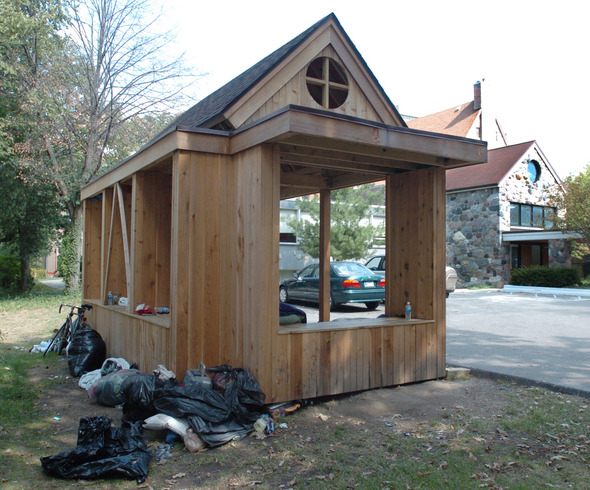
Problems at the First Baptist Church's pavilion for the homeless have prompted the church to take steps to remove it.
Ann Arbor News file photo
The First Baptist Church of Ann Arbor’s experiment in providing a rudimentary shelter for the homeless is coming to an end. Sometime this week, a wooden pavilion the church built in 2008 at a cost of more than $15,000, will be removed and given to the University of Michigan’s Matthaei Botanical Gardens.
The church, 517 E. Washington St., tried but did not have success in managing “problematic behavior” among the homeless men who slept in the pavilion, co-pastor Paul Simpson Duke said. The pavilion was built as an alternative for the homeless who had been sleeping on the church grounds, particularly under the large portico at the entrance to the building. Some church members felt unsafe when entering or leaving the church as a result. The church wanted to be compassionate and did not want to remove the homeless; some were ineligible to receive assistance from local shelters, Duke said. So the church settled on the idea of building the pavilion, which has a roof and floor, but no walls, and put it on the side of the church's property. But it became a place for people to gather and drink and take drugs, Duke said. There were fights among the people who stayed there. And the church had concerns about noise and lewdness affecting its next-door neighbors, he said. “Some of the (people who stayed at the pavilion) became territorial, so there was a bit more violent behavior,” said Duke. “We came to have some concern for the safety of the people who would use the place.” Rules were posted to limit use of the pavilion to the nighttime and restrict the number of people who could use it to no more than five. Although church officials tried to keep watch over the pavilion and defuse any problems quickly - going so far as to have a church member keep watch from the parking lot at times - the church couldn’t provide all-night supervision or hire security. In January, church members at a regular meeting voted to end the experiment, setting the church on a search for what to do with the pavilion. Church members didn’t want to throw out the materials. Eventually, they found a place for it at the Matthaei gardens, which will use it on its grounds as a place for people to sit, said Duke. On Friday around 9 p.m., four men gathered under the church’s portico, which provided greater shelter than the pavilion from the wind-driven rains of a thunderstorm. “It’s putting me out on the streets,” said one of the men, Jack, who would not give his last name and has slept under the pavilion since it was built. Although the smell of alcohol was strong in the air and one man crawled on his hands and knees in front of the door of the church, Jack said he thinks the reason for removing the pavilion is that the church and its neighbors didn’t want to “see the eyesore there,” pointing to the bags and suitcases of the homeless men that were piled up in the pavilion. Another man, who wouldn’t give his first or last name, said there had been problems at the pavilion, but he wouldn’t discuss them. “It’s their pavilion, so what can we do about it?” he said of the church. Duke said the church remains committed to caring for the homeless and poor. It is a leader in the creation of the new Interfaith Coalition for the Homeless, which will advocate for greater support for existing services and develop new initiatives. The church continues to host a meal for the homeless and poor on Tuesday evenings and is part of the rotating shelter network, which provides additional beds for the homeless during cold weather.
Comments
Life in Ypsi
Wed, May 26, 2010 : 3:05 p.m.
I worked for the shelter some years ago. I have to say it saddned me to see so many people fall through the cracks. The atmosphere was very unprofessional and I could list off so many unethical things that I witnessed, but my post would probably be removed. One day I long to tell my story to someone who believes me. I even notified board members and got no response.
Life in Ypsi
Wed, May 26, 2010 : 3:02 p.m.
Anyone who thinks we should go back to warehousing mentally disabled people should read this book about someone who grew up in an institution: http://www.amazon.com/Waiting-Home-Richard-Prangley-Story/dp/0802842119
gamebuster
Tue, May 25, 2010 : 10:14 p.m.
It's true. It's absolutely not a failure. Our community has learned a lot and starts to help our neighbors in different manners. Just today, Tuesday morning, originated by Ron Gregg, Pastor Paul from First Baptist Church, they invited many representatives from local churches, non-profit organizations to form a united force called "Religious Coalition for the homeless". The meeting was held at Zion Church, 19 people joined. We will try to help in different ways : Establishing a day-warm center for them, some people even want a 24 hr engagement center, 'Housing Advocacy" "Public Education Advocacy"....the way to help the veteran homeless and mentally-ill homeless can be different. An advocate suggested that "mentally-ill homeless" long for the sense of community. It also explains why certain homeless people not favor individual housing. A building like "Dorm" or "Senior Center" suit their need. Residents there enjoy the help from the supportive staff, communal TV room, a cafeteria or shared kitchen. Mentally-ill people might not get enough care from their own family. They are afraid of isolation.They might need extra care from the people around. To tackle different issues, we might need different approaches. Yes, it's true, some substance abuse might start from mental illness. If you check the internet, you'd know that around 35% of mentally-ill people avoid medications, and choose alcohol to heal themselves when the episode attacks. Again, it's not a failure. It's the beginning for many people from our city to join the forces together. Besides, I really don't want people having prejudice against the homeless camp. As there's inadequate housing in AA, Shelter is full, homeless city is a way of survival. But they're still living in fear as police, state troopers, county sheriff might come any minute, plus the hostility from the residents in the vicinity. I feel sorry to say "They're miserable". There's no electricity and water there, but many mosquitoes. No matter where I go, I just remind volunteers to bring them water. The nearby residents driving by still honked us. The homeless don't bother us, and they just want a place to sleep. Take my words, I've been with them over a year.
C.
Tue, May 25, 2010 : 3:09 p.m.
Thumbs up to First Baptist for being real Christians and trying to deal with the issue of homelessness, as well as get at some of the roots of homelessness with your meal on Tuesday evenings, giving of space for twelve-step meetings, providing warm clothing in the winter, offering spiritual care to all those who come through the doors, and many other ways that I'm sure none of us know about. I noted that Pastor Paul Simpson Duke named the reason that the structure will be removed -- the safety of those who wish to sleep there. My point is that it is not being removed for the good of the congregation. Even if the pavilion provided one night of dry shelter for someone (although it clearly provided many nights), I don't think it can be called a failure. I feel confident that First Baptist will continue to evolve in their work in ending homelessness and addressing poverty, mental health issues, addiction, etc... in our community.
Danielle Mack
Tue, May 25, 2010 : 1:53 p.m.
Awakened, I am new to this story, but I can tell you from personal experience that the shelter can NOT help everyone that comes there with all their needs. Your attempt to lump all those unable or unwilling to go to the shelter for help as "mental illness, substance abuse, or some combination of the two" Is so far from the truth as to almost be a lie. I say almost because there are some instances where that is the case. A much larger percentage however receive some help there in the way of showers, meals, and a few services. However the Shelter is no longer able to provide laundry services to the homeless, and there program has a few flaws that when they were put into practice were fine and worked 90% of the time to help most people. Due to the terrible economy, and changing times those rules are starting to allow way too many to fall through the cracks in increasing numbers. Many of the homeless now that do not stay at the shelter have over extended their three month stay, and are still looking for work with no luck. Some came to Ann Arbor looking for work from another county and are turned away from the shelter due to not having established Washtenaw County residency. Some people are out there struggling to find work, and/or going through job retraining at a local college, and don't fit within the established rules and definitions at the shelter. Then there are those that are working hard to find work and the shelter staff have continually insulted them to the point where they just don't feel welcome and prefer to try things out on their own rather than put up with staff attitudes. I say this from experience that there are a lot of good people at the shelter, that may have a bad day and catch someone else on a bad day and it sticks with the person that came in for help, but there are a few bad apples amongst the shelter staff too. In my personal opinion the shelter is a system that is slowly falling apart due to lack of funds and lack of keeping the system updated with the times. If we fix these problems we could fix the shelter and see less homeless on the street.
dlb
Tue, May 25, 2010 : 8:51 a.m.
True, there was a general movement away from long term psychiatric hospitals and state centers for developmental disabilities, that was in keeping with a general "deinstitutionalization " movement, however when Engler closed the hospitals he did not pass on the money to the county mental health agencies, in fact he cut the CMH budgets. He then largely dismantled the State Dept of MH. This is the mess we are left with. Mental illness is very difficult to treat, sometimes hospitalization is needed! We need professional, humane treatment for the mentally ill.
Eric P
Tue, May 25, 2010 : 8:40 a.m.
Ref the closing of the state mental Hospitals: one element that has been missing from the comments here is that the 70s and 80s also saw the rise of medications to help many of the people who would have been residents of those facilities previously. Of course making sure that those meds were taken is a different story.
bedrog
Tue, May 25, 2010 : 8:14 a.m.
kjm clark...re the 'great depression'/john steinbeck/hooverville/ccc analogy: while few of the ann arbor street people seem to evoke the nobility of woody guthrie, or henry fonda as steinbeck's 'tom joad', there is a stadium street bridge that could stand in for some ccc projects...or the hoover dam.
Cash
Tue, May 25, 2010 : 6:10 a.m.
rwing1, From Asylumprojects.org "Gov. John Engler sought to cut state spending on mental health. Under Engler, State Mental Health Director James Haveman Jr. sought to close all the state's mental hospitals. Ypsilanti State Hospital - by now renamed Ypsilanti Regional Psychiatric Hospital - was one of the first to go, closed in 1991."
KJMClark
Tue, May 25, 2010 : 6:05 a.m.
Drug abuse, including alcohol abuse, is a borderline mental illness. http://www.nida.nih.gov/researchreports/comorbidity/index.html "To help explain this comorbidity, we need to first recognize that drug addiction is a mental illness. It is a complex brain disease characterized by compulsive, at times uncontrollable drug craving, seeking, and use despite devastating consequences behaviors that stem from drug-induced changes in brain structure and function. These changes occur in some of the same brain areas that are disrupted in various other mental disorders, such as depression, anxiety, or schizophrenia. It is therefore not surprising that population surveys show a high rate of co-occurrence, or comorbidity, between drug addiction and other mental illnesses. Even though we cannot always prove a connection or causality, we do know that certain mental disorders are established risk factors for subsequent drug abuse and vice versa." - Nora D. Volkow, M.D. Director, National Institute on Drug Abuse, writing last year. We really need to look to the Great Depression for ideas. Unfortunately, I don't know that they did much better. I suppose something like the Civilian Conservation Corps could help a little here. Too bad we gave that money to the bankers. Kudos to the church for trying.
drew_blows
Mon, May 24, 2010 : 11:13 p.m.
jtwilkins: Did you know that DHS sends a worker to the Delonis Shelter once or twice a week to help the homeless apply for assistance. Did you know that you can apply for assistance 4 mornings per week and see a worker that morning and not have to wait for an appointment to arrive by mail. Just the facts.
Deanne
Mon, May 24, 2010 : 11:11 p.m.
Eileen Peck, you made some interesting points without resorting to partisanship like some do. Refreshing! I like those kinds of comments.
Agradable Amigo
Mon, May 24, 2010 : 10 p.m.
Nice try First Baptist Church. They should be commended for trying at least. It was a matter of timeit always is. The pan handling, graffiti, public urinating, and random crime is really escalating in certain areas. Good luck walking in-front of the book store across the road from the Michigan Theater without being accosted by the professional beggars. I refuse to bring my kids and friends around the Liberty and Maynard area. Notice any vacancies in that area? I argue there is more random crime in Ann Arbor now than other notorious areas in the state.shame. I do know what Im talking about in this regardsorry.
ShadowManager
Mon, May 24, 2010 : 9:35 p.m.
Bums being bums? imagine that!
eldegee
Mon, May 24, 2010 : 9:07 p.m.
Yet again another misguided (albeit good-intentioned) effort to help those individuals who can not and will not be helped. These are people who would rather sleep on the street, than follow a few rules like the rest of us. And there is NO WAY that shelter should have cost $15 grand, when (I'll bet) it has less than $1000 worth of materials in it. Someone took that congregation for a ride bigtime. Oh well, live and learn - hopefully.
Eileen Peck
Mon, May 24, 2010 : 8:48 p.m.
Overall, Michigan spends more per capita on mental health services than most states, and is ranked 16th or 17th in mental health spending, depending upon which source you look at. The National Alliance on Mental Illness gives Michigan a C+ in terms of the way it handles the provision of mental health care within the state. (28 states received a grade of D+ or below.) The closure of state psychiatric hospitals is not limited to Michigan. Nationwide, states are moving away from running psychiatric hospitals and toward delivering mental health services in a community-based setting and through private providers for all but the criminally insane. Long-term hospital-based psychiatric care is largely ineffective for treating many kinds of mental illness. Combine this with the fact that mental illness is the fourth most-expensive type of health problem to treat and you'll quickly understand why the days of warehousing mentally ill people in state-run hospitals are over. This shift in Michigan would have happened regardless of who occupied the Governor's office. It's not really a political issue when all parties agree that state-run psychiatric hospitals aren't the answer.
dlb
Mon, May 24, 2010 : 8:41 p.m.
Having worked in the State mental health system during the 80's and 90's, I had an inside view of the collapse of the State's service to this needy population. Yes, compassionate people (liberals) did complain about he horrible conditions of the hospitals in the 60's and 70's. Earlier govenors responded by successfully facilitating a massive overhaul of the system. The state system, at the time Engler took office, was much improved. However, Engler took a sledgehammer to the system, destroying it almost beyond hope.
dlb
Mon, May 24, 2010 : 8:32 p.m.
Bravo to 1st Baptist for their efforts! A significant issue is our State's decision to turn our backs on the mentally ill during the 90's to placate anti=gov't folks has contributed greatly to the problems of homelessness and jail overcrowding. With the continued libertarian current we are seeing this year, I am afraid it will only get worse. I do hope that eventually our society will come to its senses and address the needs of people like this again.
robyn
Mon, May 24, 2010 : 8:24 p.m.
@ rwing. You're actually right about that - but studies did show that private agencies did a much better job with a lot of the 'social services' related care and at a lower cost than state run agencies. Child Foster Care was one of the programs that showed that children received far better care under private foster care than under state run institutions and foster programs. They found the same with the state run mental hospitals - many of the hospitals cost a lot of money but did not provide better care than community based programs. People also seem to ignore the fact that there were people placed in mental hospitals against their will and people with mental disabilities (and physical disabilities) that were not necessarily dangerous or 'insane' were dumped into these facilities by families that did not want them or did not have the means to care for them. Community based care encouraged families to care for their disabled and they provided help for them - educational, rehabilitational, training, adult services, etc. All in all - closing these hospitals was good financially and better for many of those that faced rotting away in such a facility. Unfortunately - the community based services are now over burdened by the sheer volume of those who use these programs - many of whom have been in the system for generations. Those who 'moved into' the system and never 'moved out' of it have soaked up funds that could be used for those who have no means or are not capable of caring for themselves. Liberals will not allow those who have been in the system for generations to be cut from the system - or otherwise 'weaned' from it. Instead they just ask for more money to be put into the system and those who end up falling through the cracks are those who need the system the most.
rwing1
Mon, May 24, 2010 : 5:58 p.m.
As usual you libs have a selective memory. Yes the hospitals were closed under Engler but he only closed them after the pressure from the left that whined about how cruel it was to keep the mentals in state hospitals. Do your research...
Woman in Ypsilanti
Mon, May 24, 2010 : 4:04 p.m.
@bedrog Unfortunately, it is true that if the social services are better in one location than others, people who need the services will be drawn to that location. That is why the most meaningful changes need to happen at the state and/or federal level. Here is the thing folks when it comes to the homeless mentally ill and/or substance abusers: sooner or later they are likely to run afoul of the law. Then they will be housed at great expense in prison. Wouldnt it be better if their basic needs were taken care of outside of a prison setting? It would be cheaper at least. I suppose people with compassion for them can justify the prison time as something positive for them which it sometimes is. But I find it more compassionate to just make sure everyone has basic things like a roof over their head, clothes on their backs, and food in their bellies delivered without judgment about their lifestyle choices even if those choices (like to abuse substances) led them to the situation where they cannot provide for their own basic needs. That method has the added advantage of being cheaper which I would hope the anti-tax folks could get behind.
annarbormommy
Mon, May 24, 2010 : 3:47 p.m.
Though I am not surprised that this didn't work out, I appreciate that the church tried their best, and that they are continuing the effort through their new coalition. We're seeing the symptoms (hunger, homelessness) of much larger issues (mental illness, substance abuse, lack of access to proper services... and the failing economy!). It will take a lot of time and effort to address these issues (and I don't even know where to begin), but in the meantime, the symptoms will have to be addressed. There are some options out there for people who need and want help, but they aren't enough. Friends I know are using food stamps for the first time in their lives (they both work, but can't find more than part-time), and they never thought they'd be in that position. They were kind of ashamed of needing help, and the process seemed really difficult, but there are some cool new programs happening like this one: http://www.annarbor.com/news/foodgatherers-offering-education-on-federal-food-assistance-program/ which could help sign up eligible people quickly (instead of taking 2-3 months).
packman
Mon, May 24, 2010 : 3:24 p.m.
@jtwilkins who said "Ypsi/A2 shelters are over capacity with waiting lists the majority of time. There are a good number of substance abusers that are homeless but a staggering amount of homeless are veterans and people with severe mental illness." To say that "a staggering amount of homeless are veterans" needs some discussion and definition. There are "veterans" (I happen to be one) and then there are veterans. Some definitions are: 1. Retitred veterans who served their county for 20 years or more. 2. Productive veterans who served and are successful. 3. Veterans unable to adapt after a few months of military service. 4. You can go on and define many other subsets, discharges for drug abuse, etc. The implication by using the term "homeless veteran" is that we are mistreating and ignoring those who served our country when that is more than likely not the case.
quitoslady
Mon, May 24, 2010 : 2:59 p.m.
A lot of people who abuse drugs and alcohol suffer from mental illness to begin with.
bedrog
Mon, May 24, 2010 : 2:30 p.m.
rwing...as noted by others much of the mental health cutbacks occurred during a republican 'watch', so your particular effort at ' big bad liberal' bashing doesn't wash...although im sure you'll keep it up regardless of evidence. but in fairness, to note the way both political wings can be undone by a surfeit of badly behaved indigents ( whatever the reasons for such misbehavior) consider the case of a small college city ( much smaller than ann arbor) whose mayor ( now a congressional rep) is a self proclaimed socialist...and a damned good mayor actually. but during his mayorality the town became inundated with such folks as those in the story here, largely because of the excellent social services offered. they became such a pain in the lower extremities that one of the mayor's most ardent progressive supporters, (and a restaurateur irked by the way the downtown was becoming the domain of aggressive panhandlers and inebriates), eventually organized a campaign called 'westward ho'...which provided one-way bus tickets out of town.... it actually sort of worked, at least as to putting the most offensive on notice that there were limits to tolerance even among the socially charitible and compassionate.
Cash
Mon, May 24, 2010 : 1:42 p.m.
rwing1, Can't rewrite history. John Engler closed Ypsilanti State Hospital in 1992...one year into his "reign" putting the mentally ill in Washtenaw County out on the street.
rwing1
Mon, May 24, 2010 : 12:15 p.m.
It's great that the church at least tried to help, but it just proves that you can't just give something to someone and they will appreciate it. If we take the mentals off the street maybe the people that just need a little help could finally get it from the churchs and other organizations...
rwing1
Mon, May 24, 2010 : 12:11 p.m.
The homeless problem was caused by the do gooder liberals that forced the State of Michigan & others to close the pyschiatric hospitals becaus ethey claimed they were inhumane. At least those that needed help were receiving help and had food and shelter. It's time the liberals open their wallets and provide the necessary psychiatric hospitals that these people need. YOU caused the problem you fix it....
robyn
Mon, May 24, 2010 : 12:01 p.m.
Gamebuster: For years I'd drive by 94 & Jackson Avenue and see that abandonded hotel - it was closed for so long I can't even rember what hotel it was. I always thought that a place like that would be ideal for some sort of 'transitional' housing for people who had become homeless but that were able to get help and begin working toward independence. Give them up to a year - as long as they were making progress and working/training - to live there and teach them life skills (how to manage their finances, how to look for a job, child care, health and nutrition, etc.). Have them pay some sort of 'rent' which would be given back to them at the end of their stay to help them with housing costs. It can be done - our taxes are being tossed out the window with the programs that we have now - they only seem to keep the status quo. Why not spend money in a way that really addresses the problem?
genericreg
Mon, May 24, 2010 : 11:43 a.m.
For $15,000, they could bought 3 houses in Detroit. Or one house and paid one of the more responsible homeless men $10,000 to look after it for a year.
gamebuster
Mon, May 24, 2010 : 11:42 a.m.
I know them. It's not the homeless at the Baptist church refuse the help offered to them. The fact is Delonis shelter has its rules. If people fail the drug & alcohol test, they have to leave the shelter. A certain amount of the homeless are barred from the shelter. Even the homeless camp "Camp Take Notice" has its rules, they don't encourage drug & alcohol use. It explains why the homeless you see at the First Baptist Church are substance abusers. I know them. They are friendly guys. They've alcoholic issues but it doesn't mean that they're bad guys. We drink too, but the difference is we're housed. If you check the document of homeless research from the Washtenaw County. Substances abusers occupies around 25-30 % of the homeless community. There're many different stories. Denver in Cororado initiates "Housing First Program", it got successful in 9 different states, which is the program to house them first, then provide supportive service to heal them. Unfortunately, the current system in Ann Arbor is to make sure that they're all clean, then they've the chance of being listed in the long waiting list for apartments. Worse still, AA even doesn't have enough affordable housing. These combining factors make them "Chronic Homeless". Years ago, Denver's Mayor faced much criticism to build about 300 units for the homeless. It finally proved successful and saved money on ER, Police force, Detox center, supportive services from shelter....administration costs of case managers....in the long run.
Skeet
Mon, May 24, 2010 : 11:34 a.m.
The homeless should be made to take classes at a Community college and register with michigan works if they want some help from the state. Aren't unemployed workers held to those standards before they get benefits? I think that if someone is mentally ill, then the physician who diagnosed him should have contacted the proper authorities when they made that decision. How is it that a non American person can come to this country and get mad handouts while folks who were probably born here are pushed to the side and forgotten about? When I pass homeless folks on the exit ramps, I look them in the eye to let them know I feel them before I hit that corner. That is their choice to be there, as opposed to going to Mickey D's and filling out an app. If you build a lean-to in downtown Ann Arbor and say that its for homeless folks, then you can be sure all the homeless folks for miles around are going to lay claim to it.
rusty shackelford
Mon, May 24, 2010 : 11:22 a.m.
I suggest the church read Matthew, Chapter 9, and then reconsider their actions. Of particular interest are verses 8-13. No one said being charitable--as Jesus commands--was easy or convenient. They did the right thing in the past, I urge them to stick with it. Turning away the wayward who have found shelter in your domain is almost the quintessential anti-Christian act.
FreedomOfSpeech
Mon, May 24, 2010 : 11:11 a.m.
If you build it, they will come.
robyn
Mon, May 24, 2010 : 10:54 a.m.
A minimum standard of living... That has been done. It's called 'welfare'. As altruistic as the concept was, it has been taken advantage of. Just as social security disability has been and any other program designed to help those who do not have the ability to do for themselves. In some ways the 'mental' hospitals helped by housing those who were incapable of caring for themselves. HOWEVER - these hospitals were rife with abuse, neglect and the patients really didn't receive much in the way of help or rehabilitation. They were simply warehoused at the expense of the tax payers. I may come across as harsh in saying this - but I have more compassion for those who are mentally ill and cannot make choices that better their lives. Their illness' prevent them from taking even a basic responsibility for their own lives. I cannot and do not hold those feelings for people who abuse drugs or alcohol - they have a choice (and yes it is a very difficult one to make). They made a choice to begin using, a choice to continue using. People with a mental illness don't have a choice. They can't/won't wake up one day and decide to become 'normal'. But an addict can wake up everyday and try to become clean. And even if they fail - they have the option to keep trying. I agree that something has to be done - but to what extent and by what means?
Woman in Ypsilanti
Mon, May 24, 2010 : 10:30 a.m.
Personally, I think that we, as a society, need to accept that there is a population in our midst who for whatever reasons are unemployable. Sometimes they are lazy. Sometimes they are mentally ill. Sometimes they are substance abusers. Sometimes they are all three of those things. Like it or not, those people bring a cost to our society. They might turn to crime. They might panhandle. They might sit around drinking on the stoops of our churches. It really might be cheaper and better for everyone in the long run if we could, as a society, just have a minimum standard of living that everyone is entitled to even if they choose to do things we don't like, like drink themselves to death or whatever. I am not talking about anything luxurious: just a roof and some meals and a place to bathe and use the toilet.
Cash
Mon, May 24, 2010 : 10:22 a.m.
40 years or so ago,in my younger years, there were state mental hospitals where these people would have been kept. Yes, they were snake pits. They were dark, cold, frightening places. And I'm not saying they were good places to be. But, they did at least demonstrate that society recognized that there were mentally ill and addicted people who needed care. And we accepted that responsibility. Later, these hospitals were closed, saving taxpayers money. The people who were receiving food, shelter and medical assistance were put out on the street to fend for themselves. Halfway houses were splattered across Michigan cities. We, as a society wiped out hands of these people, pretending they didn't exist any longer. Now when they pop up at a shelter or a church or your downtown park, people shudder. They are lazy! They are drunks! They are degenerates! This my friends is how society has "progressed". We once accepted our responsibility as a people. Now we turn our back and look down our nose at the mentally ill and addicts. "Whatsoever you do for the least of my brethren, so you do it for me". J. Christ. Most people will laugh off that quote...at least until you are taking your last breath. Then maybe, you will realize why you were given life. The church tried to do a good thing, but it didn't work out. I give them credit for trying.
robyn
Mon, May 24, 2010 : 10:01 a.m.
It seems to me that the church did what they could and tried to help people. The part of the atricle that everyone has missed is the reason the church gives for removing the shelter, which is a valid point - and the response by those who have used the shelter. "They didn't want to see the eyesores.." I don't think it was the eyesores - it was the behavior. The church did not have to build that pavilion, they had every right to kick the homeless off their grounds - but they chose instead to act compassionately and in return the shelter was turned into a drunk and drug shelter - complete with fights and 'lewd' acts (don't even want to know what those were). The church stated that they will continue to help the homeless by other means. Which is probably more than many who discuss the problem but don't actually do anything to change it.
Janene
Mon, May 24, 2010 : 9:59 a.m.
I just want the church to know how this story has impacted me. I have been thinking, lately, of how the church can best help those individuals who find themselves without shelter, and who have challenges that prevent them from making permanent commitments to changing their lives. I had considered just exactly what you did-having a structure, and I began to think that the challenges may be too great to monitor the behavior. Thank you for the "reality" check. This is a really tough challenge, but I know that God wants us to work toward helping these people who desperately need it.
Rasputin
Mon, May 24, 2010 : 9:41 a.m.
@ uawisok, you are so right! I was also thinking about Engler's cuts back and the surge of nuts on our streets back then. No accident there. I think the Church proved that unsupervised sheds on their property do nothing to get to the root of the homeless issue; it is but a band aid and the tumor persist. The shed should be burnt.
uawisok
Mon, May 24, 2010 : 9:29 a.m.
With 90-90 hindsight aren't we proud of former Gov. Engler's dismantling of the mental health support system once provided by the State of Michigan and now we the consequences. A society is judged by how it treats it's most vulnerable....if that's the case the judgement that come's upon those who endorse Reaganomics is self evident as a failure.
a2miguy
Mon, May 24, 2010 : 9:24 a.m.
$15,000 for THAT?? Sheesh!
jns131
Mon, May 24, 2010 : 9:23 a.m.
Ann Arbor News wrote a story on why the homeless beg for money on those off ramps. I find it totally unnerving to have someone staring at you while you wait for the lite. There are places for these people to go but they refuse to believe they have a problem. Same thing with this shelter. They believe it is their last resort. As for this shelter? I always thought it was a place for mothers with small children to huddle under waiting for their hubbies to get the car while raining. Who knew.
Davidian
Mon, May 24, 2010 : 9:20 a.m.
Some of them are profoundly mentally ill; they deserve our help. Some are substance abusers. Call it a disease, call it a choice, but whatever you call it, enabling them won't help. Then some have dropped out of society and don't want a home. Leave them be.
leaguebus
Mon, May 24, 2010 : 9:12 a.m.
Truffledog and Mr Wilkins: How would you suggest we handle the problem?
krc
Mon, May 24, 2010 : 9:09 a.m.
Why doesn't the church assign someone to clear out the church portico prior to their services? I, too, would feel unsafe trying to navigate through the the men and/or women lying around. It's a shame that the church's loving attempt to help these ones failed. These ones took advantage of the kindness shown. Mentally ill, veteran or 'resistant', I find it difficult to have compassion for them.
silverwings
Mon, May 24, 2010 : 9:05 a.m.
There are various reasons for the homeless problem in Ann Arbor. But what this story shows is that enabling substance abusers is really no solution.
jtwilkins
Mon, May 24, 2010 : 8:51 a.m.
Ypsi/A2 shelters are over capacity with waiting lists the majority of time. There are a good number of substance abusers that are homeless but a staggering amount of homeless are veterans and people with severe mental illness. Anyone who thinks getting off the street is as easy as walking into a nonprofit and asking for help has no idea what they are talking about. Ypsi/A2 nonprofits are closing by the dozen each year, shelters are overcrowded and food is running out. People who do their best to use the system are given 3 week wait for an appointment to even see someone from the state (Michigan Independency Agency for example) for help.
Smiley
Mon, May 24, 2010 : 8:38 a.m.
We're all mentally ill; it's just a matter of degree.
Top Cat
Mon, May 24, 2010 : 8:35 a.m.
It appears that everyone is in agreement that the church made the right decision in removing the shelter.
Truffledog
Mon, May 24, 2010 : 8:30 a.m.
The Delonis Center offers a variety of services including meals provided by a number of agencies. SAWC (Shelter Association) is contracted to run the county owned shelter. SAWC took this deal to move into a fancy building back in 2002. Beds in very functional shelters were reduced from 80 to 50 to "fit" Delonis. Drug & alcohol testing ended sheltering active users in 2001--this is called "creaming." Only folks who are able to meet conditions can enter and stay and only for a limited time.That assures many ineligible people on the streets timed out, barred, or actively addicted. (Remember a housed alcoholic can hold a job for decades, but sleeping on the streets limits employability.) Most admitted at a given time come from out of county and from local drug programs and are fast tracked into long term housing. The rest are on the street. Safe Haven is the alternative model that provides safe, spare overnight shelter for using or less "compliant" people (i.e. the vast majority of perceived homeless you see). Nothing like that in Washtenaw. SAWC once was a grass roots organization aimed at alleviating suffering--now it is just another self-interested player with an overly cozy relationship with the County.
Dave
Mon, May 24, 2010 : 8:04 a.m.
Its nice to see how painting comments with a broad brush is acceptable. I am sure there are people that are "lazy". They really don't see a purpose is paying a mortgage, getting a job, or contributing to society. Doesn't mean they have mental illness. Means they stopped caring or there is no perceived incentive to do this. Also there are some people that just need a little help to get back up on their feet. Always remember you can lead a horse to water but you cant make it drink. It needs to be something the person wants to do.
David Cahill
Mon, May 24, 2010 : 7:46 a.m.
@Awakened - What evidence is there in support of your claim that "Those who are left out are unwilling to take the help"? Is this the Shelter Association's position?
peg dash fab
Mon, May 24, 2010 : 7:36 a.m.
Some of these folks have been moved into apartments in the Ann Arbor Inn, with State of Michigan support, I suppose.
Erich Raulfestone
Mon, May 24, 2010 : 7:33 a.m.
I believe who NEVER been homeless should not commit:ie, dont know what they are talking about.I myself have been homeless many time here for many reasons. Some of my doing, some not. I now have a home of my own and going to school.Its clear by the comments here that many do NOT know what they are talking about and saying useless garbage behind the safety of a computer screen.
mermaid72
Mon, May 24, 2010 : 7:20 a.m.
Hey Rodney & chimarathon, These people are not lazy, they have mental illnesses, drug & alcohol problems, and a myriad of other social problems. You should have a little compassion, if you even know what that means.
The Picker
Mon, May 24, 2010 : 6:53 a.m.
Again it proves the old axiom that, No good deed goes unpunished!
Awakened
Mon, May 24, 2010 : 6:37 a.m.
Yes, Jan. Having worked with our Shelter Association I can assure you they will help anyone who seeks it. Those who are left out are unwilling to take the help. Mostly this is due to mental illness, substance abuse, or some combination of the two. The Church's attempt to provide a little help to keep body and soul together for these folks was laudible but, I'm afraid, doomed. God Bless you for trying.
Jan
Mon, May 24, 2010 : 6:27 a.m.
You can see by this experiment that being homeless isn't necessarily a choice that people make for themselves. The people in the story have serious mental and social problems that leave them without places to live and resistant to help. I remember the stories of my grandmother setting food on the stoop for the hungry hobos during the Great Depression. We shouldn't confuse these folks with someone who is a little down on his luck.