

Mayor John Hieftje to Ann Arbor Connector project opponents: 'Just show a little bit of vision'
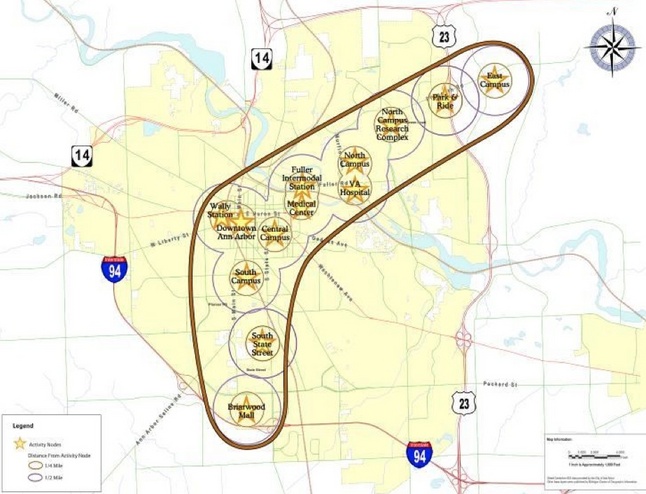
The Ann Arbor Connector project is focused on determining new transit options for a boomerang-shaped area that extends from northeast Ann Arbor, down through the area along Fuller Road where the city is planning a new train and bus station near the U-M medical complex, through Central Campus and downtown, and then south along State Street to Briarwood Mall and I-94.
Image courtesy of URS Corp.
But it's still expected to come back up at the City Council's next meeting after at least two council members who support the Ann Arbor Connector project— Sandi Smith and Margie Teall — threw their votes and strategically voted against it when they saw it wasn't going to pass.
As members of the prevailing side of the 5-4 vote, they'll be able to bring the issue back up for reconsideration at the council's next meeting.
The proposal calls for spending $60,000 to continue studying options for bus rapid transit, light rail, streetcars and an elevated system such as a monorail to meet Ann Arbor's growing transportation needs. The 18-month alternatives analysis would help decide which of those options makes the most sense and would provide more information to help make a future decision about going forward.
Joining Smith and Teall in voting against spending $60,000 for the alternatives analysis were Council Members Mike Anglin, Jane Lumm and Sabra Briere.
Lumm expressed concerns about the unknown future costs of operating an advanced transit system, while Anglin said it seems like it mostly will benefit the University of Michigan.
Council Members Carsten Hohnke and Marcia Higgins were absent. With their two votes, plus Smith and Teall, the proposal could have the required eight votes at the next meeting.

John Hieftje
"If we want to back away from transit, and back away from furthering transit and have more congestion in the city, we're free to do that — or we could vote to say no more jobs in the city," he said, subtly criticizing council members opposed to the project.
"We can accept more traffic and parking structures or we can have transit," he concluded. "It seems very simple. And I would ask that council members just show a little bit of vision."
The Ann Arbor Connector project is separate from a handful of other transit initiatives under way, and specifically is focused on determining new transit options for a boomerang-shaped study area.
The area extends from northeast Ann Arbor, down through the area along Fuller Road where the city is planning a new train and bus station near the U-M medical complex, through Central Campus and downtown, and then south along State Street to Briarwood Mall and I-94.
The city has been working with the Ann Arbor Transportation Authority, Downtown Development Authority and U-M on the Ann Arbor Connector initiative since 2009.
Eli Cooper, the city's transportation program manager, said enhanced transit service can improve mobility, provide competitive alternatives to automobile travel and strengthen the economic competitiveness of the city and region while adding to Ann Arbor's sustainability.
He said higher-capacity systems are more energy efficient and generate fewer emissions than cars or lower-capacity transit. He also believes it would benefit both the city and the university.
The four parties involved in the Ann Arbor Connector project completed a feasibility study last year that concluded an advanced transit system for Ann Arbor is technically feasible and could take the form of bus rapid transit, light rail or an elevated automated guideway system.
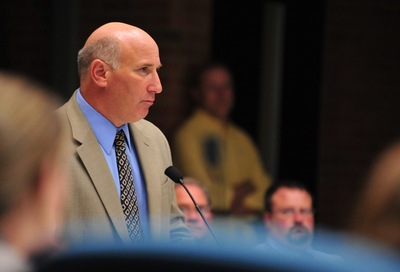
Eli Cooper, the city's transportation program manager, said the do-nothing alternative to the Ann Arbor Connector project would result in increased congestion on roads throughout the city and decreased quality of life for residents.
Ryan J. Stanton | AnnArbor.com
The next step in the planning process — which the council rejected going forward with Tuesday night but likely will reconsider — is to conduct the alternatives analysis.
That picks up where the feasibility study left off and would provide additional technical information to select the best of the options on the table, as well as more specific alignment and station locations.
The AATA was awarded a Federal Transit Authority grant for the preparation of the alternatives analysis. The total budget for the next phase is $1.5 million with $1.2 million being provided by the FTA and $300,000 coming in the form of a local match.
U-M has agreed to pay $150,000 of that, while the AATA is expected to contribute $90,000, with the remaining $60,000 coming from the city. According to Cooper, the DDA has communicated that it doesn't have money to contribute at this time given its current financial situation.
Though the $60,000 for the Ann Arbor Connector alternatives balance would dip into the city's cash reserves, Cooper pointed out the general fund netted $90,000 from the sale of a strip of land adjacent to the Blake Transit Center for the AATA's downtown transit center expansion project.
Counting the Connector project, Lumm said the city is talking about hundreds of millions of dollars in future capital costs for transit and she doesn't see where the money is going to come from.
"We have at least five major ongoing studies and initiatives on alternative transportation," she said, mentioning the city's train station project, the countywide expansion of AATA transit services, the WALLY north-south commuter rail project and Detroit-to-Ann Arbor commuter rail.
"We continue to proceed on these multiple fronts without answers to basic questions and I really feel strongly that needs to stop," she said. "Questions like: Do we know what all these will cost? No."
A consultant who worked on the Connector feasibility study told the City Council last year his firm's projections show capital costs of $15 million to $20 million per mile for bus rapid transit, $50 million to $60 million per mile for light rail and more than $200 million per mile for an elevated system.
The added cost of operating and maintaining such systems could range from $500,000 to $1.5 million annually per mile, according to the consultant's report.
Based on forecasts for continued growth in population and employment in Ann Arbor, Cooper said it would be unwise for the city not to be looking at alternative transportation options.
The do-nothing alternative, he said, would result in increased congestion on roads throughout the city and decreased quality of life for residents.
Though Lumm's list of transit initiatives under way was meant as a criticism, Hieftje said he thought she did a good of summing up the work the city is doing.
"We need to expand transit," he said. "If we were to take the AATA off the streets, I can't imagine what the gridlock would be like."
As for future costs not being pinned down yet, Hieftje and other supporters of the initiative said that's exactly the point of doing the alternative analysis.
"This study is an effort to obtain that data," said Council Member Christopher Taylor, D-3rd Ward. "This, in my view, is a deeply prudent and wise thing for us to proceed with."
Cooper said future funding for the chosen system would come from multiple sources. Based on the ridership forecasts developed as part of the study, he said, it appears that the Ann Arbor Connector could qualify for New Start or Small Start funding from the Federal Transit Administration.
He said the governance of the connector system, including responsibility for planning and design, construction and operation needs to be determined.
Ryan J. Stanton covers government and politics for AnnArbor.com. Reach him at ryanstanton@annarbor.com or 734-623-2529. You also can follow him on Twitter or subscribe to AnnArbor.com's email newsletters.
Comments
Basic Bob
Fri, Sep 7, 2012 : 9:11 a.m.
Growth projections in the only state consistently losing population. Where's that grain of salt?
MyOpinion
Thu, Sep 6, 2012 : 7:16 p.m.
Flying Bicycles is not so far fetched. Atlantic Cities has an article out about above ground bicycle lanes: http://bit.ly/OTcd3d Perhaps, we know what the mayor reads during his bathroom breaks.
aabikes
Thu, Sep 6, 2012 : 7:09 p.m.
Actually, flying bicycles would be awesome. Just put in a bunch of elevated bike tubes. That would be way cheaper than a train, and use much less energy than a train. You could even pair it with a bike-share system at each 'stop'. Oh Yeah! I doubt it would even need as crazy as environmental assessments and zoning specifics. Flying Bike Tube! C'mon, nothing in Ann Arbor is that far away.
Basic Bob
Fri, Sep 7, 2012 : 9:12 a.m.
We can call it HabitRail.
Jaime Magiera
Thu, Sep 6, 2012 : 5:35 p.m.
Ann Arbor is going to continue growing. It's going to continue to become more and more congested if we don't do something to help the transportation situation. There is not enough space on the roads for everyone to have a car or bike. It's time to consider mass transit options that hit the hotspots of the city.
28's..andtheydon'trub
Thu, Sep 6, 2012 : 5:50 p.m.
Not to give any bad ideas but I can imagine now: thousands of students, drunk, bar hoping all semseter long... My 21st b-day was about 400 days ago, trust me I see some THINGS on U of M campus.
28's..andtheydon'trub
Thu, Sep 6, 2012 : 5:32 p.m.
Why is it the more I read on what the big shots do in Ann Arbor the more believe common sense is missing. I read numerous comments before reading the article and I agree with so many others! Why should the citzens be patient and have a vision when problems that are as clear as day (communting and parking in Ann Arbor) that affect thousands of people daily have not been address OR given a reasonable vision? This vision sounds pretty big and makes me wonder how long would that take to complete if the Stadium bridge took how long??? AND how many police and fire staff can you hire for the amount of this "Vision"? Just curious, I called 911 for a hit in run (both cars were traveling east at 35-40mph at the time, driver at fault made a u-turn and fled scene)in July and took 57 minutes for an officer to arrive where Huron turns in to Washtenaw... I'd expect that back on the East side of Detroit not Ann Arbor.
Macabre Sunset
Thu, Sep 6, 2012 : 5:01 p.m.
My vision includes honest, efficient politicians who don't feel the need to tell us lies in order to sell us impractical pet projects. I notice wally is still being included in this vision. This issue was thoroughly studied in recent years. The report indicated a rather low daily ridership - and that assumed upgrades to the rail lines that simply wouldn't happen. It also indicated that all costs related to the train stations - necessary infrastructure improvements - were not included in cost estimates. No honest politician who has looked at the wally project would support it.
Vivienne Armentrout
Thu, Sep 6, 2012 : 3:06 p.m.
ICYMI, I wrote a blog post over 2 years ago about the UM presentation that kicked all this off. http://localannarbor.wordpress.com/2010/03/11/our-shining-city-on-a-hill/
Stephen Landes
Thu, Sep 6, 2012 : 3:05 p.m.
Mr. Mayor: My vision is quite clear and what I see is a mayor with dreams of huge projects and no vision for how to pay for them. Capital cost is one thing, but we're saddling ourselves with operating costs for 50 or more years -- costs that are simply not sustainable. Time to put the blinders back on and FOCUS on the things that we need government to do: public safety, water and sewerage, and maintaining public spaces. That's what you do with a horse that is easily distracted by all the peripheral stuff so it can focus on the race.
James
Thu, Sep 6, 2012 : 2:17 p.m.
When it comes to committing to a $100 million dollar expenditures, we should be reactive instead of proactive. There is little need for this project right now in Ann Arbor, so there is no reason why we should go forward. If the projected population growth materializes, then we can consider a project like this, however, by that time the ideal route may be quite different. For the time being, AATA fulfills Ann Arbor's public transportation needs quite well. As Ann Arbor grows, AATA can add and adjust bus routes to better serve the city. There is no benefit to a rail system in Ann Arbor at this time. It is too expense, and Ann Arbor is too small to justify a rail system. This fact should be blindingly obvious to council, yet they refuse to accept reality.
Gerry
Thu, Sep 6, 2012 : 1:09 p.m.
The transit opponents fail to address the issue of where people would park. If we rely exclusively on the automobile, we will have to spend tons of money on city parking structures that will leave downtown looking more like an airport than a vibrant center. Ann Arbor is going to grow whether you like it or not, and we can be a vibrant, green, transit oriented community like Portland, or we can tear up the beautiful country surrounding our town and become a sprawled, congested, polluted city like Houston.
Veracity
Thu, Sep 6, 2012 : 3:37 p.m.
You have a right to your view but recognize that others disagree. You can finance changes in the transportation system so that it reflects your expectations but do not ask me to assist in what I believe will be a wasteful effort.
Larry Baird
Thu, Sep 6, 2012 : 2:36 p.m.
Transit alone does not solve the issue of high development costs for new downtown office buildings (where are all these future workers going to work?). With cheaper land, taxes and development costs available in the townships, along with free parking adjacent to the major freeways, the major employer's such as Toyota, Hyundai, etc. will continue building in the townships versus downtown. For example, look no further to where the boomerang begins and ends to the north - the growing UM East Medical Campus - located in Ann Arbor Township.
RUKiddingMe
Thu, Sep 6, 2012 : 1:49 p.m.
Gerry, I contest the assumption that Ann Arbor is going to grow. I can also backtrack, however, and say I contest it will grow at the rate at which we must, simply must, IMMEDIATELY institute a grand scheme for serving the future's millions of new residents. Why don't we just put in a millage for teleportation technology development? Eventually there will be too many people to use buses and trains. In fact, I'm guessing the mayor is SURE of it.
Ron Granger
Thu, Sep 6, 2012 : 12:39 p.m.
Clearly, the lack of a People Mover is what is holding Ann Arbor back. Has anyone asked Detroit if they'd be interesting in selling? We could call it the "Bar Hopper". The students would love it.
Stephen Lange Ranzini
Thu, Sep 6, 2012 : 4:13 a.m.
@David Cahill: The population of the county rose 3,171 during 2011 to 347,962. This 15 month increase is just 741 below the growth expected in the 10 years from 2010 to 2020, when the population is expected by SEMCOG to be 352,616. At this pace of growth, if sustained, the county could meet the 2040 population projection of 384,735 by mid-2021, 19 years early! Population growth is good for home prices, government budgets, local businesses, job growth, and getting the moribund home building industry back on it's feet, but growth will cause congestion, pressure our infrastructure and could cause more suburban sprawl. Probably it won't be sustained, I agree, but if it does, it will have major implications for many of the decisions that our city leaders will need to consider in the future.
Stephen Lange Ranzini
Thu, Sep 6, 2012 : 5:31 p.m.
@Macrabre Sunset: I highly recommend you read "Suburban Nation: The Rise of Sprawl and the Decline of the American Dream" by Andres Duany, Elizabeth Plater-Zyberk and Jeff Speck. There are many reasons to not live in a suburb. For example, data indicates that people who live in suburban communities because they make more trips by car and get less exercise, live on average ten years less than those that live in walkable urban environments and for the last ten years of their life, they are less healthy, on average. For example of a good summary of this argument, read: www.baconsrebellion.com/2012/05/americans-need-to-drive-less-walk-more.html
Macabre Sunset
Thu, Sep 6, 2012 : 5:09 p.m.
In the old days, we called it growth, and it brought a higher tax base and new business to a city. Now, the politically correct call it suburban sprawl, and yammer endlessly about the evils of nice neighborhoods, literally wanting to wall themselves off from new development with "green belts." Yet these politically correct seem to whine the loudest about wanting more and more money for expensive urban toys and entitlements. All while vilifying the taxpayers who actually pay these bills.
Veracity
Thu, Sep 6, 2012 : 3:32 p.m.
No reason for growth to continue at the same pace. No means of predicting negative events which can reverse the growth trend. No way of knowing exactly where growth will occur in the county and where future transportation demand - if any - will be located.
Dog Guy
Thu, Sep 6, 2012 : 1:12 a.m.
Remember that the purpose of government rail projects is for the projects to fail and the money evaporate without trace, leaving politicians with very rich very close friends.
Stephen Lange Ranzini
Wed, Sep 5, 2012 : 11:36 p.m.
@Vivienne Armentrout: In addition, you will note on the map that a "Wally Station" is noted west of downtown. If a Wally Station were ever built there, it would be a giant waste of money. A north-south commuter train line could for a small additional expenditure in the future have a spur line that allowed trains to move between the north-south Ann Arbor Railroad line and the east-west Amtrak/MDOT line. Having all the trains connect in one location would increase usage and lower the cost of operation.
Vivienne Armentrout
Thu, Sep 6, 2012 : 12:39 p.m.
That location for a WALLY station was predicated on the supposition that the Ann Arbor Railroad will allow passenger service on the railway it owns, which it has so far refused to do. Also there is no foreseeable funding for WALLY (even though a grant for station design was recently procured). None of the current published plans or design projects have any intersection between N-S and E-W rail lines.
Mike
Wed, Sep 5, 2012 : 11:21 p.m.
"The jobs picture for our community appears to be bright and that should be a good thing for most of us to consider. But I think with those jobs we have to also consider that traffic continues to grow in the city, congestion continues to grow," Mayor John Hieftje said during the meeting" So the solution seems to be to reduce the lanes from two to one on Stadium and Jackson? Wow, how did I miss the obvious?
LXIX
Wed, Sep 5, 2012 : 10:46 p.m.
I somehow missed the most critical council vote concerning Ann Arbor transportation - putting pedestrian lives in jeopardy every day until a role call vote is made - the CROSSWALK ordinance and its ultimate repeal. Any updated "visions" about that issue coming from the bubble palace? I thought so.
Detached Observer
Wed, Sep 5, 2012 : 10:15 p.m.
It always amazes me how dead-set car drivers are against public transportation. Anything that helps more people walk or bike means fewer cars on the road and less congestion for drivers. I don't know what the best long-term solution is, but I know that doing nothing and pretending that change isn't happening will only lead to worse congestion and other big-city problems. Wake up, people! There are 1000 new beds downtown just this year. (U of M shuttles 1000s of students back and forth between Central Campus and North Campus every day. A monorail connecting just these two locations would take dozens of buses off the streets, leaving more room for the rest of us.)
talker
Thu, Sep 6, 2012 : 5:13 a.m.
Beyond reasons such as a U. of M. project should be paid for by the U. of M., a monorail is fixed route transportation and doesn't provide the flexibility of buses. By looking at the destinations shown on buses, it's obvious that buses go to many destinations including Bursley/Baits, different outlying parking lots, etc..
say it plain
Wed, Sep 5, 2012 : 11:23 p.m.
Exactly @Arboriginal! I can imagine it being really cute, with a little wolverine helmet logo on the front cars, no?! But those would be design decisions I'd like for UM to make, not the City itself. Unless, perhaps, and it is a big big perhaps, we start accepting *very sizable* PILOT payments from them (payments in lieu of taxes), to help pay for the millions per year of upkeep as well as the tens and tens and tens of millions to pay for getting some buses off the roads.
Arboriginal
Wed, Sep 5, 2012 : 10:59 p.m.
Is the U going to build a monorail?
David Cahill
Wed, Sep 5, 2012 : 10:11 p.m.
Stephen, I appreciate the data. But present trends have not persisted in the recent past. We have suffered through years of economic collapse/stagnation thanks to the George Bush Depression. I expect many more years will pass before we see significant population growth, either in AA City or Washtenaw County as a whole. Please don't fall prey to the "Cheesy Economic Boosterism" that infests SEMCOG and other people/groups with vested interests in growth for its own sake.
Vivienne Armentrout
Wed, Sep 5, 2012 : 9:58 p.m.
Not mentioned in the story is the likely involvement of the Fuller Road station site in this scheme. If you look at the illustration, you will note the "Fuller Intermodal Center" as an important part of the system. This system is designed to "hinge" through Fuller Road and is one of the underlying motivations to build a station there.
Vivienne Armentrout
Thu, Sep 6, 2012 : 12:37 a.m.
Yes, but this is unrelated to the parking structure. The city passed a measure donating more general fund money to a design and environmental study for a train station, and JJR is currently doing that work.
Arboriginal
Wed, Sep 5, 2012 : 11 p.m.
I thought the U backed out of that scheme and is building their parking structure on Maiden Lane.
Stephen Lange Ranzini
Wed, Sep 5, 2012 : 9:25 p.m.
@David Cahill & @Veracity: Since you question the growth numbers and where they are coming from, here you go: In the 12 months to June 30, 2012, employment in Washtenaw County rose 4.8% according to the U.S. Commerce Department, one of the fastest rates of any region in the Midwest. According to the U.S. Census Bureau, the population of Washtenaw County is rising, and rose 0.9% (+3,171 people) in the 15 months ended July 1, 2011 (latest data). SEMCOG's projections for population growth in the county are probably going to be exceeded if the current trends persist for a few years. Since home building activity is low versus the annual rise in jobs in the county, and homes are so cheap in the nicer suburbs of western Wayne County, we can expect a large rise in commuters from out of town. For example, one can buy a 2,500 ft2 home in Livonia in a nice neighborhood near I-96 for under $130,000, while the same home would cost at least $300,000 new build or perhaps $300,000 to $800,000 for a comparable existing home in Ann Arbor, depending upon the neighborhood. The data is at: http://quickfacts.census.gov/qfd/states/26/26161.html and http://figpartners.us2.list- manage.com/track/click?u=1f304fb0dac38867f701af108&id=98524864bb&e=a91ab4b81e Now please note, the issue I am raising with these numbers above is how to deal with the traffic jams on the 2 lane freeways circling Ann Arbor and coming to and going out of Ann Arbor. Also, it raises the issue of questioning the merits of making four lane major highways running into the center of Ann Arbor into three or two lanes. I am not taking a position on the merits of the Mayor's Connector project. If the U-M wants and needs a monorail or other mass transit system to speed its internal traffic that's an entirely different problem, and perhaps it could and should pay *all* of the city's share of the study.
Veracity
Thu, Sep 6, 2012 : 3:20 p.m.
I would feel more confident about future job growth projections if I could see a list of new enterprises coming to Ann Arbor over the next few years and the exact number of new jobs that would be created. For instance, Costco recently opened a new store at Ellsworth and State Street which likely created 300 new jobs. If Costco promised to open a similar store in Washtenaw County every six months for the next fifteen years then I will feel confident about the 600 new jobs being created each year. But I have not seen a list of companies that plan to expand into Ann Arbor territory and bring new jobs with them. I believe that Google anticipated adding 3000 jobs to the Ann Arbor area when it arrived but has not approached that number yet. Barracuda is expanding downtown and expects to add several hundred jobs but then what? Meanwhile houses are being sold with sub-prime interest rates and the mortgages continue to be securitized by Wall Street just as was happening prior to the financial collapse. And the New York investment banks continue to create derivatives because preventive regulations are not yet active. So we may have another banking Armageddon that will reek havoc with our business climate and real estate transactions. With this looming possibility who could confidently commit to transportation expansion?
A2comments
Thu, Sep 6, 2012 : 10:39 a.m.
@treetowncartel M14 will still be 2 lanes. I hope the asphalt surface will be quieter than the grooved concrete.
Stephen Lange Ranzini
Thu, Sep 6, 2012 : 4:16 a.m.
@Treetowncartel: To make all those roads three lanes would, I am told by senior MDOT officials, cost a lot more than $1 billion. Just widening U.S. 23 from M-14 to I-96 to six lanes from four, would cost $500 million alone.
treetowncartel
Thu, Sep 6, 2012 : 2:50 a.m.
Very good point about the highways. I am guessing M-14 will still only be two lanes after the construction, but maybe I am wrong. Three lanes of travel on the Highways circking the city should happen sooner as opposed to later, in addition to making US 23 3 lanes from M-14 to 96.
Barzoom
Wed, Sep 5, 2012 : 9 p.m.
Think of a sewage system in Sylvan Township, the Waters Street Project in Ypsilanti, or the movie studio in Allen Park. That's where this city's administration is leading us. They will commit to some hugely expensive project thet the tax payers will be forced to pay for.
Gardener1
Wed, Sep 5, 2012 : 8:43 p.m.
Vision is needed before there are more problems with traffic. Most people who work in Ann Arbor seem to live outside the city.(The usual answer I get when I ask a store worker where something is in Ann Arbor - "I don't know, I don't live here".) Traffic streams into Ann Arbor each morning and out in the evening. It would be nice to have a light rail system moving through the area with buses to move to areas not served by the rails system. More park and ride lots would also be beneficial. And no, I do not like the City Hall Sculpture. What a waste of $$$.
Angry Moderate
Wed, Sep 5, 2012 : 8:53 p.m.
If the system is designed to benefit people who don't live here, THEY can pay for it. Do you think that Ypsi, Dexter, Chelsea, and Saline are going to raise THEIR taxes to pay for this system? Or are you expecting Ann Arbor property owners, once again, to cover the costs of something that is made to benefit outsiders who often move outside of the city specifically for the purpose of avoiding city taxes?
Ron Granger
Wed, Sep 5, 2012 : 8:22 p.m.
It looks like this project is mainly to service the University. How much are they going to kick in? Why aren't they funding it? What happens when the fed cancels funding?
annarboral
Wed, Sep 5, 2012 : 8:21 p.m.
Just when you start to think it couldn't possibly get any worse or sillier along comes the Connector and DDA Affordable Housing. You have to give these people credit for absolutely amazing creativity. I strongly suggest they give up on city government and try the Comedy Channel.
Brad
Wed, Sep 5, 2012 : 7:40 p.m.
The "Boondoggle Boomerang". Remember you heard it here first.
LXIX
Thu, Sep 6, 2012 : 12:25 a.m.
Lol. Boondoggle is right. Just another City Hall stick that returns on its own to haunt the taxpayers.
Captain Magnificent
Wed, Sep 5, 2012 : 8:12 p.m.
No, I've definitely heard that somewhere else before. Probably on Crocodile Dundee.
Sam S Smith
Wed, Sep 5, 2012 : 7:14 p.m.
This all kind of makes sense to me now. Let's keep thinking up ways to increase taxes to pay for all this glory so that the middle class residents can't afford to live here and they'll need these transits to get to Ann Arbor. That way only the very rich can live here. Then eventually we can tax people who drive cars here and that underground parking lot will remain empty. And then we can...
Sam S Smith
Wed, Sep 5, 2012 : 11:35 p.m.
Wait a minute! I'm lower middle class and I guess now I will have to find another place to live!
Captain Magnificent
Wed, Sep 5, 2012 : 7:06 p.m.
"Just show a little bit of vision"... hello people, he's practically telling us he wants a monorail. Buses and light rail are NOT visionary - they're old, dated technology and require far too much maintenance and operational expense. @4 Fingers - with a monorail the maintenance is minimal, all that's required is a bit of rail grease periodically. See this article from back when Lincoln Consolidated School District was considering a monorail- it has lots of useful facts. http://www.annarbor.com/community/news/monorail_considered_an_option_for_relieving_lincoln_trasnsportation_woes/ ALSO, Monorails allow the riders to face forwards AND backwards- 360 degrees! how's THAT for vision! come on Ann Arbor, make the right decision. Monorail is the mono (one) and only way to go!
Captain Magnificent
Wed, Sep 5, 2012 : 7:07 p.m.
I see my link didn't post correctly- here's the URL Shortened version: http://goo.gl/W6WXq
Larry Baird
Wed, Sep 5, 2012 : 6:55 p.m.
"....Anglin said it seems like it mostly will benefit the University of Michigan." That pretty much sums it all up. Since when did Fuller Rd. become THE major north - south "connector" within the city? How about a survey AA.com? "What is your primary north - south "connector" route?" - State St./ Packard / N. Division/ Broadway / Plymouth? - State St. / Depot or Huron / Fuller/Bonisteel/Beal/Plymouth? - Huron Parkway/Platt? - Main St. / AA-Saline? - Other?
say it plain
Wed, Sep 5, 2012 : 10:34 p.m.
LOl @Brad...Fuller Road is a great "North Campus"/"Central Campus" connection route though (doesn't do the whole job, but is a sizeable stretch of it, and has the added benefit of swinging by the Med Center, perfect!)
Brad
Wed, Sep 5, 2012 : 7:38 p.m.
There is one thing that keeps Fuller from being a great N-S connector - it runs nearly due East-West. I guess if I just had me some "vision" I would understand that. North-South through town = Division and Fifth Ave.
SonnyDog09
Wed, Sep 5, 2012 : 6:45 p.m.
"It seems very simple. And I would ask that council members just show a little bit of vision." Sometime later, in a Galaxy far, far away, in his best galactic emperor impression, Hizzoner stated: Now, you will pay the price for your lack of vision!
Veracity
Wed, Sep 5, 2012 : 6:32 p.m.
Ryan - What is the basis for your rosy job growth and population growth numbers? Can you provide a detailed listing of each job category and what employers will be hiring so many new workers? Recently, members of the UM economics program adjusted DOWNWARD their job growth expectations indicating that not all pundits expect such a dynamic recovery. I wonder how many of the soothsayers predicted the economic collapse of 2007-2008 and the resulting glut of joblessness? How can they be so sure further economic disaster is not awaiting us two or three years ahead, especially if certain economic measures are imposed by the government. Do not forget that we have a new paradigm according to which future jobs will be dominated by automation and computer efficiencies, minimizing the need for human labor. There is reason why our present slow movement out of recession is termed a "jobless recovery."
LXIX
Thu, Sep 6, 2012 : 12:13 a.m.
The crash is already here. "You see we never ever do nothing Nice and easy We always do it nice and rough So we're gonna take the beginning of this song And do it easy Then we're gonna do the finish ,,,rough" The "Proud Mary" song, Tina Turner
say it plain
Wed, Sep 5, 2012 : 10:31 p.m.
The Mayor is a realtor. Sandi Smith is a realtor. The current director of info or whatever here at the .com is a realtor. They always believe positive projections about population growth, it's central to the business model ;-) The news about the imminent collapse of the RE bubble was a little hard to swallow for them too, as it was for many 'news' outlets which depended on the advertising revenue and the need for subscriptions to 'keep up' with the markets lol. The little recent busy-ness on the part of realtors will allow them to be very very confident that growth is assured, no doubt! They'll easily start believing that if they build the people movers, *everyone* will come! And they will clog the golden streets (will these still be pot-holed?! Even then, Mr. Mayor, even then?!) with their shiny new cars unless we give them Tomorrowland monorails!
bunnyabbot
Wed, Sep 5, 2012 : 6:30 p.m.
Imagine Mr Mayor, a city with low crime and friendly Police Officers that arn't stretched thin, Serving and Protecting. Imagine too, a Fire Department that isn't gutted. Just show a little vision!
xmo
Wed, Sep 5, 2012 : 6:25 p.m.
This will only increase the number of people living in the city, working in the city and destroy the planet! It also caters to the "RICH" residents of North-East Ann Arbor while the "POOR" South East Ann Arbor residents get left out! Not Fair!
demistify
Wed, Sep 5, 2012 : 6:19 p.m.
The unhealthy politics is having a lame-duck Council push through expenditures for a project that does not have the support of the incoming Council. Regardless of what you think of the Mayor's "vision", this is simply money down the drain.
B2Pilot
Wed, Sep 5, 2012 : 6:12 p.m.
I thought the fuller road mega mall transit solve all problems forever connector interface was dead? what gives? Okay heres a little pie in the sky vision; what about a North Main transit center or South state transit center; you know to keep the vehicles out of the city. Next will be a city income tax to pay for the mega projects .
Brad
Wed, Sep 5, 2012 : 6:11 p.m.
Every time I drive by that chunk of occasionally-damp scrap metal outside City Hall it always makes me think about the mayor's "vision".
Alan Goldsmith
Wed, Sep 5, 2012 : 7:25 p.m.
Bingo!
EyeHeartA2
Wed, Sep 5, 2012 : 6:09 p.m.
"It seems very simple. And I would ask that council members just show a little bit of vision." "Lumm said the city is talking about hundreds of millions of dollars in future capital costs for transit and she doesn't see where the money is going to come from." Looks like Jane can clearly see a train wreck before it happens. Maybe hizzhoner needs a little vision himself.
Billy
Wed, Sep 5, 2012 : 5:55 p.m.
"Sandi Smith and Margie Teall — threw their votes and strategically voted against it when they saw it wasn't going to pass. As members of the prevailing side of the 5-4 vote, they'll be able to bring the issue back up for reconsideration at the council's next meeting." Once again I'm reminding why politics disgusts me...I don't care if people think this is "strategic"....you just voted against something you were supporting to "game the system." That just doesn't sit right...at all.
RUKiddingMe
Wed, Sep 5, 2012 : 5:54 p.m.
"We continue to proceed on these multiple fronts without answers to basic questions and I really feel strongly that needs to stop," she said. "Questions like: Do we know what all these will cost? No." This type of question and RATIONAL take on things is precisely what this city needs MORE of. I hope we can get one or two more Lumms next time around. And the mayor, for lack of any real data or evidence that suports the insane and constantly-growing expenditure involving studies and task forces and analyses, continues to use the fallacious assertion that we either MUST expand and expend to address this massive wonderful growth of jobs and residents, or we will crumble and perish under the weight of their numbers and dissatisfaction. Which COMPLETELY ignores the fact that there is simply no proven need; again, it is NOTHING but "build it and they will come," "fire, ready, aim." Hey Mayor and Eli Cooper, why don't you guys drive around downtown? Or up and down the I-94 exits onto State and Ann Arbor/Saline? THE ROADS ARE BAD AND THE SIDEWALKS ARE WORSE. Clean this town up and make it less miserable to drive in, then MAYBE we might actually be able to SHOW a NEED for new transit options.
Jim Mulchay
Wed, Sep 5, 2012 : 5:52 p.m.
I'm not sure how practical it would be, but an approach would be continue what has been started by eliminating truck traffic - ie close down several streets and make them "bus only" routes - or on some of the larger streets define a bus-only lane (a streetcar without tracks and overhead wires). If the goal is to discourage passenger traffic to the downtown / university / hospital areas this might do it. But anything like that would take both a serious willingness to irritate a lot of people and some study of "people-flow" - and an affordable, dependable and round-the-clock bus system. A little (a lot?) extreme, but if it doesn't work you have not spent a lot of money on construction, tracks, equipment Beyond the question of "practical" the other fly in the ointment is that the biggest employers impacted (Hospital, University) will probably put in a minimal amount of financial support letting the city take the brunt of the costs.
Here
Wed, Sep 5, 2012 : 5:44 p.m.
We need light rail to correct the congestion that results from my efforts to frustrate automobile traffic. Come on, "it seems very simple...just show a little bit of vision." Especially my vision, and if you disagree then obviously you must not have a vision. PS - if we don't pave the roads maybe the drivers will give up and walk...
say it plain
Wed, Sep 5, 2012 : 10:21 p.m.
Exactly! I wish I could vote that up ten times!!!
Sully
Wed, Sep 5, 2012 : 5:43 p.m.
This project seems to have numerous issues. As Councilwoman Lumm, this project seems focused towards areas with the largest U of M prescence. While I haven't used the AATA in quite a while, it has already seemed to heavily service University areas. Along with that, I see areas that see heavy use by Ann Arbor citizens, such as the Washtenaw corridor, would not be serviced by this project. Also, I see little evidence that this would really lead to decreased congestion. While their is a vocal, but minor, subset of citizens who choose public transportation as a lifestyle choice, most people, if they have the money for any type of motor vehicle, are going to use it, as public transportation is a long ways away from being as personally efficent as an automobile. The Ann Arbor area just isn't urbanized enough to really have any use for a much expanded public transportation system.
Ken
Wed, Sep 5, 2012 : 8:02 p.m.
Yes indeed, if you look at the "boomerang" This wonderful concept would completely do away with the U-M's bus system. This is why U-M has pledged 150K.
Sully
Wed, Sep 5, 2012 : 5:50 p.m.
EDIT: *As Councilwoman Lumm said,
brimble
Wed, Sep 5, 2012 : 5:40 p.m.
Presidents and CEOs need to demonstrate 'vision'. Mayors of small cities need to manage the infrastructure, basic services provision and sensible taxation policy. After accomplishing that, there is room to talk about 'vision.' $60K may not seem like much, but it is money that could pay for (I'm guessing) two fully-equipped police cars, 1 1/2 park workers, one police officer for a year, fill for 9,000 potholes.... Here's my vision for Ann Arbor: a pleasant, well-managed city with good roads and sidewalks, fully-staffed police, fire, and park services, nice parks, reliable water and sewer systems, and efficient waste & recycling and snowplowing services, all provided with an eye to being a good steward of the taxpayers' money. How does that square for you, Mr. Mayor?
brimble
Thu, Sep 6, 2012 : 2:03 p.m.
The thing is, Gerry, the "Houston-style" sprawl lies outside of the geographical area of the City itself. Is sprawl a bad thing? No argument. Are there ways to deal with that? Sure. Does this transit plan have anything to do with sprawl? Tough to make a case there. Sprawl is a function of economics: when a given family can buy 3,000 sq ft. for $300K and pay $3,000 in taxes outside the City limits or buy half the house for the same money and pay double the taxes inside the City, many will choose the former. Will a monorail change the math? Not in the least.
Gerry
Thu, Sep 6, 2012 : 1:20 p.m.
You fail to mention that your nice core is surrounded by former farmland that has been torn up and turned into ugly, polluted, congested Houston-style sprawl. Ann Arbor is going to grow whether we like it or not, and the mayor is showing the vision to spell how that might happen in a sustainable fashion.
Linda Peck
Wed, Sep 5, 2012 : 10:51 p.m.
Amen to that, Brimble
David Cahill
Wed, Sep 5, 2012 : 5:39 p.m.
We should be wary of relying on SEMCOG's predictions. They have repeatedly forecast greater population growth than has in fact occurred. Ann Arbor City's population has been been almost unchanged for the past 40 years.
Mick52
Thu, Sep 6, 2012 : 1:13 a.m.
I think David raises a good point. Whether or not city or county population and or jobs increase where such workers will settle will depend on the cost of living. Living in Ann Arbor has gotten more and more expensive, particularly these high rise apartment buildings. I can recall the surrounding communities in the 70s and 80s when they were primarily agricultural and then exploded with homes when it became so expensive to live in A2. So if population and jobs increase they better be high paying jobs to get people to move to A2
Tom Whitaker
Wed, Sep 5, 2012 : 9:59 p.m.
I'm confused, too. For 10 years we've heard about the need for more people living downtown, from "young professionals" to low income people living in "100 units of affordable housing." A greenbelt around the city was supposed to squeeze more people into the urban core. Downtown zoning was redone to encourage more high-density residential buildings. But then we started hearing about commuter trains and countywide commuter transit. A new, and very expensive underground parking structure was also built for commuters. AATA is even funding a commuter bus for people living in Canton using our tax dollars! The people of Ann Arbor are calling for a park/town square that would make downtown living more desirable, but just the idea of that is being squashed by the DDA and city council members. You have to listen closely, but it is clear the ground has shifted and the focus has turned toward downtown office space, hotels, conference centers, and commuter amenities and away from residential living. As far as this corridor goes, it appears to me to be a way to tap into the huge ridership of UM staff and students between the north, medical and central south campuses. Ridership numbers can then be used to leverage more federal dollars for the countywide commuter bus and train visions being promoted. Just as reducing the use of packaging is better than recycling packaging in terms of energy savings, having people live and work downtown is better than building housing for them in the townships and having them commute by bus or train. Why has the mayor lost focus on the more credible and sustainable goal of more residential living opportunities downtown?
Brad
Wed, Sep 5, 2012 : 6:39 p.m.
But if you listen to the "visionaries" all the new, young talent will be living and working downtown, so they won't need to commute. So which is it?
fjord
Wed, Sep 5, 2012 : 6:24 p.m.
The population prediction cited above was for Washtenaw County, not the City of Ann Arbor. If there really are 10,000 more jobs in the county by 2015, you have to figure that a lot of those will be here in the city, which means more commuters, which means more congestion. It makes sense to investigate various new rapid transit options as a potential means of relieving some of that congestion..
Katherine Griswold
Wed, Sep 5, 2012 : 5:37 p.m.
"Counting the Connector project, Lumm said the city is talking about hundreds of millions of dollars in future capital costs for transit and she doesn't see where the money is going to come from. "We have at least five major ongoing studies and initiatives on alternative transportation," she said, mentioning the city's train station project, the countywide expansion of AATA transit services, the WALLY north-south commuter rail project and Detroit-to-Ann Arbor commuter rail." Jane Lumm continues to research the issues and ask the tough questions. Thanks for putting this project in the proper perspective.
GoNavy
Wed, Sep 5, 2012 : 5:31 p.m.
While I'm not a proponent of federally-subsidized inter-city high-speed rail transit, I can throw my support behind this sort of local initiative. Given the layout of Ann Arbor, the location of major "attractions", and the hockey-stick service map proposal, it makes sense to continue to study this option.
shrewdrealist
Wed, Sep 5, 2012 : 5:31 p.m.
This is a good thing.
Craig Lounsbury
Wed, Sep 5, 2012 : 5:30 p.m.
Reminds me of the people mover in Detroit. Last time I checked that thing has failed to live up to expectations. (that's being polite)
Gerry
Thu, Sep 6, 2012 : 1:13 p.m.
The people mover was supposed to be part of a larger system that was never built. This is why it is important that transit is built in accordance with a comprehensive plan. As for the need for transit in the first place, a major factor preventing downtown Detroit buildings from finding tenants right now is that they do not have parking. Transit opponents in Ann Arbor fail to address the parking issue.
say it plain
Wed, Sep 5, 2012 : 10:19 p.m.
I agree with @Craig and @Fordie...if the Mayor is "envisioning " a monorail going around "downtown", that's just weird... It's true that UM students tend to consider from First St to Central Campus to be too long to walk, but that doesn't mean we somehow need to provide little trains for the trip, does it?! What kind of 'gridlock' will be avoided with such folly? This project looks like so much a UM deal it's comical to think of it as the City proper addressing it in some ways...
Fordie
Wed, Sep 5, 2012 : 6:23 p.m.
It doesn't work because they quit building the monorail system a tenth of the way in. Lines out of circle downtown were supposed to reach the suburbs. The equivalent of that would be building whatever this system becomes from Briarwood to Yost.
Angry Moderate
Wed, Sep 5, 2012 : 6:18 p.m.
The People Mover is a catastrophic failure. Being full a few times a year for sporting events doesn't change that.
Arboriginal
Wed, Sep 5, 2012 : 6:07 p.m.
Last time I used the People Mover, I had to wait for the next train because there were so many riders. Probably not a round the clock problem, but at times the mover works out great for the city.
Craig Lounsbury
Wed, Sep 5, 2012 : 5:41 p.m.
I can think of a lot more reasons why it won't work GoNavy. If we define "work" as an efficient way to move people as compared to other forms of transportation.
Angry Moderate
Wed, Sep 5, 2012 : 5:38 p.m.
I don't think that he was referring to the type of technology.
GoNavy
Wed, Sep 5, 2012 : 5:33 p.m.
Ah, logical fallacies: "Project A doesn't work, and it uses Technology A." "Project B uses Technology A" "Therefore, Project B wont' work." Think hard, Craig: Are there *any* reasons this project may find more success in Ann Arbor vs. Detroit?
Alan Goldsmith
Wed, Sep 5, 2012 : 5:06 p.m.
Does the Mayor have a day job? If he does, it obviously don't involve anything to do with budgeting, setting priorities or realistically running a business. He has all these great ideas, no way to finance them and yet plugs along meeting after meeting and whines when others ask basic facts like WHERE is the money coming from. Lots of people in this town support alternate transportation options Mr. Mayor. They just don't believe you have the political skills or or 'vision' to pull it off. Just because people are rejecting you and don't trust you doesn't mean they want gridlock. We just need a better leader to articulate and create a broad coalition to make it happen. You're rapidly diminishing support on Council should be a wake up call for you but apparently isn't.
CynicA2
Thu, Sep 6, 2012 : 3:48 p.m.
The Mayor is a moron. What do you expect?
Katherine Griswold
Wed, Sep 5, 2012 : 4:57 p.m.
It it so much easier to talk "visions" and "strategies," than to focus on resolving current problems. Let's first address our current crosswalk "transportation" issue. City Council needs to fund an independent traffic engineering study. The minimum scope would be: 1. the crosswalk ordinance; 2. the physical conditions of our crosswalks, including lighting, sight distance (vegetation, utility boxes, etc.), width of roadway, traffic speed, and pedestrian type, with special priority to crosswalks in school walk zones; 3. related ordinances, such as required sight distance in Chapter 40; 4. staff practices with respect to enforcement of the crosswalk ordinance and all related ordinances; 5. a benchmark analysis of ordinances, crosswalk conditions, and enforcement practices of other progressive pedestrian- and bike-friendly communities; 6. a recommendation signed by a professional traffic engineer.
Plubius
Thu, Sep 6, 2012 : 3:06 p.m.
A new oxymoron: Professional traffic engineer
Gerry
Thu, Sep 6, 2012 : 12:53 p.m.
None of these six items address the parking issues.
Ron Granger
Wed, Sep 5, 2012 : 8:21 p.m.
It is much easier to just ticket distracted drivers and drivers who have the "I won't stop for a pedestrian" attitude.
Angry Moderate
Wed, Sep 5, 2012 : 5:24 p.m.
The last thing we need is more "studies" by outside consultants!
SonnyDog09
Wed, Sep 5, 2012 : 5:07 p.m.
Agreed. Also, don't forget figuring out what to do with crosswalks that are located next to bus stops. They just added a new one of those when they finished up resurfacing Packard. We all know that the bus will arrive much sooner when the rider steps out into the street to look for it.
Ryan J. Stanton
Wed, Sep 5, 2012 : 4:46 p.m.
Regarding the job growth and population growth claims, SEMCOG's regional forecast shows Washtenaw County's population jumping by 41,444 people from 2010 to 2040 (up 12%), including 27,254 new households (up nearly 20%) and 48,979 new jobs (up more than 20%). There's a gain of more than 10,000 jobs predicted just from 2010 to 2015.
Vivienne Armentrout
Thu, Sep 6, 2012 : 12:45 p.m.
Here is the link to the SEMCOG summary for those who would like to follow up. http://www.semcog.org/uploadedFiles/Programs_and_Projects/Planning/Regional_Forecast/2040ForecastSummary.3-12.pdf It has some maps and easy-to-read tables. It is a companion piece to a longer study and analysis.
LXIX
Wed, Sep 5, 2012 : 11:30 p.m.
And therein lies the problem - overpopulation. For all of the wonder builders without a real vision beyond myoptic - At what point does Ann Arbor (Washtenaw, Michigan, the USA) stop growing by choice??? Should this "small college town" freeze once it becomes exclusive like Chicago (3M), New York (8M), Mexico City (9M), Moscow (12M), Shanghai(14M) or is that residential survivor free-market interference?
say it plain
Wed, Sep 5, 2012 : 10:09 p.m.
Interesting, so, if @Vivienne Armentrout's info is right, it seems that for *within the City Limits*, we're talking mostly about growth projected by (and for, and from) UM. So, UM might want a monorail?! They can afford to get some more buses going, can't they? If they are hoping for light rail, it's only to get the folks who will live in the surrounding towns and townships. Perhaps they can buy themselves a little fleet of commuter vans and buses, no?! Perhaps given that people still are free to choose their transportation, the Mayor might consider the *roads* and whether they work for us, since lots of folks will still want to use them...paying as they are already for the vehicles themselves, the insurance, etc. Growth isn't the only reason for nasty unpleasant commutes around here, you know...
Vivienne Armentrout
Wed, Sep 5, 2012 : 9:54 p.m.
The SEMCOG study to which Ryan refers (and which he reported on earlier) is worth reading in some detail. Predictions are based on many assumptions and these authors actually cite 3 different scenarios, depending on such things as the future of the automotive industry. Their figures for Ann Arbor show only an 8.6% increase in population by 2040, but a 20.2% increase in employment. SEMCOG bases projections on material they themselves receive from employers, in part, and I suspect this mostly reflects UM's own growth projections.
M
Wed, Sep 5, 2012 : 8:15 p.m.
Since I've lived in Ann Arbor about a decade, the population has gone up ~5%. And SEMCOG wants to tell me that that population will not only jump 10% in 5 years, but none of those will be unemployed? Keep dreaming.
Sully
Wed, Sep 5, 2012 : 6:17 p.m.
dotdash, Most likely little to none. Scio, Pittsfield and Ypsilanti Townships will see most of the growth I'm guessing.
dotdash
Wed, Sep 5, 2012 : 6:03 p.m.
How much of that growth be within AA city limits?
Angry Moderate
Wed, Sep 5, 2012 : 4:41 p.m.
How ridiculous and silly. This is a small college town. An elevated rail system for local transportation--is the mayor joking?
Bill
Wed, Sep 5, 2012 : 7:50 p.m.
Perhaps the Tomorrowland rail will includes stops in Fantasy Land and It's A Small Small World. I suspect one stop at the mayor's office would catch both of those locations!
Brad
Wed, Sep 5, 2012 : 7:34 p.m.
If you just had "vision" you'd be able to see that Tomorrowland monorail.
Craig Lounsbury
Wed, Sep 5, 2012 : 5:32 p.m.
sadly I don't think he is joking. I think he is deadly serious...in his own delusional world.
4 Fingers
Wed, Sep 5, 2012 : 4:41 p.m.
And who will maintain said system?
GoNavy
Wed, Sep 5, 2012 : 7:01 p.m.
The system's maintenance staff.
SonnyDog09
Wed, Sep 5, 2012 : 5:23 p.m.
Members of Transit Workers Unions that will make contributions to the ruling party, of course. Politicians give taxpayer money to Unions that make political contributions back to those same politicians. Think of it as the circle of life.
groland
Wed, Sep 5, 2012 : 4:36 p.m.
Ann Arbor is not large enough to warrant rail systems, which would require serious zoning and land issues be addressed. Bus service seems like the rational alternative, especially with more electric and natural gas power now being used. I would suggest spending available money to PAVE THE ROADS! Despite the limited repaving underway, we still have abysmal road surfaces on just about all of our major thoroughfares. Meanwhile, the sidewalks are getting redone AGAIN! Is there someone in city hall with a connection to the contractors doing sidewalks? I really have to wonder about that.
Gerry
Thu, Sep 6, 2012 : 12:51 p.m.
Ann Arbor is part of metro Detroit, which is large enough to support a rail system.
easy123
Thu, Sep 6, 2012 : 2:17 a.m.
You are right, Someone paid off the city
Mick52
Thu, Sep 6, 2012 : 1:03 a.m.
Great point. Ann Arbor has to have the worst streets in the state.
say it plain
Wed, Sep 5, 2012 : 9:59 p.m.
Oh yes, please Lord, pave the roads! I figure praying to the heavens is about as useful as mentioning to the "visionary" Mayor that our roads are horrendous lol...
antikvetch
Wed, Sep 5, 2012 : 4:35 p.m.
Have we discussed the feasibility of flying bicycles yet? Come, Ann Arbor, show a little vision!
Craig Lounsbury
Wed, Sep 5, 2012 : 5:34 p.m.
I will be happy to study the feasibility as soon as the check clears.
SonnyDog09
Wed, Sep 5, 2012 : 5:23 p.m.
Hizzoner would prefer flying bicycles over flying cars, of course. :-)