

Changes to Ann Arbor's investment policy intended to make city's portfolio less reactive to market
The city of Ann Arbor has watched its financial return on investments steadily shrink ever since the economy went south in 2008, but city officials still see the silver lining.
"Over the course of the entire economic downturn, we didn't lose one cent of principal," said Matt Horning, the city's treasurer for the past six years.
A resolution to revise the city's investment policy and give the city some new options for investing awaits the Ann Arbor City Council's approval next week.
The changes are intended to allow the city to structure its portfolio to be less reactive to market volatility and improve yields, while adding new restrictions to ensure diversification.
The city has $229 million tied up in investments. Through Sept. 30, the city saw a 1.81 percent return, according to a third-quarter investment portfolio report.
That's down from 2.22 percent in calendar year 2010, 3.1 percent in 2009, and 3.87 percent in 2008, according to year-end reports reviewed by AnnArbor.com.
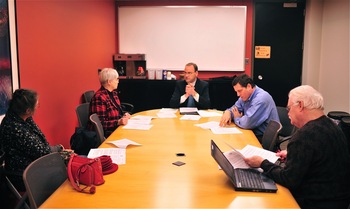
City Treasurer Matt Horning, center, discusses proposed revisions to the city's investment policy at a City Council budget committee meeting Monday night.
Ryan J. Stanton | AnnArbor.com
Present for the discussion were Tom Crawford, the city's chief financial officer, and Council Members Sabra Briere, Mike Anglin and Marcia Higgins.
The city manages a flexible investment portfolio that includes general operating funds, bond reserve funds, proceeds from bond sales and various other funds.
Horning clarified that the investment policy applies to all cash and securities of the city except assets of the Pension Fund, Housing Commission, 15th District Court, Elizabeth Dean Fund, Downtown Development Authority and Contractor’s Retainage Fund, which are managed separately and are not included in the $229 million previously mentioned.
Horning said the changes have been reviewed and approved by Cutwater Assent Management, the city's investment advisor, formerly known as MBIA.
"We've had an investment policy for years and years," Horning said. "Every few years, just as a matter of due diligence, we review it. It's kind of an ongoing process actually."
The city's investments consist of $91 million in U.S. Treasury Obligations, $98 million in Federal Instrumentality Securities, and $40 million reported as cash and equivalents.
"Our investment strategy is to ladder our investments," Horning said. "So right now, our maximum maturity horizon is seven years. And by laddering, what we do is we buy bonds at roughly one-month intervals out over that entire seven-year period."
By having a laddered portfolio, Horning said, the city is able to mitigate the volatility in interest rates, which can repeatedly rise and fall — sometimes sharply — over time.
"We kind of lock in an average interest rate," he said. "So as we continue buying, the rates for the city will change, but we're not going to have the ups and downs in the market."
Horning said the city's current investment policy has been in place since 2007. After reviewing it with the city's investment advisor and various members of the Investment Policy Committee of the Association of Public Treasurers of the United States and Canada, some modifications are recommended, including increasing the maximum maturity horizons.
The following changes to maximum maturity horizons are proposed:
- U.S. Treasury Obligations extended from 7 to 15 years
- Federal Agency Securities extended from 7 to 10 years
- Federal Instrumentality Securities extended from 7 to 10 years
- Certificates of Deposit extended from 3 to 5 years
- Obligations of the State of Michigan extended from 3 to 10 years
And the following portfolio restrictions are proposed:
- Federal Instrumentality Securities limited from no restriction to a maximum of 65% of the portfolio and maximum of 30% in any one issuer
- Certificates of Deposit limited from no restriction to a maximum of 5% of the portfolio in any one issuer
- Obligations of the State of Michigan limited from no restriction to a maximum of 3% of the portfolio in any one issuer
- Prime Commercial Paper limited from a maximum of 50% of the portfolio to a maximum of 25% of the portfolio
- No more than 25% of the portfolio may be invested in securities with maturities exceeding seven years
- No more than 12.5% of the portfolio may be invested in securities with maturities exceeding eleven years
- Maximum weighted average final maturity increased from 3.5 to 6.5 years
"We're basically saying we can go out a little farther, but we can only have a certain defined amount of the portfolio that's extended that far," Horning said.

Matt Horning
"The farther out you go into the future, the higher interest rate you can achieve," Horning said, adding he has no intention of immediately buying long-term securities.
"Right now, a 15-year T-note is earning about 2 percent," he said. "It would do the city no good to put money out 15 years at 2 percent. What I'm trying to do is position us so that when rates do increase, and we see the long end of the yield curve bump up to its historical levels where you might be earning 8, 9 or 10 percent, then it would be a good idea."
The first goal of the investment policy, Horning said, is safety and making sure the city's capital is preserved and principal is protected. The second goal is liquidity, he said.
"We want to make sure that the coupon payments from bonds that we purchase and the maturities of those securities coincide as closely as possible to our cash flow needs in the future," he said. "That way we can pay our bills, we can make our payroll, and we can achieve a higher yield by buying securities that go farther into the future."
Because those funds might be required at any time, Horning said, it's essential that the city maintain strict maturity horizons for the purpose of liquidity control.
"They don't allow the treasurer or any future treasurers to take too much money and put it out too far, because that would put our liquidity needs at risk," he said of the changes.
Horning noted the city's current investment policy was awarded a certificate of excellence from APTUSC and the revised policy still meets the same requirements for certification.
Horning said the size of the city's investment portfolio actually ranges from $185 million to $300 million at any given time depending on tax receipts and other revenue inflows.
Total city spending across all funds is $314 million this year, including $79.1 million in the general fund, which pays for basic services like police and fire protection.
Ryan J. Stanton covers government and politics for AnnArbor.com. Reach him at ryanstanton@annarbor.com or 734-623-2529. You also can follow him on Twitter or subscribe to AnnArbor.com's e-mail newsletters.
Comments
snapshot
Thu, Dec 8, 2011 : 4:52 a.m.
Interest rates are a lot worse when you don't have 229 million dollars yet when the Ann Arbor Assessor adjusts your property tax you can bet it'll be in the 3-5% increase range. There ought to be a law, hopefully soon that limits what type of inflationary factors can be used by government. Maybe Matt Horning can fill us in on all the ugly details of "artificial inflation" of property taxes.
Vivienne Armentrout
Tue, Nov 29, 2011 : 6:29 p.m.
I generally respect Mr. Ranzini's viewpoints, but some of what he says here regarding reserves sounds a bit like apples and oranges. I've heard before a conflation of reserves with "surplus" and that seems to be applied here. It has been my impression that municipalities are prohibited from practicing arbitrage with money obtained from selling municipal bonds, and in fact I recall that Washtenaw County had to pay a penalty in the past after holding on to some bond proceeds (and earning interest) longer than permitted. I don't know what entity (governmental, financial, etc.) enforces this rule. The point about diversifying the location for CDs and other income-producing instruments seems an important one. We've seen a lot of damage in the search for higher yields. Look at what just happened with MF Global (though I hope Ann Arbor has not been dealing in commodities). If we are really so plush, rather than "returning" the money, let's hire back our police officers and firefighters, and start picking up leaves again. Some of my neighbors seem never to have gotten the postcard.
Stephen Lange Ranzini
Tue, Nov 29, 2011 : 2:37 p.m.
If you want more info on the city's finances and want to learn more about how this large "rainy day fund" was accumulated read the following article: <a href="http://www.a2politico.com/?p=10130" rel='nofollow'>www.a2politico.com/?p=10130</a> I don't agree with everything written there, however there is a lot of useful information on the big picture with respect to the city's finances.
Roy Munson
Tue, Nov 29, 2011 : 2:30 p.m.
Maybe some folks should go sleep in the street at City Hall.
xmo
Tue, Nov 29, 2011 : 2:27 p.m.
Why does the city have Sooooo much money? Is it a For Profit corporation? Maybe our taxes could be lowered a little during these times of "Hope & Change"?
Stephen Lange Ranzini
Tue, Nov 29, 2011 : 1:56 p.m.
The original strategy behind accumulating the Cash (and Investments) on the city's balance sheet appear to have been to make arbitrage profits by borrowing for tax exempt projects at low municipal bond tax free rates and then investing that money in higher yielding taxable investments to earn an arbitrage spread of about 1%. It is perhaps then not so coincidental that Cash and Investments were $254 million at 6/30/2010 per the audited financial statement CAFR and the total of Bonds Payable and Other Debt Payable (including long term and under one year due short term) is also $254 million. Think of it like a hedge fund. The city was making a nice spread on this money until Bernanke and the Fed dropped interest rates to zero. Now the yield on the city's investments has plummeted and the city isn't making enough on the earnings side to beat the "low 4%'s" overall cost of the annual interest on the bonds according to the information I was given during a briefing by city officials. So instead of making a profit, borrowing and investing this $254 million, now the city is losing money every day. That's the problem with running a hedge fund, everything is great until the strategy stops working. In this case a mismatch between the assets invested and the liabilities borrowed. Why the city should be running a hedge fund is another really good question for another day.
Simon Green
Tue, Nov 29, 2011 : 12:37 p.m.
Didn't realize the city of AA is a one percenter.
average joe
Tue, Nov 29, 2011 : 1:21 p.m.
Yes, a one percenter that is laying off employees because they have no money.......Where are those occupy folks.
average joe
Tue, Nov 29, 2011 : 12:17 p.m.
The city lost a lot of leverage with the employees (& readers) as far as more wage concessions. I agree with Stephen- drain the buckets!
Stephen Lange Ranzini
Tue, Nov 29, 2011 : 11:51 a.m.
The Michigan Municipal League states that a best practice for the "rainy day fund" of a city or any municipality is that it should be 20% of annual spending. For Ann Arbor that would be $63 million. Because of all the 58 separate accounts ("buckets"), we've piled up $229 million (plus some more in the funds not managed in this investment pool), money which would do a lot more good in the hands of the city's citizens, instead of being invested on Wall Street. Especially in rough economic times, it is really immoral to hold onto more money than needed instead of using the rainy day funds and drawing them down! We are not just having a rainy day, but a financial hurricane! We should be draining the buckets that have too much money lying around in them! Also despite what is said in the article, a lot more risk is being taken with this money than people realize. Would you really want to put up to $11.5 million on deposit at Goldman Sachs Bank, which the new proposed policy allows? It is always one of the highest paying banks around and it's deposits are only insured up to $250,000 by the FDIC.