

City Place developer talks about new 'Heritage Row' proposal
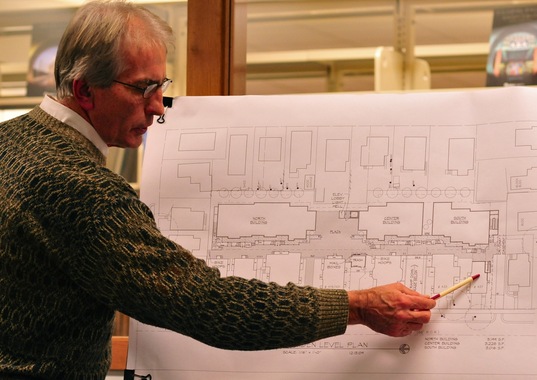
Developer Alex de Parry unveiled a new plan tonight for a project called Heritage Row. It calls for constructing three new, red-brick apartment buildings behind seven existing houses on South Fifth Avenue, and separating them with a paved plaza area.
Ryan J. Stanton | AnnArbor.com
The City Place project is no more.
The development proposal that's been mired in controversy for the past two years was tossed aside tonight as developer Alex de Parry unveiled a brand-new project called Heritage Row Apartments.
Following historic renovation guidelines, de Parry said the Heritage Row project would preserve and restore seven historic houses along South Fifth Avenue, just south of downtown, while adding three new brick apartment buildings behind them.
Click here to view the tentative plan.
The seven houses were slated for demolition - or at best major alterations - under previous plans for City Place. But now de Parry is proposing a scenario under which the houses will be rehabilitated and the streetscape preserved.
"We've tried to address a number of issues and have had a number of problems to resolve," de Parry said. "What we are really trying to do is a development that meets the Secretary of the Interior's Standards for Rehabilitation."
By following those standards, de Parry is hoping to receive tax credits that will help pay for part of the project.
De Parry relayed his vision tonight at a neighborhood meeting attended by about 18 people at the Ann Arbor District Library, less than a block from the proposed development.
Preservation architect John Dziurman offered an overview of the new plan. He said he's working to make sure the project will meet historic renovation guidelines if the area is designated a historic district - something neighbors and city officials have been pushing to force de Parry to develop a project that fits the neighborhood.
Residents still had some concerns tonight, but not nearly as many as at previous meetings.
"It's certainly a great improvement over what it was before, but the density and the height are still issues," said Beverly Strassman, president of the Germantown Neighborhood Association, a group that opposed de Parry's earlier plans.
"We need to see the drawings, but I'm concerned this potentially is going to loom behind the old structures," Strassman said of the three new buildings. "I'm also worried about ... the fact that 163 bedrooms and 60 parking spaces is a mismatch."
De Parry said an underground parking garage with 60 spaces would serve the 163-bedroom complex.
The design for the rear of the site consists of three separate, 3.5-story buildings. Within them, de Parry is proposing 34 two-bedroom units and 10 three-bedroom units. He said the floor plans of the existing seven houses, which are broken up into apartment units of varying sizes, would not change much, though there would be upgrades to the bathrooms and kitchens.
A drawing of the new site plan shows a large plaza area behind the existing houses, providing a walkable space between the historic portion of the property and the new buildings. De Parry said he plans to make the development eco-friendly, and about 15 percent of the apartments would be marketed as affordable housing units.
Dziurman, a longtime member of the Rochester Hills Historic Districts Commission, said the seven houses will be nudged closer to the street. To put in new foundations and basements, the homes will have to be temporarily relocated.
Dziurman said one goal of the project is to get rid of "inappropriate additions" that were made to the backs of the seven houses over the years and restore them to their original state. For some of the houses, that includes undoing modernizations.
He said the three buildings will be no taller than the highest point of the houses, or about 39 feet. The first level of each of the three buildings would be below grade.
De Parry acknowledged the revised plans would not meet the city's current zoning codes and would require special approval of a Planned Unit Development. He said he plans to finish up his proposal this week and post it to his Web site, but it's still not clear how the approval process will play out at city hall.
The city still is in the process of having a committee evaluate the historic worth of the Germantown neighborhood and report back to the City Council. In the meantime, a moratorium on development in the area remains in effect.
Council Member Sabra Briere, D-1st Ward, attended tonight's meeting. She said she's glad to see that - after two years - de Parry has produced a plan that is better received by neighbors, and now it'll be interesting to see how the plan becomes embraced by the city.
"The city planning department has to embrace it, the Planning Commission has to embrace it and ultimately the City Council has to embrace it," Briere said. "And if the planning staff and the historic district study committee bring forward a proposal saying they want a historic district, then this also has to pass muster with the Historic District Commission - assuming council says yes to a historic district."
Briere said it looks like de Parry's plan is "90 percent of the way there" but still needs work.
Ethel Potts, a former city planning commissioner, said she's glad to see de Parry thinking about preservation in his latest proposal.
"That has gotten my attention," she told him during tonight's meeting. "This sounds as though your intention is to do real historic preservation, but it's too soon to say anything else beyond that."
Ryan J. Stanton covers government for AnnArbor.com. Reach him at ryanstanton@annarbor.com or 734-623-2529.
Comments
Dudley
Fri, Feb 19, 2010 : 9:50 a.m.
Looks like a very interesting test case for integrating old rehab'd facilities and new. I like the plan and am looking forward to seeing the finished product. We have a lot of run down areas in Ann Arbor that needs to be cleaned up like this and keep Ann Arbor progressive and moving into the future.
Alex de Parry
Wed, Dec 16, 2009 : 10:10 a.m.
I appreciate Mr. Whitaker's comment that we should have constructive discourse and that civility and politeness should prevail, but I do recall instances of personal affronts at both council and neighborhood meetings, There are many city policies and goals and the Central Area Plan is just one of these. It is impossible for any development to meet each and every stated goal, and frankly some are contradictory. The meeting that we held on 12/14 at the AA Public Library was the second follow up meeting to the public noticed meeting held on 8/12 at the AA Public Library. Yes, the plan has been modified and refined, but these revisions are a result of comments and suggestions we received at and after this meeting. And we have had two follow up meetings to keep everyone informed as to our progress, meetings that were either posted on the city's web site, at annarbor.com,and at annarborchronicle.com. We have also sent out email notices to the GNA and others who voiced an interest in following our proposal. There is an old saying that "you can please some of the people some of the time, but you can't please all of the people all of the time". The Near North development is a good example of a developer and the neighborhood working towards a compromise that was acceptable. That proposal went through radical changes from its initial submittal and its one originally publicly noticed meeting. To expect new notifications to be sent every time a change is made to a development proposal is not the intent of the Public Notification Ordinance. Were this so, the process could go on forever. Our proposal calls for a total of 82 units in the existing houses and the three new proposed buildings.The units will be a mix of efficiencies, 1, 2, and 3 bedroom units for a total of 163 bedrooms. current zoning allows for 144 bedrooms. Our proposal is a further refinement of the concept proposed bt the GNA which called for two buildings behind the houses. We have further reduced the massing of their proposed the southern building by splitting it into two smaller buildings and creating an open plaza area in the center of the site. And our underground parking access was moved further south on order to protect the Buhr Oak tree, a further change from the GNA proposal. The public benefits of our proposal will be addressed in our PUD submittal package.
Tom Whitaker
Tue, Dec 15, 2009 : 3:28 p.m.
Attendance was light because Mr. de Parry failed to send out written notices to the property owners located within 1000 feet of the site, as required by the City's public participation notice. We assume there will be another meeting, properly noticed, that will also include more and better information about the project. If you ask the neighbors and Mr. de Parry, they will all tell you that despite our very different visions for the future of the neighborhood, our meetings, conversations and emails have always been polite and constructive. Only ignorant bystanders have engaged in the nasty accusations and bitter comments online, usually anonymously. In fact, the current plan Mr. de Parry is presenting is based on a rough concept the neighbors presented to him early this year, when it appeared that he might get approval of something far less desirable. Only when the historic district study come to pass (with restrictions on demolition and the potential for tax credits) did he decide to give this concept more serious consideration. Mr. de Parry's version is somewhat larger than what we had in mind, but I, for one, certainly appreciate his effort in moving in the direction of preservation of the neighborhood, which is consistent with the goals of the City's Central Area Plan. There may be the potential for a compromise under this new direction, but Mr. de Parry is still pushing for much higher density than current zoning allows and as a result, he'll need to submit this as a PUD (planned unit development), which has very high standards in the zoning code that must be met. He presented no drawings or renderings at the meeting that could be used to truly assess the aesthetic impact of the proposal nor any information about how this project would have a beneficial impact on "present and potential surrounding land uses" as stated in the ordinance. Also per the ordinance, he must show that, "This beneficial effect for the City shall be one which could not be achieved under any other zoning classification and shall be one which is not required to be provided under any existing standard, regulation or ordinance of any local, state or federal agency." In other words, the project must have a tremendous positive impact on the neighborhood--not merely mitigate the negative aspects brought about by its own creation.
MB111
Tue, Dec 15, 2009 : 1:50 p.m.
PersonX, A few things... You flout the process - which allowed for the worst possible outcome in the approved plan. Had the neighbors been reasonable, the earlier (and far better) versions would have been approved. If the neighbors were truly interested ina joint solution, more than a few would have attended the presentation. The neighbors are not interested in any change - hence the poor attendance. Finally, you claim to abhore the "nastiness", yet the neighbors have stampeded across the property owner's rights with a great deal of rancor and unpleasantries. I guess the nastiness proviso is a one way street.
voiceofreason
Tue, Dec 15, 2009 : 1:16 p.m.
This plan is silly. I hope everyone in the "Germantown Neighborhood" is happy with the finished product.
PersonX
Tue, Dec 15, 2009 : 11:48 a.m.
Those who are putting down the neighbors who live in the vicinity of this project should step back and realize that without democratic opposition, all of these houses would have been torn down and replaced with really horrible blobs. It is nice to see the developer turn around and acknowledge the input from the neighborhood and to embrace much of what his critics have said, and this is definitely to be admired. No one can judge the project beyond that because only the bare outlines have been offered. This is a process that still has to play out; the final plans have to be proposed, and many different constituencies have to be satisfied, especially of the developer wants to obtain tax credits, which he certainly should get if the building adheres to certain preservation regulations. Again, none of this would even been possible if there had not been concentrated dialog with the neighbors and city officials. This is a good thing, and should not be disparaged, especially at this stage in the process. The neighborhood association, which some seem to need to disparage, has not expressed any opinion at all about this project as a)it has not seen any mature plans, and b)it has not met for any discussions. Only a few people attended this informal presentation of preliminary plans. All this nastiness is uncalled for and is hardly constructive. Let us wait and see how this plays out, but right now it looks like significant progress is being made; no one can tell for certain, but it just may be that everyone will benefit from constructive give and take.
Phil Dokas
Tue, Dec 15, 2009 : 10:46 a.m.
I'm pleasantly shocked that Alex de Parry finally gave up on his intentions of leveling some of Ann Arbor's oldest homes for a condo. Here's hoping that this works out well! It's nice to finally be able to say something positive about this project with honesty.
PSJ
Tue, Dec 15, 2009 : 10:14 a.m.
Alex deserves much credit for sticking with the process and identifying a plan that apparently is both economically viable and one with which the neighbors might be able to live. Increased downtown housing density is a trade-off for having our perimeter greenbelt.
MB111
Tue, Dec 15, 2009 : 9:21 a.m.
Strassman and the neighborhood group are sure to fight the project. It will have nothing to do with the plan, it will strictly be based on the fact that there is proposed change. These "progressives" are deathly afraid of any change - particularly in their neighborhood.
Ryan J. Stanton
Tue, Dec 15, 2009 : 7:23 a.m.
The Germantown Neighborhood Association apparently has not yet met as a group to discuss de Parry's new project. Strassman's comments are her own at this point. She did say last night she could feel better about the project if the developer took one story off each of the back three buildings. Council Member Briere even threw out the idea of lopping off 4 feet, saying that could make a huge difference as well.
voiceofreason
Tue, Dec 15, 2009 : 7 a.m.
The "Neighborhood Association" is still unhappy with the plan. Who could have possibly foreseen this reaction?
LDR
Tue, Dec 15, 2009 : 12:15 a.m.
well, finally, a clever play for the entire system of A2 gov! Fabulous and well done! Luv it!