

Use of electronic clickers becoming more popular in college lecture halls
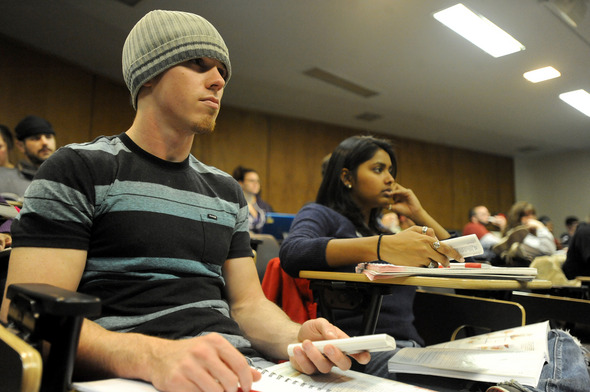
Eastern Michigan students Josh Roselieb, left, and Allison Bohn use their clicker devices to answer a question during human anatomy and physiology class.
Angela J. Cesere | AnnArbor.com
Technology is continuing to transform the college classroom.
In the second decade of the 21st century, computers have become more commonplace for note-taking than actual notebooks and professors who use blackboards over PowerPoint are nearly extinct.
Outside of classrooms, hundreds of students can be found huddled in Ann Arbor or Ypsilanti coffee shops studying their electronic textbook while using the latest edition of the most popular e-reader.
"There's all kinds of way-cool technology that we try to keep up with," Eastern Michigan University President Susan Martin said in an interview.
Adding to this change in the academic landscape is the recent surge of the 'clicker,' an electronic voting device that resembles a basic remote control and is widely being embraced by universities as a way to encourage interaction in classes.
During the fall semester at EMU, the devices became so popular that the school bookstore ran out of stock and had to order a second wave of them.
"At first it was very annoying," EMU senior Ryan Johnson said of the clickers, which he's used in two classes. He had to foot the bill for his clicker; new versions cost between $33 and $46.
But after using the device, Johnson said class became a loose game of Jeopardy. Lectures became more entertaining and he had an incentive to pay attention.
"It helps increase people’s willingness to pay attention," the philosophy and accounting major said. "It takes class from a lecture thing where you're just taking notes to an interactive experience."
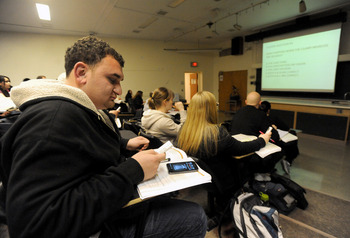
Eastern Michigan student Nehme Bazzi uses his clicker device to answer a question during human anatomy and physiology class.
Angela J. Cesere | AnnArbor.com
At the University of Michigan, 14,698 students in 41 classes used clickers in the College of Literature, Science and Arts during the recently completed fall semester alone. That's up about 1,300 from last year. LSA has been using clickers since 2007.
The clickers, according to EMU biology professor Anne Casper, have the most value in their flexibility. They can be used to monitor attendance, conduct paperless pop quizes, review for an exam or poll students' opinions regarding a class debate. Professors can give bonus points for correct answers or make answering compulsory and part of a student's participation grade.
Casper says clicker use counts for about 10 percent of a pupil's grade in her introduction to biology class, where points are acquired only when student answers correctly.
"On student evaluations students... will, unprompted, tell me clickers got me to class," Casper said, explaining that the biology department has seen an uptick in class attendance since it first began using the devices five years ago. "The clickers might be the thing that pushes you over the edge to go on in."
In large classes, which at EMU typically don't exceed 250 students, attendance and student engagement usually flags as the semester wears on.
The clickers, however, provide an incentive for consistent engagement, according to EMU anatomy professor Michael Kielb, who said he's seen an improvement in his students' grades since he began using the clickers.
"They pay attention to what’s going on," he said. "They might actually read the materials they're supposed to read ahead of time with the fear of, 'Oh my gosh, he might actually ask a question.'"
Clickers also give faculty instant feedback on how well they're teaching new information and how much students are absorbing it.
"It gives them instantaneous feedback on how they’re actually doing at teaching," said Johnson.
At U-M, clickers are also used outside of the classroom on prospective student tours, student orientation and at the occasional regents meeting, says Monika R. Dressler, director of LSA Instructional Support Services.
Kellie Woodhouse covers higher education for AnnArbor.com. Reach her at kelliewoodhouse@annarbor.com or 734-623-4602 and follow her on twitter.
Comments
FredMax
Wed, Jan 4, 2012 : 1:08 p.m.
Click if Vanilla-Ice comes to mind.
PK
Tue, Jan 3, 2012 : 11:28 p.m.
Mr. Bazzi might pass for a young John Belushi from Animal House. I don't think they used clickers in Animal House though.
djacks24
Tue, Jan 3, 2012 : 7:15 p.m.
I remember the good ol' days where at least in college, the students had to take accountability for passing their classes and earning a degree. Every professor was more or less different about attendance or attentiveness. But basically it was the students responsibility to ask for help, participate, take notes, or even show up for class. In one class, we had a person falling asleep during a lecture. The professor said that he didn't mind the student sleeping, but just not in his classroom. He told the student they had the option of staying awake or leaving class to go to sleep. The student chose to leave and the professor was fine with that. Furthermore, I can't count how many classes I had that required a lot of note-taking. If you happened to miss class or something the professor was saying, you'd better hope your in good with a classmate, because the professor would never fill you in on what you missed, no matter what the reason was for missing lecture. I suppose nowadays with the exorbitant cost of college, the high unemployment rate, and the high default rate on non-dischargable student loans, Colleges are doing whatever it takes to prove their existence and keep the higher education bubble from bursting by covering every aspect of student accountability.
Robert Granville
Tue, Jan 3, 2012 : 3:37 p.m.
Ignatz has it right. To students, this is just one more thing we HAVE to buy. It's a racket. I've never met a student who appreciated their use in the classroom. Fortunately, I went to a small enough school that classes were still taught the old fashioned, personal way.
RunsWithScissors
Tue, Jan 3, 2012 : 2:32 p.m.
I'm so disappointed! I thought this article would be about using clickers to train students. Just imagine, through clicker training (or perhaps cattle prods) students can be trained to have better manners, not dart into the road without looking and clean up after themselves. After training all the students we can focus on city council, drug abusers, and drivers driving while chatting on their cell phone. What fun!
the thing is...
Tue, Jan 3, 2012 : 7:54 p.m.
+1 for "driving while chatting on their cell phone."
Jaime Magiera
Tue, Jan 3, 2012 : 1:56 p.m.
As a programmer and technical support person, I've worked on several projects that involve class interaction technology (including work at U of M). There is a lot of potential with technology and classroom interaction. It's important to note that the technology frames the way in which information is presented, in which questions are asked and answered. Regrettably, "clickers" have gained prominence despite being a very limited tool along those lines. Questions and answers have to be squeezed into the multi-button format. Also, students need to get used to a particular device interface that they do not use under any other circumstances in their life. If an educational institution decides to switch clicker products, or the student goes to a different educational institution, they have to get acclimated to a new interface. Using standard mobile devices that have keyboards, with web applications, is a far better way to do classroom interaction. There are far more interface options with a webpage -- providing a much wider canvass for content and response. Most students already have a web-ready mobile device. So, the interface is familiar. Web applications and standard mobile devices also more cost effective because of ubiquity.
xmo
Tue, Jan 3, 2012 : 1:55 p.m.
Where is the ACLU? Keeping track of attendance, monitoring students participation by their clicking? All are forms of electronic data collected and stored on you. In the right hands it doesn't mean much but in the wrong hands and we have trouble. I thought that the "Progressives" were against things like the "Patriot Act"?
Peter
Tue, Jan 3, 2012 : 9:46 p.m.
No, it really isn't a nice try. xmo constantly mocks legitimate societal problems with crappy posts like that.
Peter Baker
Tue, Jan 3, 2012 : 3:07 p.m.
Nice try.
spm
Tue, Jan 3, 2012 : 1:45 p.m.
Call me old fashion, but I don't understand how a clicker encourages greater participation? What happened to the professor calling on random students? Pop quizzes can be given without clickers as well. I must be missing something...
Jaime Magiera
Tue, Jan 3, 2012 : 1:59 p.m.
The idea is that students who wouldn't ordinarily comment/participate in class feel more comfortable doing so with a clicker. Now, one might argue... "Why not work towards making students more comfortable in class" -- which would be a valid question.
MDavid
Tue, Jan 3, 2012 : 1:33 p.m.
Funny, a different form of "clicker training" is used to get animals to perform in desired ways. Now apparently it's needed to get students to attend class, pay attention, and prepare to participate? I guess the exorbitant tuition they pay isn't enough incentive anymore. Well, I can only hope their bosses of the future will use clickers too so that they will actually come to work prepared, be attentive, and do the job they are paid to do.
Brad
Tue, Jan 3, 2012 : 1:54 p.m.
The students and profs seem to like it. Hey - if it allows the students to hone their critical thinking skills then maybe someday they'll know that all "clicking" thing are not necessarily related.
A2comments
Tue, Jan 3, 2012 : 1:26 p.m.
The cost to the school is minimal.
Robert Granville
Tue, Jan 3, 2012 : 3:41 p.m.
Does it even cost the school anything besides the initial software license purchase? The clickers are required purchases for students. The school certainly does not pay for those.
Ignatz
Tue, Jan 3, 2012 : 12:51 p.m.
To those who constantly rail against the rising cost of higher education, this is one of the reasons for the increases. New technology costs money.