

Counselors describe push to help students graduate on time as 'full-court press'

Saline High School's Class of 2010 marches down to the football field at the beginning of the commencement ceremony two years ago at Saline's Hornet Stadium. The Class of 2012 graduation will be at 6 p.m. Sunday.
Melanie Maxwell | AnnArbor.com
Huron High School counselor Denise Eaddy-Richardson said around April, she starts wearing her gym shoes to work almost every day.
“Literally for chasing kids down the hallway to get them to turn in their work,” she said.
Every year, there are always a handful of students — at Community High it’s about 10 — in jeopardy of not graduating on time, either because of illness, family crisis, mental health issues, attendance issues or issues with their credits, explained John Boshoven, counselor at Community High School and Ann Arbor Public Schools coordinator for all district counselors.
If seniors are missing schoolwork through no fault of their own, such as they are out with mononucleosis or recovering from surgery, the district is “very merciful” about increasing their opportunities to retake tests and complete extra-credit assignments and papers, Boshoven said.
If it is the student’s fault he or she is behind, it becomes a team effort to help that student cross his or her commencement stage.
“It’s our job to give them a diploma,” Boshoven said. “If we can’t, we’re failing them as a school.”
Often children at risk of not graduating on time are identified as such during their freshmen years, the counselors said.
At Huron, the entire Class of 2012 was “targeted” four years ago as needing some “extra attention,” Eaddy-Richardson said.
“Student achievement was not where we thought it would be,” she said. “We had a mandatory after-school study hall for two years.”
Eaddy-Richardson said sometimes students come in and they are emotionally immature or aren’t academically ready or don’t have the support at home.
“That was our perception (of this 2012 class). That they just needed a little extra care and monitoring to get them on the right track,” she said, adding it was the first time since she has been at Huron that the school has mandated a study hour. Other classes have needed other interventions, though, she said.
Boshoven explained the earlier a school can identify its at-risk students, the better. Early intervention gives counselors and teachers the opportunity to move students into another school or program that might be better suited to help them achieve, he said.
“We’re a less-structured school. But there are other schools in town with more structure,” he said. “Sometimes when a student is not earning credits, it’s because they don’t have the right environment. Some kids need bells to get to class and walkie-talkies urging them in the hallways, so as counselors (at Community) sometimes we urge kids back to their comprehensive high schools.”
But for those students who squeak by and make it to the 12th grade just shy of the required number of credits, that is when what Boshoven called the “full-court press” occurs.
The counselors said what remediation is done to ensure graduation changes on a case-by-case basis.
But the one thing that stays the same is communication.
At all of the schools it goes by a different name — at Community it’s called a forum, at Huron it’s an achievement team meeting — but the premise is regular, consistent and ongoing dialogue between the student, his parents, teachers and counselors to determine what is needed for the child to earn a diploma on time.
"It starts with the classroom teacher asking how come they didn’t get that last assignment in and where is it? Does the student need help? Do they want a tutor?" Boshoven said. "Then the teacher spells out exactly what they have to turn in, which tests they can re-take, if there are summer school options."
Eaddy-Richardson added Ann Arbor's teachers care about students acquiring a body of knowledge, so they do not give out too many "freebies" unless there are extenuating circumstances.
"They want (students) to know true success, but (teachers) will stay after school with them — do whatever it takes to get them to learn the material," she said.
Boshoven said at Community, counselors use the graduation ceremony itself as a "pressure point."
"The kids don’t want to miss the ceremony. It’s a big love fest for families and for the school, and kids want to be a part of that," he said, explaining at Community High, there are no commencement speakers, that any student can step up to the podium and speak, sing, dance, perform on the tuba, tell jokes — "Whatever they want.
"It’s special, and kids treat it specially."
Boshoven said sometimes during second semester, counselors can get students out of a class they are struggling in and put them in a credit recovery class instead.
"By second semester, we're not after 'A's for these kids. We're only after credit," Boshoven said.
Students are allowed to walk at their AAPS graduations if they are within one credit of the requirement. They can walk, but they won’t receive a diploma and then they have until the end of the regular school year to do the work that is required and, sometimes, they can finish one class at summer school, officials said.
Huron has 30 students who are within 1.0 credit and will be walking this year, the district reported.
Boshoven added counselors and teachers use “loving, encouraging, nagging pressure” to get students to graduate. Eaddy-Richardson echoed his remarks and stressed the importance of being able to accomplish it on time with the rest of the class.
“These kids are not just our students. We’re invested in these young people,” she said. “And it’s important that they know the joys of success and have that kind of positive outlook on their achievements when they step out into the future.
“Our society needs kids who understand how to make things happen in their own lives and can push through difficulty. That’s why it’s so important (students graduate on time).”
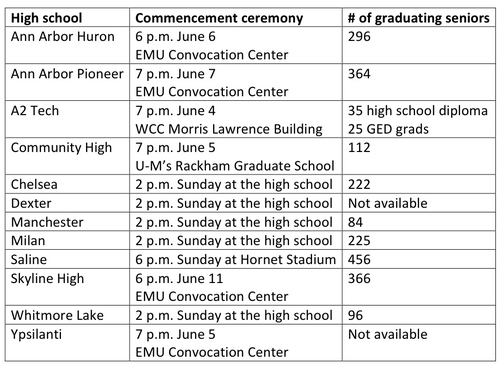
High school graduations begin this weekend for all of Washtenaw County's school districts. Lincoln and Willow Run high schools had commencement ceremonies Friday night, kicking off the summer open house season. They had 283 and 62 graduates, respectively.
The following chart shows the dates of the remaining commencements. Ann Arbor schools spokeswoman Liz Margolis stressed AAPS' graduation numbers are not final. Students still have until next week to turn work in to meet requirements, so the numbers will change, she said.
Staff reporter Danielle Arndt covers K-12 education for AnnArbor.com. Follow her on Twitter @DanielleArndt or email her at daniellearndt@annarbor.com.
Comments
Cindy S
Wed, Jun 13, 2012 : 12:34 p.m.
It is very distressing to learn that there is even a remote possibility that the number of counselors at Pioneer may be reduced or expected to work with additional students. These services are an integral part of the educational mission and make a marked difference between student success and failure. I believe we need additional counselors and cannot fathom a reduction in the number. At the high schools, the counselors Run 504 meetings, write 504 plans, spend nights and weekends working (I know this because of how responsive the counselor is to email messages even over the weekend and late into the evening) meeting with students in large (assemblies for the entire class), medium (classroom visits a number of times a year) and small groups (freshman meetings and college prep meetings and PSAT and PLAN meetings) as well as meeting with individuals for all the regular things: interpreting test scores, career and college planning, personal issues, etc). My oldest daughter will be applying to colleges in the fall - I can only imagine the inordinate amount of work the college application and letter writing process entails.
MMM
Sun, Jun 3, 2012 : 1:48 a.m.
Too bad parents aren't doing the "full court press" on their own kids. What is the attendance like for these kids? I am guessing that there is a great deal of absenteeism. What were their middle school grades? I bet their transcript had lots of unsatisfactories. The high schools are being forced to teach tougher curriculum, and get kids through the most rigorous course requirements in history, and at the same time parent support and student accountability has declined sharply. I thought this article was sad. We are not really helping those kids in the long run.
a2flow
Sun, Jun 3, 2012 : 10:46 p.m.
MMM, In my experience, it's been that the parents spend more time defending why their child is not capable and should not be held accountable in most instances. The parents are always saying, the school has failed my child. The school should have done more. The kids don't take notes in class, don't write down assignment due dates, don't check Powerschool (and oftentimes the parent will want to schedule a meeting with me but doesn't do anything proactive at home to correct the issues), don't come for help/ask what they missed when they have missed a day (or ten), and don't seem to care until it interrupts something important to them (e.g., sports, field trips, graduation, etc.). AAPS has many outstanding students, but it also has many students that have been failing forever. Sadly, the charade of social progression ends after 8th grade and then the consequences of failure start to set in. By then, years of parent enabling have been well established as well as years of poor habits, in which the kids think I can do nothing and still move on. Maybe the better question for our high priced superintendent is...why are kids allowed to fail year after year without any consequence until high school?
AMOC
Sun, Jun 3, 2012 : 3:40 p.m.
In a lot of cases, the parents are deliberately not kept in the loop in sufficient detail to be helpful to students who are forgetful or less-than-eager students. The teachers claim that they are trying to "force" the kids to take responsibility for their own schoolwork. But if there are documented reasons that have interfered with the student attending class, hearing, recording or understanding classroom instructions, posting the complete assignment instructions on Powerschool or a teacher web site or on an e-mail distribution list that parents may also subscribe to is the least we should expect, right? But it happens only very rarely, and never, in my experience, without a fight. Most teachers do work hard, and genuinely want to help their students succeed. Making the info available so that a student who missed class can do his or her work, and a parent can check up on their student's assignments BEFORE work is late and a grade penalty has been assessed would be helpful. Why is it not standard practice in all our schools?
Donna
Sat, Jun 2, 2012 : 10:18 p.m.
The Pioneer High School guidance counselor staff is slated for yet another cut next year, which would put Pioneer at 325 students per counselor. Most schools will have under 300 per counselor, and middle schools about 250. Why cut at the high school, especially at Pioneer, where counselors already have their plates overflowing certifying students for graduation, scheduling a complicated array for classes for a range of students, dealing with the severe issues of teenagers in a diverse community, writing mandatory counselor letters for everyone applying to college, etc. Pioneer has suffered counselor losses and reconfiguration every year for the past five years. A counselor is the one touchstone a teenager has through his or her four years at what can often be an overwhelming school. They are extremely important. What is the AAPS thinking?
MRunner73
Sat, Jun 2, 2012 : 7:27 p.m.
Good article. Perhaps a crisis point in our education system. It seems like the schools are doing as much as possible to prompt, prod, help, counsul and showing mercy to those students who have the various issues to deal with. But I atrongly agree with the harsher comments about responsibility on both students and parents. The reason for that is, life gets harder and hashers going forward. There will be competition for college placement, vocational career insitutues and ultimately, applying for that job in the career of choice. For the first time in their lives, many of these students will learn what it like not a ribbon of achievement just for being on the Little League team. They will experience failure for the first times and that's the scary part. How it is that the Asian or Indian cultures can produce such overachieving students who then go on to attend our colleges and obtain many of our better careers, such as doctors, lawyers, engineers, etc? (I know the answer..) Bottom line: Help these students EARN their diplomas from high school but the journey through life really starts at 17 and 18 years of age. (And taking algebra 2 will be the easy part.)
Linda
Sat, Jun 2, 2012 : 9:56 p.m.
I have long found it curious that there is so much concern about the achievement gap between Caucasian students and African American students (and maybe Hispanic students too, in the last several years) -- but no apparent concern about the achievement gap between Asian or Indian students and Caucasian students. Why set the bar according to the middle-achieving group? Just because it's the majority? Or is there some other reason?
J. A. Pieper
Sat, Jun 2, 2012 : 9:38 p.m.
My best students are always from the other cultures you mentioned, and since I teach elementary, obviously they keep it up all the way through school. The sad thing is that many students develop their work habits in elementary school, and these tend not to change over the years. Another sad aspect of this is that we, as educators, can't seem to instill the overachieving habits of the cultures mentioned in many of our students, and we so wish we could. Since you know the reason (so do most educators), I hope you realize that several of the problems related to out "gap" students are impossible for the schools to fix!
boo
Sat, Jun 2, 2012 : 4:45 p.m.
with counselors chasing kids down and holding hands until the crawl across the stage, what lesson is being taught to the student. If they don't make it, tough. Go pay for a GED program and learn to appreciate the education you were offered for free (parents tax dollars) all these years. the students need to take responsibility. stop blaming parents, teachers, schools, TV, video games, etc. take personal responsibility. enough already!
J. A. Pieper
Sat, Jun 2, 2012 : 7:11 p.m.
Boo, you have to realize that many a parent wants their child to have fun and an easy time progressing through school. They help their child so much that the students develop something known as "Learned Helplessness", where they just can't seem to work on their own at school. We bend over backwards to help all students, but you are right, the student needs to take responsibility for their own learning. Many do, and as teachers, we often wonder, what do they have that the other students lack? I also love what others are saying about the comment "It's our job to give them a diploma" - this is what's wrong with our educational system these days, GIVE THE STUDENT WHAT HE OR SHE EARNS, period. Oh, but the district can't do that, it would make them look bad...
xmo
Sat, Jun 2, 2012 : 3:54 p.m.
I just love this quote! ""It's our job to give them a diploma," Boshoven said." Why have requirements? They just get in the way!
mixmaster
Sat, Jun 2, 2012 : 2:58 p.m.
Life is hard. The sooner that young people learn that they have to apply themselves to their education and less time socializing on and off line with friends the better off they'll be. It's not about walking in the ceremony with your friends, or having a graduation party. It's about getting an education and hopefully a better shot at being a self supporting adult. If it takes a couple of tries to pass Algebra 2, so be it. I think that parents are to blame for the misplacement of their children's and their own standards, goals and ideals.
a2flow
Sun, Jun 3, 2012 : 10:57 p.m.
@Freight, What I know of the students I have had is this. If the classes are so easy and AAPS so terrible, why is it that our top students routinely are admitted to UM or better? Sooth doesn't know what he/she is talking about. There is a certain segment of our population that believes that all these kids are just dying to learn, if the silly incompetent fools would teach them. These same people are also the ones that say must be nice to work 8-3 with an hour break and a lunch break. The reality is that our top students are really driven, have supportive parents, and take the most challenging classes. One of my bright students a few years back said UM was her backup option if she didn't get into Harvard/Yale. She was a great student! The reality of why some of our students don't achieve is they have poor reading skills, education isn't valued at home, they don't come to school, parents sometimes work 2-3 jobs, parents sometimes buy them expensive shoes/phones but don't have a computer, parents set no expectations for them, hate school (and yet we continue to cut voc ed funding), and are disrespectful to authority.
Freight Train
Sun, Jun 3, 2012 : 12:11 p.m.
@Soothslayer "These public schools are a joke. Even the "advanced" curriculum is a cake walk to ensure everyone moves through the system and graduates. These kids are no where near at the same level of education kids in other developed nations are." I seriously doubt you would find it a joke to get 5s on the AP curriculum. I would put AP tests up against virtually any other high school programs.
Soothslayer
Sat, Jun 2, 2012 : 8:36 p.m.
So... blame the kids for not getting a decent education and not the adults that are supposedly in charge of the entire program? These public schools are a joke. Even the "advanced" curriculum is a cake walk to ensure everyone moves through the system and graduates. These kids are no where near at the same level of education kids in other developed nations are. It takes a village to raise a child and the amount of money spent per student isn't the issue because its the same or less in far more successful programs. Lack of family priority, bloated system bureaucracy and a failed educational system are. The program has failed these children and the children will grow up failing society. We should probably rethink our stance on who's at fault here and what to do about it.
J. A. Pieper
Sat, Jun 2, 2012 : 2:46 p.m.
The elementary schools can identify the students in danger of not graduating once the get started in kindergarten. Much of the same support as mentioned in the article is given them throughout their school years, especially while they are still in elementary school. I wonder if the children in the current lower elementary are some of the same children that counselors will be chasing down in 2024, 2023, 2022? Invest in our running shoes now!
Barb's Mom
Sun, Jun 3, 2012 : 2:07 a.m.
This must have changed since my kids were in elementary school. Then the only help was for students who needed to learn english as a second language.
Dr. I. Emsayin
Sat, Jun 2, 2012 : 1:04 p.m.
New state law requires students to take 4 years of math and also chemistry or physics. It used to be 2 years of math and 2 of science. It makes it harder for struggling kids to graduate and pushing at the last minute doesn't help acquire skills. There should be something to take instead of algebra 2 for the struggling students. I would like to know how many of the students in jeopardy of not graduating are in that boat because of algebra 2. Can someone get that answer?
Angry Moderate
Mon, Jun 4, 2012 : 3:21 a.m.
Algebra 2 at Huron is not remotely advanced. Anyone who can't manage to get a D- in that should not be getting a diploma. Dumbing down the curriculum is what made a high school diploma a useless credential.
Barb's Mom
Sun, Jun 3, 2012 : 2:13 a.m.
@Elijah-- not everyone is a math wizard. It is not that they are dumb, some people just can not handle advanced mathmatics.
Engineer
Sun, Jun 3, 2012 : 1:52 a.m.
There is always calculus that can be taken for the fourth year. The standards at these schools are not all that tough. I personally would like to see them raised. This thing where 2/3 of a class is 3.0 and above is crazy. Scholarships are given to a lot of kids that are gone within a year while kids that got what it takes are passed over. Performance should determine scholarships much more than it does. And I do not mean if you can run a 4.0 40 you do not need the grades or cash to go!
djacks24
Sat, Jun 2, 2012 : 6:54 p.m.
""It's our job to give them a diploma," Boshoven said. "If we can't, we're failing them as a school."" No wonder our nation is falling behind. It should say "it's their job (the student) to earn a diploma, if they can't they're failing as a student". If our schools didn't think off themselves as diploma charities and some parents disciplined and supported their children, then there would not be a problem and our country would have a much higher global standing in an educated populous.
chubbybunny
Sat, Jun 2, 2012 : 4:46 p.m.
As harsh as Elijah Shalis' comments are, he makes a strong case. Students (and their parents) need to take responsibility for their education. The schools give the tools and resources to make that possible. If students (and their parents) expect to have their hands held in school, then they will expect this throughout life. We need to develop young people who can think for themselves, struggle and persevere, and overcome obstacles. Blaming the schools, a teacher, a counselor, or "the man" for their shortcomings won't achieve these goals.
Elijah Shalis
Sat, Jun 2, 2012 : 1:57 p.m.
Every year you get to choose classes and the handbook lists the graduation requirements and which courses are required. What part of that don't people understand? It is not the counselors job to literally hold the students hand and hand pick each choice. That would be impossible with 1,800 students. Maybe the parents should take some responsibility in the process.
Michelle
Sat, Jun 2, 2012 : 1:48 p.m.
My daughter failed her algebra 2 final exam, PLUS her counselor 'forgot' to tell her she needed another elective to graduate. All the invitations are sent, all the money is spent. She isn't 'helping' my daughter at all. So she won't walk in commencement. The school gave her no support at all, she worked her tail off to pass that class and algebra 2 is HARD.
Elijah Shalis
Sat, Jun 2, 2012 : 1:27 p.m.
No there shouldn't. If a student is lazy or dumb they should not graduate. -Huron '98, GPA Honors
Paula Gardner
Sat, Jun 2, 2012 : 12:22 p.m.
Community High's graduation date is incorrect in this chart, which is being corrected. The correct info is: Tuesday, June 5th, Rackham Graduate School Auditorium, 7:00 pm.
Danielle Arndt
Sat, Jun 2, 2012 : 1:01 p.m.
shine16, because Lincoln and Willow Run's graduations occurred last night before the article was scheduled to run, their numbers are listed in the body of the story. You can find that info in the second paragraph above the chart. Thanks!
shine16
Sat, Jun 2, 2012 : 12:33 p.m.
Why isn't Lincoln on the list? Theirs was last night.
Lac Court Orilles
Sat, Jun 2, 2012 : 11:37 a.m.
Teacher bashers Senator Randy Richardville, and Representatives Quimet and Olson have never recognized the outstanding care that our public school teachers give to students. I dare these elected legislators who greatly enjoy cutting school budgets and making teachers' lives entirely miserable to find fault with what these teachers are doing...