

DEA: Money is dirty, but getting sick from drug residue is rare
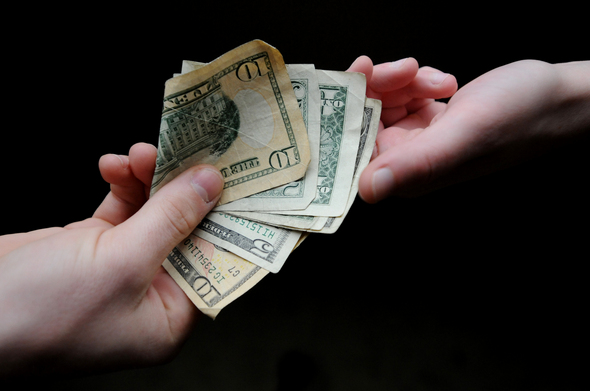
When money changes hands, there's more than meets the eye.
Melanie Maxwell | AnnArbor.com
While United States currency is usually very dirty and can often have drug residue on it, it's rare to find enough chemicals on paper bills to cause the type of reaction found in Ann Arbor's Circle K gas station on Thursday, law enforcement officials.
Three employees at the station fell ill after methamphetamine residue was found on money at the station, according to firefighters.
“You don’t hear about people becoming sick from handling contaminated money. That would be rare,” Special Agent Rich Isaacson of the Drug Enforcement Administration said.
“There’s drug residue on U.S. currency, but for people to become sick, you don’t hear of that often.”
In Thursday's incident, the DEA advised local authorities on what companies could be called to properly dispose of the money, Isaacson said.
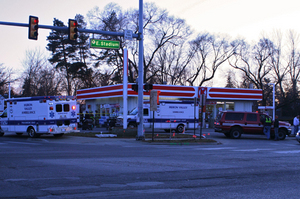
Three employees at the Circle K station at Stadium and Packard fell ill due to methamphetamine residue on paper money Thursday.
Jessica Webster | AnnArbor.com
The county’s hazardous materials team determined cash at the station used to purchase money orders had been contaminated with chemicals from a meth lab, Menard said.
Meth labs use common household chemicals to make the drug, such as battery acid and drain cleaner. When combined, the mixtures are hazardous - and officials said they can remain on surfaces and dangerous to humans for some time.
The common response to cleaning up a meth lab is to use hazardous materials protocol, which is why the station was closed Thursday amid the public safety response.
In fact, Congress restored $12.5 million in meth lab cleanup funding to an appropriations bill in late 2011. The money was important to police because finding and prosecuting meth lab operators left communities having to deal with the expensive cleanup of the toxic aftermath.
In Michigan, meth lab cleanup cost more than $1 million in 2010.
In the Ann Arbor incident, the exact nature of the chemicals found on the bills was unclear Friday. However, the gas station re-opened Friday morning.
While most people won't get sick from chemicals on money, about 90 percent of paper money in the United States contains traces of cocaine, according to a 2009 study. However, the amounts are usually not concentrated enough to cause any sort of reaction.
Disease-causing organisms are also known to thrive on paper bills.
According to the CNN story on the study, 94 percent of tested bills contained potentially diseas-causing organisms, such as staphylococcus and pneumonia-causing bacteria.
Isaacson said there had to be a lot of dangerous residue on the bills found at the Circle K in order to actually cause illness in the station employees.
There isn’t a typical way for people to protect themselves from harmful residue on money because the chances of being harmed by chemicals on the bills are so rare, Isaacson said.
But be prepared with soap and water - or hand sanitizer - when you're dealing with large amounts of cash.
“Currency is always dirty to begin with, so wash your hands when handling U.S. currency,” he said.
Kyle Feldscher covers cops and courts for AnnArbor.com. He can be reached at kylefeldscher@annarbor.com or you can follow him on Twitter.
Comments
theodynus
Sat, Feb 11, 2012 : 9:08 p.m.
This is so ironic! It just so happens that I run a currency disposal service out of my home office. For just $100 I will accept $1000 in cash and make sure you never see it again. In fact, I'm running a special right now for annarbor.com members. Give me $50 and I'll get rid of up to a grand of dirty money!
Richard
Sat, Feb 11, 2012 : 8:11 p.m.
I think this was the government's way of trying to prevent mass hysteria. It would not surprise me to see it happen in A2.
snapshot
Sat, Feb 11, 2012 : 6:56 p.m.
"Three employees at the station fell ill after methamphetamine residue was found on money at the station, according to firefighters". They fell ill "after" the residue was found?
Richard
Sat, Feb 11, 2012 : 8:12 p.m.
It was a psychological response. The DEA was trying to nicely say they were full of it without actually saying it.
golfer
Sat, Feb 11, 2012 : 6:40 p.m.
What people do not know is that what is dirty and unhealthy. You wash your hands and us sanitizer. What are the two unhealthiest items are is money and door handles. Does this surprise me? NO!.
racerx
Sat, Feb 11, 2012 : 4:57 p.m.
No sure of what is needed to get a money order, but is there anyway this can be traced? I think there is more of a problem of finding the meth lab than people getting sick. Oh. Sorry. People in Ann Arbor don't use meth. AAPD probably think this is Yspilanti's problem. Funny. They thought the same thing about crack cocaine many years ago. Oh well. We'll go back to addressing bigger issues within the city, like positioning police cars on Huron Parkway between Huron Hills Golf Course and Washtenaw avenue to catch speeders going 50mph in a 35mph speed zone while even the police acknowledge that most of the traffic at rush hour is traveling 45-52mph! You've been warned Ann Arbor!
RJA
Sat, Feb 11, 2012 : 4:41 p.m.
Money is filthy! The cleanest money I have found is the money I have left in pockets and ran through the washer and dryer. Especially the change...so shiny and clean. If you have ever rolled coins, yuck, look at your dirty hands.
grimmk
Sun, Feb 12, 2012 : 4:11 a.m.
Gotta love money laundering. Be thankful it's not all paper. I work with money all day and I wash my lands A LOT. Especially before eating. GROSS. What's worse is when people sneeze or cough into their hands and then hand me money. Really?! Have you not heard into your elbow/sleeve??
G. Orwell
Sat, Feb 11, 2012 : 4:20 p.m.
Is this a weak attempt to demonizing cash in order to move us toward a cashless society? Cash is handled billions of times a day by people all around the world without any health problems. It has been the case for over several hundred years. Just askin.
Homeland Conspiracy
Sat, Feb 11, 2012 : 6:51 p.m.
Nailed it!!!
nickcarraweigh
Sat, Feb 11, 2012 : 3:29 p.m.
My lord, you can expect this kind of thing in someplace like Saline or South Central LA, but in Ann Arbor?
JustLookin'
Sun, Feb 12, 2012 : 1:07 a.m.
Nick said: "My lord, you can expect this kind of thing in someplace like Saline or South Central LA, but in Ann Arbor?" I trust that was said with your tongue firmly planted in your cheek? I certainly hope so!
arborani
Sat, Feb 11, 2012 : 3:26 p.m.
" . . . Govt Hand washer" - see "local University"?
dexterreader
Sat, Feb 11, 2012 : 2:41 p.m.
Wow! No wonder having cash in your pocket to spend is such a high!!
Ann English
Sat, Feb 11, 2012 : 11:58 p.m.
Cash in your pocket to spend on gasoline means you're not limited to which brands you can buy, such as Marathon or Shell credit cards limit you. You can buy gas anywhere with cash, and special discounts are for cash-only gas purchases. It's harder for the gas station cashiers to process credit purchases than the cash purchases, even if the credit card is Visa or Discover.
Sallyxyz
Sat, Feb 11, 2012 : 2:31 p.m.
I too would like to see an article on the extent of the meth problem in Michigan, specifically Wash Cty. "In Michigan, meth lab cleanup cost more than $1 million in 2010." Here is the website listing the locations of clandestine meth labs in the area: www dot yourmapper dot com/map/137/meth-labs/national-clandestine-laboratory-register-from-the.htm Seems to me there is a huge problem. I'm not surprised to see these chemicals on cash, especially if the perps were trying to launder a large amount of cash by buying a money order. Right there is a flag for a gas station. How many people buy large money orders in a gas station and not a bank?
DBH
Sat, Feb 11, 2012 : 7:23 p.m.
Here is the correct link for the website: <a href="http://www.yourmapper.com/map/137/meth-labs/national-clandestine-laboratory-register-from-the.htm" rel='nofollow'>http://www.yourmapper.com/map/137/meth-labs/national-clandestine-laboratory-register-from-the.htm</a> .
DBH
Sat, Feb 11, 2012 : 7:16 p.m.
Sallyxyz, did you actually visit the website you listed? The link you gave needs to have the two "[space]dot[space]"s replaced with a period in order for it to work. Secondly, it claims to be updated annually but then notes that the last update was 641 days ago. The website seems to be fairly out-of-date. Lastly, given its results, I saw no labs listed for Ann Arbor or Ypsilanti. The two closest ones to Ann Arbor were near South Lyon and in the SW corner of Saline (actually, probably Saline Township, given its location). Apart from this site, I saw no others listed in Washtenaw County. Your impression that "...there is a huge problem" probably is correct if you are talking about Michigan or the nation in general but, based on the link you (sort of) provided, Washtenaw County appears to be relatively unaffected, at least as of 641 days ago.
Joy Bash
Sat, Feb 11, 2012 : 5:09 p.m.
I have bought money orders from Kroger and CVS , They are no larger than $500. If you need a money order for more then that you have to buy more then one.
Gorc
Sat, Feb 11, 2012 : 2:46 p.m.
Typically, you cannot purchase money orders for more than a $1,000. Over that amount could require an official check (cashiers check).
Gorc
Sat, Feb 11, 2012 : 2:30 p.m.
Think about...money is the most common object that is handled by people in our society. During a bills useful life cycle and before the FRB pulls it out of circulation, how many people touch one bill. I'm guessing, but one bill could be touched by thousands of people. Is it possible a small percentage of bills get touched up to 10,000 times? Can you name any other objects shared amoung society that get handled more than money?
johnnya2
Sat, Feb 11, 2012 : 9:44 p.m.
"Can you name any other objects shared amoung society that get handled more than money?" I really want to throw in a comment about my ex here, but it would likely get censored.
Homeland Conspiracy
Sat, Feb 11, 2012 : 2:20 p.m.
"Think of the children"
bunnyabbot
Sat, Feb 11, 2012 : 2:06 p.m.
disease causing should also include ecoli. I knew someone once whos dog ate some bills, they waited for them to pass "washed them" (somewhat) and then used them at someplace like fastfood. So there you have it your money might have passed through a dog at one point. maybe more people should actually send some money through the washer to give it a bath. At least I think that banks send money in to be exchanged with fresher bills, but I don't know how frequently. Kyle, the program I watched on tv, and I think I read it somewhere too said that a higher % of money had drug residue on it, was newer than the 09 study. The residue parts per mil were very very small. The percentage you claim was easily found by internet searching (btw that was a study on US money done in the UK!) all those articles were signhting the same study (oh boy is that only how far you looked into it?, did you call the DEA and ask, did you call the Treasury and ask if they had thier own more recent study?) When you widen to include other drug residue than that % went up. AND in some cities the % was actually higher, I think in some places like Detroit, St Louis among others it was higher, nearly 100%
thinker
Sat, Feb 11, 2012 : 2:02 p.m.
Don't worry, the government will regulate the banks to literally "launder" the money that comes in before they hand it back out. Or maybe to have cash laundry machines in every bank branch alongside the change sorter. With government intruding into every aspect of our lives, we must not let people handle cash, or expect people to wash their own hands.
huh7891
Sat, Feb 11, 2012 : 2:17 p.m.
Maybe they will create a new job title- Govt Hand washer
annarborkid
Sat, Feb 11, 2012 : 2:02 p.m.
What are we know? Detroit?
djm12652
Sat, Feb 11, 2012 : 3:07 p.m.
almost 'now' only with better housing and vehicles, but a lot less hookers...alas, no Tigers, Lions or Wings oh my
Gorc
Sat, Feb 11, 2012 : 2:18 p.m.
Don't act like your poo doesn't stink.
grimmk
Sat, Feb 11, 2012 : 1:53 p.m.
God knows I hate it when my customers cough/ sneeze into their hands and then hand me money. NOT enough hand sanitizer in the world will fix that. Not that it even helps at all.
tdw
Sat, Feb 11, 2012 : 1:15 p.m.
I wish A2.com would run article ( I'm not criticizing ) about meth in Washtenaw County.I've known people who have had problems with heroin, oxycotin ( unfortunitly ( ? spell check not working ) 4 or 5 have been fatal ) and cocaine.But I've never heard or seen anything about meth,either personally or in the news about meth in this state
tdw
Sat, Feb 11, 2012 : 1:18 p.m.
Ooops.....I take that back.Some female got busted with a lab last year.I'm talking about use or possession
June Gordon
Sat, Feb 11, 2012 : 12:44 p.m.
Take a few deep breaths, hypochondriacs. That's why we have immune systems.
thorj97
Sat, Feb 11, 2012 : 12:41 p.m.
Use a credit or debit card...
johnnya2
Sat, Feb 11, 2012 : 9:42 p.m.
So instead a mag strip reader will steal money out of your account.
The Picker
Sat, Feb 11, 2012 : 3:05 p.m.
Unfortunately for many credit and debit cards are bad for their financial health
A2comments
Sat, Feb 11, 2012 : 12:06 p.m.
diseas-causing?
Homeland Conspiracy
Sat, Feb 11, 2012 : 2:17 p.m.
He get "brownie" points