

Teen killers Christopher Machacek and Steven Stamper still serving life sentences for 1987 shooting
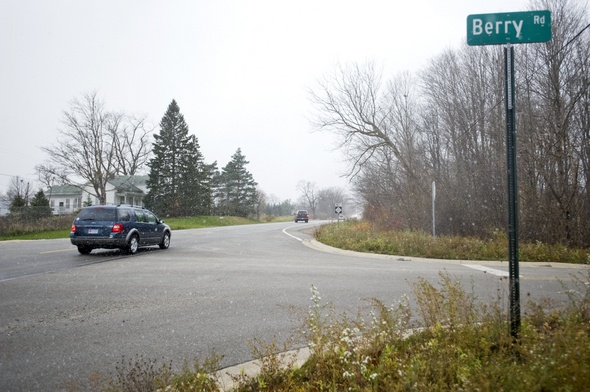
The intersection of Ford and Berry Roads in Superior Township is near the field where Mary Ann Hulbert's body was found in the morning hours of Jan. 7, 1987.
Joseph Tobianski | AnnArbor.com

Christopher Machacek
Courtesy of the state of Michigan
Christopher Machacek and Steven Stamper were just 16 years old when they picked up 13-year-old Mary Ann Hulbert in Stamper’s Ford Bronco from her Canton Township home, drove her to a field in Superior Township, blindfolded her and shot her to death because of the pregnancy scare.
The two boys were later tried as adults — after months of hearings to see if they should be charged as juveniles instead — and both were convicted of murder.
They’re both still in jail, where Machacek will stay for the rest of his life because he was convicted of first-degree murder. Stamper has the opportunity to be paroled because he was convicted of second-degree murder.
Their trial was about their crime. But today, Machacek also can be found among 358 prisoners in Michigan who were sentenced to life without parole for their roles in a homicide commited while they were teenagers.
In Michigan, all homicide suspects between 14 and 17 years old are charged as adults. If they are convicted of first-degree murder, the only allowable sentence is life without parole in prison with other adults. And as a result, Michigan has the second highest amount of juveniles between 14 and 17 years old sentenced as adults in the nation.
The ACLU has filed a federal lawsuit in Detroit, claiming life sentences for juvenile offenders are cruel and unusual punishment. According to the lawsuit, juveniles sentenced to life in prison are less developed than adults, spend more time in prison and have a better chance for reform than adults.
The ACLU wants all 358 of Michigan’s juveniles sentenced as adults to get parole reviews when they reach 21 and then repeat the reviews every five years after.
The United States Supreme Court agreed to take up the issue last week.
It's a statewide issue that was detailed over the past week in a special report on MLive.com.
According to that report, Deborah LaBelle, the lawsuit’s lead attorney, says she has met with about 100 of the inmates and corresponded with more than 300. She blames a “toxic combination” in Michigan of juvenile reforms, mandatory sentences and immature judgment she says puts minors at a disadvantage in adult courts.
“I see so many repetitive patterns that I find very painful, where someone is with an adult and the adult does the shooting and is clearly in control of this kid, and the adult manages to negotiate a fairly good plea deal,” said LaBelle, who represents the American Civil Liberties Union.
“Some are out now. And the juvenile who said, ‘I did something, but I didn’t hurt anybody myself,’ will now serve until they die.”
In the local cases, that scenario isn't always the case.
Machacek and Stamper are both 41 now and have been in prison since they were sentenced in October 1988, when they were 18 years old. Machacek is housed at the Lakeland Correctional Facility and Stamper is held at the Macomb Correctional Facility.

Steven Stamper
Courtesy of the state of Michigan
Machacek and Stamper were both arrested by Washtenaw County Sheriff’s Office detectives on Jan. 7, 1987 after they each gave statements implicating each other in Mary Ann’s murder.
Other juveniles who are serving life sentences for murders they committed in Washtenaw County are Trevor Brownlee, Bosie Smith, Antonio Espree and George Walker.
Espree and Walker, along with Martin Simms who was legally an adult at the time of the crime, were members of a gang affiliated with Young Boys Incorporated — the major source of drug trafficking in southeast Michigan in the 1980s. They were a part of a crew sent into Ypsilanti in December 1987 to expand their “organization” when they found unexpected push back from local criminals. Washtenaw County Prosecutor Brian Mackie called their crimes “simply a facet of doing business to them.”
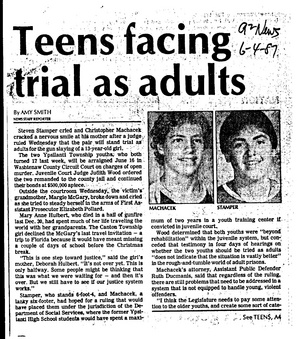
The story from the Ann Arbor News when a judge declared Christopher Machacek and Steven Stamper would stand trial as adults.
Courtesy of Washtenaw County Trial Court records
Brownlee was 15 years old in 1989 when he shot a sawed-off shotgun into a group of people, one of whom he suspected was about to pull a gun on him and his friends. He crippled one man and killed another and has become an advocate for juveniles sentenced to life in prison while behind bars.
Smith was at a party on April 13, 1992 when he got in a fight with an older, bigger man and lost. Smith left the party and went to a home where he had stashed a knife, retrieved the weapon and returned to the party. He called out the man who had beat him up and challenged him to come outside, where the older man began hitting him again before Smith stabbed him. The man died some hours later.
Smith was one of the original defendants named in the American Civil Liberties Union lawsuit against the state of Michigan last year.
The U.S. Supreme Court has heard cases related to juvenile lifers in the past, ruling in 2005 they could not face the death penalty and ruling in 2010 juveniles sentenced as adults could not face life in prison without the chance for parole. The cases in front of the court now could end the practice of mandatory life in prison for juvenile homicides.
Only two of Michigan's juveniles sentenced as adults to life in prison without the chance for parole have been released due to commutation of their sentences.
“The most pernicious myth about juvenile lifers is that they are all innocent,” Mackie said.
He says that's not in the case in the murder of Mary Ann Hulbert in December 1987.
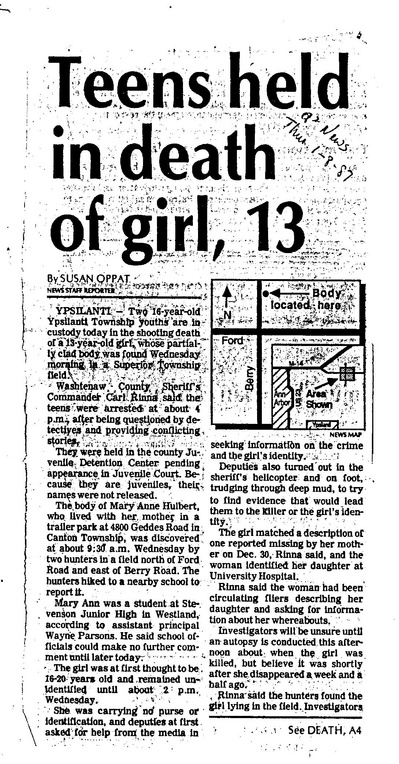
The first story from the Ann Arbor news on the murder of Mary Ann Hulbert.
Courtesy of Washtenaw County Trial Court records
Many of the people involved with the case have died or moved from the area, and could not be located for an interview.
But the case was well-documented due to its profile at the time.
According to court records, the teens were hanging out at Machacek's home on Dec. 30, 1986, when Mary Ann called and spoke to both of the teenagers.
Machacek and Stamper then left the home, dropped off Stamper’s girlfriend and then went to Stamper’s home. While they were there, they picked up two rifles that belonged to Stamper, put them in the back of the Bronco and drove to Canton Township.
They picked up Mary Ann at the entrance to a trailer park on Geddes, the last time she was seen alive by anyone other than Stamper and Machacek.
What happened next is a matter of debate between the two convicted murderers. Machacek told police Stamper drove them to a field in Superior Township near Ford and Berry roads. He said Stamper blindfolded Mary Ann, put her against a tree, shot at her six or seven times and then reloaded while Mary Ann attempted to run away, when he shot her dead. Machacek finished his statement by saying he and Stamper pulled Mary Ann’s body into a secluded area and left her there.
Stamper’s statement to police was much more detailed. He was played Machacek's statement and then, according to court records, told detectives to load up a fresh tape because he was going to tell his side of the story.
According to Stamper, the two boys believed one of them had gotten Mary Ann pregnant. Both of them had dated her in the past and there were rumors going around that one of them was the father of her unborn baby. Stamper said the two teens didn’t want to kill Mary Ann — they just wanted to scare her by shooting guns around her and induce a miscarriage.
Stamper said Machacek began yelling at Mary Ann after she got into Stamper’s Bronco, telling her she was not having his baby. Stamper told police Machacek made Mary Ann strip off her clothes while they were still in the car, parked in the field in Superior Township. The boys then blindfolded her, with everyone in the car laughing because Mary Ann thought they were playing a joke on her, Stamper said.
However, this was no joke — it was an execution. Stamper told police he and Machacek made Mary Ann get out of the car blindfolded and in her underwear. When Mary Ann complained about being cold, the boys allowed her to put some of her clothes back on. As she stood against the tree, she clutched a stuffed toy dog and told the boys her biggest fear was that the two teenagers would leave her in the field.
Stamper said Machacek then snapped and fired about 20 shots at Mary Ann, while Stamper fired his gun into the ground.
No matter who fired the shots, Mary Ann was dead at the age of 13. She was found by hunters in the field on Jan. 7, 1987 — a week after her mother had notified police she was missing. Investigators found her with between six and seven bullet holes in her body.
An autopsy revealed Mary Ann wasn’t pregnant.
Machacek and Stamper’s arrest set up about two years of controversial court hearings, a look at how Washtenaw County Sheriff’s Office detectives conducted their investigation of the murder and ended with the two teenagers getting the most severe penalty anyone in Michigan can receive for a crime.
After six months in juvenile court, Judge Judith Wood ruled both Machacek and Stamper would be tried as adults. She ruled that Machacek’s confession was illegally obtained, but Stamper’s confession was enough to make the decision on both 16-year-old boys.
She criticized the handling of the investigation, particularly Detective Lloyd Stamper’s decision to have a secretary modify the transcript of Machacek’s confession. Stamper, no relation to the teen, was eventually demoted to a desk position as a result of that decision.
“In my 13 years in practice as an attorney in the county, it is the worst investigation I have ever seen,” Wood said in court. “Detective Stamper violated just about every constitutional right that can be violated and then tried to alter the transcript of a taped confession. … This is not the first time a murder investigation involving this detective has been compromised and I hope it is the last.”
A number of court motions were filed in the period between spring 1987 and summer 1988 that led to the trials for Machacek and Stamper to not wrap up until September 1988, when juries found them both guilty — Machacek of first-degree murder and Stamper of second-degree murder. They were both sentenced to life in prison in October 1988.
Machacek, who appealed the case unsuccessfully after his conviction, is serving a life sentence without the opportunity for parole. Stamper is serving a life sentence, but will have the chance for parole. They were both sentenced by Washtenaw County Trial Court Judge Melinda Morris, who had taken over the case after Henry Conlin died in office in 1988.
As the issue of mandatory juvenile life sentences heads to the Supreme Court, experts are split on whether the law has been effective for Michigan.
Supporters of the initial reforms have mixed views on whether sending juveniles to prison for life has been effective.
State Rep. Burton Leland, a Detroit Democrat, thinks he and his colleagues made a mistake. He points to the growing prison population, which tripled from 1980 to more than 45,000 in 2009, and the Department of Corrections budget, which grew from $193 million in fiscal 1980 to $1.94 billion this year.
Even factoring in inflation, that’s nearly a fourfold increase.
“Now, 25 years later, I think locking youthful offenders up for life is ridiculous,” said Leland, who helped lead the reforms. “Life in prison should be reserved for Hitler.”
But Oakland County Sheriff Mike Bouchard, who helped lead the second round of reforms in 1996 as a state senator, said he would “absolutely” support them again.
“We’d seen a number of cases in Michigan and around the country where younger people, with a great deal of forethought and maliciousness, had carried out heinous crimes,” he said.
Kyle Feldscher covers cops and courts for AnnArbor.com. He can be reached at kylefeldscher@annarbor.com or you can follow him on Twitter
Reporters from affiliates of MLive.com contributed to this report.
Comments
Deborah Hulbert
Wed, Dec 26, 2012 : 9:46 p.m.
Life in Prison? Death penalty? I have lived for 27 years praying they will never get out on the streets. I have nightmares that they do and carry out their threat to get me next for helping to catch them.
Deborah Hulbert
Tue, Dec 25, 2012 : 2:08 a.m.
I am Mary Anne Hulbert's mother. I am spending Christmas 2012 strolling the net. I have been reading some of the comments here and must tell you it is over whelming to have this fear that the monsters who destroyed my life could be set free. Why would anyone want someone who is capable of taking a life just because they can on their streets. Mind Boggling!!
Bill Wilkins
Mon, Nov 14, 2011 : 7 p.m.
Personally I hope these two serve their entire sentences and are totally miserable every minute that they are in prison. The ACLU is no friend to justice . At least not anymore. I haven't read about the other 356 cases, but these two animals should never see a moments freedom. Not ever. Just sayin' T
Deborah Hulbert
Tue, Dec 25, 2012 : 2:10 a.m.
Amen!! Thank you so very much.
Marilyn Wilkie
Mon, Nov 14, 2011 : 6:29 p.m.
When you look at Christopher Machacek's PUBLIC Myspace page you see a smiling healthy person who says he has some college and sounds lonely. His college was paid for by the people of the State of Michigan. His punishment is certainly better than what he did to that 13 year old girl. <a href="http://www.myspace.com/263491507" rel='nofollow'>http://www.myspace.com/263491507</a>
Marilyn Wilkie
Mon, Nov 14, 2011 : 8:18 p.m.
Frustrated!, Please explain. Did you mean I have no clue what it is like to face and live life in prison? What does ASS-U-ME mean?
Frustrated!
Mon, Nov 14, 2011 : 7:36 p.m.
You have no clue...really. ASS-U-ME...you know the rest.
Berda Green
Mon, Nov 14, 2011 : 4:29 p.m.
all stories are so sad these kids today are going crazy lord have mercy
Deborah Hulbert
Wed, Dec 26, 2012 : 9:38 p.m.
This happened yesterday for me!!
MIKE
Mon, Nov 14, 2011 : 6:18 p.m.
"these kids today are going crazy" This happened close to 25 years ago.
Mike
Mon, Nov 14, 2011 : 12:26 p.m.
"Supporters of the initial reforms have mixed views on whether sending juveniles to prison for life has been effective. State Rep. Burton Leland, a Detroit Democrat, thinks he and his colleagues made a mistake. He points to the growing prison population, which tripled from 1980 to more than 45,000 in 2009, and the Department of Corrections budget, which grew from $193 million in fiscal 1980 to $1.94 billion this year." I support the death penalty, it would solve the overcrowding problem and save the taxpayers a lot of money. Why do we warehouse people who commit these heinous crimes? Obviously if you are going to spend the rest of your life in prison then there is no possibility of rehabilitation and becoming a productive member of society.
VamosAzul
Mon, Nov 14, 2011 : 9:36 p.m.
This is absolutely false. The average amount of time between when a death sentence is handed down and when it is carried out is about 15 years. There are a series of appeals that offenders are entitled to and they will not be executed without them. These appeals cost the state an extraordinary amount of money, as does keeping them on death row within prison. It is more expensive to execute someone than to keep them in prison for life. All of the reputable research points to precisely this conclusion. To suggest that the death penalty is a solution to overcrowding is completely false. The death penalty in this country is limited to only murderers - a very small percentage of the overall prison population. If you want to solve overcrowding, you need to address the people who are in prison for lesser crimes and who make up a much larger portion of the prison population.
Rork Kuick
Mon, Nov 14, 2011 : 6:24 p.m.
All reports I have ever read say that having death penalties wastes money, but people keep making up evidence for the reverse. Just search "death penalty money" and you'll get many hits, including an article earlier this year in the Economist, detailing states wanting to overturn their death penalties in order to save money. Try again.
Roadman
Mon, Nov 14, 2011 : 3:43 a.m.
Regarding life without parole sentences for teens, look at the case of Gary Fannon of Canton Township. Several months after his high school graduation at 18 years of age, he had a peripheral role in a cocaine delivery conspiracy. He was arrested and convicted under the drug lifer law, but nine years later had his conviction reversed due to the fact his trial counsel failed to raise a meritorious entrapment defense. He later sued the law enforcement agency that arrested him and settled out-of-court for the nine years of imprisonment he should have never had but for the police misconduct. Fannon's story received national coverage about the undue harshness of Michigan drug laws. Judges should have great discretion in sentencing in these cases of teens facing life imprisonment.
a2migrl
Mon, Nov 14, 2011 : 3:36 p.m.
The person you are talking about was 18, clearly an adult in the eyes of the law. He should have known better.
tinkerbell
Mon, Nov 14, 2011 : 5:01 a.m.
Sounds like you're an attorney
Mike
Mon, Nov 14, 2011 : 1:26 a.m.
Let's see. Two 17 year old have sex with a 12 or 13 year old girl. SInce a 12 or 13 year old can't consent, these two guys raped this girl. Then, when they thought one of them impregnated her during this one of several rapes, they put her up against a tree and murder her. What part of all of this does the ACLU see as socially redeeming behavior? Sounds to me like both of these animals are in a much better place than they deserve to be.
MIKE
Mon, Nov 14, 2011 : 1:08 p.m.
They were 16, not 17. She was 13, not 12. The facts are bad enough, there's no need to exaggerate them(which is one of the reasons the confession was thrown out).
Basic Bob
Mon, Nov 14, 2011 : 3:09 a.m.
Please reread the first sentence - the most CONTROVERSIAL and GRUESOME. These men are the perfect counter-argument against leniency, and the parole board could continue their sentences indefinitely. However, there are 356 other boys and girls who have been convicted as adults - some may deserve consideration for parole. Is that too much to ask?
Marilyn Wilkie
Mon, Nov 14, 2011 : 1:19 a.m.
Fortunately, The U.S. Court of Appeals denied an appeal by Machacek in 2000. <a href="http://www.ca6.uscourts.gov/opinions.pdf/00a0177p-06.pdf" rel='nofollow'>http://www.ca6.uscourts.gov/opinions.pdf/00a0177p-06.pdf</a> .
Soccer Mom
Mon, Nov 14, 2011 : 1:19 a.m.
This will be a completely unpopular opinion, however, it is morally reprehensible that we hold children at the same level of responsibility as we do adults. Clearly the decisions an individual makes at the age of 15, in most cases, would not be the same decisions an individual would make at the age of 35. The idea that a juvenile should be locked up for life with no chance of parole is heartbreaking.
a2migrl
Mon, Nov 14, 2011 : 3:40 p.m.
You are considered and adult at 18. Would you make the same decisions at 18 and 35? Where do you draw the line? I know I would make different decisions.
Mr. Ed
Mon, Nov 14, 2011 : 5:08 a.m.
God sets the age at 7.
Jon Saalberg
Mon, Nov 14, 2011 : 1:13 a.m.
As a parent of two teenage boys, I can attest to the absurd behavior that teens often exhibit. It has only come to light in the past 15 years or so that a teenager's frontal lobe is not fully developed. How relevant to this story? It means that at times teens can seem to behave rationally and at other times, behave so irrationally, it's hard to believe they can get through a day. Some people are quite adamant about demanding justice, revenge, etc., while disregarding the fact that we are talking about kids, not adults. The behavior may SEEM to be adult, but the mind is not an adult mind and does not function in an adult manner. This is not to say that nothing should be done in a case like this - only that rehabilitation should be seen as an alternative rather than many years of incarceration. If it makes you happy to incarcerate a kid for decades and cost the state millions of dollars, great. In the long run, rehabilitation should be seen as an alternative. You can argue against the truth of physiology all you want - the reality is teens are not adults and do not possess an adult's ability to make rational decisions.
tinkerbell
Mon, Nov 14, 2011 : 5 a.m.
Why then are teens allowed access to firearms?
Dirtgrain
Mon, Nov 14, 2011 : 2:20 a.m.
I don't think what they did to her was just a problem of irrational thinking; there is something else wrong there.
Marilyn Wilkie
Mon, Nov 14, 2011 : 1:25 a.m.
I do not support the death penalty. I do support life imprisonment for murder by anyone. Studies can show anything the designers want them to say. Our world is full of people making excuses for the actions of others.
10dz
Mon, Nov 14, 2011 : 12:43 a.m.
the ACLU is full of it. They can go to hell, right with the criminals they defend.
Basic Bob
Sun, Nov 13, 2011 : 11:53 p.m.
So the story says Steven Stamper will eventually be eligible for parole. Can someone clarify when he will face the parole board?
Frustrated!
Mon, Nov 14, 2011 : 2:47 p.m.
He was originally eligible for parole until he tried to escape and then was given life, no parole. He has no "out" date!
KINGofSKA
Sun, Nov 13, 2011 : 11:36 p.m.
I would never want to talk the streets anymore knowing what these men are capable of.
Roadman
Sun, Nov 13, 2011 : 11:22 p.m.
I also think an important facet of this article that needs to be addressed is the judicially-recognized improprieties by the Washtenaw County Sheriff's Department. While Prosecutor Brian Mackie has been quick to prosecute in certain cases, he has not been very aggressive in going after police misconduct. The Lee brothers case in West Willow was a perfect example where the FBI had to obtain a federal civil rights indictment against WCSD members in order for justice to be done. One deputy pled guilty to a felony in that case and a second was acquitted. Brian Mackie's tenure as county prosecutor has been marked by questionable prosecutorial decisions and sub-par results. I think the efforts of the ACLU are warranted and note only anly about 2% of all requests for United States Supreme Court review are granted for full consideration - so the justices of the high court clearly saw some arguable merit in the prisoners' cases. The ACLU should be congratulated for their attention to the interests of these prisoners.
Roadman
Sun, Nov 13, 2011 : 10:08 p.m.
Michigan is one of only a very few jurisdictions that have non-parolable life sentences as a mandatory sentence for first-degree murder. I wish to point out that this is true for not only premeditated murder but also "felony murder" which is also in the first-degree as well. Felony murder means that a death has resulted from the commission of certain enumerated felonies contained in the statute. These felonies have been amended over the past four years by the Michigan Legislature and have added such crimes as child abuse and torture. To illustrate the harshness of first-degree felony murder cases I will cite two. In one a man in his nineties won at a Detroit casino and was handed a ticket to cash in. A man snatched the ticket out of the hand of the elderly chap and ran away; while chasing the ticket snatcher, the old man suffered cardiac arrest and died. The ticket robber was charged with first-degree felony murder and eventually received a 5-15 year sentence to manslaughter under a plea bargain despite the fact he had no intent to harm anyone. In another case, a young man was accused of punching a female friend in his home several times in the head; she became unconscious and died due to brain trauma. The young man was charged under the "torture" amendments to the felony murder statute and was convicted of tha charge and received the mandatory sentence of life without parole despite the fact there was no proof needed that he intended to kill anyone. Many of those convicted of first-degree felony murder have had no specific intent to kill anyone and cannot be said to deserve life wthout parole, especially given their youth and immaturity, however the mandatory nature of the law allows no discretion in sentencing to the judge in the case. Several years ago, the Michigan Legislature accepted criticisms from many judges and amended its original enactment to allow parole to those convicted under the "drug lifer" statute. This law needs to be
Roadman
Sun, Nov 13, 2011 : 10:33 p.m.
(Continued from original post) ......amended as well.
15crown00
Sun, Nov 13, 2011 : 8:47 p.m.
they are where they belong in my opinion. "do the crime,do the time"
rosewater
Sun, Nov 13, 2011 : 7:10 p.m.
In or out of prison, the taxpayer is going to end of supporting them so just leave them there. That way it is safer for everyone.
RoboLogic
Sun, Nov 13, 2011 : 6:55 p.m.
Right where they belong. No review needed.
tim
Sun, Nov 13, 2011 : 5:49 p.m.
I've seen these types of article lately in more than one news papers----- so what's the deal? Are we being primed for the release of murderers from prison ? The whole thing seems lake a public relations campaign.
Julie Baker
Sun, Nov 13, 2011 : 6:36 p.m.
@tim: It's part of a statewide series on this juvenile lifers law. AnnArbor.com's sister publications, including the Grand Rapids Press, Saginaw News, etc., all ran stories on the issue. A link to the statewide coverage is embedded in the body of the story. Here it is: <a href="http://www.mlive.com/news/index.ssf/2011/11/juvenile_lifers_this_digest_he.html" rel='nofollow'>http://www.mlive.com/news/index.ssf/2011/11/juvenile_lifers_this_digest_he.html</a>
actionjackson
Sun, Nov 13, 2011 : 5:43 p.m.
When an eighth grade girl is tortured in an open field there is no reason to ever let the perpetrators walk free again. This isn't bad behavior time. It is premeditated murder with no concern for human life at all. Why on earth should they ever be given freedom is beyond me.
PBo
Sun, Nov 13, 2011 : 5:11 p.m.
I'm wondering if this would have been State Rep. Burton Leland's 13 year old daughter up against a tree in 1987 if he would've felt the same way. I'm for prison reform, but it seems that every case I hear about, the victims are all but forgotten.
15crown00
Sun, Nov 13, 2011 : 9:10 p.m.
you can bet he wouldn't have but that's the way our politicians are today
JMA2Y
Sun, Nov 13, 2011 : 4:55 p.m.
This is the best and the most complete reporting that A2.com has done since they began. Could we please have more of this type of complete rendering of a story?
Old Salt
Sun, Nov 13, 2011 : 4:28 p.m.
Will Someone please tell the ACLU that murder is also cruel and unusual punishment
RJA
Sun, Nov 13, 2011 : 4:28 p.m.
Reading this story as I drink my first cup of coffee this morning made me rather sick. I do remember the story. I often wondered if this 13 yr. old had talked to her mother first, gone to a doctor, found she was NOT PG, before telling these guys anything would the story have turned out different than this. I could care less now what happens to these guys.
Wolf's Bane
Sun, Nov 13, 2011 : 4:11 p.m.
Every time I read something like this: "The ACLU has filed a federal lawsuit in Detroit, claiming life sentences for juvenile offenders are cruel and unusual punishment." I start to wonder why we even have a judiciary? Why even bother prosecuting, sentencing offenders, and incarcerating them if after a few years lawsuits are filed trying to reverse the sentence(s). I was a teenager during this trial and I remember it being a solid case. A horrific case.
Wolf's Bane
Mon, Nov 14, 2011 : 2:05 p.m.
15crown00 , what's PC mean to you?
15crown00
Sun, Nov 13, 2011 : 9:08 p.m.
because the ACLU are a bunch of people who believe in political correctness. how misguided is that?
Tru2Blu76
Sun, Nov 13, 2011 : 4:10 p.m.
There are some actions which are so far outside the limits of what we call "human" that they disqualify the perpetrator(s) from any consideration, sympathy or compassion from the rest of us. In cases like the killing of Mary Ann Hulbert, forgiveness is not divine: it's plain stupid. I remember reading the killers' description of what they did to her at the time, I felt cold all over and deep down. It was like a nightmare. It still affects me because I thought about what this girl must have thought and felt in her last minutes of life and while they slowly and methodically shot her to death. The ACLU's attempt to undo justice in this case leaves me equally cold. I pray that their misguided effort fails. I do not consider permanent incarceration of teen killers cruel and unusual punishment: it's fit punishment and something that must stand as an example of our thoughts and feelings about such murderers. That - is what humanity must stand for.
a2citizen
Sun, Nov 13, 2011 : 4:06 p.m.
"Life in prison should be reserved for Hitler." said Rep. Leland. Since Leland brought him up...I wonder how Hitler would have handled these two criminals?
VamosAzul
Mon, Nov 14, 2011 : 9:26 p.m.
Ah yes, let us construct our criminal justice system as Hitler would have done. Sounds like a brilliant plan.
Ming Bucibei
Sun, Nov 13, 2011 : 5:54 p.m.
Hitlesque riminals should always get death !! as qadaffy &* sadam h!! sic semper tyrannis!! Ming Bucibei
Kai Petainen
Sun, Nov 13, 2011 : 3:41 p.m.
i am a fan of forgiveness... but.... this was an execution. i don't care how old they were. age is not a factor. they executed someone. leave them in jail.
15crown00
Sun, Nov 13, 2011 : 9:05 p.m.
right
Dirtgrain
Sun, Nov 13, 2011 : 3:34 p.m.
She was holding a teddy bear when they shot her? It's heinous what they did, but that detail, wow. There is no redeemable value in these two murderers, and I cannot sympathize with them at all. To the reporter, could you find out more about what was done wrong in the investigation? What was wrong with how they got the one confession?
Dirtgrain
Sun, Nov 13, 2011 : 9:03 p.m.
Thanks.
Kyle Feldscher
Sun, Nov 13, 2011 : 5:42 p.m.
Dirtgrain- Through my reading of court files, there was quite a bit of detail on this that really could have made its own, separate story. The issue here was the debate over whether Stamper and Machacek were under arrest when they made their confessions and if they should have been read their Miranda rights. The two juveniles were at the WCSO's station for hours before they were read any rights. Officers said this was because they were not being treated as suspects, they were only witnesses, which made reading them their rights unnecessary. At the same time, police argued they were there of their own free will and could have left at any point. Before the confessions were made, Machacek and Stamper were both read their Miranda rights, which was the first point they became suspects, according to court records. While staying under the character limit for comments, that's probably the best way I can sum it up.
Homeland Conspiracy
Sun, Nov 13, 2011 : 2:26 p.m.
We does the news media always feel the need to pick a wounds until they bleed again & again & again.
average joe
Sun, Nov 13, 2011 : 2:23 p.m.
I don't think that a burgeoning prison budget is a very good reason to let 358 convicts out early, as Mr. Leland indicates. Find other 'areas of waste' in the budget to eliminate first. And why is it that the ACLU isn't concerned about the victim's rights?
jns131
Mon, Nov 14, 2011 : 12:14 a.m.
Didn't I hear California is letting out 500 or more because they are broke? I also heard that for pedophiles? Get this, if we let you out? Leave the state and never come back. O nice, isn't it?
Mr. Ed
Sun, Nov 13, 2011 : 2:02 p.m.
The two men are in the right place and they need to stay in prison. I would not feel safe with theses two men walking free. They planed and took a human life.
EyeHeartA2
Sun, Nov 13, 2011 : 2 p.m.
After reading the article, I am more convinced than ever that these people need to stay behind bars until they rot.
clara
Sun, Nov 13, 2011 : 1:56 p.m.
"As the issue of mandatory juvenile life sentences heads to the Supreme Court, experts are split on whether the law has been effective for Michigan." Well, have any of the 358 prisoners in Michigan committed another murder? If not, It looks like it is effective.
smokeblwr
Sun, Nov 13, 2011 : 1:39 p.m.
I don't care how old they were, the fact they had the capacity to commit these horrible crimes is evidence they can't be fixed and should not be allowed to mix with the public.
15crown00
Sun, Nov 13, 2011 : 9:04 p.m.
the killers knew what they were doing.the politician is playing politics.
15crown00
Sun, Nov 13, 2011 : 8:58 p.m.
You are completely absolutely right.
antikvetch
Sun, Nov 13, 2011 : 1:30 p.m.
"Now, 25 years later, I think locking youthful offenders up for life is ridiculous," said state Rep. Burton Leland, who helped lead the reforms. "Life in prison should be reserved for Hitler." It appears that Rep. Leland has discovered a miracle cure for murderous sociopathic tendencies. Bravo for him! I'm guessing it involves lots and lots of hugs.....
Griffin
Sun, Nov 13, 2011 : 1:27 p.m.
Simple....Michigan needs....and I'll say it.....'the death penalty'. Some people are just not long for this earth and our IN-justice system along with our tax dollars give these animals room, board, 3 squares and medical care.. These clowns would have had 20 yrs. to appeal, then the walk. The victims never really receive justice as long as the American Criminal Liberal Union exists.
jns131
Mon, Nov 14, 2011 : 12:12 a.m.
There was petition that go on the ballot with enough sigs to make it a voting issue. Sadly it got voted down. We really need the death penalty in this state. Otherwise, build a nice large prison up in the UP and leave em there.
johnnya2
Sun, Nov 13, 2011 : 9:04 p.m.
Execution is not about justice, it is about revenge. Once the state gets in the business of premeditated murder, they are criminals as well. It leads to MORE killers. The law is clear that you can not murder somebody for justice, ONLY to protect yourself or family. Tell me this oh wise one, how does executing these people help bring the victim back? How does it provide "justice". It only provides revenge.
eagleman
Sun, Nov 13, 2011 : 5:38 p.m.
Execution is not about prevention, but about justice. How is it fair for these people to continue to breath air when they robbed another of being able to do so? In my eyes killing these men by doing unto them what they did to Mary Ann Hulbert.
johnnya2
Sun, Nov 13, 2011 : 1:57 p.m.
Other than that whole Supreme Court saying those convicted as minors CAN NOT be executed. The states with the highest murder rates have the death penalty.
bunnyabbot
Sun, Nov 13, 2011 : 1:23 p.m.
Am I suppose to feel sorry for them because they were only 16 at the time and had thier whole life ahead of them and now it has been taken from them? What about Mary Ann? she was only 13 at the time, she had her whole life ahead of her, that was taken away from her. Is the fact that she is dead and has less of a "voice" than the two living losers that shot her? If there was a question of mental capacity that would be one thing, but it took two years for them to decide if they should be tried as adults, and obviously that won out. Their lives and freedoms and rights are not more important than Mary Anns.
EyeHeartA2
Sun, Nov 13, 2011 : 10:06 p.m.
Yeah, I don't know. Somehow I made it through my teens without ever stripping a girl naked, tying her to a tree, blindfolding her and shooting her a dozen times. If these guys couldn't, they are right where they belong. Sorry, no sympathy for the devil. This wasn't even an accident. This was a premeditated as it gets. How would you feel about this if it was your 13 year old girl?
johnnya2
Sun, Nov 13, 2011 : 8:59 p.m.
No, they are not predators. They killed somebody, but were not fully developed mentally. The law is designed to know that people of that age do not have the ability to make decisions on their own. The state does not allow them to drink alcohol, drive a car with an unrestricted license, join the military, or sign a contract. IF your opinion is, you are the same person and would react the same way to things at 41 versus 16, then that really says more about YOU then about them.
EyeHeartA2
Sun, Nov 13, 2011 : 2:03 p.m.
If "having it both ways" means protecting innocent people from preditors who mean to do them harm, then yes, guilty as charged.
johnnya2
Sun, Nov 13, 2011 : 1:55 p.m.
Actually, in EVERY other situation the law defines those under 18 as having a lessor mental capacity. If you entered into a contract with a minor it can be rescinded because they do not have the capacity to enter into a contract legally. If a 15 year old made the decision to have sex with a 40 year old we automatically consider the 40 year old a criminal due to lack of capacity by the teenager. This is the "law and order" crowd trying to have it both ways.
Jimmy McNulty
Sun, Nov 13, 2011 : 1:13 p.m.
"The ACLU wants all 358 of Michigan's juveniles sentenced as adults to get parole reviews when they reach 21 and then repeat the reviews every five years after." I'm sure the parents of 13-year-old Mary Ann Hulbert wish for their daughter back every day. How is it fair to parole a premeditated 1st degree murderer in this case?
jns131
Mon, Nov 14, 2011 : 3:01 p.m.
I know that silly. I was quoting another article that called him Reagan's assassin which is what he is. An assassin.
tinkerbell
Mon, Nov 14, 2011 : 4:47 a.m.
Attn jns131: Reagan was not assassinated. He died a natural death a few years ago.
jns131
Mon, Nov 14, 2011 : 12:11 a.m.
They will be on the parole hearing telling the parole board, no. No release. They have that option. That is why a lot of famous prisoners are still in prison to this day. Reagan's assassin is asking for parole to be with his dying mother. Ah, no. Sorry but you stay where you are.
pseudo
Sun, Nov 13, 2011 : 1:11 p.m.
oh, and I should probably note that I think a major overhaul is needed. It is this story that makes me question if its needed.
pseudo
Sun, Nov 13, 2011 : 1:08 p.m.
this is one of those stories that makes me nuts because is points to some faults in a law and then uses a terrible example that doesn't support the posits of faults and at least by my reading, confirms that the laws have probably saved us more crime.. These two, with the planning they BOTH did: talking it through, getting the guns, having her strip, shooting her so many times and hiding her body. I'm good with where they are, even to this day. Less good that one will be up for parole. It would have been much better for this reporter to use one of the examples where the adult who controlled the kid got off instead this example. And example like that would have made the point. What I get from this story is that there may be some tweaks needed like less mandatory sentencing but a complete overhaul based on high prison population and cost when looking at just 358 cases while using this example? This story does more to confirm that these laws are right on than say a major overhaul is needed.
Craig Lounsbury
Sun, Nov 13, 2011 : 12:36 p.m.
They executed a 13 year old girl. Release them if and when they are terminally ill with days to live.
jns131
Mon, Nov 14, 2011 : 3:04 p.m.
So you want a victory parade for these felons getting out of prison with days or weeks to live? I really don't want it in my neighborhood. As for the oil? I really don't think we got a good bargain out of that one. We had to go in their, use their oil to knock out a tyrant.
RudeJude
Mon, Nov 14, 2011 : 1:48 p.m.
The Pan-Am Bomber release was a business trade: a homecoming victory parade for a terrorist in exchange for Libyan oil. <a href="http://www.nbcnewyork.com/news/local/BP-Now-Facing-Questions-Over-Pan-Am-Bombers-Release-98265824.html" rel='nofollow'>http://www.nbcnewyork.com/news/local/BP-Now-Facing-Questions-Over-Pan-Am-Bombers-Release-98265824.html</a>
Craig Lounsbury
Mon, Nov 14, 2011 : 3:02 a.m.
"The Pan Am bomber was released 2 years ago with only days to live." actually he had "weeks" to live and his release had a lot of politics behind it. So the weeks to live was not much of a medical prediction at all.
jns131
Mon, Nov 14, 2011 : 12:09 a.m.
The Pan Am bomber was released 2 years ago with only days to live. He is still kicking around Libya as we speak. So, no. No release under any circumstance. Let em rot in prison. You do the crime do the time. Nuff said.
15crown00
Sun, Nov 13, 2011 : 9 p.m.
leave them in jail until they take their last breaths.
LA
Sun, Nov 13, 2011 : 4:11 p.m.
I do not think that is a good reason to release them.