

A primer on police and emergency vehicle sirens
Do sirens in the distance ever stir you? There is seldom a time in a city like New York when you don’t hear a siren, unless it is drowned out by the cacophony of horns that are always honking. Do you ever say a silent prayer for whoever needs those sirens or for those answering the call?
Perhaps the sound of sirens just make you cranky if your windows are open and you have to sleep — soon that won't be a problem until spring.
Many times on midnights you may not hear any sirens, although emergency vehicles on calls (or “jobs”) are crisscrossing the city. There is not much traffic, and it is sometimes unnecessary to wake the whole city even though, technically speaking, sirens should always be used by firetrucks and ambulances.
Emergency vehicles use their sirens to clear traffic in front of them in order to get where they are going as quickly as possible in an emergency. Fire apparatus and ambulances must use their sirens whenever they activate their emergency lights, but police cars do not need to use their sirens if they are responding to a possible crime in progress.
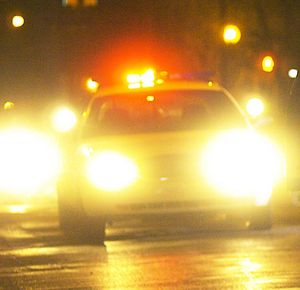
The other more specialized sirens on current electronic sirens include “HiLo” (which sounds like a European siren), “Phazer” (which sounds like a high pitched ray gun — and must have been named by a Trekky) and the “Air Horn” (which hopefully sounds like an 18-wheeler and commands the same respect).
Certain sirens work in certain settings better than others. Yelp is often used in downtown areas because it bounces off tall buildings and ricochets around city streets. It wakes people up and hopefully slows them down and gets them looking around. The downside of yelp bouncing off buildings is that it is hard to locate precisely where the siren is coming from.
These more specialized sirens are also used at intersections or to arouse the attention of the most comatose, inattentive or distracted drivers. I am amazed that some of the drivers with car stereos equipped with massive subwoofers can hear a siren at all. Perhaps they rely more on optical stimuli provided by new LED toplights and the traditional million candlepower spotlights.
Sirens are also used as a tool by police officers. Officers tend to go very loudly to “jobs” where they are trying to convey to the victim to “hold on help is on the way!” This can be anything from a car crash victim to an officer who needs help.
From experience there is no better sound when you are in trouble than multiple sirens in the distancem, then V-8 engine sounds with siren, then tires squealing, engines screaming, sirens… and then, thank God, car doors opening — The Cavalry Has Arrived!
Sometimes when responding to a crime in progress, stealth is the order of the day. When far away, top lights and spotlights are used, but not the siren. If far enough away, a quick “Whoop whoop” may be used to clear an intersection; otherwise an officer must rely on the emergency lights and manually operated spotlight to get motorists’ attention.
It can sometimes be rather busy “running a signal” — juggling the steering wheel (most important), radio microphone, exterior spotlight and siren switch/buttons while listening to the dispatcher, negotiating and navigating to the “job.”

It is especially frustrating running a signal while responding to calls when on the other side of the expressway. Sometimes you have to drive by the people who need your help in order to find the next available turnaround. The emergency vehicle operator feels as helpless as the person watching the flashing lights seeming to pass them by.
Sometimes a call for service is cancelled in the midst of a run. If you every see an emergency vehicle screaming through traffic and then shutting the lights down and merging into traffic, the operator was not joyriding. Sometimes calls like alarms are verified as false, or the first person on the scene of a traffic crash finds there are no injuries and thus no emergency.
Remember if you see an emergency vehicle or hear a siren, you must pull to the right as far as possible and stop unless otherwise directed by a police officer.
Lock it up, don’t leave it unattended, be aware and watch out for your neighbor.
Rich Kinsey is a retired Ann Arbor police detective sergeant who now blogs about crime and safety for AnnArbor.com. He also serves as the Crime Stoppers coordinator for Washtenaw County.
Comments
snapshot
Sat, Oct 29, 2011 : 10:56 p.m.
Rich, yielding and being aware of emergency vehicles should be a given with drivers. Unfortunately it's not but I have another question for you. I'm wondering why you never write about the "criminal cops" like the Romulus fiasco, or the New York fiasco, or the New Orleans fiasco, or any one of the many cop problems that occur daily across the U.S.? I'd like to be more informed on what appears to be a national police crisis affecting the authority and credibility of all police forces.
f4phantomII
Fri, Oct 28, 2011 : 8:59 p.m.
I get goose bumps when the fire trucks use their Federal Signal Q sirens.
Gordon
Fri, Oct 28, 2011 : 2:04 p.m.
Seems that most of the accidents or near misses are caused by those not using mirrors or paying attention. When one drives their universe has to be more then the edges of their car. I see too many drivers who have no situational awarness of the world around them. In the need to be careful they go slow thorough a light not realizing they holding up others by their over caution. Creating frustration is as bad as reckless driving. Those same un-aware drivers hear siren and stop. Particularily problematic in downtown areas where the sound requires concentration and visual clues as to where the vehicle maybe coming or going. Awarness comes from practice and more drivers require practice to get over the concern for their own universe.
A2comments
Fri, Oct 28, 2011 : 11:28 a.m.
If the law doesn't require the during siren when going against a light, something is wrong. Back in the early 80s, we witnessed HVA passing a line of traffic with lights on but no siren. The front car turned left, having no knowledge of an ambulance approaching silently from the rear, and was struck quite severely by the ambulance. Not only did the ambulance falsely claim they had their siren on, but they friendly bend out their damage before police arrived, I stopped them. As a former volunteer firefighter in PA, we were taught to always run the siren when approaching an intersection, regardless of whether we had the light or not.
Ron Granger
Fri, Oct 28, 2011 : 1:51 a.m.
I'm pretty sure my neighbor's dog can imitate each one of those.
RJA
Thu, Oct 27, 2011 : 7:09 p.m.
My own personal thing is listen, If I am stopped at an intersection and can't move, I stay stopped. If I can move to the right side of the road, or even off the road I do and stay (stopped) until all is clear. When I hear the siren, and my light turns green to go, I stay stopped and look for the emergency auto. Respect them, they may be going to save a life, and it could be a family member or someone you love dearly.
anti-thug
Thu, Oct 27, 2011 : 5:23 p.m.
I'm board , i went to hear story of 1970's organized crime in Ann Arbor, back when ann arbor had the highest crime rate in the state of Michigan .<a href="http://oldnews.aadl.org/node/84036" rel='nofollow'>http://oldnews.aadl.org/node/84036</a>
Leah Gunn
Thu, Oct 27, 2011 : 4:04 p.m.
I enjoy your colums, Rich. We were visiting in New York City ecently, and they have a new ordinance - No Honking! Signs are posted warning that there is a $350.00 fine. The city is remarkably quiet.
Mike
Thu, Oct 27, 2011 : 3:33 p.m.
Rich, Is it appropriate say to run a siren back to your home when you forget your luggage on the way to the airport?
RunsWithScissors
Thu, Oct 27, 2011 : 12:59 p.m.
Rich, What are the guidelines for blowing through an intersection/red light? Twice I've witnessed a patrol car blasting through a large intersection with lights flashing but no siren. In one case it caused a rear-end collision when one driver had to brake hard to avoid hitting the patrol car. The driver behind that car piled into the back of the first one. In the other case, the officer nearly hit a bicyclist in the crosswalk. (Talk about an adrenalin spike - I was scared to pieces for the cyclist.) Both situations, in my opinion, warranted the use of sirens since the officer was entering the intersection against a red light. A friend of mine says that sirens are only used for specific "codes" and doesn't have anything to do with going through a red light. Can you clear this up?
jjc155
Thu, Oct 27, 2011 : 2:37 p.m.
@runs, its gonna vary by dept per their policies. I am not aware of any state statute that regulates siren use by police. However I have never seen a policy that did not including using "due caution" while going through an intersection against the light. I always come to a complete stop (siren on or not) and make sure that ALL traffic is stopped (eye contact with the driver is a great way to know that they know what is going on, but that does not always happen). That said, there are certain calls that you DO NOT use your siren while enroute. Bank robberies/bank alarms are the classic example. The use of sirens enroute to a call like that can quickly turn a robbery into a hostage situation when the bad realizes that the police are blasting down the street to the bank. You can extrapolate that to other calls suchas home invasions in progress, business robberies/robbery alarms, panic alarms at a residence etc. Hope this kinda answers your questions.LOL
Tom Teague
Thu, Oct 27, 2011 : 12:45 p.m.
For all the criticism of local drivers on these comment pages, with few exceptions drivers here actually pull over and stop when an emergency vehicle approaches. For a quick compare and contrast, drive in Atlanta where drivers seem to equate emergency lights and sirens with the green flag in a NASCAR race.
Nerak
Thu, Oct 27, 2011 : 12:26 p.m.
When my daughter was very small, she was frightened the first time she heard the loud sirens. I quickly told her that police cars or fire trucks needed to rush somewhere to help someone who really needed it and had to warn other drivers to get out of the way. So from then on when she heard a siren she would say to me, "Someone needs help, Mom!" And she wasn't scared anymore.
Jon Saalberg
Thu, Oct 27, 2011 : 10:57 a.m.
It must be ever more frustrating for first responders - people seem blissfully unaware that when an emergency vehicle approaches you are supposed to pull to the curb or and/or stop. I guess it's all those "extracurricular" activities that keep people busy doing anything but driving - smoking, eating, talking on cell phones, texting (illegal, but I see people doing it while driving every day) - that make it hard for people to pay attention to driving, the real reason for being behind the wheel.