

DDA's contribution toward Ann Arbor Connector study leaves $30k for city to pay
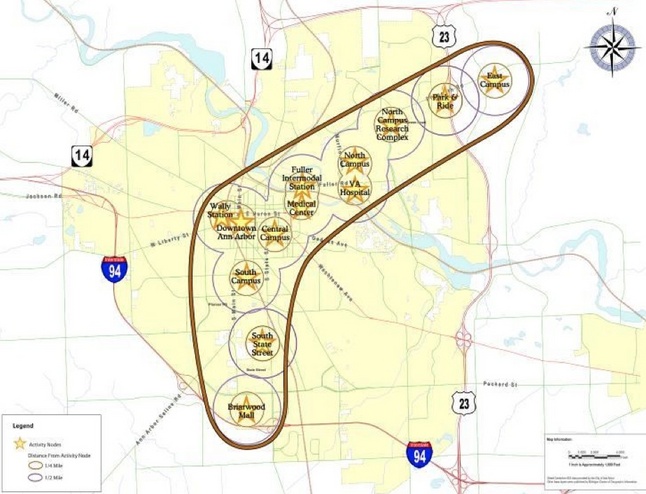
The Ann Arbor Connector project is focused on determining new transit options for a boomerang-shaped area that extends from northeast Ann Arbor, down through the area along Fuller Road where the city is planning a new train and bus station near the U-M medical complex, through Central Campus and downtown, and then south along State Street to Briarwood Mall and Interstate 94.
Image courtesy of URS Corp.
The DDA board voted 10-0 on Wednesday to approve $30,000 in funding for the second phase of the Ann Arbor Connector study, which is looking at options for bus rapid transit, light rail, streetcars and an elevated system such as a monorail to meet Ann Arbor's future transit needs.
The Ann Arbor City Council has been debating whether to pay $60,000 for the second phase of the study, but now that the DDA is paying half that amount, council members will be debating a $30,000 contribution when the funding request comes back to them on Oct. 15.
The city has been working with the Ann Arbor Transportation Authority, DDA and University of Michigan on the project since 2009.
The four parties involved completed a feasibility study last year that concluded an advanced transit system for Ann Arbor is technically feasible and could take the form of bus rapid transit, light rail or an elevated automated guideway system. The study also found higher-capacity service is needed in the core between the U-M North Campus and Central Campus and downtown.
The AATA has been awarded a federal grant for $1.2 million of the cost of the next phase of the project, which includes an alternatives analysis to take a closer look at the options for a high-capacity transit link from northeast Ann Arbor through downtown and down to Briarwood Mall.
The AATA is putting up $90,000 in local matching dollars. U-M has committed $150,000, and the city was asked to pay $60,000, but the City Council so far hasn't agreed to pay anything.
Mayor John Hieftje, who also serves on the DDA's governing board and participated in Wednesday's vote, has said he hopes fellow council members will "just show a little bit of vision."
According to the city's staff, the DDA previously communicated that it didn't have money to contribute toward the second phase of the project given its current financial situation.
DDA board member Roger Hewitt said on Wednesday the DDA can pay half of the $30,000 this year and half next year, taking the money from its parking fund budget. He noted the DDA's commitment of funding is contingent upon the City Council's approval of its share for the alternatives analysis.
"We want to be in lock step with what City Council is doing, and if they view this as not an appropriate use of public funds, so be it," he said.
Hewitt said investing in transit is beneficial to downtown Ann Arbor because it helps get cars off the streets and out of the parking structures.
"It's rare that we get a chance to partner directly with the university, as well as AATA, and I think this offers an excellent opportunity for us," he said.
The city and DDA each contributed $80,000 during the first phase of the Connector study. The AATA paid for half of the $640,000 price tag for the first phase and U-M contributed $160,000.
"Clearly the university is a huge benefactor of this with 50,000 people moving back and forth between the campuses," said DDA board member Sandi Smith. "So I think the proportions are right."
Ryan J. Stanton covers government and politics for AnnArbor.com. Reach him at ryanstanton@annarbor.com or 734-623-2529. You also can follow him on Twitter or subscribe to AnnArbor.com's email newsletters.
Comments
snapshot
Fri, Oct 5, 2012 : 6:50 a.m.
Hey guys, this is all city money you're talking about. The DDA needs to go away and city council and the mayor need to step up and start governing. First order of business should be to start the process to eliminate the DDA and put control of our tax dollars back into the hands of "elected" officials.
brimble
Thu, Oct 4, 2012 : 3:21 a.m.
Good money after bad... down a hole.
a2grateful
Wed, Oct 3, 2012 : 9:27 p.m.
So much for the DDA charter provision whereby DDA funds may only be spent on projects within the DDA district. . .
Vivienne Armentrout
Wed, Oct 3, 2012 : 10:57 p.m.
Actually, the last charter revision said that they could spend funds outside the district. They have done this a number of times. For example, they contributed to WALLY commuter rail and Near North housing development.
Dog Guy
Wed, Oct 3, 2012 : 9:14 p.m.
Do DDA /art/historical/AATA and other commissions constitute mayoral Dissociative Identity Disorder or just slushfunding?
Top Cat
Wed, Oct 3, 2012 : 8:41 p.m.
Lots of "funds" and all sorts of money slopping around. Kind of a Kwame approach to local fiscal management.
Brad
Wed, Oct 3, 2012 : 8:05 p.m.
It's all essentially taxpayer money whether it comes from the "city" or the DDA. Same people pulling the strings for both.