

Debate over public art continues as Ann Arbor City Council postpones decision on funding
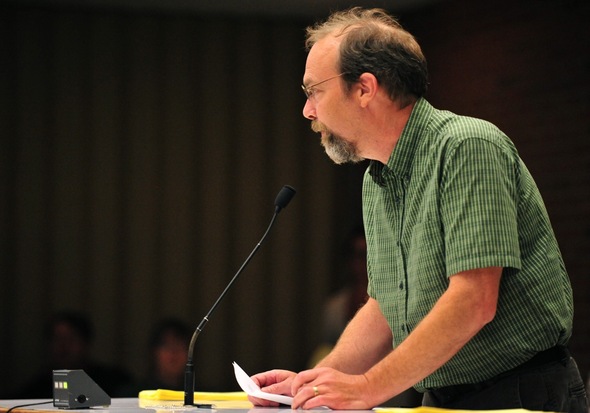
Mark Tucker, who teaches art at the University of Michigan, was one of several speakers who lobbied to preserve public art funding at Monday night's City Council meeting.
Ryan J. Stanton | AnnArbor.com
Six different speakers lined up to voice their support for the public art program that was first approved by the City Council four years ago and since has faced repeated attacks.
"It's true that we could live in any number of dull cities that would just take care of our basic needs, and they'd probably be cheaper to live in, too, But instead, we've chosen to live in a city that has a pulse and a soul," said Mark Tucker, who teaches art at the University of Michigan and is one of the organizers behind the annual FestiFools and FoolMoon events.
"This council has an obligation to invest wisely in the future infrastructure of Ann Arbor, and public art is a part of this infrastructure," Tucker said.
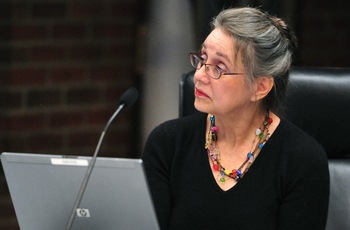
Council Member Sabra Briere, D-1st Ward, brought forward a proposal Monday night aimed at reducing funding for public art.
Ryan J. Stanton | AnnArbor.com
Under the ordinance approved by the City Council in 2007, 1 percent of the budget for all city capital projects — up to $250,000 per project — is set aside for public art.
In terms of this year's budget, $334,660 of $314 million — or 0.1 percent of all expenditures — is going to public art.
But some council members have expressed concerns that more than $500,000 in street millage funds have been channeled to public art over the last four years.
The changes Briere proposed would have specified that the city's street millage — which is up for renewal in November, along with an increase to pay for sidewalk repairs — would be exempt from contributing to public art. Additionally, so would the city's general fund, even though no money from the general fund has gone to public art in the last four years.
After some debate, during which different council members argued both for and against funding for public art, the issue was postponed to the council's second meeting in November. Council members said they wanted the benefit of more information and that they were looking forward to a special work session on public art sometime in October or November.
Briere said she didn't consider her proposed ordinance changes an attack on public art, but rather an effort to clarify where money comes from and where it goes.
She said she was surprised to find out that "taking tar and filling cracks on streets" counts as a capital improvement project and that 1 percent of that goes to art. Similarly, she said, she was surprised to learn that replacing a broken sidewalk slab counts, too.
"It was also a surprise to me to study this ordinance, something that I'll cheerfully admit I did not do in 2007 when I voted for it," Briere said, adding it seemed like a good idea at the time. "I was not aware of all of the items that count as capital improvements. To me, many of them in retrospect don't seem like what I thought I was supporting."
As a taxpayer, Briere said she still supports the idea of public art, but she's dismayed that money set aside in the public art fund has been allowed to accumulate for such a long period of time. The ordinance changes she proposed included a new stipulation that any money that hasn't been allocated for an art project for three fiscal years must be returned to the source funds, which mostly include the city's parks and street millages and utility funds.
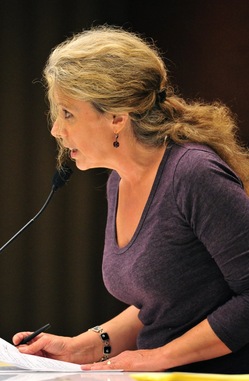
Public Art Commissioner Connie Brown addresses the City Council Monday night.
Ryan J. Stanton | AnnArbor.com
Brown also referenced new sculptures in West Park, a mural project planned for Allmendinger Park, and talks of public art along the Huron River between Argo and Gallup.
"In times of economic stress, you should never give up on your future," Brown said. "As numerous studies have shown, art is an important driver in healthy economies. When art can engage a person and cause them to think differently, it drives creativity and innovation."
Margaret Parker, another member of the city's Public Art Commission, said Ann Arbor is lucky to have set up what she called a "small savings account" that sets aside one penny for every dollar spent on city capital improvement projects for public art.
"From that frugal plan and the hard work of an all-volunteer working commission, and one half-time consultant, public art projects are now being realized," Parker said.
According to records obtained by AnnArbor.com, more than $2.2 million has gone to that account over the last four years — a large percentage of which is going to art in and around city hall, including a $750,000 sculpture being installed soon.
Council Member Tony Derezinski, who recently was appointed to the Public Art Commission, said before any action is taken to cut back funding, council members should take a comprehensive look at the program, and that's what he's doing right now.
Derezinski called it a "fairly recent program" that's still getting off the ground. In the short time he's been on the commission, he said he's been impressed with the work he's seen.
"We've talked about the importance of arts in tough times and how the soul of the city is reflected in its values," Derezinski said. "No matter how you try to cut back on the funding, it still is a cutback on the funding at a time when the programs are just getting going."
John Kotarski, a retired public school teacher, told council members that public art creates a sense of place and identity. He said art makes good business sense, too.
Kotarski said Forbes magazine agrees with him that "art is strangely economically viable despite its often high price tag." He cited New York's waterfalls — an art installation under the Brooklyn Bridge — that cost $15.5 million and reportedly brought in $69 million to the city.
John Kotarski
"Why should a city like Ann Arbor, known for its support of all intellectual and artistic pursuits, not be a leader in public art?" he asked.
Tucker said the decision to create the Percent For Art Program in 2007 was made by forward-thinking individuals who understood it would be an investment in the city's future.
"Twenty-six states and over 90 municipalities across the country have already enacted percent for public art programs in their community," he said. "They now have public art on display, which serves as a reminder that here lives a healthy, happy, productive and creative community."
Tucker said Ann Arbor's public art spending shouldn't be considered frivolous, but rather a long-term city investment not unlike building bridges or laying new sewer lines.
"Do we live in a city that clearly embraces the arts?" he asked. "The Summer Festival has been around for over 25 years. The Ark, over 40. The Art Fairs recently turned 50. The Ann Arbor Film Festival is turning 50 this year. The Ann Arbor Symphony, 81 years. The Ann Arbor Art Center, over 100 years. And UMS is currently celebrating its 133rd season."
Derezinski left fellow council members with a thought to ponder — a spin on a quote from the poet John Keats.
"A thing of beauty should be a joy forever," Derezinski said. "Its loveliness should be allowed to increase. It should never be allowed to fade into nothingness."
Ryan J. Stanton covers government and politics for AnnArbor.com. Reach him at ryanstanton@annarbor.com or 734-623-2529. You also can follow him on Twitter or subscribe to AnnArbor.com's e-mail newsletters.
Comments
Tom Teague
Thu, Sep 22, 2011 : 2:39 a.m.
I believe the following paragraph beginning ""Why should a city like Ann Arbor . . ." has the same typographical mistake.
Andy
Wed, Sep 21, 2011 : 4:54 p.m.
Hi Ryan -- the paragraph introducing Robert Oneal has a rather common typo you will want to fix. Thanks for the story.
Jen Eyer
Wed, Sep 21, 2011 : 5:20 p.m.
Thanks for pointing that out. It has been fixed.
AA
Wed, Sep 21, 2011 : 4:41 p.m.
Lets see, I have money and I want what I want. Use your money for your precious art. Use my money for the public good.
Wolf's Bane
Wed, Sep 21, 2011 : 2:54 p.m.
I'm an artist. I'll create art for free. Just give some supplies.
Ron Granger
Wed, Sep 21, 2011 : 2:13 p.m.
There will *never* be enough money for infrastructure. There will *always* be potholes. There will *always* be problems of serious crime - rape, murder, etc. By the logic some espouse, we should sell all our park land to fund those needs. If we put the art funds back into the regular budget, you wouldn't notice the impact. We'd still have all of those things on that list. I don't think it would make the slightest dent. Public art is important, just as parks are. They are not luxuries. Free, donated art is nice, but it is difficult to get great art that way. Great art has value, and artists should be paid. The University should also contribute to the art fund; they've certainly forced more than their share of incredibly ugly architecture on this town. The art program has been poorly managed, lacks transparency, and has made questionable decisions on selection of art. It needs management changes and public participation and *input* on the art. The commission has treated the public requirement of their charter as a mere formality, and even questioned whether they need to allow input (it's in the minutes, read them).
63Townie
Wed, Sep 21, 2011 : 12:55 p.m.
"Tucker said Ann Arbor's public art spending shouldn't be considered frivolous, but rather a long-term city investment not unlike building bridges or laying new sewer lines." Seriously? If art is akin to infrastructure, perhaps some of the metal "trees" in West Park should be used to shore up the crumbling Stadium Blvd. bridge.
alarictoo
Wed, Sep 21, 2011 : 12:48 p.m.
"This council has an obligation to invest wisely in the future infrastructure of Ann Arbor, and public art is a part of this infrastructure." What?!!? Public Art is part of infrastructure? Did he seriously say that? Let's look at what Merriam Webster defines as "infrastructure": "INFRASTRUCTURE 1: the underlying foundation or basic framework (as of a system or organization) 2: the permanent installations required for military purposes 3: the system of public works of a country, state, or region; also : the resources (as personnel, buildings, or equipment) required for an activity" With no disrespect intended to the military, for our purposes here I think we can discard #2. However, #1 & #3 are completely salient to this discussion. And, while I do not discount the appeal of some public art, I do not see a reasonable argument that public art is either part of the "basic framework" or "the resources required" to support "the system of public works" of any city. Hopefully Mr. Tucker was just "fooling" with us.
Kelley
Wed, Sep 21, 2011 : 12:45 p.m.
What about temporary installations of public art? Such art could be donated by the artists or leased for one or two years. The cost of this approach, even if the City absorbed installation costs, would be far less than the current system. It works in other cities (e.g. Sarasota) and provides a changing artistic environment for city residents and visitors.
hockeymom
Wed, Sep 21, 2011 : 12:16 p.m.
Twenty-one Ways To Be A Good Democrat. . . #4. You have to believe there was no art before federal, state, and city funding.
local
Wed, Sep 21, 2011 : 12:09 p.m.
This issue comes down to wants versus needs. Right now, art is a want, not a need. What we need is funding for roads, bridges, etc..., not art in the parks. Put it on the ballot and let people vote; however, have it stand alone on the ballot and not tied to something else. I have a sinking suspicion that council will try to tie it to another ballot issue, really giving people in Ann Arbor the shaft. Art is nice, but something about just living in and around Ann Arbor should be enough. As another person posted, Huron River drive doesn't need art, the landscape itself should be enough.
A2comments
Wed, Sep 21, 2011 : 11:26 a.m.
If a percent for art program exists (i am not expressing support for it), it should be a percentage of money spent on buildings, not roads...
Tom Hollyer
Wed, Sep 21, 2011 : 2:13 a.m.
I would not mind $2.2M over 4 years spent on art if it was spent more like the art patrons of the past. The City of Ann Arbor as the 21st century Medici family. Let's see, that's $550,000 per year. We could provide full-time wages for up to 10 artists a year, have them give one work of art a year to the city, and we'd have 40 works of art by now. Or, you could broaden the definition of artist beyond what it currently is to include other than the visual arts. Lots of things qualify as art. Music or musical events maybe? Support for composers? Writers? Poets? Think what an additional $100,000 a year could do for the Summer Festival, or what it could do to seed a new festival. Or artists' workshops. Or youth music programs. We have plenty of creative talent in this town more deserving of our support than are German landscape artists. It borders on criminal to use 750,000 local dollars for a work of art by a non-local artist. It's a slap in the face to the local creative community, and it's offensive in the extreme.
Kitty Robertson
Wed, Sep 21, 2011 : 1:13 a.m.
Are you kidding me??? We have potholes in nearly every street in the city. We have laid off police officers and firemen. There are young women being assaulted and we can't find the perp. And we need art?!?!? Give me a break!!! Kitty Robertson
townie54
Wed, Sep 21, 2011 : 12:26 a.m.
why is this so hard to understand?When times are good you can splurge on art.When you are laying off fireman and police you dont spend money on art or things that are not necessities.No more entitlements.Everyone has to give up things.Just provide a place on your walls or lobbies so the local artists can display their art
Carole
Tue, Sep 20, 2011 : 10:57 p.m.
First we take care of the needs of the city, i.e. streets, bridges, safety of the citizens by upgrading AAFD and AAPD to full staff, parks, water/sewer, etc. Then, if there is any funds left over for art, by all means have at it.
blahblahblah
Tue, Sep 20, 2011 : 10:28 p.m.
Water and sewer projects should also be exempted.
Let me be Frank
Tue, Sep 20, 2011 : 10:26 p.m.
Public money needs to provide public services such as police and fire protection, drivable streets..... Enterprise funds, such as the water, sewage disposal, stormwater funds, streets, etc. should not continue to be used as cash cows to feed programs not directly related to these funds' purposes. According to the C of AA's Capital Improvement Plan "Enterprise fund dollars can only be used on projects related to the fund." Is the City still funding the annual operations and maintenace of the recreational dams, Argo and Geddes, from the water fund? Remember these things when it comes time to vote on a streets millage and when our water, sewer and stormwater rates are increased.
pbehjatnia
Tue, Sep 20, 2011 : 9:55 p.m.
hooking public art into the road millage is blackmail. shame on city council. the roads are a complete and dangerous mess. fix the roads. use the road surplus monies already available. just finally do your job.
Elaine F. Owsley
Tue, Sep 20, 2011 : 9:27 p.m.
All that money for something people think looks like a urinal and a set of orange metal thingys that look like old fashioned clothes drying racks without their ropes. And which were designed by Michigan artists or even made in Michigan? I'm amazed at the support of the UM Art Prof, when nothing about the art so far says Michigan, or Ann Arbor, or, dare I say it? Art?
ArgoC
Tue, Sep 20, 2011 : 9:23 p.m.
If I were excited about even ONE of the several current projects mentioned by Ms. Brown, I might support the whole idea. But none of them are interesting/attractive to me ... certainly not for the price. Let it all go away and let's make the town more livable in other ways.
zax
Tue, Sep 20, 2011 : 9:20 p.m.
Art should be the icing on the cake. We need to take care of the cake first. our infrastructure, sewers, roads, street lights. Let's get those taken care of first. Then how about the U of M tax free people with an art and design school design us some art in public places at rock bottom prices. 2007 was the start of the down turn in the economy. I can see why the frivolous ideas to spend money on art instead of infrastructure were embraced. It's time to take a more practical look at the budget and work from the bottom up. Take care of needs first and wants later.
Carole
Tue, Sep 20, 2011 : 10:59 p.m.
Very well written.
tommy_t
Tue, Sep 20, 2011 : 9:14 p.m.
Geez just look at all the leaf pile sculptures we will have for well near 0$ let alone a couple 100K!!! Hurrah for art in beautiful tree city!
mun
Tue, Sep 20, 2011 : 9 p.m.
"It's true that we could live in any number of dull cities that would just take care of our basic needs, and they'd probably be cheaper to live in, too," With cuts to police, fire fighters, and schools, I'd say we are not even taking care of our basic needs.
Top Cat
Tue, Sep 20, 2011 : 8:55 p.m.
They should put the Percent for Art Program on the ballot and let the people speak. I'm hardly surprised nor do I care what this sextet of supporters think about it.
David Cahill
Tue, Sep 20, 2011 : 8:53 p.m.
I predict that the street and sidewalk millages will have a tough time at the polls in November because of the postponement of consideration of these needed reforms until after the election.
snoper
Tue, Sep 20, 2011 : 8:43 p.m.
Public Art is a wonderful thing IF YOU CAN AFFORD IT!!! We have quit salting our roads and fixing our roads because we can't afford it. We are laying off police and fire fighters because we can't afford it. We have quit the annual Xmas tree pickup because we can't afford it. We raise water rates because we can't afford not to. What makes this Council think thatin the face of all of that we can afford the folly of Public Art?
cinnabar7071
Tue, Sep 20, 2011 : 8:38 p.m.
Public Art Commissioner Connie Brown. Is that a real title?
djm12652
Tue, Sep 20, 2011 : 8:37 p.m.
Has any of the posters seen the fountain currently being used as a "turkish bath" by some of our hygiene conscientious drunks? Just wondering...it be a thang of beauty....
B. Jean
Tue, Sep 20, 2011 : 8:30 p.m.
Hello Arts proponents, this isn't an issue of being anti-art. The issue is being pro-public safety. There is a choice to be made here between the two because there is only enough money for one. I suggest even arts proponents would choose to fund public safety over art. Especially if their house was on fire or they needed to call the police. Councilwoman Briere is to be commended for her singular courage in proposing to cut funding to this and free up dollars for immediate and critical needs of the tax payers. The rest of the coucil should be ashamed for not having the guts to put their cards on the table on this issue before the election. And Mr. Derezinski, try quoting Keats to a victim of crime or someone who looses a loved one in a fire because of short-staffing. Or just just tell them, well at lease we have public art. "A thing of beauty" is seeing a police officer arrive when you desperately need help or seeing the fire truck pull up when your house is on fire or someone needs medical attention.
Stephen Landes
Tue, Sep 20, 2011 : 8:20 p.m.
"It was also a surprise to me to study this ordinance, something that I'll cheerfully admit I did not do in 2007 when I voted for it," Briere said, adding it seemed like a good idea at the time. "I was not aware of all of the items that count as capital improvements. To me, many of them in retrospect don't seem like what I thought I was supporting." Kudos to Council Member Briere for her honesty in speaking about her 2007 vote and for pushing a reconsideration of the way this fund for art is funded. I can understand that more public art is desirable, but cannot see why road maintenance funds should be targeted under the 1% rule. We need to put a maximum effort into repairing our existing roads in ann Arbor -- not diverting funds from road repair to art. I question the appropriateness of some of the projects mentioned in the article -- metal trees for one of our parks? some sort of art along the Huron River? Why damage the beautiful natural "art" we are blessed to have -- and that we have consistently voted to support through parks millages -- while some on Council are determined to destroy that natural landscape through ill-considered alternative uses like a bus terminal? If the art planners want to put art where the public can appreciate it then get it out of the city buildings and parkland and put it on downtown streets.
thinker
Tue, Sep 20, 2011 : 8:09 p.m.
I like the idea of free public displays of Michigan artists art work(insured by the city), but nonetheless on display -not purchased -for 6 months or a year. Could lead to purchase or not- depending if the majority of Ann Arborites like it. In any case, good advertising for the artists, and in keeping with Ann Arbor's IMAGE of itself.
Vivienne Armentrout
Tue, Sep 20, 2011 : 8:05 p.m.
Who can disagree with all the lovely words about art and its importance in our culture and our community? Certainly we don't want to lose our "soul". But the speakers fail to distinguish adequately between public art and publicly funded art. There is much public art in the city that has been placed as a result of private donations. The speakers are appealing to a worthwhile ideal at a symbolic level (more discussion at <a href="http://localannarbor.wordpress.com/2011/09/19/taxes-for-art-ii/)," rel='nofollow'>http://localannarbor.wordpress.com/2011/09/19/taxes-for-art-ii/),</a> while the actual decisions to be made must be grounded in law. Most of the money collected from this program is from restricted funds - either millages or fee-based utilities. It is illegal to use the money in this way (full argument is at <a href="http://localannarbor.wordpress.com/2011/09/13/taxes-for-art/)," rel='nofollow'>http://localannarbor.wordpress.com/2011/09/13/taxes-for-art/),</a> and most citizens rightly feel that there is a fraudulent aspect to money collected for one purpose (roads, sewers, etc.) used for another. CM Briere's measure was not to abolish the program, but merely to limit its application for the road millage that is to be placed on the November ballot. This was prudent, given some of the public outcry over the program.. Now citizens will have to make a decision in November whether in voting for road repair they also want to vote for a public art program. We'll see if the council has gauged the public's acceptance of this arrangement properly.
Tom Teague
Tue, Sep 20, 2011 : 8:17 p.m.
Vivienne - Your last paragraph nicely sums up my feelings as well - that certain common-sense changes are needed to the existing program.
nixon41
Tue, Sep 20, 2011 : 8:03 p.m.
NOT, nada, zip, zero
djm12652
Tue, Sep 20, 2011 : 8:38 p.m.
am I correct in my translation....$00.00? lol
conlippert
Tue, Sep 20, 2011 : 7:58 p.m.
We recently visited Loveland Colorado where they have a wonderful sculpture garden. I hope that Ann Arbor sees that culture in any city is enhanced by it's support of the creative arts.
huh7891
Tue, Sep 20, 2011 : 11:25 p.m.
I'll bet Loveland has't had their public safety depts sliced in half either & I'm pretty sure their roads are maintained .
bedrog
Tue, Sep 20, 2011 : 9:28 p.m.
Loveland is an unusual place in that it has at least 3 of the best bronze sculpture foundries in the world and a good chunk of the town is involved in that particular art form and its promulgation... It's not comparable to ann arbor in either size or complexity of non- art related needs. . and i speak as a bronze sculptor who nonetheless would prioritize other social sevices over public art...especially what passes for public art here in an era of shrinking police/fire/teaching services and crumbling infrastructure and rising crime. .
John of Saline
Tue, Sep 20, 2011 : 7:50 p.m.
Can bad public art be removed? I'm thinking here of the ugly statue next to the parking garage at Glen and Catherine, kitty-corner from Angelo's. That particular one is probably a U of M issue. Still, if they propose to install something that looks like a helicopter crash scene and call it "public art," is there anyway for Ann Arborites to stop it, short of voting the council out the next time that's an option?
cinnabar7071
Tue, Sep 20, 2011 : 8:50 p.m.
Careful John A2 is only friendly on the surface, they will eat your young.
John of Saline
Tue, Sep 20, 2011 : 8:29 p.m.
Um, that's why I said "Ann Arborites," not "me." If Ann Arborites vote to spend tax dollars installing a helicopter crash in a public park, they can. I can call it silly from afar.
hut hut
Tue, Sep 20, 2011 : 8:22 p.m.
Your opinions might matter if you lived here.
lynel
Tue, Sep 20, 2011 : 7:44 p.m.
"Kotarski said Forbes magazine agrees with him that "art is strangely economically viable despite its often high price tag." He cited New York's waterfalls — an art installation under the Brooklyn Bridge — that cost $15.5 million and reportedly brought in $69 million to the city." He fails to mention that NO public funds were used for this project! All money was donated by individuals and corporations! Public money needs to provide public services such as police and fire protection, drivable streets.....
treetowntenor
Tue, Sep 20, 2011 : 7:34 p.m.
Anyone else notice that they postponed action until after the election? Remember that when you go to the polls in November.
Tom Teague
Tue, Sep 20, 2011 : 7:30 p.m.
I think Council Member Briere's proposed changes are laudable and I hope the Council will adopt them (and, no, I don't live in her district). And even though I disagree with the six who spoke to council on this issue, I applaud them for getting out there, speaking respectfully with one voice, and making their points directly to Council. More of us should try that on critical issues.
Tom Teague
Tue, Sep 20, 2011 : 8:01 p.m.
By the way, my disagreement with the six speakers is not about whether we should have a public art program at all, it's about whether we should make some changes to the existing program given the current slow down to revenue.
SonnyDog09
Tue, Sep 20, 2011 : 7:24 p.m.
Were any of the speakers that spoke in support of the program not retirees? The two that you quote in the article are identified as a retired public school teacher and a retired physician.
Dee_AnnArbor
Thu, Sep 29, 2011 : 2:44 p.m.
Retirees pay taxes and live here--lots of them. They are entitled to speak out about where their tax money goes.
Ignatz
Tue, Sep 20, 2011 : 7:20 p.m.
For those members of the public who were involved in the outpouring of support for art: Let the money pour out of your wallets and private fundraising until the economy improves to a point where the city has an adequate tax base. I'm all for puiblic art, but come on, the place is falling a aprt!
janeqdoe
Wed, Sep 21, 2011 : 1:38 p.m.
But it's so much easier to spend Other People's Money... :-)
A2comments
Tue, Sep 20, 2011 : 7:18 p.m.
If you voted for something that you didn't read, you should "cheerfully" resign now. That's disgraceful. Amazing...
Marilyn Wilkie
Tue, Sep 20, 2011 : 7:17 p.m.
"It's true that we could live in any number of dull cities that would just take care of our basic needs, and they'd probably be cheaper to live in, too, But instead, we've chosen to live in a city that has a pulse and a soul," said Mark Tucker, who teaches art at the University of Michigan and is one of the organizers behind the annual FestiFools and FoolMoon events." Earth to speaker. We need to come back down to the real world and current needs of this city. What good is a pretty city that is falling apart?
Chris Blackstone
Tue, Sep 20, 2011 : 7:15 p.m.
I look forward to reflecting on Ann Arbor's wonderful art while getting my car repaired after driving over the broken, pot-holed Stadium Bridge. I'll also make sure to print a map to prominent local works of art on the back of flyers warning people of the sexual predator(s) loose in Ann Arbor.
tdw
Tue, Sep 20, 2011 : 9:55 p.m.
Chris....Ask any cop where the art is....no wait a minute.....never mind