

Scio Township, Dexter explore combining fire departments
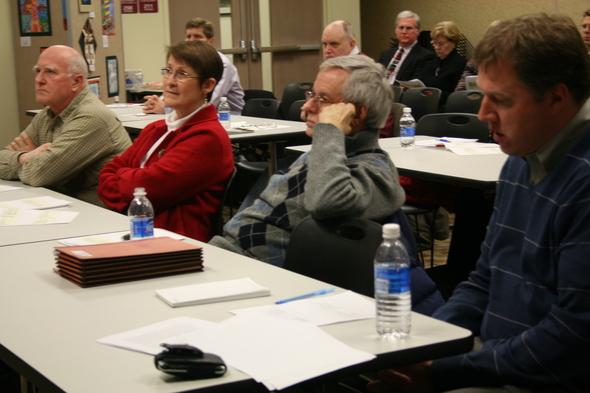
From left, Webster Township Supervisor John Kingsley, Dexter Township Supervisor Pat Kelly, Scio Township Supervisor Spaulding Clark and Dexter Village President Shawn Keough listen to Fire Chief Rick Royston of Delhi Charter Township explain the pros and cons of a consolidated fire department.
Lisa Allmendinger | For AnnArbor.com
The Dexter and Scio Township fire departments may soon be one.
After more than a year of talks, elected officials from the Scio and Dexter area say it appears to make sense to consolidate the departments instead of operating them separately.
Under the current system, Scio Township firefighters are responsible for the 34-square-mile township west of Ann Arbor, operating from a fire station on Zeeb Road. The Dexter Area Fire Department protects all of the Village of Dexter, all of Webster Township, 60 percent of Dexter Township, and 40 percent of Lima Township. Its main station is on Main Street in Dexter, and a new substation opened on North Territorial in Dexter Township.
Both departments are staffed with a combination of full-time and paid on-call firefighters.
On Monday, elected representatives from Dexter Village and Scio, Webster and Dexter townships met to discuss consolidation — the latest in a series of meetings since September 2009. They say having a consolidated fire department could improve service and reduce overall costs for fire protection.
Delhi Township Fire Chief Rick Royston spoke at Monday's meeting, highlighting the pros and cons of a consolidated department.
“It’s combining the strengths of two smaller departments to exceed anything you can do now as individual departments,” Royston said.
Dexter Township Supervisor Pat Kelly said the committee has been meeting monthly for more than a year and is working "very deliberately and slowly on this."
Scio Township Supervisor Spaulding Clark said at some point, labor attorneys would need to be involved, but the committee hasn't reached that point yet.
Royston said the benefits of a regional department include more efficient use of fire apparatus, equipment and staffing. One chief would oversee a consolidated department, and a potential exists for cost savings for centralized purchasing and testing of equipment. Currently, Carl Ferch serves as chief in Scio Township, and Loren Yates is the Dexter fire chief.
Royston said a regional fire service would consolidate training expenses and standardized training methods, as well as increase competitiveness in grant opportunities because of a larger service area and more staff.
“One of the biggest issues with consolidation is change for everyone,” he said, “From the township supervisors and administrators down to the firefighters who ride in the engine.”
Royston suggested working with Ann Arbor for more specialized services, such as confined space rescues or hazardous materials calls.
Webster Township Supervisor John Kingsley said, “Our board wants to look an anything in terms of costs and service efficiencies and the fact that Scio is interested in cooperating with DAFD will allow us to move forward.”
Response times in areas such as Loch Alpine could be served quicker by a fire engine stationed in Scio Township, while homes in the area of Dexter-Chelsea and Parker roads could be reached quicker by trucks stationed in Dexter.
Officials said portions of Lima Township could benefit from the consolidation as well.
Last September, Lynn Harvey of Michigan State University, an expert intergovernmental cooperation, gave a presentation to the group that introduced possible cost allocations. Harvey estimated $2 million would be needed for a consolidated department's budget.
In the proposed scenario, Dexter Township would pay about $300,000 or 15 percent of the total cost, while Scio Township would pay about $1.2 million or about 55 percent. Webster Township’s proposed amount would be about $342,000 or 17 percent, and Dexter Village’s share would be about $247,000 or 13 percent.
The cost figures were based on each municipality’s population, its state equalized value (with a 50-percent adjustment for open space), and the number of fire calls in each.
The next step in the process is for the individual municipalities to adopt a resolution of support to continue the process, which could take a year to complete.
If approved by all the municipalities, the committee would draft a transition plan for review and adoption by all four municipalities.
Lisa Allmendinger is a reporter for AnnArbor.com. She can be reached at lisaallmendinger@annarbor.com.
Comments
a2j
Thu, Feb 3, 2011 : 12:25 a.m.
Look that fact is, when the Scio station was built it was originally going to part of Dexter Fire Dept. This needs to happen, it needed to happen a long time ago, as does consolidation with Chelsea. It saves money, increases training, staffing levels, and just makes for a better fire department. The article is right, response times will be quicker with more trucks and equipment on the road much quicker. This is a good idea for firefighters and a good idea for residents.
Mick52
Wed, Feb 2, 2011 : 5:57 p.m.
I had the same thoughts as Ronald especially what will the changes in funding be? This is something we need to know. Consolidation should save money by cutting at the top: one chief not two and so on. The other thing that would be good to know is whether or not any of the departments involved are suffering financially, i.e., does Dexter need a bailout by Scio? If each is in good fiscal health, then the consideration should be if consolidation can provide increased (or the same) service at a reduced (or appropriate) cost? The thing I find the most frustrating is: "very deliberately and slowly on this." I do not like extended consideration on an issue. Get the facts and make a decision. If you can't make a decision, put a plan together and put it before the voters to decide with properly published explanations about the pros and cons. This is what I like the most: "Response times in areas such as Loch Alpine could be served quicker by a fire engine stationed in Scio Township, while homes in the area of Dexter-Chelsea and Parker roads could be reached quicker by trucks stationed in Dexter." When it comes to fires and EMT response, response time is the most critical aspect. Quicker is better. Quicker saves more lives. Put a cost on that and make a decision: Is it worth it? Typically in discussions about consolidation those in power are concerned about loss of control/power which is nonsense.
SemperFi
Wed, Feb 2, 2011 : 4:27 p.m.
This sounds like a well-reasoned approach to regional cooperation of services. If it, indeed, can show long-term cost effectiveness and quality service, then it's a good idea. It appears that the village and township leaders are showing due diligence and approaching this with an eyes-wide-open attitude. This is what our elected leaders should be doing. Thanks! @ BnR: The article said that the Royston suggested working with Ann Arbor for specialized services. That might mean paying directly for those services or to consolidate training to reduce costs. It might actually bring additional funding to the AAFD. It's not as if "smaller communities" are asking for a handout.
zip the cat
Wed, Feb 2, 2011 : 3:57 p.m.
I think its the worst thing I have ever heard of. Who in there right mind wants anything to do with out of control mismanaged higher than the devil taxes SCIO TOWNSHIP. Really,Really dumb,stupid shoot from the hip farce of a idea. Are the taxpayers going to be able to vote on this or are we just going to get it cramed down our throats.
BornNRaised
Wed, Feb 2, 2011 : 1:44 p.m.
Interesting to hear that smaller communities think they can depend on Ann Arbor City for specialized services, when the city government is cutting people and services. Those city administrators should talk with the city first before thinking that. And by 'city' I mean the FD, not the council.
ronaldduck
Wed, Feb 2, 2011 : 11:44 a.m.
Also curious as to staffing levels at the departments currently. Full time and paid on call.
ronaldduck
Wed, Feb 2, 2011 : 11:41 a.m.
Seems to be a well a written and comprehensive article except for one very important piece. How much are these municipalities currently paying for fire protection? It's impossible to compare the current system with the proposed system with knowing what the savings might be.