

Government strategy for combating Asian carp questioned by public at Ypsilanti meeting
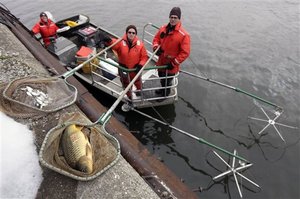
Ann Runstrom, left, Heidi Keuler, and Scott Yess, right, of the U.S. Fish and Wildlife Services show nets with stunned gizzard shad and a common carp as they search for Asian carp in the Chicago Sanitary and Shipping Canal Wednesday. AP Photo/M. Spencer Green
Plans drafted by federal and state officials to keep Asian carp out of the Great Lakes were questioned by environmental groups, Chicago Tour boat employees and other members of the public in Ypsilanti on Wednesday.
At the meeting, representatives from the U.S. Environmental Protection Agency, the Council on Environmental Quality, the U.S. Army Corps of Engineers and U.S. Fish and Wildlife Service outlined their strategy for combatting the fish.
The meeting, which drew about 200 people to the Ann Arbor Marriott Ypsilanti at Eagle Crest, grew heated at times as members of the public questioned the speed and quality of the federal response to stopping the carp.
Last week, authorities announced a $78.5 million plan called the Asian Carp Control Strategy Framework to address the problem.
Among strategies being used are electronic barriers to keep the fish from swimming through Chicago waterways into Lake Michigan. Earlier Wednesday, officials announced crews were out looking for evidence this week of carp in those waterways north of the barriers and, so far, had been unable to find any.
Asian carp are an invasive species characterized as having voracious appetites. Officials have said they fear the fish will outcompete native species and have a devastating impact on the ecosystem and on fishing in the Great Lakes. They were originally introduced in the Mississippi River in the south in the 1970s and have since moved up waterways. Now populations are as far north as waterways below the electronic barriers.
At least some DNA evidence shows carp may have made their way into the lakes. But at question is the best way to keep more carp from moving into Lake Michigan and creating a sustained population there.
Many in the crowd Wednesday, particularly those from Michigan, called for more urgency from federal officials to implement strategies, such as ramping up electronic barriers or potentially poisoning waterways to kill the fish off in those areas. Most were calling for a physical separation between Lake Michigan and the Chicago waterways, which connect to the Illinois river, by closing the canals in Chicago.
The current system is artificial and too open for the health of the Great Lakes, said Kurt Wolak, an Ypsilanti resident and a member of the group "Carp are Crap."
"With regards to proposed solutions, ultimately we're going to need to achieve a biological and hydrological barrier between the Great Lakes watershed and the Mississippi river system, not just to stop this species but all types of invasive species," he said.
This view is supported by Gov. Jennifer Granholm and several members of Congress from Michigan.

Members of the public question a draft plan to keep Asian carp out of Lake Michigan during a meeting in Ypsilanti on Wednesday.
"We cannot find ourself in a situation down the road where we look back and say, 'Oh if only. If only we had done something more,'" said U.S. Senator Debbie Stabenow, D-Mich., who also called for clearer and more urgent deadlines in the federal plan.
But dozens of Chicago tour boat operators and other boat company employees at the meeting expressed strong opposition to proposed plans to close canals in the Chicago area to help stop the fish.Â
They argued closing the canals alone wouldn't stop the fish because the canals aren't watertight and, if used in that way, would need to be modified. Closure of the locks would immediately result in economic losses in the shipping, tourism and other industries, many said.
"To jump ahead now to close those canals would put me and my husband out of work," said Ragna Russo, a tour boat captain for Wendella Boat Tours in Chicago.
Tina Reed covers health and the environment for AnnArbor.com. You can reach her at tinareed@annarbor.com, call her at 734-623-2535 or find her on Twitter @TreedinAA.
Comments
mmouradian
Sat, Feb 20, 2010 : 11:48 a.m.
It was sad to see all the tour boat operators try to take over the meeting. They had a good point but lost the crowd and any sympathy with the "my livelihood is more important than the survival of the Great Lakes" argument. They were well organized but the cheapshots at the science in front of a well informed group made them look foolish.
Kurt Wolak
Thu, Feb 18, 2010 : 10:41 a.m.
They are good to eat, and cultivated in many countries for food. Unlike carp that we are familiar with that feed on the bottom, invasive carp species such as the bighead and silver feed primarily in the upper and middle part of the water column, water that is generally 'cleaner'. In fact, part of the carp plan developed in the 1970's was to have carp feed in ponds on sewage treatment facilities in the South, then sell the carp for food. But the FDA said, "No way..." and that helped put the kabosh on the initial government carp program. Besides food, there could be other commercial uses for the carp if they could be successfully harvested. Certainly, keeping carp populations down in the lower states would take some of the pressure off the Great Lakes. Carp populations are very high in waterways connected to the Mississippi. Commercial and recreational fisherman have been on those waters for generations. The problem is this: in natural water systems, many conventional fishing techniques generally don't work for carp, especially the more 'touchy' silvers, who elude and ruin nets. While bighead carp are commercially harvested with nets, they also tend to pool in numbers that weigh the nets down to the point that they can't be pulled up and the net has to be released. As far as whether invasive carp can live in Great Lakes, it is true that that is not yet known. Consider this, however: if you were to draw parallel lines around the globe that were at the limits of the carp's natural range in China, those lines would pass through Chicago in the south and the mouth of the Hudson Bay, Canada in the north. These carp naturally prefer cooler waters and lowland rivers, of which the Great Lakes region has plenty. The safe bet is that they can survive here.
Awakened
Thu, Feb 18, 2010 : 7:49 a.m.
Are they good eating?
amsims
Thu, Feb 18, 2010 : 7:23 a.m.
I do think it would help if there were ways to make money with the Asian carp and would be interested to hear more about what they can be used for. We hear so much about overfishing and depleted fish stocks - seems like there ought to be a use for this overabundance of carp, that could help keep the population down.
earl
Thu, Feb 18, 2010 : 2:50 a.m.
The fear about the carp getting into Lake Michigan and damaging the eco system is hysterical and over blown. there is no evidence that they can live in the great Lakes in sufficient numbers to drive out all other fish. This is a fish that does best in rivers, not cold water lakes. However the economic and environmental effect of closing the canal is very real and would negatively impact everyone in the Midwest, not just Illinois and Indiana. That is a very real danger, unlike the perceived danger of the Carp, which is imaginary. By the way there is a market for the Asian carp as fertilizer and as human food. there is a plant in Illinois that processes the carp for shipment to Japan and they cannot keep up with demand