

K2: Easily accessible substance that mimics marijuana - and is legal - sold in Ann Arbor
An easily accessible substance that mimics marijuana is sold in Ann Arbor and at head shops across the country - and there's not much law enforcement authorities can do about it.
Called K2 - or "Spice," Genie" and "Zohai" - it is commonly sold in head shops as incense. Produced in China and Korea, the mixture of herbs and spices is sprayed with a synthetic compound chemically similar to THC, the psychoactive ingredient in marijuana. Users roll it up in joints or inhale it from pipes, just like the real thing.
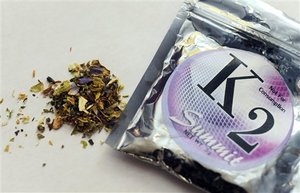
This Feb. 15 photo shows a package of K2 that contains herbs and spices sprayed with a synthetic compound chemically similar to THC, the psychoactive ingredient in marijuana.
Kelley McCall | The Associated Press
Though banned in most of Europe, K2's key ingredients are not regulated in the United States - a gap that has prompted lawmakers in Missouri and Kansas to consider new legislation.
In Ann Arbor, the mixture is sold inside the Stairway to Heaven shop on South State Street. For between $7 and $18, a person who is older than 18 can purchase an ounce of the herbal substance that resembles green kitchen spices.
"This isn't Jerry Garcia's marijuana," said state Rep. Jeff Roorda, a Democrat from the eastern Missouri town of Barnhart. "They've used chemicals to avoid creating something that's already illegal."
Authorities in Johnson County, Kan., discovered ex-convicts on probation smoking K2, and said it is spreading to high school students.
"This has become extremely popular," said Linda Weber, owner of The Vise smoke shop in the St. Louis suburb of St. Peters, who said she only sells to adults.
K2 costs between $20 and $50 for three grams - similar to the street price of marijuana - but with the key advantages of being legal and undetectable in drug tests.
The key ingredients are believed to be the unintended result of scientific research on marijuana's effects.
Dr. John Huffman, a Clemson University organic chemistry professor, was researching the effects of cannabinoids on the brain when his work resulted in a 1995 paper that contained the method and ingredients used to make the compound. That recipe found its way to marijuana users, who replicated Huffman's work and began spraying it onto dried flowers, herbs and tobacco.
"People who use it are idiots," said Huffman, referring to K2 smokers.
A proposed bill in Missouri would make possession a felony punishable by up to seven years in prison - identical to punishments given to users of real marijuana. A similar bill in Kansas would make possession a misdemeanor punishable by up to a year in jail and a $2,500 fine, also the same as marijuana convictions.
The products are sold widely, but authorities in other states contacted by The Associated Press, including Pennsylvania, California and Michigan, said they haven't heard of their use as a drug.
Locally, spokespeople from the Ann Arbor Police Department and the University of Michigan Department of Public Safety said they weren't familiar with the substance.
And if no regulations exist at this point, said U-M police spokeswoman Diane Brown, educating local emergency room doctors, substance abuse counselors and police about the herb's appearance and effects is about all that can be done.
Police in Missouri and Kansas said they've become aware of K2 in recent weeks. The federal Drug Enforcement Administration has classified it a "drug or chemical of concern."
"A 10-year-old child could walk into a head shop and buy it," said West Plains Detective Shawn Rhoads.Â
Conner Moore, 20, said he and his friends started smoking K2 after reading online news articles and postings about the substance. He compares the high to smoking medical marijuana.
"We just got on forums and looked it up and saw what other people said about it," he said. "Obviously if it comes out being bad, I'll obviously stop using it. There's really no sites out there that says what is in K2."
There is no data on the drug's toxicity or how long it stays in the body. In mice, it can lead to a lower body temperature, partial paralysis and the temporary inability to feel pain, according to the DEA.
One of the few studies of the compound's use was performed by the European Monitoring Centre for Drugs and Drug Addiction, a Portugal-based agency of the European Union, in November 2009. The study found the amount of synthetic compound varies widely between brands, and despite being widely available, it isn't clear how many Europeans use it.
Allen St. Pierre, executive director of the National Organization for the Reform of Marijuana Laws, said K2 isn't much discussed within marijuana culture.Â
"If government is genuinely concerned about controlling cannabis-related products, there is really only one thing that seems to have an effect: a tax stamp," St. Pierre said.
By the Associated Press and Tina Reed of AnnArbor.com.
Comments
hollybug
Fri, Nov 19, 2010 : 12:38 p.m.
I most definitely feel there should be age restrictions, as there are, with tobacco and alcohol products, but really, what do they hope to accomplish by banning these substances? These guys claim to have k2 incense products that are legal in every single state, http://www.k2-incense.com/what-is so you see, these bans aren't so effective are they?
Aubree
Thu, Sep 9, 2010 : 8:50 p.m.
I wish people would be more careful. My friends were telling me about some sort of blueberry k2 incense and I googled it and found out it is counterfeit. Apparently there are only a few authentic blends. The list of fakes is scary long and they don't quite know what is in those, http://www.k2incense.org. It's worth checking out if you buy this or know someone who does. Stay safe.....
ronn oneal
Wed, Aug 4, 2010 : 7:48 p.m.
Doesn't this k2 also give you the high like pcp or acid?
ispsales
Mon, Jul 19, 2010 : 6:57 p.m.
The laws are already in place... See the FDA vs. K2 at youtube.com/watch?v=TxyVdD4d6Vo
Griffen
Thu, Apr 1, 2010 : 1:50 p.m.
Can you buy chocolates with the THC sprayed on? :)
Will Parsons
Tue, Mar 30, 2010 : 2:16 a.m.
I have recently tried the substance and I have have found that, although it provides a marijuana-like high, it also provides alcohol-like side effects. I woke up in the middle of the night panicked and about to vomit. I'm not sure a legal high is worth feeling like crap.
Lokalisierung
Wed, Feb 24, 2010 : 5:26 p.m.
"Isn't there smoke involved as well?" Well I don't think it's the "smoke" itself from second hand smoke that's killing people (that is of course what 'they say,' as I do not believe there is any real evidence from second hand smoke - but anyway...) But the carcinigens(sp)they put in the tabbacco and paper to make it burn longer and things like that. They could make a relitively safe ciggerette if they wanted to but choose not to.
Atticus F.
Wed, Feb 24, 2010 : 5:05 p.m.
@really, to answer your question, yes there is a difference between medical marijuana and most stuff purchased on the streets. Some medical strains are bred specifically for pain management, others are bred specifically to induce appetite in Chemo patients, and others are bred to control nausea. Another main difference is that most medical strains are grown under strict growing conditions to ensure consistent quality and potency. While street pot is grown purely for profit, with no consideration for consistency, potency, ect.. Another thing I should mention, is that MJ is excellent for nausea from things like the flu, or food poisoning... Although it can't be prescribed for these things as the law specifically states that it's to be used for conditions causing 'chronic' nausea. As a matter of fact it's been used as a remedy for PMS for thousand of years by many different cultures.
djm12652
Wed, Feb 24, 2010 : 4:58 p.m.
Ok Ann Arbor, I don't get it...as of May 1, the state is "smoke" free. Good for people that don't want smoke in their lungs...but...what about K2 and pot? Isn't there smoke involved as well? and how many of these K2 smokers and pot for that matter are happy the restaurants are smoke free? Or does everybody do a Clinton and not inhale?
trs80
Wed, Feb 24, 2010 : 3:48 p.m.
"A 10-year-old child could walk into a head shop and buy it," said West Plains Detective Shawn Rhoads. Too bad you have to be 18 years of age to shop in stores like this. Great Detective work, Shawn Rhoads. Lmae-o
Lokalisierung
Wed, Feb 24, 2010 : 3:20 p.m.
I never heard of this stuff or where to get it. I do now and I'm goign to buy some. I'll report back if i can type.
Becky
Wed, Feb 24, 2010 : 3:18 p.m.
There's no way that MJ should be illegal if alcohol and cigarettes are legal. I don't even like it and I believe that.
Really
Wed, Feb 24, 2010 : 3:02 p.m.
Couple questions: Is there a difference between medical marijuana and plain old weed? "The high is like smoking medical marijuana" It cracks me up how many kids are making up some excuse to get medical marijuana. "I have headaches, my tummy hurts". Hurts everyone who really needs it. Also, how come the A2.com is telling every kid in town where to buy this chemical laden crap? Jeez, sometimes I wonder.....
Jed I Knight
Wed, Feb 24, 2010 : 2:36 p.m.
Oh I bet Pharma could make some *fantastic* MJ. Then all who cared to indulge could do so.
M.
Wed, Feb 24, 2010 : 1:20 p.m.
Chemists are constantly making new analogues of other drugs that are JUST different enough from their originator that they are legal. You can find all sorts of crazy LEGAL chemicals (in a large variety of forms) for mail order on the internet. Personally, I wouldn't trust any of them since there is extremely limited, if any, research done on negative and long term effects. Drugs don't get banned and criminalized until they cause a large problem to society and/or enough public furor over them, among some other debatable reasons. Why is pot illegal again?
LRF
Wed, Feb 24, 2010 : 1:13 p.m.
Fire it up while you still can. The Feds will outlaw it sooner or later. That's the mentality of our lawmakers because they can't see past their crooked nose. If they would only take a different approach they could add revenue rather than spend money prosecuting people who are not harming anybody. Unlike drunk drivers who are killing and maiming innocent people on the highway every day. We could turn the economy around if our lawmakers would legalize pot and regulate and tax it. Wake up you idiots!
Lokalisierung
Wed, Feb 24, 2010 : 12:41 p.m.
"A proposed bill in Missouri would make possession a felony punishable by up to seven years in prison - identical to punishments given to users of real marijuana." Remind me to stay out of Missouri. Jesus a felony for some reef?
mcwee
Wed, Feb 24, 2010 : 12:30 p.m.
WRT: "There's really no sites out there that says what is in K2," that's not true; Wikipedia explains that K2 (http://en.wikipedia.org/wiki/K2_(drug)) is treated with the synthetic cannabinoid JWH-018 (http://en.wikipedia.org/wiki/JWH-018), which may or may not have any basis in Huffman's research (http://www.clemson.edu/chemistry/people/huffman.html).
a2guy1974
Wed, Feb 24, 2010 : 12:28 p.m.
ha ha, this story originally broke about a week ago. what was left out of this a2.com version is that our good friend, mr. connor moore--who is eager to hear if K2 has any negative side-effects--is currently a community-college dropout. chhhhheck! way to "aim high!" also: his claim that this crap is equal to medicinal/real deal type stuff... uh, i "highly" doubt it. http://www.msnbc.msn.com/id/35444158/
a2grateful
Wed, Feb 24, 2010 : 12:18 p.m.
"it can lead to a lower body temperature, partial paralysis and the temporary inability to feel pain..." So could hitting oneself in the head with a hammer... Wooo Hooo : (
uawisok
Wed, Feb 24, 2010 : 12:15 p.m.
Nothing made in China goes into this body!!
David Marshall
Wed, Feb 24, 2010 : 12:03 p.m.
So what's more irresponsible: To smoke the weird, legal, yet-unstudied chemical, or to smoke the illegal drug?
Blklight
Wed, Feb 24, 2010 : 11:32 a.m.
Oh noes we gots to save the children! Won't somebody please think of the children!!
Dark Dichotomy
Wed, Feb 24, 2010 : 11:20 a.m.
So it costs $20 to $50 for 3 grams but according to this article an ounce (28 grams) costs $7-18, not $187-466? Someone who thinks they are a journalist is not checking thier facts. Also, who cares if these idiots want to smoke some lawn clippings sprayed with some synthetic crap from China. It's legal. Cuts down on the people doing illegal drugs doesn't it?
Freemind42
Wed, Feb 24, 2010 : 11:11 a.m.
haha bunny it DOES look like a condom!
bunnyabbot
Wed, Feb 24, 2010 : 11:06 a.m.
I agree with the post about smoking something thats been sprayed with chemicals from China, the same care probably goes into the product as the melamine in baby formula and the lead paint on toys did. If the Chinese gov't is trying (or succeeding) at hacking into the western worlds commercial and gov't computers why wouldn't they just go about slowly poisoning our population? Like the doc said, they are idiots. Great packaging, looks like a condom and says summit on it.
Woman in Ypsilanti
Wed, Feb 24, 2010 : 10:35 a.m.
The only people who would smoke this stuff are people who don't have a pot dealer.
Atticus F.
Wed, Feb 24, 2010 : 10:23 a.m.
It's amazing that a chemical hodge podge, sprayed on some weird mix of herbs is completely legal... But the second you light up a natural, organically grown joint in your own home, they want to put you in jail. Just decriminalize pot, and people would probably avoid this stuff like the plague.
F. Andy Seidl
Wed, Feb 24, 2010 : 9:41 a.m.
LOL: "Obviously if it comes out being bad, I'll obviously stop using it. There's really no sites out there that says what is in K2." That's the kind of forward-looking guinea pig mentality we need to help sort this out. For example, if in a few years, he has tumors or can't remember his phone number, he can stop using it. Thanks, Conner, keep up the good research.
Scott Beal
Wed, Feb 24, 2010 : 9:22 a.m.
Did the Clemson professor say anything else, besides that users are idiots? I imagine he's probably referring to the lack of toxicity data, but the isolated quote makes it sound like he just doesn't like potheads.
Craig Lounsbury
Wed, Feb 24, 2010 : 9:21 a.m.
So if I get this right, people are inhaling in to their lungs "a synthetic compound" "Produced in China"? Somehow that doesn't seem like a good plan to me.
Freemind42
Wed, Feb 24, 2010 : 8:32 a.m.
You're exactly right Blue Marker, although there already is a Marijuana lobby called National Organization to Reform Marijuana Laws (NORML) but they just don't have the power that the tobacco and paper lobbies have. As for this being the same thing as Salvia, no it isn't. Salvia's effect occurs naturally without needing to spray on extra chemicals.
M.
Wed, Feb 24, 2010 : 8:02 a.m.
Is this not salvia?
donderop
Wed, Feb 24, 2010 : 7:48 a.m.
Bet sales will be smokin' at Stairway to Heaven.
Blue Marker
Wed, Feb 24, 2010 : 7:46 a.m.
If the old powers that be would just legalize marijuana you wouldn't have this product. If Pfizer grew pot we could all light up! Marijuana needs a lobby.