

East Stadium bridges project in Ann Arbor awarded nearly $14 million in federal funding
Ann Arbor officials have been heavily criticized over the past year for holding off on repairing the failing East Stadium Boulevard bridges. It turns out that was a good bet.
The U.S. Department of Transportation is awarding $13.9 million to allow the city of Ann Arbor to reconstruct the two bridge spans, Congressman John Dingell announced today.
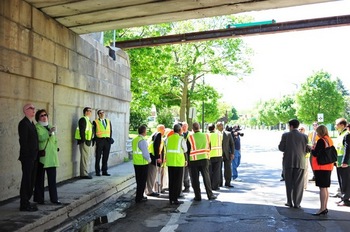
Federal and local officials gathered under the bridge in May.
"It's a great validation of the approach that we decided to take to make sure we accessed every opportunity to leverage federal and state dollars while still setting a deadline to make sure we improved the bridge one way or another," said City Council Member Carsten Hohnke, D-5th Ward. "It looks like we got that balance right, and this is a huge win for the people of Ann Arbor and for the future of our road system that would have suffered significantly if we had to tap into the millage money to repair the bridge."
The federal funding through the Tiger II program is a major announcement for the city, which has been applying for funding for years to reconstruct the bridges over South State Street. Officials say it's about a $23 million project and would have crippled the city's ability to repair local streets for the next few years if it had to pay for the bridges on its own.
"It's absolutely tremendous," said City Council Member Tony Derezinski, D-2nd Ward, reacting to the news today.
"It's like an early Christmas and it's something, with Thanksgiving coming up, that we have to be thankful for," Derezinski said. "John Dingell was with us from the beginning on this and gave us some hints in terms of how we could structure the project to be attractive. He brought high-ranking officials from the U.S. Department of Transportation to see the problem. Certainly the president saw it when he flew over it for commencement. And we just have a lot to be thankful for — this is a substantial part of the money we need."
Dingell's office said in a news release that the congressman has been fighting for the funding for more than a year, and his efforts included bringing U.S. Deputy Secretary of Transportation John Porcari to Ann Arbor to meet with officials and see the poor condition of the bridges for himself in May. Dingell also credited Secretary of Transportation Ray LaHood.
“I want to commend Secretary LaHood and Deputy Secretary Porcari for recognizing the great need the city of Ann Arbor has in reconstructing the bridges along East Stadium Boulevard," Dingell said in a statement. "This corridor serves as a critical to link to one of the strongest and most successful parts of Michigan’s economy. The city of Ann Arbor and the university serve as a leader in the state of Michigan for small business spin-offs, academic talent, and innovative research, and this reconstruction will enable this success to continue."
The bridges carry more than 48,000 vehicles per day. Since January 2009, traffic has been reduced to one lane in each direction on the north side of the bridge after an inspection showed a small deflection in one of the beams under the eastbound traffic.
The bridge over South State Street was built in 1917, and the bridge over the Ann Arbor Railroad tracks was built in 1928.
Repairs are scheduled to begin in the spring.
Porcari peered up at what remains of the failing bridge span above South State Street in May and called what he saw "pathetic." He said Ann Arbor made a good case for its bridges, but it was likely only a handful of cities across the country would get a portion of the $600 million pot of money awarded through the TIGER II grant program.
The fact that the Stadium bridges are a vital link to the University of Michigan, which is a statewide economic powerhouse, helped the city's application rise to the top as the federal government's criteria for the grant weighted the significance of the economic impact.
"There had to be a huge number of applications," Dingell said by phone today, adding that Ann Arbor beat difficult odds to get its project approved for grant funding.
"Money is tight. The administration is under constant pressure and, of course, there's a tremendous competition for different kinds of federal programs and federal assistance," he said. "This application had to be an extraordinarily good one."
"Frankly, it's the result of real teamwork," Dingell added, "on the part of the city, Mayor Hieftje, the council, particularly Margie Teall, and of course our two senators and my colleague from next door, Congressman Mark Schauer. We all pitched in together with the city, the university and the state, city and county elected officials, and you see the end result."
Dingell also secured $450,000 in the fiscal year 2011 Transportation, House and Urban Affairs Appropriations bill, which passed the House by a vote of 251 to 167 on July 29, his office said.
Homayoon Pirooz, head of the city's project management unit, said the nearly $14 million awarded today is the entire amount the city asked for in its application to the federal government. Pirooz said the city still is waiting to hear back from the state on two other grants — one for $1.5 million, which is a federal enhancement grant administered by the state, and one for $3 million in local bridge funds. He said announcements should be made soon on both.
"That brings us close to $18.5 million," he said. "The rest of that likely will come from our street construction millage and also the utility fund."
Pirooz said the city spends about $7 million to $8 million on streets every year, so the $14 million the city will save represents a couple of years worth of road work.
"Now that $14 million, every penny of it will be put back in to the city's streets," he said. "A lot of the road projects that we were not sure whether we could actually begin next year, now they very likely will be reconstructed and resurfaced as planned."
Derezinski echoed those sentiments.
"The fact now that we have $14 million of the approximately $23 million means that the funds we otherwise would have taken out of our road funds can now go to the roads themselves that are on a cycle of repair that we can get back to," he said. "Obviously this (the Stadium bridges) was our first priority because of the danger involved, and now we can meet that and can get back to the other projects that need funding."
Ryan J. Stanton covers government and politics for AnnArbor.com. Reach him at ryanstanton@annarbor.com or 734-623-2529.
Comments
Snarf Oscar Boondoggle
Tue, Oct 19, 2010 : 1:05 a.m.
hmmmmmmmmmmmmm, maybe there is someting to be said, finally, for shovel-ready projects...
Michael O
Mon, Oct 18, 2010 : 5:21 p.m.
Pork? No,it's not.Those bridges are vital,and long overdue for repairs.Like the Zilwaukee,I cringe when I pass over them...Safety first,folks...and I highly doubt Dingell is pandering for votes here in A2-unless he's eyeing the huge metropolises of Barton Hills or Burns Park....
Chad
Mon, Oct 18, 2010 : 11:52 a.m.
The bottom line to me is that the bridges over State and the AA railroad are old and beyond band-aid repair both being in place before when was it 1930?. IT seems that we are wanting to hang out to dry the government of today, when in reality it should be previous governments all the way back to the late 1940's. Many of you may not know this but Stadium Blvd was for a time a part of I-94 back before the complete interstate was completed in 1957-1958, and before this was a part of US-12, which was replaced fully by I-94. It's whole reason for being was to alleviate congestion and problems downtown on Washtenaw/Huron and the bijillion stoplights drivers then ( and now) had to contend with. When it was introduced during the 1940's as the US-12 bypass the beginning ( the split from Washtenaw), and ending terminus (Stadium Maple and Jackson) are exactly where they are today. The completion of the interstate I-94 in 1957-58 and the then "decommission" of Stadium Blvd as a "TRUNKLINE", I repeat "trunkline" for the entire state to travel over, left it in the state that it was allowed to be in for the next FIFTY years. Whats the point? The point is that the bridges should have been replaced over thirty + years ago. They were worn out then. Clearly not enough to do anything about it, but they had to be. Bridges only have certain lifespans. And considering how much traffic the bridges STILL had to handle as for awhile Stadium was considered a (Buisness Route) to I-94 before that was applied back to Washtenaw and Huron Streets, and being that IT just NOW after so many years of being that "secondary" "City Problem" that it finally was beyond repair and decided to give way???. It shouold have been tackled by our state DECADES ago. But then, where was our state monetarily then? IT was a probably in the same mess that it's in now. Turn out the lights when you leave Michigan wasn't just invented a few years ago. IT was coined in the 1970's if not earlier. The trick is....do we as a whole blame current city administrators, or dp we blame our forefathers who blindly let things slip little bit by little bit for the last 50 years until the cement literally dumped down on us. Thoughts???
Thomas
Mon, Oct 18, 2010 : 7:11 a.m.
Am I the only one in Ann Arbor who wonders why this bridge is here at all? 14 million seems like a total waste for a bridge that should simply be a light and a railroad crossings. Are we unwilling to wait for the 5 trains a day that pass? Plus it would be nice to make a turn here!
Heardoc
Sun, Oct 17, 2010 : 11:38 p.m.
this is just political pandering and pork barrel politics by Dingell. He is using this to buy votes. Rob Steele should win and get ethics back into this congressional seat -- it has been lacking for the past 55 years.
Stuart Brown
Sun, Oct 17, 2010 : 2:01 p.m.
I agree with Stupid Hick on the toll booth part, not the privatization part. When the Stadium Street bridge is rebuilt, put a toll-booth at the top of it and run it on game days. Also, place toll booths at strategic spots around the Big House on other access streets and run them on game days as well. This would sure beat a city income tax. The toll should be $5.00 dollars to pass. With 35,000 to 70,000 vehicles descending on Ann Arbor on game day the city could raise $175K to $350K X 8 games/year = $1.4 to $2.8 Million/year this way. Or UofM could give Ann Arbor $2-3/ticket and the city could forgo the expense and trouble involved with setting up toll booths on city streets. As a townie, my feeling is my town is invaded on the few nice Saturdays available in the Fall by a flood of outsiders, the least the U can do is share the bounty with the residents of this town who have to endure the inconvenience of putting up with it.
Stupid Hick
Sun, Oct 17, 2010 : 10:48 a.m.
Using tax dollars to repair bridges is socialism! Why is Ann Arbor in the bridge business to begin with? It should be sold or leased to a private company which could operate it for a profit. Put toll bridges on both sides, and fund repairs using the tolls collected from those who actually use it!
maallen
Sun, Oct 17, 2010 : 10:01 a.m.
Let me try this approach: We can't keep spending money that we don't have. Just because something should be done, doesn't mean that it has to be done right now. Trying to get funding for this bridge has been going on for years. So, another year, until we get back on our feet and we have the money, wouldn't have been an issue. Some say people should pay their "fair" share in taxes. But what is fair for me isn't fair for them. To get funding for bridge repairs should be as a result of better priorities on funding from the government. There's only so much you can tax the people. If the government would spend our money more wisely, then we would have the money to repair the bridge.
Ray D. Aider
Sat, Oct 16, 2010 : 9:49 p.m.
Yes. The bridge needs to be fixed. Is there anything else Ann Arbor needs? Now would be a really good time to make a really long wish list! I'm sure the Federal Government would be happy to satiate your every desire if you would only keep voting Democrat. In my sarcastic opinion, A2 should be it's very OWN Congressional District. You seem to be a very needy region. I hope the hospital has no problem whatsoever with Dingell's Health Care Plan. If it does, just holler....we (US) will bail you out....and let the government run it the way it's 'suppose' to be run. I won't be seeing you at the polls but I'll be there....in the humble, crumbling, future ghost town next door. Let me know when the bridge is done...I might be moving in....UNDER IT!
annarbor28
Sat, Oct 16, 2010 : 7:13 p.m.
Many jurisdictions with colleges and universities have negotiated funding from them, even though they are not required to pay taxes. U-M uses this bridge extensively for construction and traffic. The mayor and City Council should be making a huge effort continually to get money from U-M to pay for repairs such as these, as well as the many services the City of Ann Arbor and its taxpayers provide. This would be the sign of a strong city government. U-M took over the Pfizer site without so much as a peep from City Council about their paying for services provided. U-M could easily afford to contribute to the repair of the Stadium Bridge, but is the mayor and CC MIA in this regard?
Speechless
Sat, Oct 16, 2010 : 5:48 p.m.
"... How was the Huron River bridge near Gallup Park funded or the Broadway bridge? Were those completely funded locally?..." Apparently, the new Broadway bridge cost around $31 million, with federal and state sources providing roughly $18 million to help cover the expense. During the patient wait for the arrival of that major funding support, it seems the older bridge also experienced decay issues which raised concern. The price tag for rebuilding the bridge on Broadway was about 35% higher than the current projection of $23 million for new E. Stadium bridges.
Milton Shift
Sat, Oct 16, 2010 : 2:23 p.m.
maallen, billionaires don't earn money through working and salaries, it comes from investing. Their income is thus subject to the capital gains rate (15%, which Obama wants to lower even further - still think he's on your side?). Warren Buffet famously remarked that he paid half the tax rate of his secretary. As for sales tax, a much higher percentage of our income is lost to it. Many big ticket items aren't subject to sales tax. All the things we need to buy to stay alive are, however. So, we pay a higher percentage, and in terms of percentage of income spent that might be needed to put food on the table, we pay vastly more, as this figure is zero for them. "Cutting back spending" means spending nothing on us and everything on them. Military spending benefits them, as well as spending on prisons and other things. They make the money off the military, construction, and mineral contracts, and they make the money running the private prisons. Many other examples. Their plan is to reduce even further what they pay in taxes, and shift even more of the tax base to be spent in their honor. They want us to be footing the bill for their expenses - money from us to them. Redistribution of wealth, and not of the egalitarian kind. All this is why we're having trouble coughing up the money for things like this bridge. They have the money, and they're not contributing their fair share, because they're trying to keep budget situations so bad that pressure is on to cut any and all social programs. It's leading to the general decay of our infrastructure and our society.
E. Manuel Goldstein
Sat, Oct 16, 2010 : 2:22 p.m.
Perhaps the US should go back to using the income tax rates that existed during the Republican Eisenhower administration. That would fund many bridges being repaired across our fine country!
Milton Shift
Sat, Oct 16, 2010 : 2:11 p.m.
@Tony Dearing: Sorry, just saw your comment now, guess I should tie mine back to the topic at hand: the lack of taxation of the wealthy, and sole taxation of those without the money leads to tiny treasuries and very hard time funding necessary projects such as the reconstruction of this bridge (without some kind of external god swooping in to save us, like the feds in this case).
Harm
Sat, Oct 16, 2010 : 2:10 p.m.
Halflight and a few other posters seem to have a better idea of where the money is coming from than most of you, who seem to think the tooth fairy is coming up with the money.... You DO all realize this is still money from OUR taxes, right?
MyOpinion
Sat, Oct 16, 2010 : 11:32 a.m.
@maallen I think the folks in those top tax brackets use really good tax accountants (or shady tax accountants) and end up not paying that rate. Related to this would be all the perks from work that are not taxed. This applies to the middle class as well. All of us who get health benefits from work are getting $5,000 - $15,000 in untaxed income. Our progressive tax structure isn't quite as progressive as it appears.
maallen
Sat, Oct 16, 2010 : 10:10 a.m.
Someone wrote "Right now billionaires pay about 15% on income and the rest of us, who work to put food on their plates, pay more like 30% and upward... don't forget the effect of things like sales taxes, they add up!" Two things: One, here is the income tax table: Tax Bracket Single Married Filing Jointly 10% Bracket $0 $8,375 $0 $16,750 15% Bracket $8,375 $34,000 $16,750 $68,000 25% Bracket $34,000 $82,400 $68,000 $137,300 28% Bracket $82,400 $171,850 $137,300 $209,250 33% Bracket $171,850 $373,650 $209,250 $373,650 35% Bracket $373,650+ $373,650+ Show me where someone who makes billions only pays 15%? Secondly, on the sales tax....if someone is making "billions" then they have more money to spend, so in essence they will be paying more in sales tax. Those of us who barely scrape by will spend less on goods, therefore paying less in sales tax. It's quite simple, really. "And if you're wondering why we are suddenly bankrupt..." That would be because the government doesn't spend within its means. If the government would cut back on its spending then we wouldn't be in the mess we are in now. Quite simple, really.
breadman
Sat, Oct 16, 2010 : 9:27 a.m.
You know that bridge would not be so bad if drivers would read the signs road closed ahead. Last Saturday 10-9-10 Michigan/Michigan St. game I went over the bridge towards Packard not a problem!! Now for coming towards Stadium that was a different story.. Cars were lined pass Industrial Hwy ot get into the golf course. Not a one emergency vehicle could get over the bridge. (7:40am) And U of M wants to close down Main street for bomb attacks! Where would the people go? Great thought but bad for all the cars on a home game day..
mel48
Sat, Oct 16, 2010 : 8:56 a.m.
It is actually two bridges that will be replaced-the one over State and the one over the RR tracks. This is a significant project and the cost does not surprise me. My only hope is that they save the knitting bandit's work that is hanging from the fences over State. BTW, the knitting bandit has hit lots of trees at the Farmer's Market as well. How come we haven't seen coverage of the knitting bandit yet? It's an interesting story. Maybe I just missed it. Glad to see the bridge getting fixed but I am going to miss racing people from both ways to the merge point.
Ian
Sat, Oct 16, 2010 : 8:54 a.m.
It is good news for Ann Arbor. However, it would be much better if more of the money stayed in Ann Arbor and Michigan to repair our infrastructure rather then having to send the money to the federal government and having them pick and choose what projects will be funded. It gives them too much power and we have to grovel to get it. Also, ulterior motives like election timing can be avoided. Finally, it give the federal government the ability to choose winners and losers. Sometimes destroying businesses they do not approve of and benefiting their cronies in the military-industrial-media-big pharma-insurance-big agra-complex. One of the reasons for the endless wars are to benefit their friends. Which could be avoided if we kept more of the money and put a strict limit on how much debt our federal government can run up. Why is it that the state governments have to balance their budgets while the federal government has unlimited spending powers. Is it by design to control states?
MyOpinion
Sat, Oct 16, 2010 : 8:13 a.m.
It would help to have some historical context here and I cannot provide it but I bet Ed V. can. How was the Huron River bridge near Gallup Park funded or the Broadway bridge? Were those completely funded locally? My recollection whenever I see a funding sign on road construction is that it is 90% federal and about 10% local and it isn't just on interstate highways (e.g., I-94). Still, it would be helpful to know if this is unprecedented. It would also be helpful to know the $$$ amount for the other bridge replacements.
ThinkForYourself
Sat, Oct 16, 2010 : 7:58 a.m.
David Frye wrote: Hmm... Maybe you live in the part of Ann Arbor that doesn't pay federal income tax or federal gasoline taxes. Can you let me know where that is so I can look into house prices there? In the meantime, I'm happy to see OUR federal tax dollars at work in OUR community. There's no reason why we should always send the bulk of our tax dollars to the deadbeat "red" states in the south that complain about taxes but take in more from the government than they ever give. David, I am from the part where Dingell already voted to spend that money on GM, the stimulus and my new health care plan. How many times can you expect to spend the same dollar?
mychildrensfuture
Sat, Oct 16, 2010 : 7:52 a.m.
Mr. Dingell seems to be very interested in Ann Arbor lately as exampled by this latest announcement of federal funds and earlier this week a visit to announce more federal funds. Yet Mr. Dingell cannot seem to find time to visit Ann Arbor for a debate with Dr. Rob Steele. What a perfect opportunity for Mr. Dingell to crow about all he has done for Ann Arbor. Yet he refuses to come. Why is that? It is time to put in a citizen stateman who will represent the people. It is time to elect Dr. Steele.
MjC
Sat, Oct 16, 2010 : 6:31 a.m.
"Will we now hear a series of apologies from those who insisted that the city should have used its own money for this repair, and slammed those who help out for federal funds? That would be nice." "Agreed! We need to start thinking what the next crying issue will be in this town that so many posters will just complain about no matter what the topic is." Why should anyone apologize? People who voice their concerns about an UNSAFE BRIDGE do not need to apologize for anything. That bridge needs to be fixed. Not next spring, but five years ago. If it had actually collapsed and injured hundreds of people would you have been glad we waited for Dingell's re-election? There is no apology needed from anyone. Not on this issue.
Cash
Sat, Oct 16, 2010 : 4:48 a.m.
Thank you John Dingell! Once again you came through for us.
RedWingGuy
Sat, Oct 16, 2010 : 1:21 a.m.
We should send all our money to Washington. Then our politions, Democrats and Republicans can send us back a little right before elections. Follow the yellow brick road...follow, follow the yellow brick road!
bugjuice
Fri, Oct 15, 2010 : 11:55 p.m.
Michigan ranks 46th of all states on return of tax dollars from Washington. Th bottom five states all have progressive Democratic leadership. The top ten are primarily Republican led states. Check this list and see which states that have conservative leadership rank on their return of federal tax dollars. http://www.nationalpriorities.org/publications/what_came_to_and_left_your_state_in_2005 Because Michigan elects progressive Democrats to Congress, has union members and is not a right to work state, we are always snubbed when Republicans controls the purse strings.
Diagenes
Fri, Oct 15, 2010 : 10:56 p.m.
Being able to earmark $14 million for a bridge is the only accomplishment Mr. Dingell can run on. While the Dems have controlled Congress since 2007 unemployment doubled and the budget deficit went from 244 billion in 2006 to 1.3 trillion dollars this year. Dingells health care bill will cut 500 billion from Medicare and raise taxes by 600 billion. Ann Arbor voters come cheap. Dingell thinks $14 million will do the trick. Lets prove him wrong and vote for Dr. Steele. Things might improve. Vote for Dingell and you will have two more years of stagnent economy and high unemployment.
treetowncartel
Fri, Oct 15, 2010 : 10:40 p.m.
There are five types of beneficiaries from federal spending and the tax dollars that are paid by the electorate. First(#1), are the recipients of federal benefit programs. Second(#2), are public employees. Third(#3) are the lobbyists and their respective organizations that benefit from the money spent by #1 and #2 and the taxpayers(#5) who make the money #1 & #2 have to spend available to #4. Four(#4), are the companies that contract with government and make money hand over foot. I would suggest setting some type of monetary threshold for at least #4, and perhaps #3, where they contribute to the money for at least #1, if not #2. Then, we might be able to stop talking about #2 having it to good for being able to pay #3 and #4. This in turn will allow the taxpayers,#5, who make they money that#1, #2 & #5 have available to spend, to perhaps keep more of their income, which #3 and # 4 could attempt to obtain within the frame work of the federal regulations. Fianlly, people who strive to be #5 and are not resigned to being #1 by some sort of physical or mental ailment, should get recognition for their efforts and a better cut of meat from the butcher for the same price than memers of groups #1#3 &4. Suckin off the governement is the lowest form of existence.
John Q
Fri, Oct 15, 2010 : 10:20 p.m.
"Point 1: I'm not that familiar with AA, but if these are city streets (versus county roads or federal highways), why in the world would you be using federal dollars to repair them? That's what your city budget is for." You must not be familiar with your local community either. Federal road aid money goes towards many local road projects. Check out SEMCOG's web site for a list of those projects. There's nothing special about using federal funds on this project. Be informed, not ignorant.
David Frye
Fri, Oct 15, 2010 : 10:18 p.m.
ThinkForYourself wrote: "Why are so many people excited about handouts? Doesn't anyone take pride in earning their own way and funding their own communities? Have we just become a free-loading society?" Hmm... Maybe you live in the part of Ann Arbor that doesn't pay federal income tax or federal gasoline taxes. Can you let me know where that is so I can look into house prices there? In the meantime, I'm happy to see OUR federal tax dollars at work in OUR community. There's no reason why we should always send the bulk of our tax dollars to the deadbeat "red" states in the south that complain about taxes but take in more from the government than they ever give. Handouts, indeed.
A2_Jim
Fri, Oct 15, 2010 : 9 p.m.
You could easily repair the bridge with half of the 14 mil. with a modest replacement but NO the city fathers (& mothers) have designed an extravagant replacement that will make the Broadway bridge look austere! Fact is these dolts let the bridge deteriorate unabated to get it on an "emergency" list of bridges in the state - hoping that they would get State & Federal tax dollars to spend on what should have been the city's responsibility.
jns131
Fri, Oct 15, 2010 : 8:27 p.m.
They can't fix the bridge. I was just getting use to dodge em orange barrel polka. Now what will I do I wonder so? I love the challenge in winter. O dear, what ever shall we do? By the way, when is this bridge going to shut down and be rebuilt? How long will it take? A better Q there.
Milton Shift
Fri, Oct 15, 2010 : 8:11 p.m.
Am I hearing conservatives calling for the rich to pick up the tab for the poor? So how about some progressive taxation? Right now billionaires pay about 15% on income and the rest of us, who work to put food on their plates, pay more like 30% and upward... don't forget the effect of things like sales taxes, they add up! Part of the reason Ann Arbor doesn't have money for this is because of the lack of progressive taxation. There may be a lot of wealthy people here, but they aren't contributing much more to the city treasury than the rest of us. And as for the level of sacrifice, the wealthy don't approach even 1% of ours. Most of us have hardly anything left to offer in the first place, and many of us have literally gone homeless trying to pay our taxes! (Property tax...) If you're wondering why we're suddenly so bankrupt, it's because all the money has gone to the rich, and they are sheltered by modern tax law. Hard to raise capital when you don't tax those with the money. 40% of 0 isn't a very big number, we have nothing left to give - I thought this would be obvious!
Speechless
Fri, Oct 15, 2010 : 8:09 p.m.
Linda Diane Feldt wrote: "... Will we now hear a series of apologies from those who insisted that the city should have used its own money for this repair, and slammed those who [held] out for federal funds? That would be nice." My response: "... Based on their past track record, that group clearly doesn't "do" apologies." Later, sbbuilder later responded: "... To all the others, like Speechless and Ms Feldt, all I can say is: just wait until November. You'll get a good idea where the rest of the country is going, and I would hazard to say that you guys will be in the very distinct minority. Happy voting! The group being referenced by myself (and I presume Linda as well) were the candidates who challenged the incumbent Democrats in the August city primary election. Since they all lost, we will not be seeing them on the ballot in two weeks time, when the August victors are huge favorites to win again. These council challengers invested heavy campaign capital in the ongoing decline of this bridge and the long delay on its replacement. As a result, the impending arrival of $14 million in funding is a political disaster for them.
join now
Fri, Oct 15, 2010 : 7:38 p.m.
Happy for you in AA. We in Monroe recieved a John Dingell bridge about ten years ago after our first John Dingell bridge collapsed do to age, it's very pretty. You should thank the Chinese for the loan and then name it the Dr.Rob Steele Bridge out of gratitude.
ThinkForYourself
Fri, Oct 15, 2010 : 7:38 p.m.
Why are so many people excited about handouts? Doesn't anyone take pride in earning their own way and funding their own communities? Have we just become a free-loading society? Do you think that the local tax base is being used properly? How many bridges could be built for what is being invested in new city buildings & offices? How many bridges could be built for what the University, a non tax paying entity consuming large areas of the city, has invested in the stadium and university buildings in the last 5 years? And you wonder why our country is in decline!
sbbuilder
Fri, Oct 15, 2010 : 6:38 p.m.
It's one thing to use Federal dollars for projects that are clearly in the public domain beyond local juristictions. For example, if we need to improve Barton Bridge over the Huron, then using Federal dollars makes sense. The highway clearly is used as a means of transit for those moving large distances daily. But using those funds for a bridge smack in the center of a municipality, not even on a designated Businesess Route, is really pushing it. Just what do we expect the Federal Government to 'do' for us? If my sewer backs up in front of my house, can I ask for Federal funds? Where do we draw the line between local responsibility for infrastructure, and those areas that should be included in Federal aid? I also agree with those who point out that AA is a very wealthy town that consistently has the lowest unemployment in the state, and should not be bringing in monies that are taxed from areas that are far more hard pressed than we are. We knew this problem needed addressing long ago, and failed to budget for any improvements. That is our responsibility. Having failed in that, we turn to the Feds to bail us out.
Dearborn Laura
Fri, Oct 15, 2010 : 6:26 p.m.
Point 1: I'm not that familiar with AA, but if these are city streets (versus county roads or federal highways), why in the world would you be using federal dollars to repair them? That's what your city budget is for. Point 2: When federal funds are made available just 2-1/2 short weeks before an election, I must wonder about the motivation. First, if I were mayor of AA, I wouldn't accept the federal money and second if I were Dingell I would have waited until after the election before I announced the funding. But since Dingell does not know anything but politics that might explain his timing choice. Point 3: If federal monies are to be spent, there are much bigger fish to fry than two little bridges in AA.
Dog Guy
Fri, Oct 15, 2010 : 6:12 p.m.
Using my federal taxes to buy my vote is predictable timing.
mike from saline
Fri, Oct 15, 2010 : 6:03 p.m.
Briegle, are you trying to play Sir Lancelot and rescue the Damsel in distress? Let him [or her] answere for themselves. Or were you just waiting for an oportunity to launch into your predictable rant, so you can change the subject? I'll stand by what I said. good night and good luck!
CobraII
Fri, Oct 15, 2010 : 5:38 p.m.
Those A2 votes keep getting more & more expensive. Dingell is desperate! Must not be polling well.
David Briegel
Fri, Oct 15, 2010 : 5:34 p.m.
mike, his point was that not one single solitary "fiscal conservative" has ever "submitted" a balanced budget. Of course I am positive you know that it is the President who submits his budget to the congress for approval. Right mike? Fiscal conservancy and responsible spending is only a republican "value" when they are in the minority. Otherwise it is damn the torpedoes and Bridges to Nowhere! For Jesus of course!
rulieg
Fri, Oct 15, 2010 : 5:29 p.m.
the timing is quite incredible. who wants to bet that if that poll showing Steele up 4 points hadn't come out, we still wouldn't have the money? as far as how smart we were to wait: oh come now. someone could easily have been injured or killed on that wreck of a bridge. it's just pure dumb luck that that didn't happen. for those of you on the "lefty" side who just don't seem to get it: we on the "righty" side don't think government CAN'T do ANYTHING...we just don't think government SHOULD do EVERYTHING. of course that may be too nuanced for some of you.
TripleVSix
Fri, Oct 15, 2010 : 5:18 p.m.
"The reason it took so long to gett the money for the bridge is because Bush was president and he was punishing Michigan for the Democratic representation." There it is, folks: George Bush is responsible for the Stadium bridge. Don't forget: sunspots and the drift of the magnetic poles are his fault, too.
mike from saline
Fri, Oct 15, 2010 : 5:02 p.m.
Hey johnnya2, you asked the question; Just an aside, who was the last President to balance a budget? The answere of course is no President has ever balanced a budget. That would be the responsibility of Congress. But you knew that, Right? It was just a trick question, right? I thought so!
Oregon39_Michigan7
Fri, Oct 15, 2010 : 5:02 p.m.
Invading/Occupying Iraq = $2 Trillion Dollars. Tax Cuts for the Wealthiest 1% of income earners = $1 Trillion Dollars. Expansion of Government Run Socialist Medicare (Part D) = $500 Billion Dollars. Money to fix major bridge that would have wiped out city budget for years: $14 million. Being financially conservative since 2008? Priceless.
Milton Shift
Fri, Oct 15, 2010 : 4:51 p.m.
@af3201sps So if you voted for Democrats 2 years ago after the Republicans screwed us for 8 years, and have now seen how the Democrats intend to screw us too - why vote for any of these corrupt bums?
Bob W
Fri, Oct 15, 2010 : 4:42 p.m.
Glad as the next person it's getting fixed, but trying to turn this affair into "we always planned for this outcome" is a joke. I thank the citizens of the other 49 states for their $$ contribution.
Urban Sombrero
Fri, Oct 15, 2010 : 4:37 p.m.
I don't care about the politics of this. I just don't. It's an unsafe eyesore right now. I'm just glad that we now have money to get it fixed without cutting other projects that are also needed short. Not to be all "Martha Stewart" or anything, but it's a good thing!
af3201sps
Fri, Oct 15, 2010 : 4:28 p.m.
@David Briegel David...realize this will be a hard one for you and other Dems to comprehend but NOT all of us voting for Rick Snyder and Rob Steele are Republicans. I'm certainly not but this time (like many others I know) will be crossing over to the other side to vote for the obvious best choice...Rick Snyder and Rob Steele. I have lost all trust in the Democrats (including the aged dinosaur Dingell himself as well. Jenny G blew us away and Obama's hope and change left us hopeless and now we are looking for change. Sad but true, the Democrats wasted yet another chance and focused too much on blaming Bush and party. There seems to be a movement nationwide to clean house of the Democratic party. Maybe they can regroup and refocus over the next few years and learn from their mistakes.
A22Ypsi
Fri, Oct 15, 2010 : 4:22 p.m.
@johnnya2 - Obviously, the downside to splitting the cost of our bridge with the rest of the country is that we must then pitch in for the rest of the country's bridges too. Now, add in the massive costs of administering this system through a federal bureaucracy in which Ann Arbor pays for Ohlahoma City's bridges while Oklahomans pay for our bridges and the inefficiency of appropriating the money through a partisan political process steered by candidates seeking re-election. Who is left with the incentive to ensure that public money is directed to the most worthwhile projects and spent on the most cost-effective solutions?
johnnya2
Fri, Oct 15, 2010 : 4:10 p.m.
@halflight See that is why we are a NATION, not a group of individual cities and states and towns. Some projects can help an entire area that crosses multiple jurisdictions. Areas that need help can garner more from the power of numbers. Think of it in these terms. Mainstreet Ventures restaurants, versus McDonald's. Who has REAL economies of scale? By the way, the money used to fund this comes at the cost of less than a NICKLE from each US citizen. If you are concerned with paying for things you didn't ask for or want, I would start with the military invading two countries, money spent prosecuting a harmless drug like marijuana, or funding stadiums for republican sports teams. When that corporate welfare stoops, talk to me then. Until that time, just be glad the bridge will be footed by million of people instead of thousands. Just as an aside, who was the last president to balance a budget? Yeah, thought so.
InsideTheHall
Fri, Oct 15, 2010 : 4:10 p.m.
Now we have to name that bridge, how about: "The John Dingell Memorial Shovel Ready Bridge". Dr. Rob Steele will make a fine Congressman as a citizen legislator.
A22Ypsi
Fri, Oct 15, 2010 : 4:02 p.m.
Ann Arbor is far, far above average in income, education, employment, etc. Funny how the local "leftists" have no problem transferring money from poor to rich when the backwards subsidies just happen to push through pet projects that benefit themselves.
Milton Shift
Fri, Oct 15, 2010 : 3:44 p.m.
You said it well, TruBlu. What I disagree with you on is this: "Those who so arrogantly assure us that "only Capitalism can save us" are no better than the utopians who claim, "only Socialism can save us." BOTH extremes are toxic and dangerous." Perhaps we have different definitions of socialism. Mine is a system where everything is democratic - both politics and the economy. Democracy would be much more direct, and any representatives would be immediately recallable. Things aren't perfect in this world and disagreements are still a problem, but it's still a big step up from the despotic system of capitalism. We don't have to give everything away for free and force people to have a job at gunpoint, etc... we just need the fruits of our labor to be in our hands. Those who work, get paid accordingly. The Stalinist system, China of the 60s and 70s, North Korea, etc. had nothing to do with socialism except for the name. The Democrats aren't socialists either, they're wimpy gutless cowards as corrupt as the Republicans. They spew rhetoric that sounds vaguely leftist, then screw us for the almighty dollar - no wonder so many Americans think that socialism is a scary thing.
snacks
Fri, Oct 15, 2010 : 3:41 p.m.
How can a bridge of that size cost so much. I would like to know who make these decision. Someone is getting paid and I don't mean the contractors. No way it cost that much. Also while i'm on a roll someone tell me how can the project on west stadium take 8-9 month of road repair and all the sewers when it only about a half mile, unacceptable.
David Briegel
Fri, Oct 15, 2010 : 3:32 p.m.
Like I said, Rob Steele would not have brought this home! Gee, you Republicans wouldn't be happy unless we were bombing some third world country into oblivion for the Perpetual War Profiteers! That would be money well spent! I am also certain the city would have accepted your donations to get this done with local money! Heck, Rick Snyder will spend more to buy the governorship!
bugjuice
Fri, Oct 15, 2010 : 3:19 p.m.
The reason it took so long to gett the money for the bridge is because Bush was president and he was punishing Michigan for the Democratic representation. Why is the economy doing so well in Texas? It's because Bush played favorites by sending tons of federal money to his adopted home state. Talk about politics!
spaceman
Fri, Oct 15, 2010 : 3:09 p.m.
Ah Yes, less than three weeks before the election, just in time for Dingell the Dinosaur to take credit for bringing home some bacon.
Hot Sam
Fri, Oct 15, 2010 : 3:06 p.m.
14 Mil...and just think...we probably only had to send 25 mil to DC to get it!!!
treetowncartel
Fri, Oct 15, 2010 : 2:56 p.m.
The pedestrian bridge span over 23 is a waste for the fact that they should have gone the extra step and widened Geddes at that point too. Putting in those footings for the columns was a monumental task, and it only makes sense to build the infrastructure for the future. I will note that the argument put forth for it is very flawed, since there is a rails to trails bike/walking path just south of there along the river in Gallup park. The other problem with that project is that there is a lot more foot and bike traffic where Washtenaw and Packard intersect 23, but there is not a nice shiny path facilitating the foot and bike traffic in those two locations. With respect to this new bridge, I do think the design should include a sidewalk on both sides and it would also be nice to see U of M and Ann Arbor Golf and Outing put a sidewalk in up to Main street.
Huron74
Fri, Oct 15, 2010 : 2:46 p.m.
Hooray! Uncle Sugar is spreading the wealth around! And I hope all those celebrating right now will remember their current euphoria and self-righteousness about accepting federal "$ugar" the next time they bitch or crab about other communities "pork" projects that they may object to, eh?
Bob Needham
Fri, Oct 15, 2010 : 2:43 p.m.
(comment removed because it was in all caps)
Lokalisierung
Fri, Oct 15, 2010 : 2:28 p.m.
"That is: it - and billions in interest - will come from our descendant's taxes." So that means my taxes are coming from our American ancestors? Yeah, I'm ok with that. What would happen if ouor entire debt was abolished today? You think our taxes would go down? We already pay far less tax then other countries...stop complaining.
Terry Calhoun
Fri, Oct 15, 2010 : 2:24 p.m.
I'm glad that Congressman Dingell thanked Congressman Mark Schauer for working with him on this. I look forward to voting for Schauer on November 2, as I live in Lodi Township and he is my representative. (Someone tore down my sidewalk sign for him last night, so I'm going to get a new one on the way home tonight.) To those who would turn down the money: Let's see you give up your social security and medicare first. To those who say there are other places with greater needs: That is probably true. But I am sure the competition included not just need, but a demonstration that careful planning and project management would ensure the success of the project. I bet the expertise of Ann Arbor planners was a big factor in the award.
Brandon
Fri, Oct 15, 2010 : 2:22 p.m.
We've been living on the backs of our grandfathers, who did the hard work necessary and paid the taxes necessary to build the country we have. But our grandfather's back is breaking. And no longer do we want to put in the work or pay the taxes necessary to fix it. I don't like that we had to get funding from the Federal government to rebuild the Stadium bridge, but the fact is we weren't willing to pay the taxes necessary to fix it. We'll cut, cut, cut until there's nothing to fix the bridges or the sewage systems.......Until we're living in a broken down country with collapsed bridges, crumbled stone roads, and open rotting sewage systems spreading disease. And we thought the Russians were going to bomb us into a post-Apocalyptic state.
Duane Collicott
Fri, Oct 15, 2010 : 2:11 p.m.
"all but 1.2 TRILLION! dollars came from our taxes. The rest we borrowed." That is: it - and billions in interest - will come from our descendant's taxes.
Stephen Landes
Fri, Oct 15, 2010 : 1:44 p.m.
Once government has taken money from us it is silly to refuse the hand out. However, that doesn't make the system of taxing, sending money to the state or feds, and then having it doled back out to us sensible. Yes, I would have preferred that we paid for this bridge ourselves: I don't see our local road being the responsibility of 49 other states. I will urge that we change the system so we aren't in this situation in the future. I'm not dumb enough to refuse to take my own money back from the feds. Don't forget where all that fed money comes from -- we pay it in taxes and then allow other people to tell us what we can do with it if we are very good and write a very nice request.
sbbuilder
Fri, Oct 15, 2010 : 1:38 p.m.
I agree totally with: halflight and TripleVsix To all the others, like Speechless and Ms Feldt, all I can say is; just wait until November. You'll get a good idea where the rest of the country is going, and I would hazard to say that you guys will be in the very distinct minority. Happy voting!
af3201sps
Fri, Oct 15, 2010 : 1:34 p.m.
You gotta admit......nice farewell gift from Dingell. Rob Steele has my vote locked up. Hope you enjoy retirement Mr. Dingell. It's time for you to go!
Jay Thomas
Fri, Oct 15, 2010 : 1:31 p.m.
@Jenna: Exactly. Who needed to use State Street anyway?
maallen
Fri, Oct 15, 2010 : 1:30 p.m.
Sure looks like Dingell has lost a lot of his clout in Washington. It only took about 5 years to finally get the money! Oh and how can we soon forget that the original grant was rejected earlier this year? Hmmm...where was Dingell when that happened? $14 million is only going to create 400 jobs at most? And then what happens after the job is complete? They lose their jobs. Once again, Dingell's slick public relations team is at it. Wonder what will be next?
mike from saline
Fri, Oct 15, 2010 : 1:25 p.m.
Thank you Ed Vielmetti. You are the MAN!!
Milton Shift
Fri, Oct 15, 2010 : 1:20 p.m.
"If the government would have stayed out of our lives and allowed free enterprise to work without the burden of far too much regulation and the threat of heavier taxation, our country would not be in the trouble it is in now. " Hope you're joking. Deregulation caused the financial crisis!
Duane Collicott
Fri, Oct 15, 2010 : 1:12 p.m.
@djm12652 - Good question. Maybe they'll get a trendy German artist to build it so we can all feel more cosmopolitan.
TripleVSix
Fri, Oct 15, 2010 : 1:07 p.m.
It's pretty funny to see the comments from the parrot left who call us anarchists (anti-government). Am I the only one that realizes that the money for this project was taken from other people in other places who also need their roads and bridges fixed? Is it really a happy thing to be spending this much on a bridge when much less could have been spent if it had been maintained properly over the years? Am I the only one who is now asking which other structure is out there rotting away unmaintained? Anybody else remember all the temporary wood supports holding up the Maynard Street parking structure when it was discovered that moisture had seeped through the neglected cement and in to the steel beams, causing them to rust? This isn't the first time this has happened in Ann Arbor. Taking money from other citizens for a bridge that our town neglected, politically-scheduled by a legislator who is only afraid of losing an election in a couple weeks, is not something to be happy about. And calling people anarchists is not very becoming of the party that claims to be "uniters" and "post-partisan." Not becoming, but it is expected.
mike from saline
Fri, Oct 15, 2010 : 1:05 p.m.
WOW!! I realy don't know wheather to laugh or cry. I called this! Back in May when this story ran with the picture [above] I posted comments that went something like this. Don't worry Ann Arbor, you'll get the money. You don't really think that Dingell is going to fly the Deputy Secretary of Transportation out here from Washington, for a photo-op with the Mayor, and City Council Members all standing around, in hard hats, and reflective vests, looking up [all serious, and concerned] at there crumbling Bridge, if they wern't going to get the money do you? This is an election year, and Obama and the Democrats voted themselves a three quarters of a trillion dollar slush fund [along party lines], they called the "Stimuless package," and since Ann Arbor Voters supp- orted Obama overwhelmingly, It's time to get paid. I also predict that they'll be another photo-op, with Congressman Dingle, The Deputy Secretary of Transportation, The Mayor, Council Members, The Democrat Party Candidate for Govonor, and Granholm, with one of those great big, oversized checks. See if I'm not right! Well, That's basicaly it. Maybe not word for word, but pretty damn close. I'm pretty sure they printed it, but being as how my batting average hovers around.500, ya never know [If it was taken down, it was probably for being too speculative]. Note to Ed Viemetti: If you still have access to that post, go ahead and print it. Now, You folks in Ann Arbor will probably give me a C for cynisism [which I will gladly accept], but ya gotta give me straight As for acuracy. Note to Libertarians: you might want to make a copy of the comments posted here from gleeful Ann Arborite's, and have them with you the next time you run int an A2 liberal who wants to give you a lecture on selfishness.
Hunterjim
Fri, Oct 15, 2010 : 12:55 p.m.
Listen.. your wrong, we pay for ALL of it. Just a different way of cutting the tax pie. I wonder how the costs of the project have increased over the years we have waited. So actually we are probably paying more...for those of use who work and pay our taxes.
djm12652
Fri, Oct 15, 2010 : 12:43 p.m.
hmmm...wonder if a local company will be awarded the contract to rebuild the bridge...or will jobs be created for people that live elsewhere?
Suitsmetoo
Fri, Oct 15, 2010 : 12:37 p.m.
As I approach the new Michigan Stadium Sky Boxes and hope that the crumbling structure I'm on will hold long enough to make it to Main St. it makes me very tired. With every purchase of a gallon of gas we spend aprox. 18 cents in federal excise taxes and 19 cents in state excise taxes which are meant to be used for roads maintenance. The roads are the commons we all use. I would of thought that when the giant double haulers used the commons to build the Sky Boxes at the Stadium the repair of the bridge would be part of the construction cost. I am sure all the construction equipment crossing the bridge quickened its demise. Go Blue!
Listen
Fri, Oct 15, 2010 : 12:33 p.m.
If you check the FAQ section for the Tiger II grant information, it states that the recipients of grant money would be announced "no sooner than September 15,2010". Once the federal government decides who gets what they post it and the information is there for all to see...Dingell couldn't have sat on the news even if he wanted to. If it's convenient political timing then so be it. Good for him. Get over it. You're getting the bridge and you're only having to pay for 1/3 instead of all of it. Heiftje and city council were right to make one last effort before draining the road millage checkbook.
Buster W.
Fri, Oct 15, 2010 : 12:33 p.m.
@halflight...Very well said!!
Roadman
Fri, Oct 15, 2010 : 12:32 p.m.
Obviouly timed for the elections. A big pork barrel project. No apologies to the politicians. This should have been done years ago. That said, I am happy that this eyesore is on its way out.
ElizabethG
Fri, Oct 15, 2010 : 12:27 p.m.
A pedestrian Bridge, no matter what shape it is in presently does not seem like the most important issue that should be even considered by any city at this time. If most of you who are so happy with this bribe to voters would take a good hard look at what trouble this country is in, perhaps you wouldn't be jumping so high for joy. When will Americans wake up and smell the roses. We are sliding over the edge of no return with the out of control spending that our "representatives" have been engaged in. The stimulus was a joke and did not secure jobs. It contained much pork when its main incentive should have been our economy and our jobs. The stimulus money was used to set up the committee that will oversee this horrendous health care bill. The stimulus bill was used for many things other than what it main objective was, jobs. Do you like the way our representatives make deals for votes, like Nebraska's opt out of the plan, Money to Louisiana, etc., etc., etc., Do you like the idea of this. It will come out of your pocket. I hope that is all right with you! All of the shenanigans of our represenatives to push this through, I might add against the majority of Americans, will cost all of us for many years to come. If the government would have stayed out of our lives and allowed free enterprise to work without the burden of far too much regulation and the threat of heavier taxation, our country would not be in the trouble it is in now. Turn off your tv's and start paying attention to what this government is doing and where we are headed and perhaps you will feel the same as I do. It is time for all of us to wake up and take responsibility for our country and our lives and stop whining that we didn't get enough for this or that. Above all stop supporting those who who have only their own self interest at heart, and right now, Mr. Dingell is only interested in re-election and I'm pretty sure that is the reason that the bridge grant was pushed through at this time. We need those in office who understand fiscal responsibility and will fight for us to keep more of our "own" hard earned dollars. If you haven't noticed lately there is no fiscal responsibility in Washington. You can't spend yourself into balance. That only comes with keeping costs under control. I dare say that hasn't been even attempted with this administration and if you dare to look back at history, you will find that it is the only way that we will get out of this mess, before it is too late, and America is No More. Please stop electing those who do not understand what our country is all about, before it is too late and we no longer have a voice or a vote and we are no longer in charge of our own destiny. This is not a subject that should be taken lightly and I have high hopes that most of us in this country will never allow our freedoms to erode in such a manner that we will no longer have a system that allows us choices in all we do.
Speechless
Fri, Oct 15, 2010 : 12:24 p.m.
"... Will we now hear a series of apologies from those who insisted that the city should have used its own money for this repair, and slammed those who [held] out for federal funds? That would be nice." Based on their past track record, that group clearly doesn't "do" apologies.
Forever27
Fri, Oct 15, 2010 : 12:24 p.m.
It's amazing that even when the federal government gets something accomplished people are upset that they're doing it in the first place.
Craig Lounsbury
Fri, Oct 15, 2010 : 12:17 p.m.
"No one died, no traffic was really slowed that much, no big whoop." The 4 lane bridge has been reduced to two lanes for how long? So if your thought is we let things go till somebody dies or the Federal Government throws us money which ever comes first I guess we just have a different idea of maintaining our infrastructure.
Speechless
Fri, Oct 15, 2010 : 12:16 p.m.
People, we must stridently object to this immoral act of godless Obama-Dingell-Hieftje-Teall democRAT socialism! Government cannot possibly fix the Stadium bridge — only the one true free market can handle that. In the interest of liberty for American citizens, it is incumbent upon us to flatly turn down this blood money, stolen from the pockets of patriotic taxpayers, and proceed to privatize this bridge right away! As a society, let us construct our bridges and roads under the same enlightened economic model as our glorious private health care system, which is so amazing that developed countries everywhere else in the world fear to imitate it.
David Parker
Fri, Oct 15, 2010 : 12:10 p.m.
Hooray for free money. At least free for us in AA. Is there more free $'s? Just asking... :-) Obviously timed for the elections.
Lokalisierung
Fri, Oct 15, 2010 : 12:07 p.m.
"Amazing how the funding appears 3 weeks before an election where Dingle is trying to hold on to his seat." Does that actually "amaze" you? I mean honestly does it?
Lokalisierung
Fri, Oct 15, 2010 : 12:05 p.m.
"not from me. No infrastructure should have to get to that level of decay to get attention." No one died, no traffic was really slowed that much, no big whoop.
Seasoned Cit
Fri, Oct 15, 2010 : 12:02 p.m.
Amazing how the funding appears 3 weeks before an election where Dingle is trying to hold on to his seat. Ah the power he has accumulated. He helped the President give GM and Chrysler to his Union bosses and now he's getting credit for sending Federal $ to town with no mention at all to the fact that those dollars are all borrowed with their hopeful payoff coming from our grandchildren!! The govt. like the bridges is broken.
Hunterjim
Fri, Oct 15, 2010 : 11:59 a.m.
I have no problem with the money finally coming through..our taxes at work!!! John D used it to his advantage as any political figure would. But call it what it is. A last minute move by Washington to help Johnny D. So going beyond that..we have the money. I also wonder what the city has in place to get this project started, or will we see the old pattern of studies, surveys, consultants and then our council argue over the project...maybe even the historical society will get involved...I hope...truly hope I am wrong and this moves forward like it should. Time will tell.
Newzdog
Fri, Oct 15, 2010 : 11:39 a.m.
@halflight You are exactly right!
Buster W.
Fri, Oct 15, 2010 : 11:33 a.m.
I hazard to guess this was awarded several months ago. Get a clue, people!
soggy waffle
Fri, Oct 15, 2010 : 11:32 a.m.
@Halflight Pork is funding given out to specific projects by being tagged on to federal legislation. This is part of TIGER 2, a competitive grant program. It isn't a pork project in the normal sense. Dingell took credit for something he didn't actually have a say in. What he did do is bring the feds here a few months ago to help the city understand how they prioritized projects to improve the application. The state government is the one who should be funding the bridge through its bridge program, but dollars are unevenly distributed to less populated rural areas rather than high capacity bridges. Ann Arbor was repeatedly told this was going to be funded by the state-just as the Broadway bridge was, so they held off.
ERIC MEYERS
Fri, Oct 15, 2010 : 11:25 a.m.
Yes the City needs to spend it's own bloody money on this the federal goverment is broke anyway.Way to go John Dingell.Let the D.D.A PAY FOR IT.
Lokalisierung
Fri, Oct 15, 2010 : 11:21 a.m.
"Will we now hear a series of apologies from those who insisted that the city should have used its own money for this repair, and slammed those who help out for federal funds? That would be nice." Agreed! We need to start thinking what the next crying issue will be in this town that so many posters will just complain about no matter what the topic is. And agree with bugjuice also. Yes, we get it, it's political, that's why a polotician is announcing it. I don't care personally, just fix the thing. If it's a bad policy to spend Federal dollars on things in my neighborhood, I guess I don't know what they are supossed to do with the federal tax money I've been giving them for the last 20 years.
Jim Heinold
Fri, Oct 15, 2010 : 11:09 a.m.
$14 million dollars for a bridge over a two lane road? Wish I could bid on that contract!
Kai Petainen
Fri, Oct 15, 2010 : 11:07 a.m.
SWEET!!!! Thanks!
bugjuice
Fri, Oct 15, 2010 : 11:01 a.m.
"But...The timing is political, without a doubt." The grudging agreement then the qualifier, "But,". And your point is? Of course it's obvious that it's political. Everything is political. Dingell didn't get this far by not being politically astute. Dingell's opponent would have made his not coming through the the money just as much of an issue if her hadn't been able to deliver.
Craig Lounsbury
Fri, Oct 15, 2010 : 11:01 a.m.
where are the hardhats? Isn't that a falling cement zone? and what is the combined daily payroll for that gathering of "Federal and local officials"? @Linda Diane Feldt:"Will we now hear a series of apologies from those who insisted that the city should have used its own money for this repair, and slammed those who help out for federal funds? That would be nice." not from me. No infrastructure should have to get to that level of decay to get attention. I hope this doesn't become our default setting.....If we wait long enough maybe the Feds will bail us out. That is no way to operate.
E. Manuel Goldstein
Fri, Oct 15, 2010 : 10:57 a.m.
"Governor Rick" can pony up the $9 million, out of his own pocket even! That would be a great jumpstart for all of the millions of jobs he will create over the next 2 years, right here in Michigan! "Rick" is literally going to save our state! And personally funding the Stadium Bridge repairs would be a great way for this millionnaire to have a direct impact on our local economy!
ordmad
Fri, Oct 15, 2010 : 10:56 a.m.
Not waiting was one of the centerpieces of Ms. Lesko's candidacy. May her political aspirations continue to rest in peace.
halflight
Fri, Oct 15, 2010 : 10:55 a.m.
Rather than be happy that we're finally going to have one of the most important roadways in the city fixed after years of inaction you get upset that Dingell is bringing home pork dollars? While as a local taxpayer I might like the idea of all other federal taxpayers funding the construction of my local road, it's a bad model of policy. When local taxpayers don't pay for local improvements, they are much more lax in the costs involved. For an example, look at the Geddes-US 23 project. Although I really like the multi-million dollar pedestrian bridge, I have to admit as a long-time resident of the neighborhood, it wasn't necessary. There were existing, though small, raised sidewalks on either side of the existing US 23 bridge. I daresay if Washtenaw County residents alone paid for the new pedestrian bridge, it wouldn't have been built. There are more pressing needs, like, say, the Stadium Boulevard bridges. The city politicians have known for a long time that the Stadium Boulevard bridges needed replacement, so why haven't they allocated the money for it? Because they knew that through the federal government they could force taxpayers in South Carolina and every other state to foot the bill, and then they could add all sorts of goodies to the project--goodies that local taxpayers would never approve if they had to pay for them. Consider the impact when this same process plays out across the nation. When the federal government pays, local improvements cost more, and if I don't try to grab federal funding for my over-priced project, I'm just a sucker--because the City of Santa Monica is using my tax money to repair its pier--which I will never use. If Ann Arbor was a relatively poor area, I could see the need for the federal government to subsidize local improvements. But it's not. This is one of wealthier MSAs (Metropolitan Statistical Areas) in the U.S.--even though it contains comparatively poor areas like Ypsilanti and lower income parts of Ypsi Township. Frankly, Ann Arbor doesn't need the federal government's help. The only reason we're getting it is that John Dingell is playing the old game of buying votes with pork. So, no, I'm not going to cheer the product of a corrupt political process, even if I derive some personal benefit from it.
Roaring_Chicken
Fri, Oct 15, 2010 : 10:54 a.m.
I suggest that everyone who objects to the timing, circumstances, or the source of the funding for the repair continues to drive a detour.
Tom Teague
Fri, Oct 15, 2010 : 10:48 a.m.
Hooray. Very glad that the city waited this out. For everyone who is "suspicious" of the timing, let me paraphrase Captain Renault from Casablanca: I am shocked -- shocked! -- to see this announcement so close to an election.
kremlach
Fri, Oct 15, 2010 : 10:44 a.m.
Now the City will complain that they cannot proceed because they don't have the other $8.9 million dollars.
a2miguy
Fri, Oct 15, 2010 : 10:37 a.m.
OUTSTANDING. I hope this project can finally move forward. Anyone wanna take an over/under on how long before the first shovel of dirt is turned? Amalie, do you know if the City/Mayor have anything in place such that if the federal money came through, the project could move forward immediately with the City pick up the extra $9M?
Ariel
Fri, Oct 15, 2010 : 10:35 a.m.
Politics, schmolitics. We're getting the bridge fixed! Hooray!
Jim Clarkson
Fri, Oct 15, 2010 : 10:32 a.m.
Finally!
InsideTheHall
Fri, Oct 15, 2010 : 10:31 a.m.
This is good news and should have been done long ago. The sad thing is an aging Congressman, who used to wield enormous power, has been kicked to the curb by his own party and had to grovel for funding to prop up his faltering reelection bid. Even sadder is Pelosi/Obama gave him the money despite having stuck the dagger in his back by dumping Dingell, stripping him of his committee chair, replacing him with the radical Waxman. Time for a new Congressman in District 15.
JSA
Fri, Oct 15, 2010 : 10:28 a.m.
There is nothing like buying votes just before an election. I admit surprise that he wasted his efforts in Ann Arbor though. Ann Arbor is going to vote for him regardless. He'd have been better off sending the money to Dearborn where he has problems. The city has ignored the bridges for 40 years, what another 100 years to the city.
Milton Shift
Fri, Oct 15, 2010 : 10:22 a.m.
About time. Fiscal responsibility begins with cutting outrageously unaffordable salaries (250k+, they have something like 50% of the income while being a tiny percentage) and military spending (about that of the rest of the world combined.) It does not begin with letting a bridge collapse and kill people.
Barb
Fri, Oct 15, 2010 : 10:15 a.m.
Wow - glad to hear it. I am so relieved. And we are one lucky town.
Hunterjim
Fri, Oct 15, 2010 : 10:14 a.m.
I'm happy we got the money.But...The timing is political, without a doubt. Now lets eee how fast the city acts on this...how much will be spent for studies,surveys and more consultants... maybe by the 2012 elections the city will announce that the construction will begin....
Fiscal Responsibility
Fri, Oct 15, 2010 : 10:13 a.m.
I can not believe that this man thinks the people of AA are that stupid to see right through this. I for one think he is out of touch with reality. This state and the country are broke and he just want to keep printing more.
John Q
Fri, Oct 15, 2010 : 10:12 a.m.
Does this mean we finally can move on to some new point of contention for every other comment to complain about?
SillyTree
Fri, Oct 15, 2010 : 10:05 a.m.
I can understand peoples frustration with the bridges over the last couple of years. It has been painful, but it would have been more painful if we had to foot the bill alone. The mayor said that he was looking for funding and he found it. He did what he said he would do. You can't argue with success. Well, you can, but it would just mean that you enjoy arguing.
bugjuice
Fri, Oct 15, 2010 : 10:03 a.m.
I want all the anti tax, anti government right wing tea party crowd to now tell us to send the money back because it should be used to pay off the federal debt. Either that or just shut up. Sheesh! Can't we get a break from the cynicism and anti everything rhetoric and sarcasm because getting federal tax money for infrastructure might not fit with a few folks world view? Especially when more than a few of the posters here have long railed against our local government and federal officials to get anything done to the bridge?
Linda Diane Feldt
Fri, Oct 15, 2010 : 9:59 a.m.
Will we now hear a series of apologies from those who insisted that the city should have used its own money for this repair, and slammed those who help out for federal funds? That would be nice.
A2_Jim
Fri, Oct 15, 2010 : 9:57 a.m.
He just can't stop with pre-election bribes!
Jenna Thom
Fri, Oct 15, 2010 : 9:56 a.m.
Patience is a virtue...it typically works out in one's best interest not to rush things. Yay!
Forever27
Fri, Oct 15, 2010 : 9:54 a.m.
Seriously sonnydog09? Rather than be happy that we're finally going to have one of the most important roadways in the city fixed after years of inaction you get upset that Dingell is bringing home pork dollars?
ViSHa
Fri, Oct 15, 2010 : 9:53 a.m.
This is good news! Timing is interesting though.
SonnyDog09
Fri, Oct 15, 2010 : 9:52 a.m.
... bringing home the bacon. How convenient.
kittybkahn
Fri, Oct 15, 2010 : 9:50 a.m.
This is great news!! Go Dingell go!!!
cjenkins
Fri, Oct 15, 2010 : 9:49 a.m.
Woo Hoo!!!! Yeah!!
Atticus F.
Fri, Oct 15, 2010 : 9:47 a.m.
GOOD!!!