

Eastern Michigan University, faculty union far apart in contract talks
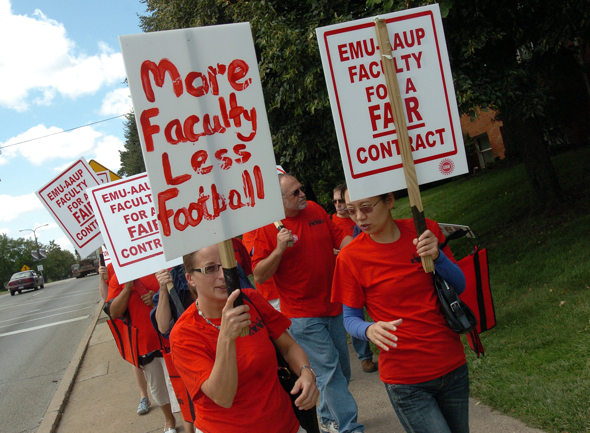
Robin Lucy, associate professor of English at Eastern Michigan University, marches with other members of the faculty union during a protest Wednesday. Lon Horwedel | AnnArbor.com
Here’s one thing the administration and the faculty union at Eastern Michigan University agree on - the gap between the two of them is pretty wide with less than a week to go before the current contract runs out at the start of the school year.
Here’s what they don’t agree on - how big a raise, if any, the professors should get; how much the professors should pay for their health benefits; and if the pay for professors should be tied to student enrollment numbers in any way.
And while negotiators plan to spend the rest of the week bargaining, the union has already set a meeting for Aug. 31 at noon that could include a strike vote. The contract for the nearly-700 member union expires on Aug. 31. The faculty union voted Wednesday to let its bargaining team use the threat of a strike during talks with the administration.
Striking is a route the faculty has chosen before. In 2006, faculty struck for five days, prompting the canceling of about 50 percent of classes. Instructors and lecturers who do not belong to the professors’ union taught the other 50 percent.
On Wednesday, as about 100 red-shirted faculty marched around the university’s administration building chanting their desire for a “fair contract,” union officials reminded the crowd of that strike and said that although they don’t want a repeat of that, they are willing to strike if necessary.
“The only thing that people in this building understand is you people putting pressure on them,” accounting professor and union treasurer Howard Bunsis told the crowd as he pointed at Welch Hall, the administration building.
The union is asking for a 4 percent raise in the first year, a 4.25 percent raise in the second year and a 4.5 percent raise in year three.
According to a chart put out by the administration, the average base salary for a professor is $76,096, while the average income actually paid out as reported on the 2009 W-2's was $87,880 (that includes any extra assignment pay). For administrators the average base salary was $90,478, while the average income actually paid out as reported on the 2009 W-2's for administrators was $84,080.
EMU is offering much-lower raises - no pay increases the first year, a 1 percent raise the second year and a 1 percent raise the third year. In addition, the administration's offer includes a possible 1 percent raise each year if a formula that relies on student enrollment and state appropriation is met.
The administration also proposes to include a provision that would pay a $5,000 salary increase to those who have been full professors for 10 or more years if they undergo an evaluation and meet various criteria.
The union has, so far, rejected the added bonus tied to student enrollment and state funding.
‘We don’t have any control over either of those,” said union president Susan Moeller, pointing out no other peer institutions have a similar program.
Kraft said that’s because EMU is trying an innovative program that rewards the faculty as the university gains.
Differing views
As she marched, Robin Lucy wore her red union shirt and held a sign exhorting the administration to spend more on professors and less on the football program that was winless last year.
“I think the offer (from the administration) was insulting and unfair,” the English Department member said. “We work hard and support our students.
“They are asking us to take a significant pay cut, when the health benefits are counted in. That’s not valuing our work.”
Administrators disagree.
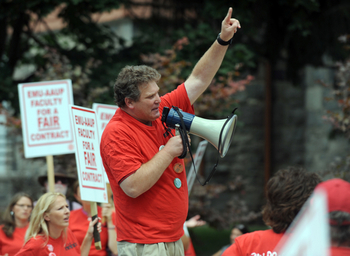
Faculty union treasurer Howard Bunsis speaks to the crowd at a rally on Wednesday. Lon Horwedel | AnnArbor.com
“The excellent faculty of Eastern Michigan University have demonstrated their commitment to providing students a high quality education,” said Provost and Executive Vice President Jack Kay in a press release. “Enhancing quality is the principle we have taken in formulating our proposal for compensation and non-compensation issues. Our proposal rewards faculty and enables them to share in EMU's success in increasing enrollment.”
It's the union who's being unreasonable, administrators say.
“Our salary offers are based on the current economic environment and address the dramatic increases in health care costs that must be considered in any agreement moving forward,” university spokesman Walter Kraft said. “The union’s salary proposal calling for a more than 12-percent increase over three years is simply unrealistic in today’s economic environment.”
Union officials also said the administration’s health care offer would raise health-care costs for an employee to nearly $5,500 out of pocket a year.
“We are working together in good faith to address the difficult challenges of our increasing health care costs, which rose more than 15 percent last year, from $15.7 million to $18.1 million,” said Kraft. Those costs are projected considerably higher this year due to significant medical cost inflation as well as federal health-care reform, which mandates coverage of adult children up to 26 years old, administrators said.
How much money?
A lot of the dispute centers on differing views of how much money the university has to spend.
Both sides agree that there’s $74 million in its reserves, which is 24 percent of its total expenses.
Administrators point out that's a lower percentage than Central Michigan University, Grand Valley State University, Ball State University, Kent State University and the University of Toledo. According to charts prepared by the administration, among institutions considered EMU's peers, only Akron and Western Michigan University have a lower percentage of their expenses in reserve.
Union officials point to a financial review done by Bunsis, which shows the university has increased its net assets over the last year.
“The university is in good financial shape,” he said. “We want them to do well. We support the zero (tuition increase, fee increase and room and board increase) imitative. It is increasing enrollment.
“We think the university's priorities should be in the core academic areas.”
Administrators said they don’t believe it’s good financial management to use one-time dollars like the money in the reserve to pay for ongoing expenses like salaries. They also said lowering the reserve could affect the university’s bond ratings.
Strike looming?
Over the last couple of months, the two sides have reached agreements on a number of smaller issues, largely around various work rules, but now that they are on to the larger financial pictures, the negotiations have slowed down.
In 2006, a fact-finder was brought in after the strike and an agreement was reached well into the school year. That agreement gave professors a 3.5 percent pay increase the first year, a 3 percent raise in the second year, a 3.6 percent raise in year three and a 3.75 percent increase in the final year. Professors also agreed to start paying about $1,000 per year in a premium for health insurance.
No one wants to guess whether or not professors will end up on strike. Instead, both sides said they hope to have professors report to work for various departmental meetings on Sept. 1 and be ready for students on Sept. 8.
“We want a contract on Aug. 31,” Bunsis said. “We want to be in the classroom when students arrive. We do not want a job action. That’s a last resort, but if it comes to that, we will take that step.”
David Jesse covers higher education for AnnArbor.com. He can be reached at 734-623-2534 or at davidjesse@annarbor.com.
Comments
braggslaw
Mon, Aug 30, 2010 : 6:07 a.m.
Steve, UM and MSU are different, their applications have been consistently up. They can charge whatever they want and students will still come. The comparison is not valid. If I were the administration at EMU, I would look at hiring non-union professors who would be more than happy to take the jobs.
Steve Krause
Sun, Aug 29, 2010 : 9:40 p.m.
bragggslaw, you ask if the professors at EMU are worth an increase in tuition. Well, yes, obviously. Though I'm biased. I think that EMU is in a similar place as CMU, WMU, GVSU, and some of the other regional schools in Michigan, both in terms of the kinds of students who attend and graduation rates. All of these other schools increased tuition and all saw increased enrollments this year. EMU's enrollment this year is overall up, but that's mostly a result of returning students and not as much a result of first year students. 0/0/0% is a great PR campaign and it sounds good. But it demonstrates first that supply and demand is not always tied to costs-- and we should have known that before. If it was always about costs, than EMU would be turning away 2 out of 3 students who apply and it would be U of M would be down in terms of enrollment. Unless there is a big turnaround in enrollment, that part of it will prove to have been a failure. Will it get EMU some goodwill in the state legislature and with the Michigan public? Maybe. Will that help funding here? That's a bigger maybe to me.
braggslaw
Sun, Aug 29, 2010 : 3:27 p.m.
Steve, As the taxpayer only pay 27% of the costs at EMU, any increase in teacher pay and benefits would have to come from students. So the argument is that the teacher's at EMU are worth the increase in tuition? May universities in Michigan can get away with increasing tuitions (UM and MSU) without driving away students, as demand outstrips supply. I don't think EMU is one of those. I suppose you could try. My understanding of EMU students is that the graduation rate is around 40% and the number of students applying was falling. The 0% program (brilliant in my opinion) increased the supply of students and improved enrollment numbers. Thus the inevitable results of the laws of supply and demand work as predicted again. cost went down and demand went up...
Jay Thomas
Sun, Aug 29, 2010 : 3:26 p.m.
EMU is a failure as an educational institution, much like Wayne State. When most of the student body does not graduate and leaves indebted how can it be otherwise? At least it provides employment for the faculty even though we can't really afford such a waste.
AlphaAlpha
Sun, Aug 29, 2010 : 12:48 p.m.
"It's a question of valuing quality by putting money into it--we are "university" faculty" Is there not a question of efficiency as well? You may not realize: you are overpaid by national standards. Your next assignment? Learn to do more with less, like the general population.
Dalex64
Sat, Aug 28, 2010 : 8:33 p.m.
I don't think that the percentage of administration vs teacher spending is meaningful. So, EMU spends a higher percentage on administration, and a lower percentage on teachers. How much do the teachers themselves make when compared with other universities? Raising teacher pay to reach a more equitable distribution of a budget is nonsensical. The teachers getting a smaller share of the budget does not mean the teachers need to get a larger percentage of the budget as pay. Overpaid administration is no justification for raising teacher pay. It means administration pay needs to be corrected. A hefty cut to the administration's share of the budget would improve the teacher's pay-as-percentage too.
Joanna.V.Scott
Sat, Aug 28, 2010 : 3:34 p.m.
In response to: "The fact that professors don't see the increased expenditure to cover higher health care costs in their paychecks is irrelevant", let me note that whoever posted this comment in response to mine ("sweat shops..."), misses the point of higher education entirely. The issue is "education first", to borrow our marketing logo, not "entertainment (football)first." Education first means, quite literally, the future of Michigan first. It's a question of valuing quality by putting money into it--we are "university" faculty, and teach at the very highest level, as well as being active researchers in our fields. Sadly, in spite of the fact we are proud to be a public institution that holds, along with others, the future of the State's economy in our hands, our Administrators persist in making non-education choices in funding. It is very troubling. Hope the State legislature doesn't notice..... Graduation rates are a very important and a very dangerous metric, not a poor one. As David Leonhardt at the NYT reported, naming EMU in the process, too may public institutions are doing badly on this measure. It's bring them in the front door, take their money, and don't commit to getting them out the graduation door with an EMU degree. State legislatures all across the nation are taking this issue seriously in funding decisions. Individual faculty cannot control grad. rates, just as we can't control funding. This is an Administrative matter in the end, since the coordination of services for "students in-students out" is in their hands. So, again, if we are to be held to a quantitative measure --more students, more pay--they should too. More students out the door with a degree in 5 yrs, more pay for Administrators. Only fair, I would say.
AlphaAlpha
Fri, Aug 27, 2010 : 9:22 p.m.
"We're talking about highly trained and skilled employees here." No more so than those in countless other professions. "Not that easy to replace." To the contrary; easily replaced. The fear of many public employees of fair competition is acute...
Hypnotique
Fri, Aug 27, 2010 : 7:31 p.m.
I don't think "Krista" is a real person... most likely a "Cyrano de Bergerac" for someone at EMU.
Hypnotique
Fri, Aug 27, 2010 : 7:30 p.m.
I don't think "Krista" is a real person... most likely a "Cyrano de Bergerac" for someone at EMU.
Steve Krause
Fri, Aug 27, 2010 : 4:57 p.m.
InsideTheHall (and others who have basically said "lock 'em out" or "let 'em get another job"): I won't even attempt to get into the complexities of the academic job market with this group, but hiring university faculty is not quite the same as hiring people to work at a fast food restaurant. We're talking about highly trained and skilled employees here. Not that easy to replace. And if EMU were to "lock us out," then you'd have 20,000 or so students out of luck and/or suing EMU since they can't finish their degrees without the professors around. No, this isn't much of a solution, I'm afraid. As for various "taxpayer" arguments: Sadly, public universities in Michigan (and across the nation, for that matter) are just barely public nowadays. EMU only gets 27% of its operating budget from the state; 10 years ago, it was probably closer to 50%. In other words, EMU is not as taxpayer supported as the Secretary of State office, for example. Bill, I appreciate your comments about the negotiation process, but I have to say that there is no way that faculty salaries ought to be tied to enrollment. True, we are a part of the formula by offering good programs and being good professors. But faculty have no say in who we admit, we have no control of advertising or marketing, we have no control over budgets, and no one at EMU has control over things like the Michigan and national economy. It's not like faculty are the same as salespeople working on commission. There's a reason why no university in the country has such a salary tied to enrollment incentive. Macabre Sunset, I too have mixed feelings about being a professor-- a professional, as it were-- and being in a union. But I should point out that there are lots and lots of professionals in unions all over the U.S.-- pilots, teachers, nurses, government workers, etc., etc.-- not to mention some high paid professionals like athletes and actors. Our union is still mostly about protecting workers from abuse, and if it were meant to be about getting us rich and boosting the number of professors, well, it's not doing a great job of that. And Krista (and anyone else!), you are of course welcome to comment on the blog I run, EMUTalk.org Just remember that my moderation is a little more strict regarding ad hoc attacks and repeatedly illogical and ill-informed opinions. Oh, and my thanks too to Dave Jesse, his article, and this discussion.
braggslaw
Fri, Aug 27, 2010 : 12:29 p.m.
Alain, "collectivize" please... Just like the union postal workers complaining because people are now sending e-mails instead of letters. How did collective farms workin the USSR? Cuba? China? I still remember the heady days when Castro motivated his people to create the largest sugar cane harvest ever.... didn't work, output dropped. When China privatized farms output doubled and tripled. You are entitled to your opinion... but it is wrong
Dante Marcos
Fri, Aug 27, 2010 : noon
Bragg Slaw, This will be like Karl Marx offering Sarah Palin a lift in his rental car, but in regards your quote: "if you believe you are not getting paid fairly, find someone who will pay you more. If you can't then your belief was wrong in the first place." In fact, the braver and ultimately more productive move to make, if you're not being paid fairly, is to collectivize, and from that position of solidarity, to bring your grievances to your employer. The discussions that ensue are often the basis for mutually-satisfying decisionmaking.
Technojunkie
Fri, Aug 27, 2010 : 10:30 a.m.
@Joanna: the graduation rate is hurt by students who run out of money to pay for tuition and helped by the grade inflation that's run rampant over the past 10+ years. Graduation rate is an unreliable metric though not entirely worthless. How much of that football revenue came from when they decided to essentially force students to buy season tickets in the form of a new student fee back around the time they built the football stadium? Drop the football program, drop the fee. Hardly anyone cared about football while I was a student. The fact that professors don't see the increased expenditure to cover higher health care costs in their paychecks is irrelevant. What it costs students and taxpayers to keep professors employed is all that matters. Same goes for pension funding. And federal payroll taxes. Total compensation, including the stuff the government tries to hide, is the metric that matters.
braggslaw
Fri, Aug 27, 2010 : 9:20 a.m.
joanna, You act as if your profession is a "sacred cow". Everyone... and I mean everyone should be accountable. Educators don't get a free pass. EMU professors are state employees. There are probably many private institutions that may better suit EMU professors looking for better jobs (or maybe not). I have always taught my children, if you don't like what you are doing, do something else.......if you believe you are not getting paid fairly, find someone who will pay you more. If you can't then your belief was wrong in the first place.
Joanna.V.Scott
Fri, Aug 27, 2010 : 7:21 a.m.
A thought as a faculty member and former Department Head, I am wondering why the education process is being treated with such disrespect. In the administrative proposal faculty are reduced to the status of piece-workers in a sweat shop--our pay increases tied to the numbers we process. Here's an equivalent idea--tie Administrative pay to graduation rates. That is, students come in, but what percentage leave with a degree because of a broken student aid, admission and advising system?
Krista Schneider
Thu, Aug 26, 2010 : 10:31 p.m.
I want to compliment Dave Jesse on a well written article. I also want to thank him for allowing a diverse array of opinions to be expressed here. There are some faculty-related blogs that are strong discourage comments that do not support their agendas. Since the university is a state-owned entity and its employees, including faculty members are also state employees, might it make sense to either a) allow the powers-that-be at the state level determine whether or not Eastern's faculty members receive increases or b) since their salaries are paid by the state, students via tuition and tax payers; she their increases be decided with a public vote?
AlphaAlpha
Thu, Aug 26, 2010 : 8:35 p.m.
Mr. Jesse - Thank you for your comment regarding the EMU employee base salary range being $88-90,000 per year. Base salary, as you likely know, is only a portion of total compensation-typically 2/3 for public employees. This means total compensation is approximately 50% higher than the base salary figures you cited. Average total compensation of EMU employees thus is approximately $132,000 - $135,000 per year, which is well over twice the US average employee total compensation of $58,000 per year.
InsideTheHall
Thu, Aug 26, 2010 : 8:32 p.m.
With 0% tution increase where will the money come from?????? Lock em out EMU. A month on unemployment may help the educational experience when they return.
braggslaw
Thu, Aug 26, 2010 : 8:25 p.m.
ok let's make this simple. The EMU teacher's union wants to take money out of my pockets (I am a taxpayer supporting the public institution that is EMU) and give it to them because they believe they deserve it. I say no.
Speechless
Thu, Aug 26, 2010 : 8:03 p.m.
The continual insistence that everyone follow some presumably "pure" law of supply & demand amounts to little more than expression of a secular religion. No such law exists in practice, anyway, as all economic activity involves various forms of subsidy which influence results and development. Democratic unions and governments alike have a right — as well as a social responsibility — to adjust the tendencies and results of the marketplace in order to facilitate a more humane and just society. It's the 21st century now, and it's best we all move past living the law of the jungle. The EMU staff in question should not abandon their union and forsake their future financial stability in return for a blind faith that the Good Lord behind the Invisible Hand of Competition will somehow magically take care of them. Even if St. Ayn Rand commands them to do so through a miraculous vision.
braggslaw
Thu, Aug 26, 2010 : 7:40 p.m.
Thinkplease, you are asking for a transfer of wealth from the taxpayers and students to the teachers. As a consumer and taxpayer, I am against subsidizing the faculty. If they don't like it they can get new jobs.... like people in the real world.
thinkplease
Thu, Aug 26, 2010 : 7:21 p.m.
Braggslaw, "Not a public works project for Philosophy and English professors"? Still regressing but at least we have some insight now. You see no use for the arts and can't understand why a professor of philosophy or English should get paid to "sit around and think." Why should universities continue to offer anything outside of B.S. those are the "real" or "useful" degrees, right? We solved the problem for those who wanted nothing more than a technical education a long time ago by creating technical colleges. Obviously, if all you desire is ITT Tech then paying tuition at any liberal arts university would be a bad choice.
braggslaw
Thu, Aug 26, 2010 : 6:14 p.m.
thinkplease, I agree with you, a university is for teaching and learning. It is not a public works project for philosophy and English professors. There are thousands of phd's who would love to have those jobs. I say let supply and demand work towards the correct result.
katmando
Thu, Aug 26, 2010 : 6:10 p.m.
Sunset: where did I say spending? I said underfunded also I stated that EMU has the most NCAA quailied teams 22 the most in the MAC. That is why they are underfunded, most MAC universities have only 16 that is why they spend less. And yes athletics should be left out of this. The adminstration deserves the same pay increase as they give. They also deserve the same medical and dental.
Macabre Sunset
Thu, Aug 26, 2010 : 5:57 p.m.
And, just to add to katmando's absurd comment. EMU is 5th among the 13 MAC schools in athletic department spending - about half the conference is within a 5% spending window of each other. It's completely irrelevant to bringing the athletic department into this argument - on either side.
Macabre Sunset
Thu, Aug 26, 2010 : 5:02 p.m.
Only nine football teams in the country bring in as much as they spend. EMU is not on that list. It's fair to say the university supports its athletic teams. However, athletic teams help with marketing. It's harder to attract students without a division I sports program. Even non-athletes. Everyone is taking pay cuts these days. Unions are only negotiating themselves out of jobs. Pretending that the offer is some sort of insult, or that the university doesn't value the staff is just a silly negotiating tactic that will end up backfiring. Unions were once necessary to protect workers from abuse. These days, they are a shell of what they once were. I can't imagine calling myself a professional and belonging to a union. That's a mutually exclusive concept.
Heardoc
Thu, Aug 26, 2010 : 4:57 p.m.
With 10% unemployment (that does not include those that have given up on looking for job)-- if you have a job you should be happy. If you have a job like a professor at EMU -- YOU SHOULD QUIT COMPLAINING!
katmando
Thu, Aug 26, 2010 : 4 p.m.
The reason EMU has "absurdly under-performing athletic programs" is that they are very much under funded compared to most if not all other MAC universities. We have the most NCAA qualified teams (22)but spend the least on them. The football team will more than likely bring in close to 3 million and should pay for its self.
thinkplease
Thu, Aug 26, 2010 : 3:48 p.m.
Wow Braggslaw, you clearly didn't read the same post I did. Eastern is in very good condition fiscally. Therefore, being an institute of higher education, they should be passing that positive position on to those people (professors) who make higher education possible. I would say that when it comes to a university's finances professors are ABSOLUTELY entitled to pay reflecting the years they spent in higher education. The question is why is EMU giving these professors a hard time about their pay when they have no issue dumping money into absurdly under-performing athletic programs. You don't seem to have much regard for higher education or the time and money it takes to achieve it, fine. Your entitled to your opinion. But a university is by definition an institution whose sole purpose is higher education.
HaeJee
Thu, Aug 26, 2010 : 3:30 p.m.
I worked and graduated from EMU two times and love many of the professors that I had, which is why I tolerated the administration. I would love to see the administration salary be cut by 20% in pay and increase the pay for the professors and instructors. The real people who keep enrollment at that school. The V.P.'s at that school are a joke, which makes me loss respect for all of administration there.
braggslaw
Thu, Aug 26, 2010 : 3:05 p.m.
SalinProf, you had many ideas, reasons, excuses etc. in your rather long post. This is a simple issue. Nobody is entitled to anything no matter how long they went to school. The market is the only objective measure of a person's value/salary. If you are a liberal arts professor there are thousands of Phd's banging down the door for a professorship at any unversity. If you are Phd particle physics professor there might be 4 of you in the world and universities are banging down your door. Not all degrees are created equal. So I find it a very weak argument when somebody brings up the twelve years they studies Elizabethan Poetry and how that should be equivalent to twelve years spent in nuclear physics. Just sayin..
SalineProf
Thu, Aug 26, 2010 : 2:57 p.m.
I am currently an assistant professor at EMU and feel the need to address some of the comments given relating to contract negotiations at EMU. I understand why there are those in the community who feel that professors are overpaid and believe we only work for a portion of the year. I think that, as teachers, we need to acknowledge that we generally have a choice as to whether we wish to teach in the summer and that there is a general perception that, by having our summers "off," we have some of the cushiest jobs around. The flip side to that argument is that during the school year we don't have the time necessary to do serious research. As educators in higher education a major part of our job is research. We are evaluated every year based on our scholarship/research, teaching effectiveness, and service to the University, community, and academia at a local, state, regional, national, and international level. To be effective in all of these areas requires a major time commitment beyond just the time we spend in the classroom. Being a truly great and devoted teacher at any level isn't about the money. Those of us who choose the path of education choose to continue in it because we're passionate about teaching and making a difference in our communities. If it was about money, the private sector offers jobs that pay much better for the majority of college professors. Another factor that isn't discussed regarding the amount of time teachers invest at EMU, is that we're required to hold 5 office hours a week to meet with students. That may not seem like a lot but it is the better part or one work day a week. I believe that these hours are important for the students who choose to take advantage of them and should be known to those who make comments such as "you only teach 3-4 classes as semester." We are also required to participate in committee work that can take from a couple of hours of work to many hours a week depending on the committee and the time of year. In speaking with a neighbor this morning he was telling me how the company for which he works was doing well and that they actually just hired five new people. EMU's financial situation is apparently the best it has been in many years. It is so strong that they were able to offer the 0% tuition increase for 2010-2011. I know that there are many people in Michigan who are hurting. I see it in the families of my students and in the sacrifices they make to get their kids to school. If EMU's financial situation were bleak, it would be time to discuss why the situation is bleak and to see where we all could cut back between salaries and/or benefits. The situation for my neighbor's company isn't bleak and they hired new employees. I don't believe anyone would begrudge those employees for finding gainful and well-paying employment. Why should the professors at any institution who is financially sound be held to a different standard? The last point I would raise is that I spent 12 years in college to gain my doctorate so I could pursue my chosen career. I am much more the norm in this regard, as most of my colleagues have their doctorate. Medical doctors spend a similar amount of time in school to become doctors, with the knowledge that they will be properly compensated in a way that will help them to pay back the investment they spent on their education. College professors, in general, make much less than medical doctors but have also spent many thousands of dollars while pursing graduate school. To illustrate this point, I currently make around 57,000 dollars. To most people that sounds like an excellent wage. I am grateful to have employment in today's economy and appreciate why that sounds like a lot to many people; however, when I take into account what I spent on my own education and what I currently pay back in student loans every month, $57000 doesn't go as far as it may seem. I hope that people on both sides of this issue realize that it is much more complex than miserly administrators and money-hungry professors. I look forward to a day in Michigan where all of our students are afforded the highest levels of education and that there is a good paying job for everyone who wishes to live here. I hope that the general public will come to learn that college professors do work year round and that much of the work of an educator is work that isn't reflected in the simple definition of how many classes we teach. And I hope my colleagues acknowledge the public perception of our "ivory tower" and feel as grateful as I do be working in a profession we love.
Bill
Thu, Aug 26, 2010 : 2:50 p.m.
EMU administration needs to step up with a reasonable offer and I suspect that the Union would be willing to negotiate in good faith. I'm in the private section and I have had a pay decrease in the past years due to the economy. I still believe that the EMU professors should have a reasonable pay increase even during these tough economic times. I do not believe that most of the professors have a "cushy" job by any means. I have friends on the faculty at EMU and I know the amount of hours they put in providing a quality program or class that is not a part of their hours on campus. While professors may make higher than some national average salaries, the education required for these jobs are higher as well. You also have to consider what the professors could make in the private sector in their field of expertise. Someone commented about Howard Bunsis salary being high. With his background and education, he would most likely hold a high ranking executive position in a firm, making several times his current salary. I fail to understand why the Administration at EMU always comes to the table pleading poverty. If the situation at the university is that dire, then across the board pay decreases and/or pay freezes should be in order along with reductions in unnecessary administrator positions. Faculty members are required in order to teach students who are the actual customers of the university. I will disagree with the comment by a faculty member however regarding enrollment. While faculty has no direct control, they do have influence over enrollment by providing superior programs which will attract students to EMU. Each faculty member should look at their programs and ask themselves if their program is a best-in-class program. If the answer is no, the faculty member should develop a plan of action to correct the situation and make their program the best. If the administration wishes to tie faculty raises to student enrollment and funding, then administrators pay should be tied to that same program. This will encourage both administrators and faculty to work to bring in more students.
katmando
Thu, Aug 26, 2010 : 1:39 p.m.
The indoor practice field was paid for by donors not out of university funds. The football team normally breaks even in expenditures and with playing 3 big conferences teams this year should more than break even. The biggest problem I see is that the adminstration is offering much than what they are getting. That 10.85% was over 3 years not 10.85% every year like you have written. This also came with higher copays and deductables for medical and dental coverages. So basicly the union broke even.
catfishrisin
Thu, Aug 26, 2010 : 1:20 p.m.
At least now people will realize that "Education First" is a fake slogan. When it comes down to it, education is last. Athletics and administrative bloat are what really matter.
liekkio
Thu, Aug 26, 2010 : 1:06 p.m.
"How about making me a member of your union so I can get a big fat raise". Well, what's the problem? Apply, get hired, get this "cushy job".
catfishrisin
Thu, Aug 26, 2010 : 1:05 p.m.
Stunhsif, Do you really believe you fund any and all public education? Wow, thanks, you are the man! P.S. What part of 25% state funding don't you understand?
braggslaw
Thu, Aug 26, 2010 : 1:03 p.m.
Steve, I don't consider it bargaining. I consider it a shake-down for tax payers and students. The results of union bargaining are littered in the wreckage of the automobile industry, the steel industry, etc. etc. Companies rotted at the core due to union collective bargaining that no longer have the capital to investe in new products and competitive processes. If you don't think you are being paid fairly...quit and get a new job that pays you more. If not I would suggest you comfort yourself that you have a job and a steady paycheck on the taxpayer's and students' dime.
stunhsif
Thu, Aug 26, 2010 : 12:40 p.m.
As a taxpayer who funds any and all public education I am disheartened to read posts from profs at EMU who truly believe they are entitled to these massive pay raises. The last go around they got 10.85%, if this demand for 12.75% goes through that would equate to a 23.7% pay raise over six years. This would equate to a five figure pay increase for the average prof salary, which is unconscionable given the state of this economy over the past 4 years here in Michigan. Wages in this state have gone down dramatically, unemployment is over 12% and the unions just keep demanding more and more. I personally am not going to sit on the sidelines and keep getting beaten up. I have to somehow come up with 3500 dollars to pay my summer taxes by Sept 14th or pay a penalty. How about making me a member of your union so I can get a big fat raise. I have not had a pay raise in 4 years and took a 5% paycut in april 2009. You do not have my support, that is for certain.
Woman in Ypsilanti
Thu, Aug 26, 2010 : 12:23 p.m.
It is always amusing to me to see people complaining about the cushy working conditions experienced by those in academia. In the first place, as a general rule jobs held by those with the most education tend to be nicer from a working conditions point of view than those jobs held by those with the least education. Yes, it really is nicer to be a teacher than it is to be a ditch digger. In the second place, from what I have heard from friends who are university professors, it isn't necessarily all that cushy. It certainly doesn't sound cushy enough to make me want to get a Phd and deal with it. I'll stay in the private sector, thanks. As an EMU alum, I can say that the professors there made my time at the school productive. I learned a lot from them and think they probably really do deserve all that they are asking for.
Speechless
Thu, Aug 26, 2010 : 12:01 p.m.
It's certainly heartening to see that the Great Recession provides the cheerleading, far-right fans of the union bashing an ongoing opportunity to indulge in schadenfreude. With barely concealed delight, they call for the attention of unionized EMU staff while pointing in the distance toward those less fortunate who roam the streets as homeless, or as unemployed without health coverage, or who prepare for foreclosure on their homes: "If not for the grace of god, there go all of you! Knuckle under now to your masters at the university, before it becomes too late for you as well!" If union bashers want EMU staff compensation based on the standards of the less fortunate and the destitute, then why shouldn't staff counter by demanding to be evaluated on the basis of corporate executive salaries? For them to do so wouldn't be any less illogical than what the bashers ask. In the minds of union bashers, anyone who engages in collective bargaining and insists on fair treatment will always be in the wrong, no matter what the circumstances, while those at the top of the hierarchy never deserve worse than a mild wrist slap, no matter what the indiscretions by management.
InsideTheHall
Thu, Aug 26, 2010 : 11:58 a.m.
Put em on the street they'll get religion real quick. If they are good they will get snatched up by other universities with a pay raise. Reality is the mediocre EMU profs will get no takers.
xmo
Thu, Aug 26, 2010 : 11:51 a.m.
Maybe they should hire scabs teachers, I know that the present teachers are the highest paid but are they the best teachers we could get for the money?
Steve Krause
Thu, Aug 26, 2010 : 11:48 a.m.
braggslaw, one of the reasons we have unions in this country is to allow for people to earn the wages they are entitled to based on the work they are performing. This is called "bargaining," and it is certainly something that folks in Michigan ought to be familiar with. I don't think anyone at EMU-- and that includes the administration, frankly-- are trying to shake down taxpayers or students or anyone else. But people are certainly entitled to ask/bargain for a fair contract. Rodney Nanney, I don't know how your math works, but if you think that faculty at even the high end of the range in salaries are going to be getting a $10,000 + raise, well, you're nuts. Very VERY roughly speaking, if the union got all it asked for and if insurance ends up costing me an extra $2000 a year, then I would end up with about a $1,000 a year pay raise before taxes. And I should point out that as a full professor (I've been here since 1998), I am in the upper third of the pay for faculty at EMU; a newer and inevitably not as well paid faculty person would get less, and in many cases, significantly less. After taxes? I guess it means about another pizza a month, give or take.
Rodney Nanney
Thu, Aug 26, 2010 : 10:32 a.m.
Do the math - this clueless public sector union is demanding a guaranteed five-figure increase in income for an average EMU professor, at a time when private sector incomes are falling and private sector unemployment rates remain at historic (and painful) levels! Yes, EMU has a top-heavy administration - that has been the case for 25 years or more. Fortunately, EMU finally hired a president who understands the economic realities in which we are living and is starting to do something about that (the 0% 0% 0% tuition/fee freeze was a brilliant move, and should be continued!). As much as it would hurt my family and people I care about, I would much rather see this clueless union leadership fall flat after suffering through a prolonged strike (where they might get to feel a bit of this Michigan depressocratic economy!) than see the EMU administration give in to highway robbery and blatant union thuggery.
braggslaw
Thu, Aug 26, 2010 : 10:19 a.m.
People get paid what the market will bear. If you believe you are worth more... find someone willing to pay your more. If you cannot find someone willing to pay your more than your belief is wrong. Don't shake down students and taxpayers.
justthefacts
Thu, Aug 26, 2010 : 10:08 a.m.
Bob, In the "real" world...most people who have gone to college for 10 years DO make the salaries these professors make.
bob
Thu, Aug 26, 2010 : 10:01 a.m.
Regarding faculty hours.... Copied directly from the faculty contract on emuprofessors.org ARTICLE XXVI. COMPUTATION OF WORK TIME 1001 In those instances in which the computation of the number of hours in a regular Faculty Member's workday, workweek or academic work year is necessary, the following formula shall apply: 1002 One (1) full-time academic year or its equivalent = 34 weeks 1003 One (1) full-time academic year or its equivalent =1,360 hours 1004 Faculty appointments of less than full-time shall be prorated in accordance with the above formula. In the "regular" business world full-time is 2,080 hours. 1,360 hours is 65% of full time...not a bad deal for $76000 per year (works out to $55 per hour)
bob
Thu, Aug 26, 2010 : 9:55 a.m.
@Jay - you state "To answer a question the professors at EMU have no retirement benefits--most work year round--they don't have summers off--summers are the time where most professors conduct research--which is a REQUIREMENT to keep their jobs!" Per the faculty contract on the emuprofessors.org website they DO get a retirement - see page 102. And I know professors who spend the summer vacationing & visiting friends...NOT working on research. They teach in the English dept.
Technojunkie
Thu, Aug 26, 2010 : 9:45 a.m.
While I don't dispute the incompetence and wastefulness of EMU's administration, with tax revenue plummeting along with the incomes of EMU students and parents where is the money to fund any pay increases going to come from? Drawing down reserves now seems very short-sighted when the Second Great Depression is still ramping up. Student loan debt is the next financial bubble that will burst. The 0/0/0 plan was a belated necessity. Loading up on more and more debt for degrees that have been devalued by EMU's decreasing admissions standards is very dangerous for students in this economy. I'd like to see the EMU football program put out of its misery. Much of the administration ought to be fired. Put the savings into keeping tuition down.
Jay
Thu, Aug 26, 2010 : 9:28 a.m.
Take an accounting or business class--the 10.75% that you quote was negotiated years ago--AND was the decision of a state appointed Fact-Finder! That is a non-biased third party examined the facts and made the most fair decision. This time around, from the data, it looks like the faculty is proposing break even points--increases in healthcare contributions (which the faculty team has proposed) coupled with pay increases that will basically offset those over time. Faculty don't have anyway to control increases in enrollment besides the social and economic factors--there is a whole division (administrators) including media, enrollment services, etc who are highly paid that make those decisions--professors see the students once they are on campus and in class--I think they may be able to impact retention. BUT--they have no hand in deciding the criteria for admissions--so retention is hard to figure out too because EMU admits some who are very under prepared. Also, I am sure that the 4 million spent on a practice 'bubble' did nothing to recruit OR retain students. The salaries for the admin that control enrollment is : $821,000! See slide 26 on the link above.
Steve Krause
Thu, Aug 26, 2010 : 9:19 a.m.
stunhslf, as far as I can tell, you're assuming I received a 10.85% raise with the last contract. I guess that's true over three years-- that is, if you add up the 3% or so each year for 3 years. But that's not exactly the same as just getting a 10% bump to my pay in one year. I wish, frankly! No, the raises I've received are pretty much keeping me steady with cost of living, health care expenses, etc. And again, the same is true for what the faculty are asking for this time around too. glimmertwin, I'm not trying to make myself or EMU sound more important than it is. Actually, just the opposite. I was trying to point out that it doesn't make much sense to compare EMU to U of M for a bunch of different reasons, but it does make sense to compare EMU to WMU, CMU, etc. And when you do that, the way EMU spends money on faculty versus administrators is upside-down. And while I'm not going to do it here, I would dispute the way you are disparaging EMU as a "commuter school" where anyone can get in. Sure, we're an "opportunity granting" institution, but we also have highly qualified faculty, we have regionally and nationally recognized programs, etc., etc. We're a "real school" here, not a U of Phoenix or some other nonsense.
justthefacts
Thu, Aug 26, 2010 : 9:15 a.m.
First of all, let's put aside the so-called "highly overpaid faculty." All employees at EMU are on the same health care plan and pay the same premiums for said health care. That means that the clerical worker, who makes less than $30,000 per year, will be asked to absorb these new health care premiums. This will be a 10 - even 20% pay cut for them. What happens at the bargaining table for the faculty will effect the entire university. That being said, anyone who knows how negotiations play out knows that the bargaining unit always asks for much more than they know they will end up getting in the end. Just because the faculty are asking for over 12% over three years does not mean they expect to receive this sort of increase. They may not even be expecting an increase at all. They are looking to not take a pay cut from a University that is financially stable and is using the current economy as a scare tactic to justify imposing pay cuts across the campus. Education first means providing a quality education to students by quality professors. As my mother always told me, "You get what you pay for!"
stunhsif
Thu, Aug 26, 2010 : 8:57 a.m.
@SteveKrause, "with the increase in healthcare costs-which is pretty significant,the raise that the union is asking for is more or less is a "break even" proposition. No one is goint to be getting ahead on this". With all due respect Steve, have you read any of the posts others have written? You've gotten a 10.85% raise the past three years which far exceeds the measly 1000 dollars you have to pay into your health insurance and now you want a 12.75% raise for the next three years and say it a "break even" proposition. I don't think so, nor does anyone else. The "entitlement" attitudes of these education unions is really mind boggling, they are so disengaged from reality.
glimmertwin
Thu, Aug 26, 2010 : 8:46 a.m.
>> And compared to a place like U of M? We make WAAAAAYYYYY less money. Than get a job a UM. EMU is a commuter school where if you can pay, you can get enrolled there. I find it amusing at how employees when they want something can make themselves sound important.
Steve Krause
Thu, Aug 26, 2010 : 8:35 a.m.
As a professor at EMU and the keeper of a blog about some of this stuff, a couple of brief thoughts: * With the increase in health care costs-- which are pretty significant-- the raise that the union is asking for more or less is a "break even" proposition. No one is going to be getting ahead on this. * If EMU is now going to plead poverty-- we don't have enough in reserves, we have to pass along the health care expenses, etc.-- then why were they claiming just a year ago that EMU was running a surplus? And why would they engage in this 0/0/0% marketing gimmick if they couldn't afford it? * When you compare EMU to other similar institutions in the state, EMU pays less as a percentage of its budget than any other in faculty salaries, and it pays more as a percentage of its budget than any other in administration salaries. That's messed up. * As for how much faculty make: averages are pretty meaningless numbers because how much someone does or doesn't make depends a lot on the discipline they are in. For example, Howard Bunsis and I came to EMU at about the same time, and we both have PhDs and credentials and such (though Howard also has a JD and is a CPA). But he makes way more money than I do because I'm in a field-- writing studies/English-- where faculty make significantly less money. That's the way the world is; you may have noticed that lawyers, doctors, accountants, and CEOs tend to make more money clerks, elementary school teachers, carpenters, and auto mechanics. So just because someone makes $50K or $100K or $150K doesn't mean they are overpaid. It depends on the job, right? The bottom line is that faculty at EMU-- compared to faculty at similar institutions (WMU, CMU, Grand Valley, etc.)-- make less money, and they make dramatically less money at the upper-levels. And compared to a place like U of M? We make WAAAAAYYYYY less money.
stunhsif
Thu, Aug 26, 2010 : 8:26 a.m.
These professors got a 10.85% pay raise the past three years and in that contract all they gave up was having to pay $1000.00 per year( less than 20 bucks a week) toward their health care. Now they want a 12.75% pay raise for the next three years! Is this for real folks, I cannot believe this, what a slap in the face of the taxpayers and students. Most of us in the private sector have not had pay raises in years, are on paycuts ( 5% since 09), have had profit sharing taken away (not that our companies are currently making a profit) and pay hundreds of dollars a month for health insurance. I say we start over. Fire all the administrators and the professors and get folks in place that care about the kids and want to teach. None of us disagree with you Jay with how the university has spent big money on programs they probably should not have ( football) and given big raises to lawyers and administrators but "two wrongs", don't make it right. The facts are the professors have cushy jobs, they work less than 40 hour weeks, they get paid for extra work, their health care benefits and pension are second to none, and they get summers off if they wish or they can work and get paid more money. I graduated from EMU in 82 and have not given them a dime for the past 4 years for many reasons. This mess will ensure that my hard earned money never ever goes to EMU moving forward.
Krista Schneider
Thu, Aug 26, 2010 : 8:01 a.m.
To correct myself - W-2s. Somebody...please FOIA faculty payroll data. The truth will come out.
Krista Schneider
Thu, Aug 26, 2010 : 7:54 a.m.
Are the students and public aware the Howard Bunsis makes over $100,000 a year? That many of the professors "MANY" make close to $150,000 a year? Are the students and public aware that MANY of these faculty members only work September through April and might teach 3 or 4 classes per term? That for online classes, faculty are paid extra money for the online students and for each enrolled student over a certain number, they are paid extra money? These professors are crying poverty when they make much more than they are claiming. Also, does anybody recall the pay freezes that occurred last year for the Top 100? Has ANYBODY received any pay increase yet this year? Health care - everybody is going to pay more. Would it be better to have no health care at all? Faculty are crying poverty, when in fact, they are not. Let's find a list of what all faculty members are really paid (W-4s perhaps) and find out what the REAL story is.
Henry Ruger
Thu, Aug 26, 2010 : 7:49 a.m.
Average professor pay is given. Does this include assistant and associate professors? What are the pay ranges? Who counts as an administrator? E.g., are academic advisers and computer programmers in that category? Faculty don't have control over enrollment, the union says? That's a laugh. If the faculty do well, enrollment does well. They don't want to be held responsible collectively for enrollment? Then why is there collective bargaining?
Bryan123
Thu, Aug 26, 2010 : 7:49 a.m.
To use the fact that EMU has healthy cash reserves as a reason that EMU can afford significant salary increases doesn't make sense. Is the implication that EMU can afford to budget a deficit and deplete the reserves so that they can pay higher salaries? As someone pointed out, EMU is doing well financially right now. But that can change quickly. If EMU does hit a rough patch, then they'll be starting with reduced reserves and their burn rate will quickly excellerate. If the implication was just that EMU has healthy cash reserves, so they're in good financial shape and can afford to pay higher salaries, I wouldn't buy that either. The fact that they've been financially prudent and planned for difficult times doesn't mean that there's a surplus that can go towards higher salaries. I can understand wanting some of the bloated spending to be redirected towards faculty pay (since skilled faculty are the number one factor in a quality education), but the cash reserves really have nothing to do with this issue.
Blue Eyes
Thu, Aug 26, 2010 : 7:29 a.m.
A raise of any kind? Where are all of the comments about being grateful to have a job and being way overpaid already?...or are those reserved only for City of Ann Arbor employees?
glimmertwin
Thu, Aug 26, 2010 : 7:16 a.m.
Who else but government and education employees think that yearly raises are just fine while those that pay tuition are struggling and cannot keep up with current higher education costs. Raises mean higher tuition. Get a grip. Typical academia - not in touch with the real world. This makes me sick.
Jay
Thu, Aug 26, 2010 : 7:05 a.m.
Faculty pay only makes up 25% of the University budget--so what is driving tuition costs is NOT faculty pay! It is the other 75% which includes the irresponsible spending on bloated administration and waste on non academic priorities! EMU is not heavily reliant on tax payer dollars. EMU, is in the best financial shape it has been in for decades--these are good financial times for EMU. Revenues are up, enrollment is up. Why is this? It is likely that the hard working professors have something to do with it. SO, now you want to punish them and cry poor? University's that are financially strapped do not spend like EMU does on crazy stuff--I am tired of people using the poor state of the economy in Michigan as an excuse for everything. To answer a question the professors at EMU have no retirement benefits--most work year round--they don't have summers off--summers are the time where most professors conduct research--which is a REQUIREMENT to keep their jobs!
Rasputin
Thu, Aug 26, 2010 : 6:59 a.m.
EMU's strength is in its academic and professional programs, not sports. However, school officials have always funneled monies into pathetic sports programs. It is time to pay teachers what they deserve and to provide them with proper offices, supplies, and support staff. I entertained teaching a class or two at EMU until I found out what it paid. Let's just say I couldn't afford to take the job because I would have had to move into a homeless shelter. If any of you had to live on an EMU Adjunct Salary, you would go ballistic. It is really that bad.
northside
Thu, Aug 26, 2010 : 6:55 a.m.
Anyone familiar with the track record of EMU's Administration will know what the faculty are up against: * Belittling the university's status during the last negotiation * Spending millions on a Presidential mansion * Failing to inform students of a murder of campus
Jay
Thu, Aug 26, 2010 : 6:53 a.m.
As a Michigan taxpayer and an EMU alum, what I expect is that a public university put my money into education. Real education, not 'campus beautification' not athletics, practice fields and pretty signs around campus. But hiring and paying qualified educators. If EMU keeps offering pay cuts and higher health care how will they attract the highly qualified educators? It is ludicrous that the football coach makes $350,000/year. It is outrageous that the university attorney got a pay raise last year of $85,000. And the Chief Financial Officer got a pay increase of $35,000! The professors are the ones that teach us, do the research, serve the community. They are the ones that help us find jobs, answer our questions day and night. Spend countless hours preparing and serving students. EMU needs to invest in those folks that actually help students, not those that sit behind the closed doors pretending to be important.
nekm1
Thu, Aug 26, 2010 : 6:41 a.m.
I swear to God, teachers have NO clue. Keep pushing the taxpayers (your bread and butter) and keep pushing the student costs (the reason YOUR there) to the limit. My health insurance costs my wife and I $350 per month with an $8000 deductable. That is the REAL world. You folks, with your summers off, weeks of more vacation around the holidays, and many of with with classes only a couple of days a week, need a dose of reality. I wish the administration had the courage to tell you all to go home. Maybe a few months on unemployment at $350 a week would give you a better clue on life. Quit complaining, accept the pay you get for now.
steven
Thu, Aug 26, 2010 : 6:33 a.m.
you know how they get a lot of this money? by refusing to even consider transfer students' appeal for residency, they are charging me an additional $12,000 each year, even though i will have completed 3 years worth of classes at EMU, and have a job lined up in the area when for when i graduate, they say since i am not in the military and i do not own property i cannot be considered, also you cannot apply for residency tuition while attending EMU (how bogus is that?). guess who made these ludicrous rules...the board of regents.
David Jesse
Thu, Aug 26, 2010 : 6:32 a.m.
According to a chart linked above and put out by the administration, the average base salary for a professor is $76,096, while the average income actually paid out as reported on the 2009 W-2's was $87,880 (that includes any extra assignment pay). For administrators the average base salary was $90,478, while the average income actually paid out as reported on the 2009 W-2's for administrators was $84,080.
InsideTheHall
Thu, Aug 26, 2010 : 6:28 a.m.
Is there a salary link for EMU similar to what the Michigan Daily used to post for UM?
InsideTheHall
Thu, Aug 26, 2010 : 6:27 a.m.
Hold the line EMU. Higher education is the last protected bastion in America. These folks have cushy jobs and are way way overpaid. Put them on the street for a few weeks and they will come scampering back. The Michigan taxpayer demands it!
McGiver
Thu, Aug 26, 2010 : 6:25 a.m.
How about some numbers, AA.com? What is the total benefit package of Professors and Administrators. Including retirement. And, how about the number of hours these folks work. I am a little tired of hearing complaints from public educators only to find out they are already paid more than I think fair and work fewer hours than the average worker and retire younger than anyone in the private sector. Ditto for the administrators. these are ALL public employees folks and it is past time they behave like it.
thinkplease
Thu, Aug 26, 2010 : 6:04 a.m.
Call me an idealist, but I would prefer my university to be first and foremost an educational institution. It has been pointed out that Eastern continues to dump money into their "midget" football program, pointedly that worthless bubble so the team can practice inside out of the cold. As for administrative bloating? The section of Eastern I work in has no less than FOUR directors (of some capacity) overlooking its operations! Yet, they are running the professors through the ringer. Without Professors there is no university. It is time this country's universities realize that their number one job by far, is to educate those of us who are paying them to do so.
Jay
Thu, Aug 26, 2010 : 5:58 a.m.
I found this at emuprofessors.org. Look under "Support and analysis of EMU-AAUP proposals August 2010" It's pretty long, but it gets very interesting at about slide 21. Emu professors are far behind most all of their comparable institutions in terms of salary. BUT the administrators at EMU are far ahead of all their peers. The pay increases for those at the top are outrageous! Last year one guys (administrator) pay went up like $36,000. WTH?
AlphaAlpha
Thu, Aug 26, 2010 : 5:46 a.m.
So, what are the compensation numbers? Average pay? Median pay? Including all benefits? Current and proposed? It would be interesting to see how the current and proposed total compensation compare to the ~$58,000 per worker national (BLS) US average total compensation.
Jay
Thu, Aug 26, 2010 : 5:33 a.m.
The administration forgot to say that they gave themselves on average an 8% pay increase! Spent about 3 million on an indoor practice field and then gave a bunch of extra money to the losing football program. Now they want to stick it to the professors! Seems like they would get rid of some administrative bloat and start putting resources into actual 'education' and 'educators' that actually benefits all of us students rather that mismanaging money. Completely irresponsible leadership.
dading dont delete me bro
Thu, Aug 26, 2010 : 5:28 a.m.
sweet, more summer vacation?