

Superintendent: 23 steps to closing Ann Arbor's discipline gap in schools
Ann Arbor Public Schools Superintendent Patricia Green answered questions and discussed her plan for improving the district’s suspension and expulsion data Monday at the Student Rights and Responsibilities Forum.
She distributed a concept paper to audience members that outlines 23 potential “next steps” for closing what she refers to as the “discipline gap.”
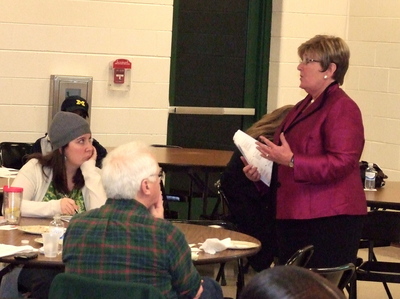
Superintendent Patricia Green describes her plan to improve Ann Arbor’s discipline policies to a crowd of about 40 people at Monday’s Student Rights and Responsibilities Forum, hosted by the ACLU.
Danielle Arndt I AnnArbor.com
Carmelita Mullins, a member of the ACLU’s Washtenaw education committee, said her group recently reviewed the discipline policies of Ann Arbor, Milan, Saline and Ypsilanti and found the policies at AAPS “very disappointing,” she said.
Green, who joined the district in July, described how her plan would be implemented throughout the next three years.
“Kids can be involved in conflict resolution,” she said. “It’s important to cultivate leadership at a young age.”
Green said to do that, she will propose having children in the upper grades from each elementary school come together for leadership training. She also intends to initiate a “Peace Education Campaign” in which the schools would fly a flag outside their buildings to indicate there were no major conflicts that day.
She said the idea is to empower children and their friends to start looking for positive behavior and to celebrate the goods things children do daily. Green added she would reward the “most peaceful schools” at the end of each school year.
Leslie Desmond, a trustee for the ACLU board, called Green’s attitude and commitment to the facts of the issue “wonderfully refreshing.” The nearly 40 audience members applauded Green for participating in the forum and for answering their questions.
The remainder of Green’s 23 steps include:
- Establish clear guidelines and procedures for removing a student from class for a timeout or detention.
- Develop a district-wide discipline referral form to better collect and analyze patterns and trends regarding student behavior.
- Analyze behavior issues, such as bullying, in the context of school climate information.
- Develop school-by-school discipline plans, as part of the overall school improvement plan, with clear and consistent rules for the classroom and the school by using positive expectations.
- Include student and classroom management as a factor/component in all district accountability measures. Also track each teacher and principal’s suspension/expulsion data and include in staff evaluations.
- Review the use of peer mediation and conflict resolution programs and consider on a broader scale.
- Consider staff training that focuses on pro-social development and the teaching of empathy, impulse control and anger management.
For further reading on Ann Arbor’s discipline gap, click here.
Related story: ACLU asks Ann Arbor community to share suspension, expulsion experiences
Staff reporter Danielle Arndt covers K-12 education for AnnArbor.com. Follow her on Twitter @DanielleArndt or email her at daniellearndt@annarbor.com.
Comments
AMOC
Wed, Jan 25, 2012 : 3:35 p.m.
As the parent of several kids who have been severely and repeatedly bullied in schools that use a "students talk it out" process to resolve conflicts among students, I want to make the point that this process almost always results in retaliation against the offended kid unless the adults in the school are unusually watchful and well-coordinated in their supervision of the students. Since the adults don't all know instantly who has done or said what to whom, or who has been in conflict with whom or why, they mostly can't be on guard for subtle or sneaky retaliation. The more this happens, the less faith the students or their parents will place in the process. Another problem is that many adults in the school system (not just teachers, but teachers are the largest and most-educated group of adults in the schools) do not have consistent standards for "respectful behavior" or "appropriate language". Some teachers discipline one student for behavior that was ignored or even praised in another student in the same class, without explanation to the class of "fair vs. identical" treatment of kids' individual situation and then assess additional discipline for "insubordination" if the inconsistency is pointed out. Getting all the staff members to agree on what "good behavior" looks like and communicating that information to all students (and their parents) is what the Positive Behavior Support program is supposed to do. The PBIS program at AAPS is still very new, not even started in the high schools, and from a parent's point of view, getting all adults in the system on the same page has been the slowest and most difficult part.
cette
Wed, Jan 25, 2012 : 11:41 a.m.
Let's Get Real is very opinionated. The world is black and white and just the way this person thinks. Finally, someone what's to figure out who and why kids are being sent home and expelled--hello, kind of important- and people dump all over her. Nice community we got here.
Wondering
Wed, Jan 25, 2012 : 1:13 a.m.
........AND I am an educator and a very strong supporter of teachers and administrators.
Wondering
Wed, Jan 25, 2012 : 1:11 a.m.
Some years ago, with my 3-year-old daughter and two other children for whom I ran a small pre-school program, I went to various work places of the parents so my students could experience their parents' world of work. One of the parents was a Home Economics teacher in a local Washtenaw County high school. I was 31 years old, and dressed in jeans and a nice sweater. I had taken the children to the classroom and had gone back to my car to retrieve some of the materials we were going to use in a cooking activity in the classroom. As I was walking back down the hall to the classroom, a large imposing figure almost bowled me over and in a very loud disrespectful voice yelled, "Where's your pass?" I DID have braces, but it had been many years since I had been mistaken for a high schooler skipping class. ;) I think what surprised me even more than the administrator's very rude behavior was my instant emotional reaction--I had not felt such a strong rush of adolescent rebellion in MANY years! ;) A number of years later, when that same daughter was a junior in high school at another local Washtenaw County high school--and had a very high grade point average and a stellar reputation for scholarship and citizenship--a question came up about whether my daughter had skipped class or whether the notoriously poor attendance system had made yet one more error. Rather than checking into the details of the absence, a staff member and an administrator simply told me, "Kids lie." My reply, "Kids may sometimes like, but my family does not tolerate such behavior and my daughter knows it, so she is not lying about this." The reply, a repeat of "Kids lie." Yes, we parents do need to teach our own children appropriate manners and an appropriate work ethic. AND our teachers and administrators also need to learn better ways of showing respect and positive expectations to students and parents. AND I am an educator and a very strong supporter of t
boo
Tue, Jan 24, 2012 : 11:09 p.m.
bring back corporal punishment.
aanative
Tue, Jan 24, 2012 : 8:58 p.m.
Step 1: Behave yourself. Steps 2 - 23: Practice step 1.
Doug
Tue, Jan 24, 2012 : 3:51 p.m.
There's only 1 step needed to solve the problem: require parents to attend parenting classes when their child starts school.
Doug
Tue, Jan 24, 2012 : 9:21 p.m.
J. A. Your idea is even better!
J. A. Pieper
Tue, Jan 24, 2012 : 6:32 p.m.
How about attending parenting classes before they have children, so they can find out what the expectations are and then make the decision to have children... and more children...
Lac Court Orilles
Tue, Jan 24, 2012 : 3:18 p.m.
Is there ever any end to the amount of responsibilities that teachers are held accountable for on their evaluations? Why not hold teachers accountable for the daily rise and fall of the S & P too? We need to hold our all Republican Party form of State government more accountable for all of the harm that they have cast upon our public schools, our children, and their overworked teachers and vote them all out in 2012.
ViSHa
Tue, Jan 24, 2012 : 3:51 p.m.
I agreed with your first sentence........and then you had to go on your usual political diatribe. Seems like the teachers are being put into a "damned if you do, damned if you don't" situation thanks to the ACLU.
grye
Tue, Jan 24, 2012 : 3 p.m.
Maybe the ACLU should realize that the school system is there to teach kids. Behavior is learned, or not learned at home. Parents need to be more involved.
Ypsi_Wings_Fan
Tue, Jan 24, 2012 : 2:55 p.m.
My experience from both the teachers desk and the back of the class, both in A2 public schools, is that at least some of the time the teachers just don't want or don't know how to deal with discipline issues in-class. If the teacher writes students up for every petty thing, they end getting suspened for something silly with this form of "progessive discipline". Sometimes the educator just needs to toughen up a bit deal with discipline themselves, instead of handing every little thing off to the administration. They are children, don't let them get to you.
Ypsi_Wings_Fan
Tue, Jan 24, 2012 : 11:55 p.m.
My answer would beyou do not need to stop class to hand down discipline. Meet outside of class.
Angry Moderate
Tue, Jan 24, 2012 : 3:39 p.m.
When a teacher spends 1 minute on discipline, 30 children lose 1 minute of education. Troublemakers need to be removed from the classroom to deny them the satisfaction and attention of disrupting the entire class.
DonBee
Tue, Jan 24, 2012 : 2:48 p.m.
Want to fix most of the issues? Simple answers that will fix many of them are known. For instance, children sit too long and have too much "energy" in most cases, playgrounds are almost unsupervised. Simple thing is 15 minutes of hard physical activity before classes start for ALL students (no notes, excuses, etc). Done in street clothes [this fixes many of the clothing issues in school too because kids don't want to do this kind of think in some clothes]. Do it again after lunch. Many countries do. It will help with lots of things, including student health. If the children have had a chance to exercise, they have less in the way of pent up "energy" to put into conflict. All teachers and staff would be responsible for LEADING these sessions. (Screams now from teachers). Then use the same displine the army uses, drop and give me 20. Pushups are a great way to remind people that they need to behave. No getting out of class, no going in the hall, no... which entices children who don't want to be there to take a vacation. Drop and give me 10, 20, 50, 100 will do it for you. And children having to do this in front of peers will find they don't want to act out, because everyone will see it. Tough to do in the current politically correct environment, but it works, ask the Army, Navy and Air Force.
grye
Tue, Jan 24, 2012 : 2:38 p.m.
Maybe the "board of education" needs to come back. That would be the wooden one with the holes in it. Worked wonders for many years. Those bent on causing problems never did get with the program but it certainly curtailed the activities of many borderline kids.
EyeHeartA2
Tue, Jan 24, 2012 : 2:13 p.m.
Here are a few more tips to help from getting suspended: - Don't bring a weapon to school - Don't get in a fight at school - Don't steal anything at school - Come to class - Don't bring, buy or sell drugs at school - Don't smear poop on a police car - Don't cut down tennis nets - Don't deface shool property at all
ViSHa
Tue, Jan 24, 2012 : 1:35 p.m.
I have to agree with most of the other posters---a lot of rhetoric and "feel good" suggestions. If a kid has no problem punching other kids, disrupting class, etc.... does anyone think this same kid is going to care if his school has a "peace flag" flying or not? Some of these ideas have merit, but I would be concerned how much they might take out of subject time, there is already a lot of academic material to get through. Lastly, if they are going to establish clear guidelines, they need to make sure the staff knows them, the parents know them, and the kids know them. And don't expect that the parents will just talk them over with their kids at the beginning of the school year. If a child is having a lot of discipline problems at school, there is a good chance that their parent is not the type who is going to go over the discipline policies with them.
La starry
Tue, Jan 24, 2012 : 1:08 p.m.
We're paying people to come up with these ideas? "Analyze patterns and trends regarding student behavior... Review the use of peer mediation and conflict resolution programs and consider a broader scale". Lets just waste more time and more money thinking about it all and analyzing and then put some flags up (and you KNOW that those flags will never come down - who wants to be the school that has no peace flag?). Why don't we just FOLLOW THROUGH on what is already set in place for once, rather than switching up and analyzing and blaming everyone else and meeting endlessly about what the next (23) steps are.
Lets Get Real
Tue, Jan 24, 2012 : 1:03 p.m.
Let's Get Real - this rhetoric is bunk. The ACLU believes everyone is persecuted unfairly. ACLU want to defend the little people? Get on the government's bullying of small business owners from whom they wish to extort money to which deem they are entitled based on exaggerated, made-up allegations. Kids are kids. They do dumb things. They need to be disciplined for the dumb things they do to prepare them to make better choices for life. There is far too much undisciplined behavior evident in how people conduct their lives bringing the results we see in the decaying society. Is the military too disciplined? No, they know that the way to get things done requires belief, committment, and discipline. Forget the touchy, feely, peer councils. Deliver expectations for appropriate behavior and hold them to it. Kids need to learn to be civil and contribute, not behave like self-important, self-centered, spoiled brats demanding everything be all about them.
Haggis Chihuahua
Tue, Jan 24, 2012 : 12:57 p.m.
"No Conflict Flags," huh? Yep. That ought to fix it.
J. A. Pieper
Tue, Jan 24, 2012 : 10:02 p.m.
The students who are causing problems in the schools don't care about such things as a no conflict flag or a peace flag. Get real Dr. Green, this idea demonstrates how out of touch you are with the realities of what is going on related to discipline in any school building. I just can't even begin to imagine a school community this idea would be effective in, another hint that once again, AAPS hired someone who isn't a good match for our school community. She hasn't even visited all the school buildings in her community, so it's not as if she truly cares, other than investing her enormous salary somewhere!
15crown00
Tue, Jan 24, 2012 : 12:37 p.m.
23 steps aren't needed.All u need to do is eliminate Political Correctness. Maybe AAPS should take ACLU to court.
squidlover
Tue, Jan 24, 2012 : 12:17 p.m.
The ACLU is apparently there to protect the rights of everybody involved...except for the teachers and principals who I'm sure will love the idea of the ACLU breathing down their necks just salivating to label somebody as racist.
Floyd
Tue, Jan 24, 2012 : 12:15 p.m.
This administrator speaks and writes in "Educational-ese", which is a language difficult to understand, due to its overuse of abstractions and generalized words that are built on other abstract and general words. This is not refreshing.
ViSHa
Tue, Jan 24, 2012 : 1:36 p.m.
Perfectly stated.
Carole
Tue, Jan 24, 2012 : 11:36 a.m.
In my opinion, the best way to address this issue is to start when the child is in elementary school (actually earlier), teaching them to be respectful (to respect themselves), to be responsible and accountable for their actions, and being safe. The other attribute that needs to be addressed is to teach the children how to "talk it out" - conflict resolution to problems at a very early age -- and this can be done by having children (kindergarten on up). This gives the offended child a chance to address his/her "hurt" telling the offender exactly how he/she feels. It also helps to empower the offended child. Have been doing this for a long time and feel quite confident it has been beneficial with the children that I work with.
AMOC
Wed, Jan 25, 2012 : 3:11 p.m.
Carole - As the parent of several kids who have been severely and repeatedly bullied in schools that use this concept, I disagree. The procedure you describe almost always results in retaliation against the offended kid unless the adults in the school are unusually watchful and well coordinated. Since the adults don't all know instantly who has done or said what to whom, they mostly can't be on guard for retaliation. Educating the whole school to stand up for others can work, eventually. But that still doesn't help the kids who are new in the school, odd, unpopular or unable to speak for themselves.
aamom
Tue, Jan 24, 2012 : 1:49 p.m.
@city confidential I had a different take on Carole's comment. I thought she was saying better off to learn early how to stand up for yourself and tell people when they make you mad, rather than stewing quietly about it while they don't realize it's eating you up inside. I also assumed she was speaking more of verbal assaults than physical.
City Confidential
Tue, Jan 24, 2012 : 1:29 p.m.
Hmm, the "offended", otherwise known as "victim", should be forced to confront his/her "offender", otherwise known as "attacker". So, it's the victim's responsibility to educate the attacker about how hurtful being attacked feels? Well, at least YOU feel confident about how beneficial it has been for the victims. I wonder how the victims feel?