

U-M study: High school sports participation lowers major crime, suspension rates
Increased opportunities for sports participation could help high schools reduce the number of major crimes and suspensions on campus.
A new University of Michigan study shows a correlation between high school sports and a school's crime statistics.
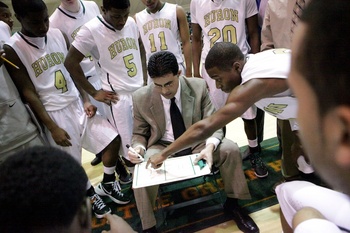
According to a University of Michigan study, high schools with strong athletics participation rates have lower levels of major crime and fewer suspensions.
AnnArbor.com file photo
The U-M study revealed no connection between sports and minor violations, such as property crimes, possession or distribution of illegal substances, or possession of a weapon at school, however.
The crimes that participation in athletics appeared to help curtail were attempted rape and violent behaviors, among others, the study said.
Researchers sampled nearly 1,200 public high schools to determine the relationship between sports participation rates and in-school delinquent behaviors. They controlled for a host of school characteristics, such as location and student-teacher ratios, according to a media release.
The average total crime rates among the researched high schools during the 2003-04 and 2005-06 school years were .039 and .042, respectively, according to the study. In other words, about 4 percent of the student population was involved in a crime during these academic school years, the media release shared.
For serious crimes, the rate was 1.6 percent during the same periods, while it was about 2.4 percent for minor crimes. The suspension rate was about 2.2 percent. The sports participation rate was 39.8 percent in 2003-04 and 42.4 percent in 2005-06.
So if the schools' athletics participation rates increased by 10 percent, serious crime incidence rates would drop by .05 percent and suspension rates dip by 0.1 percent, said Philip Veliz, a postdoctoral fellow at U-M's Substance Abuse Research Center and the study's lead author.
More about the U-M study can be found here, in the current issue of "Sociological Spectrum."
Danielle Arndt covers K-12 education for AnnArbor.com. Follow her on Twitter @DanielleArndt or email her at daniellearndt@annarbor.com.
Comments
Jim Mulchay
Tue, Sep 11, 2012 : 2:18 p.m.
While I strongly believe in the benefits of extra-curricular activities (not just sports) it is very hard to "prove" the benefits. I think most "at risk" students would benefit from additional structure, adult and peer support in their school environment - not just athletes. Also remember that for the motivated athlete (not just the elite athlete) there is the knowledge (threat?) that in school behavior problems may result in dismissal from the activity or reduced opportunities (ie playing time). Of course there is also the rare instance where an elite athlete "gets away" with problems because of their skill - I wonder how you would study that issue?
Cathy
Wed, Sep 12, 2012 : 1:12 a.m.
Rare?
walker101
Tue, Sep 11, 2012 : 11:45 a.m.
I would of never guessed, I've always wondered what research the social environment study would conclude, living in the East side of Detroit or Ann Arbor? I wonder?
golfer
Tue, Sep 11, 2012 : 10:23 a.m.
no kidding. if they want to play they better not do the crime.
Cathy
Tue, Sep 11, 2012 : 1:39 a.m.
I have to agree with dotdash here. This appears to be an observation of a correlation. If Veliz did in fact state that increasing sports participation would decrease the rates of serious crimes, he has fallen victim to a logical fallacy. Are there other explanations besides the simple idea that sports participation decreases crime? Certainly. Richer schools, for example, have more money for sports programs, which in turn leads to more opportunities to play sports. So sports participation might be a proxy for family income in the district, which could be a proxy for parental education and/or marital status. Perhaps the sample was biased, e.g. it only looked at schools that had relatively high crime rates (ignoring, for example, rigorous specialty/magnet schools with no sports or crime). So many unanswered questions. I'm not going to buy the article, though.
Linda Peck
Tue, Sep 11, 2012 : 12:08 a.m.
At this University, it is no surprise that there are people who would like to justify all of the time and money and energy that goes into sports here in Ann Arbor. From a practical standpoint, it does seem that a lot of drinking and fighting goes on around such hyped up games. This generally leads to a few fights and someone getting hurt. Also, the playing field can be the place for fairly severe injuries. Crime? To me, many sports are crimes.
rick
Mon, Sep 10, 2012 : 9:07 p.m.
Glimmer Twin is right on..... How much money did a study like this actually cost??? What a waste of time and effort for something that was proven decades ago.... HELLO...... MCFLY...... ANYBODY LISTENING????? and to think that this is actually news worthy...... Give me a break
DonBee
Mon, Sep 10, 2012 : 7:48 p.m.
Interesting - I would love to see what it does for bullying in the schools. I wonder if the UofM, a major sports university looked at that aspect of sports in the schools.
GoNavy
Mon, Sep 10, 2012 : 7:22 p.m.
"Upon the fields of friendly strife are sown the seeds that, upon other fields and other days, will bear the fruits of victory." -Gen. Douglas MacArthur
a2citizen
Tue, Sep 11, 2012 : 4:27 a.m.
Why do you quote marines?
Macabre Sunset
Mon, Sep 10, 2012 : 7 p.m.
I don't think Arndt read the article in question. This is just a rewrite of a press release, and so it's inappropriate to have a byline. But I don't expect this blog to understand journalistic standards. Anyway, yes, correlation is not causation, so the story itself has no news value. I hope the journal piece is a little more in depth. I didn't want to pay $30 to read it, either.
glimmertwin
Mon, Sep 10, 2012 : 6:45 p.m.
No kidding. Why doesn't UM fund a study that will prove students that sleep more at night are less tired during class? Or that students that eat regular meals aren't as hungry?
pseudo
Mon, Sep 10, 2012 : 6:35 p.m.
agreed with dotdash - correlation is NOT causation. And I think a broader look at crime rates (say including private schools without sporkts programs) will blow that out of the water.
dotdash
Mon, Sep 10, 2012 : 6:20 p.m.
Correlation is NOT causation. For the lead author to assert that increasing athletics participation would cause crime rates to drop is completely unwarranted. I can't believe that got into the article and I can't believe a postdoc fellow would make that mistake. Really, statistics 101. (Also - the link leads to a "buy this article" page, making it seem like this story is a sales effort. Maybe it should be AA.com policy that if they are to publicize something, it be available for free?)
dotdash
Mon, Sep 10, 2012 : 8:05 p.m.
GoNavy - I mention that correlation is not causation because that error is made not only by the reporter and the headline writer (which is common) but also by the lead author, which is, frankly, shocking. Yes, intelligent readers could read that article (or a good abstract) and understand that there is a possibility that A could cause B -- but that is very different from the lead author asserting that A causes B (with no evidence to back that up) and further, asserting how much change in B one could achieve by changing A.
DonBee
Mon, Sep 10, 2012 : 7:49 p.m.
GoNavy - We will never know, unless we buy the report. Now will we? We can only work from the article written from the press release on the report. LOL.
GoNavy
Mon, Sep 10, 2012 : 7:27 p.m.
Mr. Statistics, Do you go onto every website to share that? "Correlation is not causation" is probably the most whipped phrase among those who know little else other than the zingy headline. No, Mr. Statistics, "correlation is NOT causation," but correlation *is* correlation, especially when provided with confidence intervals and precision estimates. Intelligent readers, skilled in the art, can take these figures and incorporate them into their own study, based on a set of common metrics. That's one of the magical ways in which science works. Though I'm unable to view the report without buying it (I'm not that interested), I'm *highly confident* that the authors included the aforementioned statistics with their work.