

What it means to be an educated person
Dennis Sparks | Contributor
[I]n the past quarter-century, one narrow version of a good education—now thoroughly identified with a good schooling—has become the orthodox view among policymakers, civic and business leaders, parents, and students themselves. That version says a good education is one where a school . . . meets state curriculum standards, has satisfactory test scores, and moves all students successfully to the next level of schooling.
—Larry Cuban
Earlier this spring I stayed in a hotel in Mt. Pleasant not far from where I attended classes at Central Michigan University in the 1960s. That evening I used Wi-Fi to read the New York Times and AnnArbor.com, to review several blogs, and to connect with friends through email.
When I was a student at CMU, using information technology meant walking to the library to find a book or article that more often than not was checked out, misplaced or stolen. If out-of-town newspapers were to be found, they arrived several days or weeks late via the U.S. Postal Service. Professors and libraries controlled information, and being an educated person meant having a highly developed short-term memory for recall of information on exams.
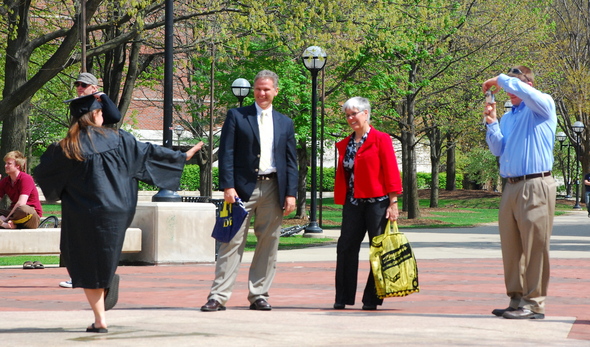
That experience and this season of college and high school graduation started me thinking about what it means to be an educated person in the 21st century. While "the narrow version of a good education" Larry Cuban critiques has become orthodoxy, it is, in my view, a partial measure of the broader purposes of public education.
In a recent New Yorker article about the economic benefits of a college education, Rebecca Mead observed, “Unaddressed in that calculus is any question of what else an education might be for: to nurture critical thought; to expose individuals to the signal accomplishments of humankind; to develop in them an ability not just to listen actively but to respond intelligently.”
In addition to Mead’s suggestions, I believe a good education:
• Provides the civic skills and attitudes required to sustain a vibrant democracy;
• Enables students to discover and link their talents and passions in ways that enrich their lives and those of others;
• Ensures the knowledge, skills, and dispositions to be successful at whatever is next in a young person’s life—further education or full-time employment;
• Helps young people understand of how they learn best so that they can remain employable across their life spans in jobs that currently do not exist using technology that has not yet been invented;
• Cultivates an appreciation of the ways diversity strengthens work teams, organizations, and communities, and teaches the interpersonal skills that enable productive and satisfying relationships;
• Models and instills integrity, civility, and concern for the welfare of others;
• Nurtures the attitudes and resourcefulness that promote hope rather than resignation in the face of complex social challenges; and
• Stimulates lifelong curiosity, creativity, and a sense of purpose.
My list is, at best, a partial one, and I am confident that others would add to or subtract from it based on their own values and experiences. The cultivation of these qualities, however, cannot be left to chance. They deserve at least as much attention as the knowledge and skills measured by high-stakes standardized achievement tests. Our success in these areas will determine the life chances of many young people and the vitality of the society in which they will be employees, business owners, family members, and participants in community affairs.
Dennis Sparks’ “Things Observed” essays and photos encourage readers to see familiar things in new ways. He also writes a blog on school leadership. He can be contacted at dennis.sparks@comcast.net.
Comments
ScottyBoy
Mon, Jun 7, 2010 : 8:08 p.m.
Having a college degree does not mean you are educated.
Will Warner
Mon, Jun 7, 2010 : 4:23 p.m.
When young people ask me what is the purpose of education I answer: The more educated you are, the more jokes you get.
Pei-pei
Sun, Jun 6, 2010 : 6:44 p.m.
To be an educated person, it means I have opportunities... opportunity to advance my carrier, opportunity to enrich my life, and opportunity to explore the world of opportunities.