

University of Michigan faculty members who advise athletic department, rule on athlete eligibility get free trip to bowl game
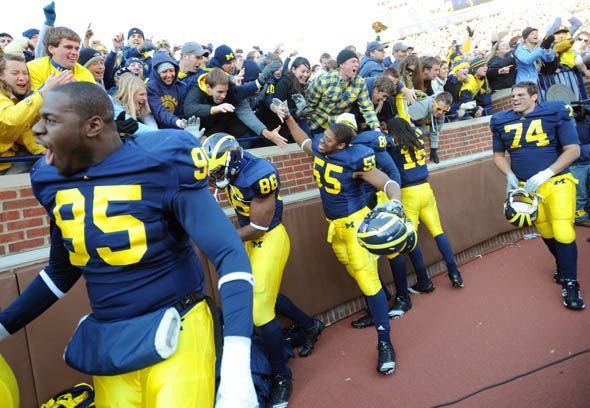
University of Michigan football players celebrate following a win against Illinois that made the team bowl eligible for the first time in three years. Melanie Maxwell I AnnArbor.com
University of Michigan faculty members who help guide the university's athletic department and determine the eligibility of student-athletes will travel on the department's dime to the Wolverines' bowl game this winter.
It's a practice the U-M Senate Advisory Committee on Academic Affairs unsuccessfully attempted to halt in January 2009 to eliminate any real or perceived conflicts of interest.
The athletic department, using its National Collegiate Athletic Association travel allotment, pays for members of two oversight committees to join the team on trips to bowl games, including airfare and lodging.
The faculty senate called on President Mary Sue Coleman to end the free trips — but that didn't happen, and the committees will follow the football team to whichever bowl game it lands this year, university spokeswoman Kelly Cunningham said.
Michigan’s football team hasn’t been in a bowl game since January 2008, but won the minimum six games this year to be eligible for post-season play.
“The faculty members are a part of all aspects of the athletic department program,” Cunningham said in an e-mail. “They play a critical role and are part of our student-athlete experience.”
The faculty will travel as part of the university’s official party, and each person will be allowed to bring a guest. Committee members eligible to attend include eight current faculty members, as well as a handful of students, alumni and others.
Physics Professor Keith Riles, who led the charge to end the free trips last year, relaunched his campaign on Nov. 8, and received an e-mail from Provost Phil Hanlon on Nov. 13 telling him the university was “managing” any conflicts of interest inherent in the free trip.
The committees
Faculty members serve as part of two committees. The first is the Advisory Board of Intercollegiate Athletics, a larger group that also includes student-athletes, alumni and administrators.
The faculty members of the ABIA make up the Academic Performance Committee, along with a representative of the Registrar’s Office and a member of the Office of the Provost. That committee is “advisory to the provost on all matters pertaining to the academic welfare of student athletes.” The APC also determines whether athletes are eligible, subject to the final authority of the provost, university policies state.
“It is worth pointing out the logic behind having the same faculty members serve on both the ABIA and APC,” according to a university management plan about the committees. “Matters considered by the ABIA often pertain to the academic interests and welfare of student athletes. So it is in the university’s best interests that the faculty members on the ABIA have as full an understanding of the challenges student-athletes face in being successful in the classroom and in their athletic pursuits. Members of the APC have much greater knowledge of the pressures and constraints on student-athletes than do ordinary faculty.”
The Academic Performance Committee makes recommendations, such as a push for priority registration for student-athletes, Cunningham said. The group also reviews practice schedules and competition calendars for appropriate study days and final exam times, she said.
The history
Before a 2003-04 NCAA Re-accreditation Self-Study, the Academic Performance Committee was a free-standing body that didn't report to anyone and made all decisions on the eligibility of student athletes.
The study recommended — and the Board of Regents agreed — to have the committee report to the provost.
The committee now acts as an advisor to Hanlon on eligibility issues. Cunningham did not say how many cases it had advised on over the past several years but noted that the two provosts preceding Hanlon — who started this year — made decisions contrary to the committee’s advice. She said Hanlon has agreed with the committee’s recommendations in the two eligibility cases this year.
“Disagreements are rare because the APC takes its responsibilities so seriously,” Cunningham said.
The controversy
In January 2009, the full faculty senate voted 19-11 to approve a resolution calling for the free trips to end. Administrators haven't responded.
Riles pushed the issue again after the Wolverines qualified for a bowl game this year.
“In light of that prospect and of the concerns about potential conflict of interest that drove the assembly resolution, have you decided yet on whether or not to continue APC bowl game reimbursements?” Riles wrote in a Nov. 8 e-mail to U-M President Mary Sue Coleman. “I realize that you stated publicly before the assembly meeting that you yourself were not troubled by the potential conflict of interest because you had full confidence in the APC faculty. But I hope that the fact that elected faculty representatives are themselves troubled by this compensation policy will lead (or has already led) you to err on the side of eliminating any appearance of such conflict in the future.
“At a time when our football program is under NCAA probation, ending the reimbursement policy voluntarily and unilaterally would send a strong message that U-M is moving in a positive and leading direction.”
Riley received a return e-mail from Hanlon, who said that because the committee reports to him, it is more applicable for him to address the issue.
“We are in complete agreement that potential conflicts of interest need to be managed,” Hanlon wrote. “A written management plan should be on file in the appropriate office whenever a potential conflict of interest arises, and that plan must be scrupulously followed."
In this case, Hanlon said, such a management plan has been on file in the Provost’s Office for a number of years, and steps have been taken to put it into practice.
RELATED CONTENT
That plan acknowledges “there is an appearance of conflict of interest in this situation. The faculty members who jointly serve on the ABIA and APC are asked to render advice to the provost on eligibility of student athletes and are simultaneously being offered an opportunity to participate in the official party at bowl games with expenses covered by the athletic department.”
The management plan says the conflict of interest possibility is mitigated because faculty members on the ABIA — who therefore serve on the Academic Performance Committee — are appointed by the president. Of the eight, six are chosen by the president based on faculty senate recommendations, and two are chosen based on athletic director nominations.
“So the athletic department is not involved in the ultimate choice of these faculty and is not even involved in the nomination of most of them," the management plan reads.
The plan also says the provost holds ultimate authority to make all decisions on eligibility of student-athletes, and the vice-provost attends Academic Performance Committee meetings and relays its recommendations to the provost. Neither the provost nor the vice-provost receive any financial benefit or bowl game trips subsidized by the athletic department, according to the plan.
In a return e-mail to Hanlon and Coleman, Riley said he’s seen the plan and believes U-M needs to go further. He also questions how attending bowl games enhances the ability of APC faculty to oversee the academic performance of U-M athletes.
“One can mange a conflict of interest or eliminate it,” Riles wrote. “I believe that the explicit preference of elected faculty representatives simply to eliminate the conflict should be respected.
“Although I can well understand why the athletic department favors reimbursements, I do not understand why you or Mary Sue would favor them. I urge you to reflect further on whether management or elimination is the appropriate way to address concerns voiced by the assembly.”
David Jesse covers higher education for AnnArbor.com. He can be reached at davidjesse@annarbor.com or at 734-623-2534.
Comments
transplant
Tue, Nov 23, 2010 : 5:29 p.m.
I would like to know what the faculty members do on these trips to justify the travel. Oh, I know! They probably spend 10 minutes "helping" the football players with their homework.
Blueman Rick
Mon, Nov 22, 2010 : 6:28 p.m.
Conflict of interest? Good grades = free trip. How nice. "the full faculty senate voted 19-11 to approve a resolution calling for the free trips to end. Administrators haven't responded." I would like to see Mary Sue in the same caboose w/ RR on that proverbial rail out of town. What a laughing stock my alma mater has become.
BillMK
Sun, Nov 21, 2010 : 10:50 p.m.
1. Chapmaja is totally correct in substance. 2. That said, this still looks fishy. Conflicts of interest are virtually inevitable in a research university, with its multiple funding streams; and many can only be "managed." (BTW "managed" has a specific meaning in this context - look it up). This CoA, or even only the appearance of a CoA, can and should be avoided. 3. THAT said, this is still an old story and pretty small potatoes. If there is not a back story of jealousy among faculty from low-income vs high-income disciplines, I would be extremely surprised. 4. As for the sentiments of Sparty-in-Exile, stunshif,Craig Lounsbury, et al: please remember that a) the Athletic Department is financially autonomous and self-sufficient, and b) the U itself is not that far from being a private university anyway. Given the plummeting state support for the U and the continuing demand for degrees from a world-class institution, you bet tuition will rise. We the people aren't doing all that much for the U anymore. The medical school, with which I am most familiar, receives only ~3% of its funding from the state; and its continued "quota" of 50% in-state students is in some ways an act of altruism, if not affirmative action outright. I wish things were different, but there is often as wide a gap between hope and reality as there is between opinion and fact.
Wolvdoug
Sun, Nov 21, 2010 : 9:01 p.m.
I'm waiting for someone to somehow blame this on RR.
wait.think
Sun, Nov 21, 2010 : 8:52 p.m.
There's a lot of money flowing through many channels at the University of Michigan. The alumni association alone has more money in their budget than the State of Michigan does. Or close.
Solar Blue
Sun, Nov 21, 2010 : 8:48 p.m.
SpartyInExile - one clarification, as a public state run institution, U of M "only" accepts up to 1/3 of the incoming undergraduate class from out of state or out of the country. In other words, 67% of the incoming freshman class (totalling about 5500 students) are from Michigan - or about 3700. I have no ideas about grad school, that is a entirely different subject.
proudtobeme
Sun, Nov 21, 2010 : 6:52 p.m.
maybe they'll end up at the Motor City bowl! Wouldn't THAT be funny!
chapmaja
Sun, Nov 21, 2010 : 6:39 p.m.
Craig Lounsbury, You are correct, Michigan may not always be profitable in athletics, but there is one thing that definately needs to be considered. As long as Michigan hosts 7-8 football games per year at Michigan Stadium, the athletic department will be profitable. Michigan's attendance at games is the reason they are profitable. Martin gets the credit for making the program porfitable, but all he did was get help from the NCAA's money grabbing ideas. Prior to the 2006 season, schools were allowed only 11 games per season, with a few exceptions. The NCAA then added a 12th game to the schedule. That change allowed Michigan to bring in schools like Ball St (2006), App St (2007), Toledo (2008), Delaware St (2009) and UMASS (2010) to fill the schedule. Michigan pays these schools 500K to 750K to come in and play at Michigan Stadium. A quick glance at the financials of such a game seems to show that Michigan brings in roughly 4.5 million per game, so if they are paying out 750K to an opponent, that game still brings in a profit of 3.75 million dollars. Martin also made one other decision. Michigan stopped playing quality opponents on the road. Michigan has played only Notre Dame on the road among non-conference games since 2003 when they went to Oregon. Every single non-conference game except for the 2004, 2006, 2008 and 2010 Notre Dame games have been at Michigan. The likelihood of Michigan not being a profitable athletic program in the future is there, but looking at the future schedule (2011 8 home games including 4 non-conference games), 2 non-conference home games (plus a "special game in Dallas against Alabama) will likely still bring in a lot of money. In 2013 as of now they have one away game and one home non-conferecne game scheduled. As long as Michigan continues to have 7 or 8 homes games per season, or plays in a game like the Dallas Football Classic in 2012 in which they will collect significant paychecks, they will continue to be a profitable athletic program. As for the othr comments. I personnally don't see what the purpose of this committee is anyway. The rules regarding eligiblity are specified pretty clearly under NCAA guidelines. This committee also doesn't do anything but make advisory recommendations to the committee. The administration makesthe decisions, not the committee. The committee can recommend things to the administration, but it is the administration's and only the administration's decision to make regarding eligiblity. I stand by the fact that given the money isn't coming from anyone except the athletic department, and the fact the committee makes only recommedations, that the issue is not as severe as what some people think it is. If this was a case where the committee had the ultimate decision makin authority on eligibility, then th conflict of interest is much more severe and the trips should be eliminated. As for the comments about the taxpayer money and therefore I should have a say. Everyone has the rght to their opinion, but a big problem with society today is everyone is allowed to report their opinion without an once of knowledge of the FACTS. I have no problem with people have actually looked information up, have actually been through the process or have actually pulled their head from down below stating an opinion. Today, more than ever people are influenced by idiots who have never actually done research. This has been a downfall of the internet age. People think just because so and so said it, it must be true. The problem is without all the facts peoples opinions are worth jack. This is the problem with all the talking heads in politics as well.
lumberg48108
Sun, Nov 21, 2010 : 6:14 p.m.
Am I missing an element of the story? What do other universities do? Does MSU or OSU have a similar policy? Nebraska? Penn State? LSU? Is there a standard? IF U-M is doing what every school does then this is a non-issue... if they are going against the grain then there might be an issue!
johnnya2
Sun, Nov 21, 2010 : 5:27 p.m.
The real issue in this case is simple. If I KNOW part of my "perks" of being on this committee is a nice bowl game, it is obvious to even the most simple minded person that I might want to let some marginal players on to the team to help them perform better, therefore garnering me and my guest a trip to Pasadena for New Years, or Tempe or Miami. I would submit it is why we are currently on probation. Too many people turned a blind eye to the obvious infractions. "The group also reviews practice schedules..." I think that says it all. @ Kafka, an auditor does go to the warehouse and factory, but it would CRIMINAL to partake in bonuses or extras that the company gets due to their performance. This is exactly what is happening. The auditors are getting a bonus. Think Enron and Arthur Anderson to see why this might not be such a good idea.
InsideTheHall
Sun, Nov 21, 2010 : 5:11 p.m.
How about posting the entire travelling party for the past several bowl games. I believe it will show many many faculty members get a free ride so they can fund raise during the bowl game festitivities. Please post names nad titles of who the athletic dept. picked up the tab for. Keep in mind no tax dollars are used for the travelling party it is all funded by the bowl game proceeds.
RobbiesBoyfriend
Sun, Nov 21, 2010 : 5:11 p.m.
Thats Ok, Michigan is a Private institution. Raise Tuition 20% next year to cover it. You know anyone traveling on the University's dime is going to be traveling in 5 star elegance. No one is flying coach, no one is staying at a Super 7, no one is sitting in the end zone, and no one will be eating off a 6 foot party sub.
Kafkaland
Sun, Nov 21, 2010 : 2:09 p.m.
One thing that appears to be missing from this discussion is that the ABIA / APC is supposed to provide oversight. And providing that oversight just from a conference room based on documents may be very hard or even impossible. Just think of an auditor who looks only at balance sheets, but never checks out the warehouse, or takes a look at a company's physical premises (Does it even exist?) So some attendance of practices, games, at home and away, may very well be in order. Places to see first-hand what's going on, talk to student-athletes, coaches and staff informally, and so on. That may indeed yield indispensible information, well worth the cost. Now to the conflict of interest: if it is preceived that the athletic department buys special favors by paying for the travel needed to provide proper oveersight over the program, one way out would be to have the University use its general fund to pay for necessary travel, instead of athletic department funds. After all, oversight over the athletic program is a University function. But I suspect the outcry would be even bigger.
rocco
Sun, Nov 21, 2010 : 1:24 p.m.
Chapmaja, nice job clarifying whos paying, which is important, but not the real issue in this case. Its the conflict of interest issue excellently described by 5c0++ Rightly so, the university wishes to reward members of its team by providing free travel. But what happens is that person receiving this perk owes team something, i.e., to understand and appreciate issues from the others point of view. If this occurs frequently enough, its easy to adopt the others perspective. The person unknowingly is co-opted by the group and loses his or independence. (Read Herbert Marcuses One Dimensional Man and Repressive Tolearance to understand how this works.) Incidentally, US embassies instill in their staff American values and life style so that they are not co-opted by the host countries. Thats one of the reasons for commissaries so you can buy American stuff. Some embassies even send Christmas trees to their employees in tropical countries so their staff can experience an American Christmas. These perks are done for a reason. So if youre policing perks for individuals who are supposed to be making independent judgments about the eligibility of athletes, you have to say a resounding no to such perks to maintain the integrity of your program.
David Jesse
Sun, Nov 21, 2010 : 1:04 p.m.
For those asking, from university spokeswoman Kelly Cunningham: The members of the ABIA and the APC are public on the web, but here they are also: Advisory Board on Intercollegiate Athletics Facultyall of whom serve on the Academic Performance Committee (APC): Tabbye Chavous Bruno Giordani Edie Goldenberg L. Rowell Huesmann Robert Kennedy Laura Olsen David Potter Phil Savage Percy Bates (ex-officio/faculty rep) Ed Rothman (ex-officio/SACUA chair) Students: Sarah Roberts Caramia Sitompul Alumni: Bruce Courtade Lynn Evans Ex-Officio: Dave Brandon, Chair (athletic director) Sally Churchill (VP/secretary of the University) Of Counsel: Phil Hughes/Academic Success Program
SpartyInExile
Sun, Nov 21, 2010 : 12:50 p.m.
Chapmaja. I am a taxpayer in the State of Michigan. We vote for the board of regents. If we are not worthy of voicing an opinion on a state owned institution, then perhaps the U should go private. With its farming out of technology and research to China, preference of out of state students (for higher tuition), ridiculous trespassing policies and lack of support to local tax roles it is already acting in autonomous fashion. I believe most of us have heard the "self funded" football mantra for many years. But what happens to the excess? Is it prudently spent? Does the University, god forbid, return excess cash to the State?
just a voice
Sun, Nov 21, 2010 : 12:47 p.m.
person x, I agree with most of what you say, but as far as coverage on annarbor.com of football, I think this is based on what people want to read, high demand subject gets lots of coverage
bruno_uno
Sun, Nov 21, 2010 : 12:32 p.m.
if this is a story, then a book can be made with all the corrupt on goings at the U of M with the football freebies that happen. you can not blame them, 60 dollar tickets for over 100,000 people in addition to 40 dollar parking on a golf course sized parking lot. what else do you expect? to not be corrupt would not be human in this case unfortunately.
Craig Lounsbury
Sun, Nov 21, 2010 : 12:30 p.m.
chapmaja, Please don't lose site of these facts: 1. the football program and everything about it is ultimatly owned by we the people of Michigan. Regardless of the sources of income it belongs to we the people. 2. The athletic Department has not always been profitable. Indeed one of Bill Martin's legacies was turning a profit from a program that was running in the red. not so much fact as opinion: There is no assurance the athletic department will always run in the black. History suggests things could change. The fact that we the people own the program allows any of us citizens to offer an opinion as to how our money is spent. And make no mistake it is our money because its our football team. They are not a private corporation paying taxes on "their" (our) income or property taxes on "their" (our) Stadium.
CLX
Sun, Nov 21, 2010 : 12:29 p.m.
David Jesse - Can you tell us who those faculty members are? How many plan to travel to the game? Perhaps interview those who plan to go or not go and share their opinions? Surely the list of the committee members is public knowledge. Are you planning a follow up?
heartbreakM
Sun, Nov 21, 2010 : 12:26 p.m.
What is the gold standard? What are other B10 universities doing? What about the "academic schools" that all B10 members belong to (I forget the name,but it came up when recruiting a new conference school)?
20/20
Sun, Nov 21, 2010 : 12:24 p.m.
Hey, It's only money and UofM has alot of it! And if money does get tight, they can always raise the tuition, so what's the problem?
Dog Guy
Sun, Nov 21, 2010 : 12:21 p.m.
Perhaps a group rate on the gravy train to the Gravy Bowl...
PersonX
Sun, Nov 21, 2010 : 12:12 p.m.
It is fairly clear that this is a conflict of interest, and it is also clear that football may be fun, but it has nothing to do with the central mission of the university and, as many have recognized, has a corrupting influence all around. Unfortunately, too many alumni and others are obsessed with what is essentially just entertainment. Nothing will change that because too much money is involved. Having said that, would it not be better if this blog, which seeks to direct public opinion, were less obsessed with this issue and would recognize that there are many more important things happening at the university. From the nasty comments posted here is is clear that many people have a very low, but essentially uninformed opinion of UM, which is one of the great educational and research centers of this country and beyond. Some of this is simply common anti-intellectual posturing, but much of it results from the kind of coverage that this blog, and the paper that it replaced, has provided. Perhaps our community would be better served by more balanced reporting on the university and less obsessive focus on the triviality of football, no matter how much fun it might be or how much it contributes to the local economy. I recognize all that, but it is still small beer compared to teaching the next generation about things other than entertainment, research on cancer, on politics, history, literature, or on the economy. Unfortunately, some of the administrative leaders of the university are equally guilty and see sports as more important than the teacher/scholars and students under their charge, so the bloggers are in good company.
stunhsif
Sun, Nov 21, 2010 : 12:06 p.m.
And Mary Sue is demanding the state cough up more money for this university, what a joke! I don't care where the money is coming from it is a slap in everyone's face given the poor economy and shared sacrifice by all, except for the U of M.
5c0++ H4d13y
Sun, Nov 21, 2010 : 11:31 a.m.
We talk about these types of conflict of interests in the medical school all the time. The issue here is not that there is a quid pro quo to rule a certain way on eligibility. It's that the free travel and parties and familiarity will draw the faculty member away from academic oversight mission and make them part of Michigan Football. It's really about softening the hard edge that may be needed to rule a star player ineligible. I think the faculty members on this committee should recognize that and refuse all gifts and travel starting now.
AA
Sun, Nov 21, 2010 : 11:20 a.m.
All of these faculty people are so coddled, they really live in an alternate universe compared to anyone else in almost all occupations. They all receive perks and entitlements, and are spoiled beyond words. Yes, they teach. Yes, they mentor, Yes, they contribute to society. But pound per pound, compared to most other occupations, they are overpaid and over appreciated. I'll be happy when the computer replaces the redundancy of many of these 'teachers'. ENJOY THE GAME.
chapmaja
Sun, Nov 21, 2010 : 11:10 a.m.
For those of you who are saying they hope your tax dollars are not going to pay for this trip, don't worry, they are not. Here is a simplistic view of the money trail for these trips. Each Bowl game provides a payout to the teams invovled (except the BCS, in which the payout goes to the conference). From the payout, the schools get to deduct their actual expenses from the trip. Any remaining money from the Bowl payouts gets sent to the conference. The Big 10 Conference then splits the money equally between all schools. Nobody's tax money is used to pay for this trip, since these individuals are part of the "official party" of the University of Michigan. People may not think this is significant money, but the University of Michgigan brought in roughly 2 million dollars from the 2009-2010 Bowl Game payouts last season, despite the fact they did not qualify for to play in a Bowl game. I personally think this is a huge non-issue. I wonder if this faculty member was denied a spot on the committee and it's just sour grapes that he has to pay his own way to the game. For those of you who think this is a slap in the face to the parents or students who are paying to attend the University of Michigan, I would suggest you take the time to actually learn about how this is paid for. I would also suggest that you learn the fact the University of Michigan Athletic Department doesn't take a dime from the taxpayers money to pay any of it's expense. The University of Michigan is one of the few self sufficient athletic departments in the NCAA. The money they spend is the money they bring in from ticket sales, marketing, programming, facilities rentals, and similar income sources. The only taxpayer money that may be used for "athletic purposes" is Federal or State Work tudy program money. This money is used to pay the wages of the students who work various jobs around the facilities, such as security, ticket taking, cleanup, ect at the facilities. The students are being paid from the same general pool of money that a student ticket taker at a concert on campus, a building secruity guard, or another student employee (fitness center) would be paid from. The only people who should have an opinion on this are those who have taken the time to be informed about where the money actually comes from. If you haven't taken the time to make yourself informed, then please don't type anything on your keyboard about this topic until you do.
SpartyInExile
Sun, Nov 21, 2010 : 10:38 a.m.
As a part of the total university and athletic department budget this is small potato's. But to a parent struggling to pay for their kids education this action is perceived to be a slap in the face.
lefty48197
Sun, Nov 21, 2010 : 10:17 a.m.
I hope they get to go to one of the good bowl games and not the crappy one the Wolveriguez will go to.
trespass
Sun, Nov 21, 2010 : 10:08 a.m.
The conflict of interest runs much deeper. The Chair of SACUA receives 50% or more of his salary from the Provost in a deal that is secret and which is individually negotiated each year. The chair also get free football tickets. You combine this with the lofty feeling of having regular meetings with the President and Provost and you have the SACUA Chair acting as the Administrations representative to SACUA rather than as the faculty's representative to the Administration. "Of the eight, six are chosen by the president based on faculty senate recommendations, and two are chosen based on athletic director nominations." It is a circular argument if the SACUA Chair works for the Provost. This is just one example of the corruption that has been caused by the University Administration's grabbing power away from the faculty over the last 20 years. The faculty is supposed to share responsibility for governing the UM but in reality the Administration controls and manipulates all decisions made at UM. The faculty has no real power to disagree.
InsideTheHall
Sun, Nov 21, 2010 : 9:57 a.m.
This is an old story and a non story in the eyes of many. This is the Starbucks Latte Liberal Faculty who parade around Ann Arbor in their Prius'just expressing some sour grapes....the wine must be bad at Morgan & York these days. Th holier than thou "elites" just can't come to grips with the fact that the most visible symbols of the University are the Big House, winged helmet, and football coach. So they make they a little stink while they rip off students peddling their books.
ViSHa
Sun, Nov 21, 2010 : 9:56 a.m.
It seems only the athletic department is still operating via "the old boys network" while most other departments have had to come up to speed with being politically correct, etc... It's like watching every cliche in college/sports movies.
RudeJude
Sun, Nov 21, 2010 : 9:22 a.m.
From the article: 'Physics Professor Keith Riles, who led the charge to end the free trips last year, relaunched his campaign on Nov. 8, and received an e-mail from Provost Phil Hanlon on Nov. 13 telling him the university was managing any conflicts of interest inherent in the free trip.' I don't know guys, it seems to me they are "managing" the conflict-of-interest just fine. I mean, is it not safe to assume what Hanlon means by "managing" is that they hired a fallible coach that would assure Michigan football only make a bowl game every third year at MOST? They've cut down the free vacations by two-thirds! What is going on at UofM? This gives a little more credence to Harbaugh's criticism of a few years ago. Let's guide our student-athletes into the easy General Studies major, and should they fail, we'll give the free vacations to the body that determines the eligibility of student-athletes. I'm not saying that is happening, only that when the potential for something to happen exists, it will happen eventually. A side note: Tom Brady's double makes another appearance in this article's picture, just above #95. We could make the next "Where's Waldo?" book with this guy.
a2cents
Sun, Nov 21, 2010 : 9:03 a.m.
I am reminded of my father, a well thought of lumberyard owner in a small Illinois town. He refused to run for the school board because he didn't wish to give up the school's business to avoid conflict of interest. It was a shame because the board lost a potentially valuable member and he retained only a piddling amount of business. Such losses will never hinder commerce in MI or inhibit the UoM's actions, I fear.
xmo
Sun, Nov 21, 2010 : 8:41 a.m.
I understand that Michigan Students and Student/Athletes are sooo smart that the Advisory Committee does not doing anything! I guess that want happens when you have a top nouch school and football team.
shipdog7
Sun, Nov 21, 2010 : 8:31 a.m.
In 2003 the Nebraska team went 9-3 in the regular season. However this level of success was not judged to be adequate by second-year Nebraska Athletic Director Steve Pederson, who fired Coach Solich before the bowl game, justifying the move by stating he would not "let Nebraska gravitate into mediocrity. And would not "surrender the Big 12 title to Oklahoma and Texas". Folks...we are definitely in a state of mediocrity and less at UM. What the University is lacking right now is integrity. If you keep bending the rules it will come back to haunt you. And it has! Do the right thing. Before this turns into a rogue university
A2lover
Sun, Nov 21, 2010 : 8:28 a.m.
3 And Out is totally correct on all counts. This U of M administration, athletic department, and the so-called coach, Rich Rod, are all so full of arrogance and egotism, not to mention unmitigated blindness to all infractions, poor decisions and anything that isn't considered "Amazing Blue". Well...there's not much amazing about the football program, and most people would use plenty of blue words when talking about the coach and the rose-colored glasses wearer, Mr. Brandon. Now the indignity and arrogance of paid for junkets for pavlov professors. Unbelievable!
FlintMaize
Sun, Nov 21, 2010 : 8:08 a.m.
More important things to worry about!!! This doesn't bother me like some.
3 And Out
Sun, Nov 21, 2010 : 6:55 a.m.
BTW..this kind of crap stinks of arrogance and elitism that we do not need ever, and more particularly at this time... the athletic program as a whole is already in turmoil and now they are advocating junkets for "approved" profs who grant eligibility? that is garbage and reeks of fat cats sitting in the luxury box watching Michigan's defense get rolled in a warm weather location, while they marvel at D Rob's records and pat each other on the back for the new lights at the stadium, Barwis' pet wolves, RR photo ops and the free trip in exchange for keeping some sketchy athletes eligible. Hey guess what: Jim Harbaugh was 100 percent correct with his comments a few years ago.... and we need to get to that standard that the M used to carry.
rosewater
Sun, Nov 21, 2010 : 6:50 a.m.
WOW sure hope my tax dollars are not being spent on this or the houses on S. Division the U intends to purchase. Seems like Mary Sue and her pals have plenty of cash to throw around. Silly me, I thought a publicly funded educational institution would spend "our" money a little more wisely.
3 And Out
Sun, Nov 21, 2010 : 6:48 a.m.
Well when your new "program" cough cough....qualifies for a Bowl Game every 3 years...I guess they feel the need to celebrate? Regardless....this is BAD timing for this controversy. The team stinks and is in the wrong hands, just came off of NCAA violations and will get rolled next week and in the bowl game. Coming off of Rich Rod lying about the team's academic "success" last year, is this what we need???? perks and junkets for those that grant eligibility? The whole thing stinks. Dave Brandon is being hailed as some sort of genius... well...Dave you listenin?? this sends the wrong message given the current political climate surrounding the most important program at our university. Wise up Dave. Put a stop to this (and RR too). Go Blue.