

5 ways Ann Arbor's single-stream recycling will impact residents
Do you regularly recycle? If the answer is no, Ann Arbor officials are trying to change that.
Late last week, the city council unanimously agreed to move forward with a $4.6 million initiative to overhaul Ann Arbor's recycling system.
Officials say the changes will offer residents more convenience and will provide incentives starting next year.
The hope is the changes will build more efficiencies into Ann Arbor’s current recycling system, allow the city to sell more recycled materials and double the rate that waste is currently diverted from landfills. That would save the city money on tipping fees and reduce the city’s impact on the environment.
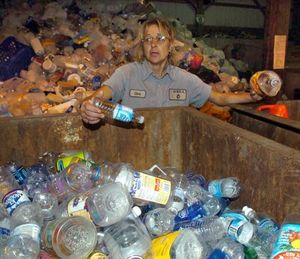
Gina Van Riper of the Western Washtenaw Recycling Authority sorts plastic bottles in this file photo.
File photo
Last week, Tom McMurtrie, Ann Arbor's environmental systems analyst, told AnnArbor.com the funding for the upgrades would come from the city's solid wast fund. The city is expecting a payback from the investment within seven years.
Ann Arbor’s annual diversion of trash to recycling rate is 400 pounds per household per year. The city estimates it could follow in the footsteps of other cities that divert 800 pounds to 1,000 pounds per household per year because of extra convenience and incentives.
The upgrades are due to be completed by mid-2010. Here’s how it could impact you:
1. 8-week switchover. The proposed equipment upgrades — which include technology for sorting and increased areas to store more recycled materials — will take about eight weeks to complete, officials have said.
Recyclables will still be collected during the switchover, but will be transferred to a facility outside Ann Arbor for processing, McMurtrie said.
2. New carts. Part of the catalyst for making the change now was it's far past time to replace aging recycling carts around Ann Arbor, officials said.
Every resident and business should eventually get a container next year. They will be notified of the sizes of recycling carts that will be available at no charge.
Residents will be able to recycle those old recycling containers. McMurtrie joked they might even make good containers for old record albums.
3. No more sorting. It doesn’t mean recycled materials won’t need to be sorted out of trash - they still will. But residents will be able to put all of their recyclables of the paper and plastic directly into a single container.
Beyond resident convenience, the benefit includes more efficient truck pick-up of recyclables since the trucks will be able to pick up more materials in a single trip rather than unused space caused by having two separate compartments that may end up returning to the MRF without a full load, officials have said.
4. More recyclables allowed. All of the changes go back to the retrofit of Ann Arbor’s MRF to allow easier sorting and more storage or recycled materials.
During the sorting process, this will allow materials that traditionally couldn’t be accepted for processing and material resale to be collected and stored, including:
• Plastic #1: Commonly used to make 2-liter soda bottles, cooking oil bottles and peanut butter jars.
• Plastic # 2: Commonly used to make detergent bottles and milk jugs.
• Plastic #4: Commonly used to make dry cleaning bags, produce bags, trashcan liners and food storage containers.
• Plastic #5: Commonly used to make bottle caps, drinking straws.
• Plastic #6: Commonly used to make packaging pellet, cups, plastic tableware, meat trays, “clam-shell” to-go containers (plastic, not Styrofoam).
• Plastic #7: Commonly used to make food containers (Tupperware).
• Bulky plastic HDPE #2: Items like buckets, crates, trays, outdoor furniture and some toys will be accepted.
The city will still be unable to accept PVC, Styrofoam or plastic bags due to problems they can cause at the recycling center.
5. Potential incentives. If a proposal to partner with a business called RecycleBank is passed by the council in December, it could set up a system to offer incentives to those who recycle. Each household’s cart would have a radio frequency identification, or RFID, chip to link their recycling to reward points.
Those points can be redeemed for rewards at retail partners by logging onto a RecycleBank account. Systems could be set up to share points when a cart is used in multiple family dwellings, representatives from RecycleBank told the council during a work session in October.
Tina Reed covers health and the environment for AnnArbor.com. You can reach her at tinareed@annarbor.com, call her at 734-623-2535 or find her on Twitter @TreedinAA.
Comments
brad
Wed, Nov 11, 2009 : 7:37 p.m.
7 year payback? I checked their assumptions, and it doesn't add up..actually, it should be a quicker payback (unless the savings aren't there). See the original story http://www.annarbor.com/news/ann-arbor-city-council-oks-single-stream-recycling/index.php#comment-28233
John of Saline
Wed, Nov 11, 2009 : 1:22 p.m.
Waste Management already does all this kind of recycling in Saline.
81wolverine
Wed, Nov 11, 2009 : 1:22 p.m.
This sounds like a good long-term investment, and will ensure Ann Arbor has one of the very best recycling programs of any city in the state. I live out in one of the townships, so we just drop off our recycling at the center on Ellsworth. I assume doing that will be easier too, as it can be dropped off unsorted? Also, I'm a little confused on styrofoam. It's accepted now at the center. Is this changing, or does the "not accepting styrofoam" only apply to curbside pickup?
Dalouie
Wed, Nov 11, 2009 : 10:34 a.m.
Bruce: If you watch the council meetings where this was discussed you would find out that like so many things in government budgets the money for this comes from a dedicated fund. This is paid for from the solid waste millage. It would be against the law for the city to take funds from a dedicated millage and spend the money on something else. Besides, in case you haven't been paying attention the last few years, the investment the city, county and UM are making in Ann Arbor SPARK has made them the leaders in Michigan for economic development. SPARK is bringing in about 2,500 high paying jobs per year. I hear you about jobs. A2 is a great town and if anyplace in the state leads the way out of this it will be Ann Arbor.
cd_booth
Wed, Nov 11, 2009 : 10:02 a.m.
This is a great investment. Anything to keep materials out of landfills and to get more people involved in environmental interests is a step forward. Still, though, a great amount of progress is yet to be made. Personal responsibility is the biggest issue. The city can't make people make decisions about actually REDUCING their consumption, that is up to you. Also, news flash: companies have been using RFID chips for a long time for tracking and product information. Don't be afraid of progress. They won't be spying on you.
Bruce Amrine
Wed, Nov 11, 2009 : 9:27 a.m.
I a comment to a previous article on this topic a comment was made regarding the illogic of incentivising us to put out empty bins. Seems like a good example of the rule of unintended consequences. Not much incentive here to reduce consumption of excessive packaging. One more boondoggle that somehow they seem to be able to find the money to pay for. How about we invest the money in creating some new jobs, instead?
katznjammer
Wed, Nov 11, 2009 : 9:23 a.m.
I'm all for this. Tired of having to take bags of yogurt cups to Whole Foods for recycling. And if we'll be able to recycle those horrendous clam shells, all the better. Having one container for everything is a great idea. I don't have an objection to the chip. From what I understand, it's just measuring weight. The more you recycle the more points you receive. Accumulated points can be redeemed at local businesses and we need to support our local businesses.
Joe G.
Wed, Nov 11, 2009 : 9:12 a.m.
really like the idea....hope this incentive concept finds its way to Scio Twp. to go along with the increase in accepted materials. Many residents may be willing to pay to be included rather than the monthly drop off.
cpshan
Wed, Nov 11, 2009 : 8:48 a.m.
It sounds like the city is doing a better job than pttsfld. twp., who had a huge 95 gal. container dropped off for biweekly pick up. There is no smaller container available. My husband can no longer park his car in our garage, or we can choose to "park" the recycling monstrosity outside - either choice being unacceptable in a Michigan winter. To top it off, the garbage truck didn't even empty it on a scheduled recycling week! Although I do agree with xmo; the ID chip is Orwellian creepy.
xmo
Wed, Nov 11, 2009 : 8:35 a.m.
Is this part of the Patriot Act? "Each households cart would have a radio frequency identification, or RFID, chip to link their recycling to reward points." First it is points then it taxes based on your usage, then fines for not complying etc. Isn't National health care enough of an invasion of our privacy?
Tina Reed
Wed, Nov 11, 2009 : 8:22 a.m.
The upgrade will allow the city to recycle all clean plastic bottles and household rigid containers marked #1, #2, #4, #5, #6, and #7 that may well include your yogurt and butter containers. The city will continue to accept and recycle glass bottles and food containers, tin, steel and aluminum cans, foil, trays; metal scrap like pots and pans up to 1 square foot and 20 pounds a piece. It will also still pick up milk cartons and juice boxes, newspapers, magazines and catalogs, corrugated cardboard, paper bags, junk mail, office paper, boxboard like flattened cereal boxes, telephone books and gift wrapping paper. For the complete list of materials recycled by the city, check out the city's recycling guide: http://www.recycleannarbor.org/pdfs/recycle_toxics_guide_fall08.pdf
HappySenior
Wed, Nov 11, 2009 : 8:06 a.m.
Does this include the yogurt and butter tubs? Will they still take curb pickup of motor oil, oil filters, and batteries?
AANative
Wed, Nov 11, 2009 : 6:39 a.m.
what about metals & glass?