

Future federally funded human embryonic stem cell research at University of Michigan in jeopardy
This story has been updated with an announcement the Justice Department will appeal the ruling.
University of Michigan scientists working with human embryonic stem cells were blindsided this week by a federal ruling that put their work in jeopardy.
A federal judge's temporary injunction Monday blocked taxpayer funding of the work.
Projects that have already awarded their funding appear to be safe, at least for now, but the National Institutes of Health have ceased review of both new applications and grants being considered for renewal.
“At U-M we have a lab space which does not use any federal funding,” said Ed Goldman, the former leader of the University of Michigan Health System’s legal office. “In the short term, the ruling will not affect us, but longer term it means we
 would not be able to apply for federal funding for promising research.”
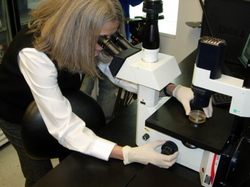
The fate of future federally funded human embryonic stem cell research at U-M is now uncertain.
There are 15 U-M researchers with approval from a university oversight committee to conduct human embryonic stem cell research. Not all of those projects have started yet. A number of them have and are funded by the National Institutes of Health.
A federal judge ruled on Monday that the stem cell research violated the will of Congress in prohibiting the destruction of human embryos.
National Institutes of Health Director Francis Collins said Tuesday that dozens more studies of promising stem cell therapies — about $54 million worth — will have to stop because of the court ruling that temporarily forbids any additional money from being granted.
It isn’t yet clear whether that will impact any planned U-M studies.
U-M research scientist Jack Mosher’s work appears to be safe. He’s a year into a $744,000, two-year project funded by NIH involving the study of Hirschstrung’s disease, a defect in part of the nervous system that regulates gut function. Those who have it are unable or defective in their ability to pass solid waste. If left untreated, it can lead to death.
“I hope one day it allows us to make real insight into understanding and treating Hirschstrung’s disease,” he said of his research. “The funding from NIH is what scientists like myself and the rest of use depend on to accomplish those goals.”
It’s also not yet clear whether the federal ruling will stick, said Goldman, who now teaches a course on women’s rights called reproductive justice. Researchers around U-M working with human embryonic stem cells are now scared and uncertain, Goldman said.
“We just don’t know what’s going to happen yet,” he said.
Meanwhile, the Obama administration has indicated a Justice Department appeal is forthcoming. But Collins said the decision jeopardizes the hunt for needed new treatments just as it was gaining speed.
The Associated Press contributed to this report.
Juliana Keeping is a health and environment reporter for AnnArbor.com. Reach her at julianakeeping@annarbor.com or 734-623-2528. Follow Juliana Keeping on Twitter
Comments
Ann English
Wed, Aug 25, 2010 : 8:19 p.m.
The belief that embryonic stem cells can be used to find medical cures is wishful thinking. Those who promote this idea are really trying to justify abortion, to devalue the lives of embryos and persuade the rest of us to agree with them; they think the ends justify the means. Situation ethics. The empirical facts about stem cells from embryos show that they cause tumors. Real cures come from adult stem cells, so no one has to further a cause supporting the idea that adult stem cells can and do help cure disease.
LGChelsea
Wed, Aug 25, 2010 : 8:16 p.m.
I don't believe in war. I don't want my tax dollars going to fund wars. What do I do to make sure that my tax dollars aren't spent supporting any kind of war?
msddjohston
Wed, Aug 25, 2010 : 7:49 p.m.
Would you please advise what the Judges jurisdiction is: What court, where, excetra? Thank you
David Briegel
Wed, Aug 25, 2010 : 5:41 p.m.
If these "pro-lifers" (and I use that term loosely) really cared they would be lining up to stop the destruction and discarding of these unused embryo's. That is the proof that their beliefs are phony! A2K, Speechless, I totally agree with you. Man created the God mythology in his own image! And evil men use the resulting fear for less than noble purposes on a daily basis! Bruce, I defy you to show me chapter and verse where our Constitution establishes Christianity or any other mythology.
Rork Kuick
Wed, Aug 25, 2010 : 2:55 p.m.
Isn't the trouble that there is the Dickey-Wicker Amendment? The judge is saying current policy violates it, right? I'll listen to opinions of judges and lawyers on that touchy legal subject, but it is clear we could change that law to more precisely permit certain uses of embryos. The law may be religiously motivated, and I don't like that law, but I don't see how this is about the constitution: the law was enacted by a democracy, where majorities can do dreadfully stupid things, and you have to change people's minds if you want your way (and even then, it can be so slow). To paraphrase de Tocqueville: It is indisputable that the people manage their affairs very poorly. If you think no scientific progress has been made, inject "embryonic stem cell" into a PubMed search. It's basic science mostly, not prone to news coverage since it's often about understanding more about certain molecules (you may yawn), mostly in mice.
SMAIVE
Wed, Aug 25, 2010 : 2:25 p.m.
It's about abortion. If taking a possible life was simply a moral issue, then explain why we are at war. Hundreds of innocent lives are taken each day in the name of moral and right. At least here, the DONATED embryo may in the long run save a life. Life is precious, but not every embryo survives in nature either. Who is to say man's involvment at this point isn't part of God's plan? Is it really God's plan we continue someone's life with machines when there is no chance of life without them?
John of Saline
Wed, Aug 25, 2010 : 2:17 p.m.
Glad the headline includes "embryonic." It's very common to drop that word and pretend that the opposition is to all stem-cell research.
SemperFi
Wed, Aug 25, 2010 : 1:54 p.m.
A22Ypsi.. I'm glad that you brought up that Gallup Poll from May 2009 that listed 51% as pro-life with respect to abortion. A simultaneous Gallup poll reported that 60% found embryonic stem cell research to be morally acceptable and less than 40% thought that the US government should keep current restrictions in place or tighten them. Stop making Stem cell research an abortion issue. It isn't. Read carefully here... Embryonic stem cells from discarded embryos that would have been destroyed anyhow.
A2K
Wed, Aug 25, 2010 : 1:39 p.m.
I'm for robust social discourse instead of let's all be nicey-nice and not say anything that may possibly offend someone. I refuse to stand by and let superstition take over. Go ahead and believe what you want, but don't expect me to be silent, stand by, or pretend profound respect for your make-belief (that is what faith/religion is, pure and simple) if you try to enforce your particular religious beliefs on everyone through manipulation of the courts and laws.
A22Ypsi
Wed, Aug 25, 2010 : 1:05 p.m.
indigonation: far from "few followers", Gallup recently polled America as 51% pro-life, a record high since they started asking the question. Thinking people know that dozens of treatments are being developed by ethical scientists using pluripotent stem cells, while these U of M researchers destroy human embryos to make an ideological statement on the backs of taxpayers.
5c0++ H4d13y
Wed, Aug 25, 2010 : 1 p.m.
It unfortunate to me that everyone needs to be so nasty when discussing these issues. Is it really so horrible that someone's beliefs are guided by their religion and to them life begins at conception? And that to destroy embryos is to destroy human life? It's not hard for me to appreciate that point of view and be polite about it even though I don't share it.
indigonation
Wed, Aug 25, 2010 : 12:42 p.m.
Obviously the religious right is scared of science and the fact that it may prove something that they think is untrue. They use this "life" issue as a cover, they seem against anything that presents potential and progress for humanity. What is it these people are so scared of if they believe the truth abortion is a control issue (they want to legislate outdated morality because so few want to follow it anymore) but there is obviously no rational reason to be against this. I think its time science actually investigated spirituality and human spiritual potential. There is a lot these people are scared of allowing out in the open and it appears some of them know something that they are trying to keep secret.
Speechless
Wed, Aug 25, 2010 : 12:27 p.m.
All rapidly advancing forms of science call for constant ethical re-evaluation within the framework of an open society. Along with stem cell research, another hotly debated area of study is the genetic modification of life forms. The way we go about this at the top levels of our society, however, makes us again and again the laughingstock of the world. As far as I know, no other developed industrial country bases their decisions on religious fantasies.
5c0++ H4d13y
Wed, Aug 25, 2010 : 10:53 a.m.
Un/Fortunately voters have a say in how tax money is spent. If you want an issue to have politics injected into it then fund it with tax money or a tax rebate/credit.
A2K
Wed, Aug 25, 2010 : 10:51 a.m.
Great, another throwback judge making decisions based on the bible/fairy-tales instead of science/reason. Just another moron in a long line of ignoramuses getting in the way of progress because of outdated, factless beliefs. These are the same people who not so long ago had major issues with women getting pain-relief while giving birth as "Woman is supposed to suffer in birth because of original sin/eve" etc. Ridiculous.
Joe Hood
Wed, Aug 25, 2010 : 10:38 a.m.
Again, proven alternatives are available, why do they persist on this "research" issue? There is no life saving when you start with a negative.
logicnreasoning
Wed, Aug 25, 2010 : 10:37 a.m.
@Bruce It takes years for there to be any "progress" made from medical research (progress being a mainstream treatment for a disease). Bone marrow transplants, which use adult blood stem cells, took 25 years to develop. Where would we be now if people in the 60's thought as you do and cut off the funding. May lives would have been lost. Researchers have only been using embryonic stem cells for a few years now and that use has been restricted. Progress comes after many years. We should not shortchange society because of impatience or lack of vision for the future. To call research a failure after a few years of restricted research is like saying a baseball team has lost the game because they are behind by one run in the second inning.
Rasputin
Wed, Aug 25, 2010 : 10:07 a.m.
Get your religious DOGMA off science research! Enough already this is so such a silly argument, religion no longer matters since we now have an explanation for our existence and fossil records that contradict the Biblical story of creation. Game over.
bhall
Wed, Aug 25, 2010 : 9:04 a.m.
Bruce forgets that the embryos used for research are donated, and are the surplus products of fertility treatments, which would have been frozen for years, and then thrown out anyway. So, if it is the choice between throwing out and destroying this material, or using it to find cures for disease and increase human understanding, which would you choose?
Dan H
Wed, Aug 25, 2010 : 9:02 a.m.
JayJay, That's very slopping thinking to say a judge preventing stem cell research is "a real example of government intervention". Let's get this straight. Using TAXPAYERS money to fund stem cell research IS the government intervention. Blocking that is simply removing the government intervention that was put in place and unconstitutional to begin with. Now, having said this, I am ALL for stem cell research. But it should be funded PRIVATELY. There are most likely real breakthrough to be made via stem cell research but it is NOT the right for the Federal government to intervene and use tax payers money to support it. Just like it isn't right to use tax payers money from people who aren't religious to fund faith based programs, like Bush did. You'd definitely be correct is you just pointed out the religious right as being hypocrites and left it at that.
SemperFi
Wed, Aug 25, 2010 : 8:27 a.m.
Bruce... of course this is a religious issue. The push against human embryonic stem cell research is driven by the religious right, who are making this an abortion issue. To call ongoing research a failure is irresponsible and wrong. There is huge potential for life saving and life enhancing medicine to be derived from HESC research. Despite the religious based rhetoric against it, this will prove to be a valuable tool in future medical research.
Bruce
Wed, Aug 25, 2010 : 7:56 a.m.
Jay Jay...this is not a religious issue, it is a moral issue. If you actually did any research at all you would find that ZERO progress has been made by using embryos for research. On the other hand adult stem cell research has already offered many promising treatments and cures. Do your homework before you start killing potential contributors to society.If you dont believe me Google it...most of the embryonic research underway is a failure, as the cells have an innate tendency to lose control and become cancerous due to their inherent instability.
Jay Jay
Wed, Aug 25, 2010 : 6:33 a.m.
It just is unimaginable how a judge casn prevent stem cell research. It is a real example of government intervention from the right, the group that purportedly is against the any government activity. Wherever religion is involved, and that is the driver behind prohibiting stem cell research, we move against the very direction the constitution tried to to separate so clearly after winning independence. Yet the right tries to say they are the defenders of the constitution. Wake up America before it is too late. This is a religious issue and has no place in the judicial system.