

Gov. Rick Snyder signs domestic partner benefits ban into law
This story has been updated.
Michigan Gov. Rick Snyder signed a heavily-debated and controversial domestic partner benefits ban into law today.
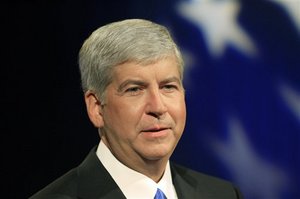
Gov. Rick Snyder
It is unclear whether the bill applies to state universities, although Snyder asserts that it does not. House Republicans, meanwhile, say it does apply to university employees.
The move is a blow to gay and lesbian activists throughout the state.
"We’re so very disappointed in the governor," Kary L. Moss, executive director of American Civil Liberties Union's Michigan chapter, said in an interview. "This was the moment for him to show real leadership, to rise above what I believe is petty politics, to tell the rest of the country that Michigan is not living in the dark ages and to create an open, inclusive Michigan."
The legislation was strongly opposed by the Ann Arbor City Council, Washtenaw County Board of Commissioners, Ann Arbor/Ypsilanti Regional Chamber of Commerce, University of Michigan and Eastern Michigan University.
City Administrator Steve Powers said the city of Ann Arbor offers domestic partner benefits as long as the employee and "other qualified adult" have lived together for 18 months. He said there currently are 12 adults receiving such coverage from the city.
The county's policy is similar. County Administrator Verna McDaniel said the county provides domestic partner benefits to nine "other eligible adults" right now.
In a letter penned after signing House Bill 4770 this morning, Snyder said the ban "does not extend to university employees" because of autonomy awarded to public universities in the Michigan Constitution.
The University of Michigan reported that 570 adults and 48 children currently receive benefits through a domestic partner allowance.
U-M and Eastern Michigan University officials have openly criticized the ban, saying it's harmful to a state economy that is still rebounding from recent years.
Moss said the bill was discriminatory and was likely to end up in court. That sentiment has been echoed by several local lawmakers, including State Rep. Jeff Irwin, D-Ann Arbor.
Leigh Greden, EMU's executive director of government and community relations, said the school does "not believe this legislation applies to EMU or any of the state's public universities."
Greden reiterated EMU's opposition to the bill.
"These benefits remain important to reviving Michigan’s economy and in helping our state to compete for the best talent to educate our students," he said. "That's why Michigan's universities worked with business groups to oppose this legislation."
Cynthia Wilbanks, U-M's vice president for government relations, said earlier this month that the university remains unclear about the impact of the amended legislation.
"There seems to be some difference of opinion about whether the approved legislation applies directly to state universities," she said then. "That remains a serious concern."
Today, however, U-M spokesman Rick Fitzgerald said the university agrees with Snyder's analysis that the ban does not apply to universities.
"We continue to believe that all of the benefit offerings at the University of Michigan are in full compliance with state law," he said in an email.
AnnArbor.com government and politics reporter Ryan J. Stanton contributed to this report.
Kellie Woodhouse covers higher education for AnnArbor.com. Reach her at kelliewoodhouse@annarbor.com or 734-623-4602 and follow her on twitter.
Comments
Forever27
Fri, Dec 23, 2011 : 1:49 p.m.
I never thought I'd say this, but Snyder is an even worse governor than Engler was.
SonnyDog09
Fri, Dec 23, 2011 : 1:42 p.m.
I have an idea. Why don't all of you folks that don't like the law start a fund, solicit contributions and then you can pay for these benefits with your own money? That way you can demonstrate your progressive credentials and moral superiority. Put *your* money where your mouths are!
ez12c
Fri, Dec 23, 2011 : 1:34 p.m.
Good Night and Good Luck on the recall. It'll never happen. Just a cool way to waste more money. By the way, I could not be more against this bill; I just have to think that you are never going to find grounds to recall.
Wolf's Bane
Fri, Dec 23, 2011 : 1:28 p.m.
I think I'm done with Michigan. I don't see how or why I should indirectly support the likes of Snyder and A2 City Council with my tax dollars when all they do is what their special interests want?
transplant
Fri, Dec 23, 2011 : 11:58 a.m.
Good people will leave the state, no money will be saved, Michigan's reputation will suffer (even more), ..... What does this ban accomplish? Nothing positive.
DAVID
Fri, Dec 23, 2011 : 11:40 a.m.
I was heart broken to see church demonstrators on a Sunday at a main intersection off packard and Platt holding signs that read "Honk if you belive marriage = One man + One women".......and now this. To think I live in a state that promotes intoloracnce and hatred. This is a very sad day for Mi and I will be joining the Recall efforts and contemplating a move to a more progessive and humane state if not country. Canada is more "Americain minded" then America!
cagazote
Fri, Dec 23, 2011 : 10:43 a.m.
Recallagain.
Monica R-W
Fri, Dec 23, 2011 : 6:38 a.m.
Sadly, this is not a surprise. So, for those who didn't know where Rick stands and wondered if he should be recalled (another recall attempt is starting next year with <a href="http://www.michiganrising.org);" rel='nofollow'>http://www.michiganrising.org);</a> think about the INNOCENT CHILDREN of Domestic Partners who are without health benefits two days before Christmas. Then tell me were you stand. Are you on the side of Rick's type of Government or with Common Sense Michiganders? You decide....
Basic Bob
Fri, Dec 23, 2011 : 11:16 a.m.
People need to focus on who writes these laws. The governor does not write laws OR pass them. He only signs them, or vetoes them. If you have a problem with your elected state legislature, you need to fire them. Or hire a lobbyist to press the point. Or sue. Or move. There are plenty of reasonable options.
Soothslayer
Fri, Dec 23, 2011 : 6:22 a.m.
Now now, just wait till he repeals the gay marriage ban tomorrow. It will all make sense then. Do the right thing Governor Snyder, we're waiting.
Soothslayer
Fri, Dec 23, 2011 : 6:42 a.m.
Gov. Snyder was just closing a loophole. Unfortunately the real issue here lies with federal law signed into order by slick willy <a href="http://en.wikipedia.org/wiki/Defense_of_Marriage_Act" rel='nofollow'>http://en.wikipedia.org/wiki/Defense_of_Marriage_Act</a>.
Citizen
Fri, Dec 23, 2011 : 5:41 a.m.
Dear Rick, If you want to attract and retain a diverse, skilled and talented workforce that can help Michigan become an attractive business climate, I would suggest that you and congress work to eliminate bigoty and hate and stop promoting an environment of exclusion but one of inclusion. I assure you that in our lifetime we'll look back on your decision to institute a new law banning domestic partnerships, as we currently look back upon slavery, segregation and the like, with the utmost disgrace. So, if lawmakers like yourself and your congressional staff want to continue to be on the wrong side of history, please remember that you're alienating people that would have helped you turn Michigan around. It's not only this issue that has caused concern but the initial bullying legislation that was proposed, basically protecting bullying under the guides of religion (you must enjoy the irony and hipocrocy of using religion as a tool to promote and protect bullying), another steller piece of legislation that you and your lawmakers should be proud to represent. A common trend from our elected republican officials? I'd say "yes, most definitely". Again, discrimination of any form should be protected and it might be wise of you the introduce and pass legislation that protects your constituency from being mistreated based on sexual orientation, gender identy, etc. to help curb your most recent "win" to encourage a population of people that are generally more educated and have more disposable income to seek solace in a friendlier environment. Aren't you suppose to be a big-picture businessman? Regards from a potential ex-Michigan resident that would prefer to pay taxes and contribute to an economy that is more focused on promoting growth and diversity, not just for those that you deem fit.
moretothestory
Fri, Dec 23, 2011 : 5:19 a.m.
I have a question - would any of you advocate for a Mormon with multiple spouses to have benefits granted to each spouse if only one was working and earning the benefits? It could be a comparable issue.
moretothestory
Fri, Dec 23, 2011 : 5:43 a.m.
Where is same sex marriage legal in Michigan? Bigomy/polygamy may be the next issue called bigotry, like it is argued for same sex marriage.
a2citizen
Fri, Dec 23, 2011 : 5:38 a.m.
Actually, it is not a comparable issue. Where is bigomy/polygamy legal in the United States?
Sallyxyz
Fri, Dec 23, 2011 : 4:33 a.m.
This is not only bigotry, but also 19th century thinking. Snyder is by far the worst governor in Michigan's history. How soon can a recall be organized? Tell me where I can sign it. I'm embarrassed to say I live in the not so great state of Michigan. This state cannot tolerate this kind of backward legislation and pandering to right wing thugs. Snyder needs to go, now. A grinch, indeed.
Monica R-W
Fri, Dec 23, 2011 : 6:40 a.m.
Sally, check out Michigan Rising at <a href="http://www.michiganrising.org" rel='nofollow'>http://www.michiganrising.org</a>. This group will organize for a second recall attempt against Snyder early next year. I believe Snyder just signed his way out of office today. Michiganders of all shapes, sizes, parties and colors will not stand for this!
a2citizen
Fri, Dec 23, 2011 : 5:03 a.m.
Did homosexuals have health insurance in the 19th century?
shepard145
Fri, Dec 23, 2011 : 4:01 a.m.
Who was your Governor when the constitutional amendment banning homosexual marriage was passed? Here's a clue - it was not Governor Snyder. ...and the lame attempt to make this a "civil rights" issue, which it is not and will never be, has utterly failed. Good night and good luck! LOL
Bruce Frier
Fri, Dec 23, 2011 : 3:49 a.m.
Rick Snyder's lack of civil courage has brought great shame upon this state. In his signing statement, not one word of consolation to the public employees whose benefits will be cut, three days before Christmas.
cagazote
Fri, Dec 23, 2011 : 3:46 a.m.
Republicans are mean
Sparty
Fri, Dec 23, 2011 : 7:42 a.m.
Clinton's actions were more than 16 years ago. Times have changed, Give it a rest. His opinion has changed as well. Sixteen years is a long time. To bad the republicans are still stuck there and haven't evolved with time!
a2citizen
Fri, Dec 23, 2011 : 5:01 a.m.
What about Bill Clinton? He signed the Defense of Marriage Act into law in 1996. In a 1996 interview with The Advocate, a gay and lesbian magazine, President Clinton said, "I remain opposed to same-sex marriage. I believe marriage is an institution for the union of a man and a woman. This has been my long-standing position, and it is not being reviewed or reconsidered." Tell me, was Bill Clinton mean?
John Q
Fri, Dec 23, 2011 : 4:27 a.m.
Like Newt Gingrich? Just checking.
shepard145
Fri, Dec 23, 2011 : 4:02 a.m.
Republicans are the adults setting the boundaries for those who have few......or none.
moretothestory
Fri, Dec 23, 2011 : 3:37 a.m.
To Dave66 - Deuteronomy is in the Old Testament.
Lovaduck
Fri, Dec 23, 2011 : 3:29 a.m.
Gov. Snyder, you're a bigot and you support homophobic bigots!
shepard145
Fri, Dec 23, 2011 : 4:05 a.m.
I doubt you have any idea what so called "homophobia" even is. The reality is that political correctness has helped make homosexuals a non-issue - irrelevant. There are far greater problems confronting our state so the demands of this tiny 1% group are not even in the top 100. The people of Michigan have spoken - no homosexual marriage in Michigan.
aataxpayer
Fri, Dec 23, 2011 : 3:17 a.m.
I had two aunts that lived together their entire lives and were, in effect, domestic partners. I see no problem with domestic partners including a relationships that don't involve sex. It reminds me a years ago when dependent care was only considered applicable to children but is no applied to caring for elders as well. Let's grow up and allow people to live as they please. This is not about a large sum of money.
Monica R-W
Fri, Dec 23, 2011 : 6:44 a.m.
A2Citizens.... One of them -a state employee- was WORKING for the benefit. This was not a hand out. Either way, to a whole lot of Michiganders today, Gov. Snyder showed his Ace Card today, three days before Christmas. And guess what A2Citizen, for many Michiganders...by Rick signing this bill he has went to far. There are CHILDREN involved in this too and they are innocent!! A2Citizen, Snyder just guaranteed he will be recalled next year, with signing this bill. Bet on it!
a2citizen
Fri, Dec 23, 2011 : 4:21 a.m.
If it's not "large" then the homosexual partners should be able to afford it without their own health insurance without taxpayers help.
Shone Brooks
Fri, Dec 23, 2011 : 3:08 a.m.
Despite the haters out there, Governor Snyder made the right call here. Best political news I've heard in quite a some time. Go Guv!
joe.blow
Fri, Dec 23, 2011 : 3:08 a.m.
Four more years! You have my vote. Thank you for upholding the views of us who believe in the holly matrimony.
clownfish
Fri, Dec 23, 2011 : 12:58 p.m.
So, Jowe you would outlaw divorce?
Sparty
Fri, Dec 23, 2011 : 7:35 a.m.
Rofl
Soothslayer
Fri, Dec 23, 2011 : 6:28 a.m.
I'm pretty sure marriages between plant & mankind are banned or at least unrecognized in this state. What other amazing things do you believe in?
beeswing
Fri, Dec 23, 2011 : 3:45 a.m.
Tis the season to be holly!
Oregon39_Michigan7
Fri, Dec 23, 2011 : 3:32 a.m.
Which "holly" are you talking about? The shurb or the late singer? Also, do you support Newt Gingrich's views on "holy" matrimony? (Hereinafter third time's a charm)
moretothestory
Fri, Dec 23, 2011 : 3:14 a.m.
I don't know how much I believe in Snyder, but I do believe what it says in the Bible makes a lot of sense.
David Briegel
Fri, Dec 23, 2011 : 3:05 a.m.
Onward Christian Soldiers!
Fire Rick
Fri, Dec 23, 2011 : 3:03 a.m.
What grade do you give Governor Snyder for his first year as Michigan's governor? Vote here . . . <a href="http://www.annarbor.com/news/gov-rick-snyder-signs-domestic-partner-benefits-ban-into-law/">http://www.annarbor.com/news/gov-rick-snyder-signs-domestic-partner-benefits-ban-into-law/</a> Of course, I voted that his first year was an "epic fail."
Fire Rick
Fri, Dec 23, 2011 : 3:04 a.m.
Sorry . . . copied the wrong link. Here's the correct one: <a href="http://www.annarbor.com/polls/poll/what-grade-do-you-give-gov-rick-snyder-his-first-year-michigans-governor/">http://www.annarbor.com/polls/poll/what-grade-do-you-give-gov-rick-snyder-his-first-year-michigans-governor/</a>
Oregon39_Michigan7
Fri, Dec 23, 2011 : 2:55 a.m.
Two Words: (1) SHAME; (2) RECALL.
Michigoose
Fri, Dec 23, 2011 : 2:45 a.m.
It seems like a lot of people have just gotten off the fence with regard to Snyder, so here's some more information. Recall: <a href="http://michiganrising.org/" rel='nofollow'>http://michiganrising.org/</a> Also, check out Facebook events for these 2 actions in January: <a href="http://www.freep.com/article/20111213/NEWS01/112130328/Michigan-civil-rights-leaders-plan-an-Occupy-protest-at-Gov-Rick-Snyder-s-home-on-Martin-Luther-King-Jr-Day" rel='nofollow'>http://www.freep.com/article/20111213/NEWS01/112130328/Michigan-civil-rights-leaders-plan-an-Occupy-protest-at-Gov-Rick-Snyder-s-home-on-Martin-Luther-King-Jr-Day</a> Occupy Michigan State of the State Snyder has a 19% approval rating because he did not run on a platform of emergency managers, union-busting, taking away the vote from Blacks, defunding public education, or harming gay couples. For those of you who believed he would be different, I'm sorry that you were let down. At least he hasn't gone after birth control.
spm
Fri, Dec 23, 2011 : 12:43 p.m.
Yes, I have gotten off the fence. I voted for him thinking he was a moderate, but I was wrong. Change this ban to Blacks, Germans, Irish, or any number of groups that have been discriminated against in the past and then you see it truly is about out outright discrimination. That was something I was taught was wrong. Rick if you do run again you've lost my vote!
Sparty
Fri, Dec 23, 2011 : 7:30 a.m.
yet
Susie Q
Fri, Dec 23, 2011 : 2:28 a.m.
Gov Snyder, I am extremely disappointed. I know you are supportive of Michigan economics, attracting the best employees and I hear that is why you have "exempted" universities from this onerous law. But WHY should other political entities have to suffer from not being able to hire the best employees? Why do universities get to consider the top candidates, regardless of sexual orientation? This is wrong and does not move Michigan into a viable position for future employers. Shame on you.
snapshot
Fri, Dec 23, 2011 : 2:23 a.m.
Sure is lots of animosity when folks don't get their way. I'd like to join a the public employees union. Can someone send me an application? Oh, I have to be employed by a public entity? That's discrimination and very "selective" in nature, is it not? I guess there's always two sides to that fence.
Fire Rick
Fri, Dec 23, 2011 : 2:16 a.m.
So glad I believe in KARMA.
snapshot
Fri, Dec 23, 2011 : 2:26 a.m.
Rick's going to fire all of you first.
Billy Bob Schwartz
Fri, Dec 23, 2011 : 1:56 a.m.
'Snyder said the ban "does not extend to university employees" because of autonomy awarded to public universities in the Michigan Constitution.' ==== Well, he seems to know it exists. Now, can we get him to read the thing?
Eric
Fri, Dec 23, 2011 : 1:53 a.m.
Virg Bernero was the better choice. Time for pendulum to swing back the other way, and for more than two years.....please!
A2comments
Fri, Dec 23, 2011 : 11:44 a.m.
Whether one likes Snyder or not, Virg was a joke.
snapshot
Fri, Dec 23, 2011 : 2:36 a.m.
Union man, of course. Next step is to change the constitution to ban all public employee unions. That'll save us a lot of grief.
Laura J
Fri, Dec 23, 2011 : 1:48 a.m.
Rick, You lost my vote.
stunhsif
Fri, Dec 23, 2011 : 1:45 a.m.
Thank you Mr. Snyder for your doing the right thing here. Please do realize that your support base is here for you and we will be here for you in three years to make certain you get 4 more years after that. We live in the land of "thinking with your heart" rather than "thinking with your brain" and it is good to have a governor that once again thinks with their brain. Keep up the good work ! Go Green Go White
John Q
Fri, Dec 23, 2011 : 4:25 a.m.
It absolutely is bigotry from people who don't like gays and lesbians. At least be man enough to admit it.
snapshot
Fri, Dec 23, 2011 : 2:34 a.m.
Hey Susie Q get a clue, It's not "bigotry". Why do you feel it necessary insult people? There's a name for that.
milanmadman
Fri, Dec 23, 2011 : 1:40 a.m.
most of these people work for the U anyways. Let them march around the diag, until they get bored and go home. Problem solved!
sh1
Fri, Dec 23, 2011 : 1:34 a.m.
#4 on Snyder's 10-point plan to bring jobs to Michigan accomplished.
leaguebus
Fri, Dec 23, 2011 : 1:16 a.m.
And he says jobs were his first priority. Discrimination against women, unions, the poor, ethnic minorities, and now gays shows his true priorities. He and his right winged American Taliban are legislating us back to the middle ages. Boy, I am sure glad he campaigned for the election on these issues. Oh wait, he didn't say anything about this agenda. Shame on us.
Sparty
Fri, Dec 23, 2011 : 7:21 a.m.
Don't forget seniors, people with pensions, everyone except businesses since our taxes are going up and business taxes are going down, teachers, police, firemen, the unemployed, anyone previously on or currently on a safety net program, k-12 education, higher education, re-education, municipal workers, etc. All have reason to be alienated by Slick Rick and the republican MI legislature.
John Q
Fri, Dec 23, 2011 : 4:24 a.m.
I guess you missed that part of the Constitution that rules out religious tests for participating in civil life.
shepard145
Fri, Dec 23, 2011 : 3:58 a.m.
You live in a country founded by Christians with laws based on Christianity. Love it or leave it.
Susie Q
Fri, Dec 23, 2011 : 3:34 a.m.
@justcurious If you just lost your health care insurance because you were married (committed) to the wrong person (racial, ethnic, gender); maybe you would not think this is "over the top".
leaguebus
Fri, Dec 23, 2011 : 3:11 a.m.
Tell me that this law that singles out gay couples does not reflect right wing Christian dogma.
justcurious
Fri, Dec 23, 2011 : 2:02 a.m.
Isn't this a bit over the top?
shepard145
Fri, Dec 23, 2011 : 12:48 a.m.
Governor Snyder is the Governor to all the people - not just fringe groups demanding more. We won!!
True Facts
Fri, Dec 23, 2011 : 12:43 a.m.
Please run again. Rick you RULE.... GREAT job on everything you do... Thanks again for saving Michigan
Billy Bob Schwartz
Fri, Dec 23, 2011 : 2:26 a.m.
Great! You support the new bridge then?
Roadman
Fri, Dec 23, 2011 : 12:21 a.m.
"The move is a blow to gay and lesbian activists thoughout the state." Yes, I know. The signing of this bill into law was the product of intense lobbying by the Michigan Republican Party. I thank Governor Snyder for his signature on the proposed legislation.
Atlas Shrugged
Fri, Dec 23, 2011 : 12:03 a.m.
No problem from here with the governor's decision. Just a problem with you bleeding heart liberal weenies who call "us" right-wing thugs. Remember what Sir Winston Churchill once said: A man (ok, a woman) who isn't a liberal by age 20 has no heart. A man who isn't a conservative by age 30 has no brains.
DBH
Fri, Dec 23, 2011 : 2:51 a.m.
Actually, neither of you are correct. This quote (or variants thereof) continue to be wrongly attributed to Churchill. Research supports it originating from Francois Guizot (1787-1874) ( <a href="http://en.wikipedia.org/wiki/Fran%C3%A7ois_Guizot" rel='nofollow'>http://en.wikipedia.org/wiki/Fran%C3%A7ois_Guizot</a> ) and further research by the Churchill Centre supports the likelihood that Churchill did not even say or write it ( <a href="http://en.wikiquote.org/wiki/Winston_Churchill" rel='nofollow'>http://en.wikiquote.org/wiki/Winston_Churchill</a> ), much less originate it. As it relates to Churchill, the quote does not make a lot of sense either. In his political career, he was first a Conservative, then a Liberal, then an Independent, then a Conservative again in his early 50s. Finally, it should be noted that these were British political labels over a century ago which do not have direct correlates with how "liberal" and "conservative" are understood in contemporary American politics.
Are you serious?
Fri, Dec 23, 2011 : 1:44 a.m.
Churchill had it exactly backwards. You would not expect someone who is 20 to understand how the world works - 20 years olds are mostly all about themselves. However, after you get out in the world for a few years you should understand how unfair the world is and have some compassion for others.
BenWoodruff
Thu, Dec 22, 2011 : 11:58 p.m.
"Relentless Positive Action"? How many jobs will this create? I thought the Snyder theme was Jobs, Jobs, Jobs...
Terri Torkko
Thu, Dec 22, 2011 : 11:47 p.m.
To review, once again: To establish OQA status at the University of Michigan is a complex process requiring specific documentation and a six-month wait from establishing the relationship before benefits are applicable. To add your spouse to your insurance, you write their name. Which scenario is more likely to be subject to fraud? This isn't about fraud. This isn't about cost-cutting. This is about bigotry. If you can't understand that, you're not paying attention.
a2citizen
Fri, Dec 23, 2011 : 2:51 a.m.
"...Which scenario is more likely to be subject to fraud?..." Answer: Establishing OQA status.
Alan Benard
Thu, Dec 22, 2011 : 11:28 p.m.
The bigotry in evidence in this law and in the majority party are appalling. This is a fine reason for businesses to avoid Michigan and for civilized people to leave.
Dave66
Thu, Dec 22, 2011 : 11:04 p.m.
For everyone bleating about how it's about fraud prevention and not bigotry, go sit at the kids' table. This conversation is for grown-ups. If gays could get married, then fine, restrict benefits to spouses. But since gays are prevented from marrying in this backwards state, this is the only way to get spouse-benefits. Gays should have the exact same rights as everyone, including marriage. The government should not be in the business of legislating marriage at all, anyway. Having the government dictate who you *can't* marry is just as offensive as the government dictating who you *must* marry. To me, this is just as ridiculous as if the government sponsored a military-style draft where everyone is forced to register, your partner is selected from the available pool, and you *must* marry the person chosen for you. None of us would stand for that, yet so many are content to allow the government to prevent marriage. Bigotry wrapped in the flag and carrying a Bible is still bigotry.
a2citizen
Thu, Dec 22, 2011 : 11:55 p.m.
That must have been what Bill Clinton was thinking when he signed The Defense of Marriage Act in 1996.
Wolf's Bane
Thu, Dec 22, 2011 : 10:55 p.m.
I will never fully understand what's in it for these social conservatives? I mean what is the big deal about same-sex couples being able to marry and to share benefits? Why this enormous amount of nasty rhetoric, energy, and expenditures on funds to halt a social cultural issue? Governor Snyder will regret his decision when he realizes that instead of leading Michigan into the 21st Century, he ushered in the dark ages with this move. Happy holidays Governor Snyder! Do unto others, as you would have others do unto you. [Matthew 7:12]
Wolf's Bane
Fri, Dec 23, 2011 : 1:42 p.m.
Michigan Man, glad to see it bugs you.
Wolf's Bane
Fri, Dec 23, 2011 : 1:39 p.m.
a2citizen: <a href="http://www.pridesource.com/article.html?article=37006" rel='nofollow'>http://www.pridesource.com/article.html?article=37006</a> Two wrongs don't make a right! So what is Snyder's excuse.
grimmk
Fri, Dec 23, 2011 : 5:03 a.m.
The Bible is the Holy Word of MAN. God didn't write the bible, man did. They put whatever they wanted in it. They took a lot out. It's changed over the centuries. You uses it to defend yourself and your political positions. Even though there is supposed to be a separation between church and state. We know this is a lie. Come out behind it and into the 21st century. The Do unto others should be what everyone is living by. If you don't want to be hurt by another don't hurt anyone. Gov. Snyder doesn't care. He's a privileged white male.
Michigan Man
Fri, Dec 23, 2011 : 2:14 a.m.
Toast - Please sop using the Bible to support your political positions - The Christian Bible was not written for nor intended to be used in this manner - Virtually anyone can grab the Bible and find a selected verse to quote to support their particular political leaning. The Bible is the Holy Word of God and not intended to be used in the manner you have selected.
a2citizen
Fri, Dec 23, 2011 : midnight
"...I will never fully understand what's in it for these social conservatives?..." Dude, when Bill Clinton signed the Defense of Marriage Act in 1996 he said: ""I remain opposed to same-sex marriage. I believe marriage is an institution for the union of a man and a woman." <a href="http://en.wikipedia.org/wiki/Defense_of_Marriage_Act" rel='nofollow'>http://en.wikipedia.org/wiki/Defense_of_Marriage_Act</a>
Kai Petainen
Thu, Dec 22, 2011 : 10:54 p.m.
what a way to alienate people, and at the same time... suck up to the university.
gild
Thu, Dec 22, 2011 : 10:49 p.m.
There is a simple answer to this whole debate. 1. Ban domestic partner benefits. You want your partner covered, you make a legal commitment to them. 2. Repeal the gay marriage ban. This way, we don't have to cover benefits for everyone's boyfriend and girlfriend, but we also have equality under the law regardless of sexual orientation. And, as an added benefit, we join the 21st century.
bedrog
Thu, Dec 22, 2011 : 10:46 p.m.
It typically takes me 4 cheek turnings ( since that's all we've got!!) to decide something is irredeemably evil. I'm now there with Republicans. What a dispicable display of bigoted cowardice, "gov".
A2James
Thu, Dec 22, 2011 : 10:45 p.m.
These are the facts: When someone decides to get "other qualified adult" benefits, they generally pay a significantly larger amount out of pocket than someone would for a qualified adult, and also get taxed at a much larger rate for those benefits. If this is truly about economics, then businesses should be able to decide to offer this. If Snyder wants to cut OQA benefits from State of Michigan jobs, then that is where it should stop...with state jobs. He shouldn't have the right to dictate how other businesses offer benefits. I have a feeling that this will eventually get overturned, for the same reasons (economic) it was implemented...
Sparty
Fri, Dec 23, 2011 : 7:07 a.m.
Wrong again a2citizen. All employees who elect domestic partner or other qualified adult benefits pay the benefit premium that every other employee pays to their employer and in addition pays imputed federal income tax on the value of the insurance that the employer provides which can run hundreds of dollars a month. This is a federal law or all employers offering these benefits. Time to get educated.
a2citizen
Fri, Dec 23, 2011 : 4:09 a.m.
oops. Oh well, you must not be a public employee.
Karen Hale
Fri, Dec 23, 2011 : 3:11 a.m.
a2citizen, you are absolutely wrong. The FACTS are that a gay employee covering their partner under domestic partner benefits has to pay FEDERAL INCOME TAX on the value of the coverage. To keep it simple, when I cover my partner, I pay $3,000 more in FEDERAL INCOME TAX than I would have had to pay if I were a straight person covering my married partner. That is a FACT.
a2citizen
Thu, Dec 22, 2011 : 11:52 p.m.
"... they generally pay a significantly larger amount out of pocket than someone would for a qualified adult, and also get taxed at a much larger rate for those benefits..." Health benefits are not taxed. And I have never seen "larger amount of out of pocket" on any health plan I have ever had. If someone else is on your insurance you pay the same for the other person, whether they are gay, straight or whatever. Those are actually "the facts".
A2James
Thu, Dec 22, 2011 : 11:37 p.m.
My mistake, I should have been more specific. I honestly don't have an issue with state/county/city government banning it to save money (however, we all know that isn't the only reason). But to be sure, with the relative low numbers of OQA's and the relative high taxes they pay for the benefits, the money saved will be nominal at best.
a2citizen
Thu, Dec 22, 2011 : 11:10 p.m.
A2James, Did you read the bill. It does not affect private businesses. Just public employees.
gild
Thu, Dec 22, 2011 : 10:51 p.m.
This does not affect businesses.
AMOC
Thu, Dec 22, 2011 : 10:45 p.m.
Damn. I had hoped when I voted for him that he would be a Replican more on the George Romney / Bill Milliken model. This was a bill deserving the governor's veto if one has ever passed our legislature.
Billy Bob Schwartz
Fri, Dec 23, 2011 : 2:18 a.m.
AMOC....I decided quite a while ago that there was no longer a place in the republican party for anyone of the Milliken and George Romney mold. Today, you stand in the party and look left, and there are the Readanites. Look to your right, and there are the teapartiers and their ilk. There seems to be no place for moderation there anymore.
xmo
Thu, Dec 22, 2011 : 10:35 p.m.
Why not just give free health care to everyone? We can tax the "RICH" those individuals who earn over the national income average of $41,000.00 a year, say at about 80% of their income to pay for this. Like the President said, They are not paying their FAIR SHARE!
Gorc
Thu, Dec 22, 2011 : 10:31 p.m.
So if I work for City of Ann Arbor and I am single and have been dating my girl friend for more than 18 months and she is a "qualified adult"...I can get her added to my health insurance coverage? Seems like this could be a slippery slope. I support same sex marriage...my question is not from a religious or moral position, it's purely from an economic standpoint.
javajolt1
Thu, Dec 22, 2011 : 10:12 p.m.
I agree with the ban on domestic partner benefits. However, I am not against Gay marriage and the conferring of all rights and benefits accorded a married couple to same sex couples. I also don't support any benefits for unmarried couples of the opposite sex living together. It's just going to have to go through the legislative process...someday it will be law. The process to passage needs to occur. It's just the way it is. Same with legalized marajuana and the rest. As soon as over 50% of the voters agree, it will all be signed into law. It's close, but not there yet. Let the process play out.
javajolt1
Thu, Dec 22, 2011 : 10:46 p.m.
You make a compelling argument, but I'm not persuaded. There are three ways to force what you want: Legislative process Judicial activism Taking it by force I prefer the legislative process, however I don't mind judicial activism in cases where the discrimination is egregious. Everyone can and does have their opinion, but I think Brown vs. Board was egregious; pure discrimination. Providing taxpayer benefits to groups may not be so black and white (pardon the pun) to some. But approach it from the absence legal same sex union, and bot benefits to partners and people will probably agree that is discrimination, too. Inthis case I think legal marriage needs to come before benefits. If you are saying provide benefits now, I don't agree. If you are saying legalize gay marriage now...that's where the discrimination may be and the more compelling initial argument. That's all I was saying: leave the money out of it...it makes it harder to argue the discimination part of the issue. Putting the benefits before legalizing the union places the cart before the horse. If you want to legalize the union first....I think you will get more agreement.
Sunkmybttlshp
Thu, Dec 22, 2011 : 10:34 p.m.
The problems seem to pop up now by how the laws are written, but, this is a subject I am fairly ignorant on, but who writes the actual language? Does all the language come from the bill, or does that get changed. The medical marijuana law is a great example of this. The people spoke, much over 50 percent, but these the language in the law is very loose and doesn't address some major issues, it just seemed sloppy and lacking common sense. And now it is getting driven backwards. Or how about a better example. the issue of the marijuana bill being removed from the ballot in the city of Detroit, after a large majority of citizens petitioned to get it on the ballot, it was illegally removed after a meeting with the police chief, which obviously was to point out how much money comes in from all the marijuana arrests.
Terri
Thu, Dec 22, 2011 : 10:24 p.m.
Why is ending discrimination via slow and inefficient means like legislation "just the way to go"? Brown v the Board of Ed, Loving v. Virginia, Griswold v. Connecticut -- all examples of how legislation trails behind ethical government. If it were your rights at stake, you wouldn't be nearly as laissez-faire, but it's easy to tell other people they need to wait.
justcurious
Thu, Dec 22, 2011 : 10:10 p.m.
I'm betting 234 comments on this. Any takers?
a2citizen
Thu, Dec 22, 2011 : 10:57 p.m.
I'll take the under. Loser buys at aut bar.
seldon
Thu, Dec 22, 2011 : 10:10 p.m.
Good job, all of you technology folks who got suckered into voting for him on the belief that he wasn't a social conservative.
Mike S
Fri, Dec 23, 2011 : 12:52 a.m.
That's a broad brush you paint "technology folks" with, and I suspect you're using the wrong color.
grimmk
Thu, Dec 22, 2011 : 10:09 p.m.
I'm ashamed to call myself a Michigander! How dare he dictate the rights of human beings? I'd be calling him all kinds of things but I don't want my post to be deleted. This hurts everyone, not just the gay community. This tells people to NOT live here. It will damage our economy even more. Who wants to have a job in Michigan if you can't even help your own spouse/significant other? Benefits are hard enough to come by in any job.
kilroy
Fri, Dec 23, 2011 : 12:21 a.m.
What's the harm in granting LGBT folks the same rights and benefits as those enjoyed by the rest of us? This is another case of right wing religious wackos telling the rest of us to live like them or be screwed.
drewk
Fri, Dec 23, 2011 : 12:09 a.m.
Since when is insurance a right and not a priviledge.
a2citizen
Thu, Dec 22, 2011 : 10:56 p.m.
Don't let the door hit you in your rear on the way out.
snoopdog
Thu, Dec 22, 2011 : 10:35 p.m.
"I'm ashamed to call myself a Michigander" Move, problem solved ! Good Day
katmando
Thu, Dec 22, 2011 : 9:58 p.m.
Just another reason to get religion out of poltics! Which will never happan though. And the right wing conservatives whine there isn't enough christain influence in politics!
John Q
Thu, Dec 22, 2011 : 9:57 p.m.
What do you expect when you give Republicans control of all branches of state government? Granholm was the only thing standing in the way of this happening years ago.
Bcar
Fri, Dec 23, 2011 : 12:19 p.m.
She's also the reason why the republicans control MI. Bec she messed up our state so bad the MAJORITY said enough with this/her/dem bs...
Wolf's Bane
Thu, Dec 22, 2011 : 10:56 p.m.
You are right. And we managed to drive her out of the state. :{
Edward R Murrow's Ghost
Thu, Dec 22, 2011 : 9:57 p.m.
I had not signed a recall petition the first time around. I will now. This isn't about jobs. it isn't about the budget. This is bigotry, plain and simple. Good Night and Good Luck
grye
Fri, Dec 23, 2011 : 1:44 p.m.
ghost: You may think this is all about bigotry and that is your right to have that opinion. However how do you control fraud when the legal relationship doesn't exist? Can't then any 2 people living under the same roof apply for benefits, regardless of the type of relationship? That opens the door for fraud. If you think that fraud is ok, then let's give benefits to everyone living under the same roof. It's just your tax dollars being spent without any questions.
grye
Fri, Dec 23, 2011 : 1:41 p.m.
Rob: I am not arguing about the certifications that are required. In fact I have to complete them for the company that employs me. All I am saying is that without a recognized union, marriage or registered partnership, then the opportunity for fraud exists. 2 people living separately under one roof could easily file for benefits together, even if they don't have any relationship at all. The offering of benefits should be reserved for significant others and spouses and any children associated with the relationship. Without this "legal" relationship, the opportunity for fraud is easily obtainable. I am not saying that I am for or against gay marriage or legal partnership. I am only arguing that benefits should be offered to employees that meet the current legal and authorized "relationships" (marriage) to reduce the potential for fraud. If you want gay couples to be able to share benefits, then get a law passed recognizing gay marriage or legal relationships (the latter is probably easier to get passed).
Sparty
Fri, Dec 23, 2011 : 6:49 a.m.
@grye: there are criteria for meeting eligibility for other qualified benefits and also certifications annually that the criteria still applies. As soon as it no longer applies, it must be reported or it constitutes fraud and repayment of costs may be required. All criteria is more stringent than that for marriages!
Monica R-W
Fri, Dec 23, 2011 : 6:48 a.m.
Ghost, I would say by this action, the new recall attempt would gain 400,000 signatures and yours for plus 1....for 900,000 easily (they had 500,000 on the last recall attempt and 805,000 are needed! Thank you for changing your mind. Please do tell your family and friends why it is important to remove this Draconian Governor from office....before he destroys our state completely!
r treat
Fri, Dec 23, 2011 : 1:33 a.m.
Sign away! Murrow had another eye btw.
kilroy
Fri, Dec 23, 2011 : 12:16 a.m.
You are exactly right. Governor Snyder has demonstrated why he has been called a nerd all his life.
Edward R Murrow's Ghost
Thu, Dec 22, 2011 : 11:16 p.m.
@snoopdog: It saves the state hardly anything. Want to save the state money? End medical benefits for all but the employee. But I guess it is always "wise" to deny someone health care benefits if one lives in teapartyland. @gyre: The legislative sponsors of this bill made clear that this was about denying benefits to gay couples. Yes, they cannot marry because of . . . wait for it . . . bigotry. Yes, in this holiday season, Scrooge Snyder has sided with the state's "Christian" bigots and took away people's health care. GN&GL
grye
Thu, Dec 22, 2011 : 10:46 p.m.
This is not bigotry since gay marriage is not legal in Michigan. This ruling also applies to heterosexuals living together outside of marriage. Since gays cannot marry, there is no way to confirm if benefits received outside of marriage are fraudulent. If a legal partnership is allowed where rights are provided similar to marriage, and the dissolution is also requires a legal avenue, the trouble to obtain and dissolve such relationships will give proof to the existance of an actual relationship. This would go a long way to reducing the opportunity for fraud where 2 or more people reside under the same residence just to obtain health care benefits. I am not saying I am for or against gay marriage. I want the rules set to reduce the opportunity for wide spread fraud.
snoopdog
Thu, Dec 22, 2011 : 10:37 p.m.
Wrong Eddie, it is about spending tax dollars wisely. Good Day
a2citizen
Thu, Dec 22, 2011 : 9:56 p.m.
Finally. A governor that stand up to screaming liberals.
Oregon39_Michigan7
Fri, Dec 23, 2011 : 2:59 a.m.
By creating 2nd class citizens?!?!?!?!?
DonBee
Fri, Dec 23, 2011 : 1:59 a.m.
a2citizen - It is a human thing to want everyone to do well and have a future. I don't see that it is either liberal or conservative to want the best for all, without any hint of discrimination.
JanL
Fri, Dec 23, 2011 : 1:42 a.m.
I don't see how taking away health insurance benefits from partners and children benefits anyone.
a2citizen
Thu, Dec 22, 2011 : 11:01 p.m.
grimmk: "...all deserve the same rights..." Yes we all deserve the same rights. But we do not all deserve the same benefits.
Sunkmybttlshp
Thu, Dec 22, 2011 : 10:24 p.m.
Your other left Grimmk!!!!
grimmk
Thu, Dec 22, 2011 : 10:11 p.m.
I'd rather hear the screaming liberals than listen to you lefties whine about every little thing that "hurts" some sanctimonious bs you've created. We're all human beings. We all deserve the same rights. Anything less dehumanizes everyone.
aabikes
Thu, Dec 22, 2011 : 9:55 p.m.
Extremely disappointing. Trying to promote and defend Michigan to my fellow recent college grads becomes harder and harder every day... :(
Wolf's Bane
Thu, Dec 22, 2011 : 11:58 p.m.
Bless you. I have the exact same problem.
Sunkmybttlshp
Thu, Dec 22, 2011 : 10:22 p.m.
This is the point that seems to be flying over the head of our Governor. Who does he think is going to strengthen MI and cause the economy to recover? Making his right wing cronies happy is never going to solve our problems. I wish there was a louder base on the right that voiced how wrong these things are. Nothing in our country should be put into law based on ones religious believes, because I assume the supporters of this ban would be very upset if sharia law was passed and put into practice in Michigan. I just don't understand the thinking that it's okay to pass laws on morals you have had strongly shaped by religion, and not being able to see the other side of that coin.
Candy
Thu, Dec 22, 2011 : 9:40 p.m.
Take a photo of Dr. Seuss' "Grinch," and place it side-by-side with Snyder's photo. No matter how you feel about the governor, there truly is a remarkable resemblance! And Snyder isn't exactly oozing with warmth and holiday spirit either!
Billy Bob Schwartz
Fri, Dec 23, 2011 : 2:01 a.m.
If he had gone to State he would wear green, and we couldn't tell the difference.
braggslaw
Thu, Dec 22, 2011 : 9:31 p.m.
Gay couples should be able to get married Problem solved
Oregon39_Michigan7
Fri, Dec 23, 2011 : 2:58 a.m.
Braggslaw, I co-sign your statement. Bravo.
braggslaw
Thu, Dec 22, 2011 : 9:58 p.m.
For me, this is a fraud issue. I know two people who are not gay , working for UM, that have said they gayto get benefits. Gay couples should be able to marry. If you don't marry, no benefits.
grye
Thu, Dec 22, 2011 : 9:44 p.m.
And what about the unmarried couples? Should they be allowed to share benefits? There has to be a better way to reduce the potential for fraud.
DonBee
Thu, Dec 22, 2011 : 9:29 p.m.
BOOOOOO! HISSS! Wrong, wrong, wrong!
Alan Goldsmith
Thu, Dec 22, 2011 : 9:27 p.m.
Rick Snyder: Profiles in Courage. "It is unclear whether the bill applies to state universities, although Snyder asserts that it does not. House Republicans, meanwhile, say it does apply to university employees." Gutless caving in to right wing thugs. Congrats 'Nerd' for turning Michigan in Mississippi and Alabama.
Oregon39_Michigan7
Fri, Dec 23, 2011 : 2:56 a.m.
Is it even possible to NOT view Synder as a neocon now?
Candy
Thu, Dec 22, 2011 : 9:36 p.m.
That's because he, too, is a "right wing thug"!
treetowncartel
Thu, Dec 22, 2011 : 9:21 p.m.
I'm guessing the law has a provision to take effect when the CBAs expire and new ones are entered into. Otherwise, the issue will end up if front of the employment relations commission.