

CFO to Ann Arbor City Council: Significant budget cuts, service reductions needed to meet major shortfalls
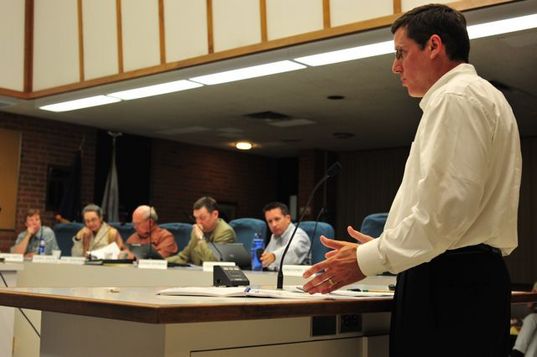
Tom Crawford, the city's chief financial officer, addresses the Ann Arbor City Council.
Ann Arbor's chief financial officer offered a grim outlook tonight, predicting the city faces a budget shortfall of several million dollars over the next two years.
“I believe we're in a new reality,” Tom Crawford said, relaying that new revenue forecasts show city officials may have to confront a $2.4 million to $3.3 million deficit before the end of this fiscal year and a $4 million to $5.8 million deficit next fiscal year.
That equates to a 3- to 7-percent reduction in city spending and a potential loss of 24 to 70 full-time city employees, Crawford said.
City Administrator Roger Fraser said it's not yet guaranteed those cuts will happen, but council members could see spending cut requests soon if predictions hold true.
Crawford said one of the biggest challenges the city faces is that state sales tax receipts are down 8 percent this year, which could equate to $1 million to $1.9 million in lost state transfers to Ann Arbor this year, as well as up to $2.8 million in lost transfers next fiscal year.
In addition, the city is expecting other revenues to come up $1 million short this year due to stagnant investment incomes. Traffic citation revenues also are down $200,000 and new development review fees are down $200,000, Crawford said.
Mayor John Hieftje said Ann Arbor is not immune to the challenges that are affecting every city in the state, the nation's leader in unemployment rates. Unemployment rates as of June for the Ann Arbor area were 10.6 percent, compared to 15.2 percent statewide.
Hieftje said city officials have their work cut out, but he said they don't face the level of challenges that Washtenaw County officials face with a $30 million structural deficit. He said part of the challenge for Ann Arbor is that 40 percent of the property in the city limits is tax exempt, largely due to the University of Michigan.
“Anyone who lives in Michigan certainly understands we are in a financially challenged state,” Hieftje said. “Things are changing rapidly all the time and one of the things that isn't changing is they aren't coming up with any solutions in Lansing.”
Crawford noted that Ann Arbor will have made a 26-percent reduction in full-time employees between 2001 and 2011, going from 1,005 to 746 over the last decade, if the city continues according to plan. He said the city is maintaining reserves equal to slightly more than 10 percent of spending, so there is not much room to dig into rainy day funds to meet the challenges ahead.
“Council has very little flexibility for obtaining revenues,” Crawford said, pointing out city officials' hands are tied when it comes to levying new taxes. He also pointed out the state previously removed the ability for local governments to have local entertainment or sales taxes.
City officials continue to evaluate the option of placing a city income tax proposal on the November ballot, potentially bringing in $7.6 million in additional revenue by the 2011 fiscal year. That's the net gain to the city after figuring the money to be gained from an income tax minus the loss of the city's 6.2-mill operating levy, which would be eliminated as per city charter.
Comments
PACE
Thu, Jul 22, 2010 : 8:11 a.m.
I think the Mayor, City council, and CFO "Tom Crawford" should do a better job managing money.
Eric64
Wed, Nov 11, 2009 : 1:21 p.m.
Well People what we should really do is lay off the Mayor and the city council.
AACity12
Mon, Aug 17, 2009 : 12:11 p.m.
The reason they have a shortage is because the miscalculated the Police early retirement buy out. They expected 14 to retire and they got something like 28. The completely mismanaged and miscalculated this deal and now they are having to pay out big time for it.
CynicA2
Fri, Aug 7, 2009 : 5:53 p.m.
... but of course we have tens of millions and more to squander on a new city hall and a big underground parking structure - not to mention a spare million for a glorified fountain to grace the new town hall's entryway. Meanwhile, I can't drive a mile in any direction without encountering axle-bending potholes and other medieval road conditions. I would like to see the mayor try to ride his bike on Miller, say from 7th to Main St. The wheels would be square before he made it! Try spending some money on something we all can benefit from, especially in the neighborhoods.
Jerome
Fri, Aug 7, 2009 : 12:33 p.m.
I think many would be surprised to discover the very, very nice "salary and compensation" packages enjoyed by many City employees. The number of City employees with six figure plus salaries is quite staggering. And secretaries and administrative assistants making almost $80,000 per year??? So, rather than address many of the "real" reasons the City's budget faces a deficit, the powers that be will just propose another tax increase. I'm not biting this time.
sottovoce
Fri, Aug 7, 2009 : 10:55 a.m.
Moose: I like it, but use "/br>" (with a "less than sign" before the slash...I don't know how to write the code as text without creating a real break) at the end of a paragraph to help reading. What bothers me most about council is they don't ask the city staff about projects before voting. Easthope used to grill the lady about new trucks. Where's the person who asks whether another $100-500k is really necessary for software development [hint to Kunselman]. I don't mind new spending on software, but it should come with oversight that we don't presently have. From 7-20-09 agenda DS-2 09-0646 Resolution to Approve a Purchase Order to The Ultimate Software Group Inc. for the Renewal of UltiPro Human Resource and Payroll System Maintenance Agreement and Subscription Fees for FY2010 ($174,000.00) (Information Technology Services - Dan Rainey) DS-3 09-0674 Resolution to Approve a 23-Month Service Agreement with Washtenaw County for Provision of Information Technology Management Services (Not to Exceed $132,000.00) (Information Technology Services - Daniel Rainey) From 7-6-09 CA-1 09-0506 Resolution to Approve a Contract with Optimetrics, Inc. for First Response Decision Support Software and Integration Services (not to exceed $43,540.00) (Information Technology Services - Daniel Rainey) DS-4 09-0391 Resolution to Approve a Sole Source Contract with Principal Decision Systems International for Implementation of TeleStaff scheduling software and support (Not to Exceed $115,375.00) and to Establish a Project Budget in the amount of $152,375.00 (Information Technology Services - Dan Rainey, IT Director) DS-5 09-0558 Resolution to Approve a Purchase Order to CGI-AMS for the Renewal of the Advantage Financial and Brass Budget Software Maintenance Agreement ($129,810.00) (Information Technology Services - Dan Rainey, Director)
Moose
Fri, Aug 7, 2009 : 9:15 a.m.
The city could save quite a bit of coin by getting rid of Trakit in PADS and returning to BSA software. The city could also save a bunch of dough by contracting out the city attorney's office, but that's a whole 'nother story. Trakit is a million dollar (and counting) software package purchased in part to settle the Washtenaw Homebuilders Association lawsuit from years back. (The actual terms of the settlement are secret) Trakit was supposed to automate and improve the development process. To this date it has not accomplished that task and CRW has not yet delivered a.NET module or a Rental Housing inspection module as promised under the terms of the purchase contract. The city continues to pay for CRW IT techs, flying them to Ann Arbor on the city's dime. On the other hand, BS&A software, designed and sold by an Okemos MI company was used previously in PADS and is currently used by the city assessors office. BS&A is a simple software package used by many Michigan municipalities and is designed as municipal software (Trakit is not). BS&A is much less expensive and now has.NET capability and a Rental Housing inspection module that costs $6000. (I have no business interest in BS&A) The people who bought Trakit are using many staff hours in a vain attempt to make it work. Indeed CRW sold the city a bill of goods on Trakit and is continuing to milk the city for software that doesn't do what is was supposed to to do or meet the terms of the purchase contract. All this was an attempt to reduce staff input by "pressing a button", cut planning and inspection jobs and better serve big developers over local contractors who get the majority of the permits and use the service on a daily basis. In other words, the whole idea was wrongheaded and misdirected from the start. It has also been heard that the purchase contract for Trakit software was expressly written around the "features" that Trakit said they would provide and have yet to deliver. BS&A was never given a chance at that time, even though they have now designed the modules that the city was seeking at that time. And BS&A did it at far less cost and was nearby to offer any tech support. A Michigan company no less! Because of the budget troubles in PADS, caused by running the construction/planning/permit fund into the ground, not saving for an economic downturn and milking the construction fund in past years, PADS is now trying to induce the Fire Department (and other city departments) to use Trakit, and then charge them to use it as a way to regain some of the costs of the software. City officials shortsightedness (or possibly something more) led to a software package that contractors and staff (the actual users not cheerleading managers) alike don't care for. In fact some contractors (mostly local) are so angry with the process that they no longer get permits for their work as it's cheaper for them to get caught than to comply. If it was the city's attempt to streamline the development process, it has failed miserably. It has been said that developers think that the development process here is onerous, Trakit has made it worse by removing the human element and relationship between staff and the public they serve. Does anyone remember the Utilities dept software scandal that resulted in the removal of it's department head? This is history repeating itself. Why is the city tied so tight to Trakit? Who's covering this up? Ditching Trakit now, even after spending a million or so $$ and returning to BS&A will save the city in the long run and restore some of the service to permit holders and the public that is now sorely lacking in the operations of Planning and Development services. Now, let's see aa.com censor this. Or maybe they would like to actually investigate this costly mess?
Top Cat
Fri, Aug 7, 2009 : 9:07 a.m.
Take a walk around downtown Ann Arbor and notice how many empty store fronts there are. I was surprised to see that Zanzibar has now closed. The one guarantee that a city income tax would bring is more empty store fronts.
David Cahill
Fri, Aug 7, 2009 : 9:03 a.m.
Oop! The Germantown proposal was rejected December 18 of *last* year.
David Cahill
Fri, Aug 7, 2009 : 8:35 a.m.
Also last night, City Council established a committee to study a proposed historic district in "the area encompassing properties that abut the east and west sides of South Fourth Avenue and South Fifth Avenue, bounded by the East William Historic District on the north, and Packard Street on the south, and also including 209, 215, and 219 Packard Street." This is a smaller version of the Germantown Historic District proposal that was rejected earlier this year. Along with establishing the study committee, Council imposed an emergency moratorium on any demolition in the proposed new historic district. Council earlier had considered at length a proposed resolution establishing a moratorium on new developments in the R4C/R2A zoning districts. It was amended several times. By the time the amendments were finished, some Council members thought that moratorium was too weak and others thought it was too strong, so it was defeated. Then the historic district resolution was introduced. The "emergency moratorium" contained in it would stop the proposed City Place project. Mayor Hieftje said that the City Place developer had tried to "blackmail" Council by pushing for a project that was within the zoning in order to pressure Council into approving the "planned unit development" project that the developer really wanted. So the historic district resolution passed - with a stronger moratorium, although for a smaller area, than the defeated resolution would have imposed. The members of the study committee will probably be appointed at the next Council meeting.
UMGrad1234
Fri, Aug 7, 2009 : 8:10 a.m.
Yeah. Yeah. Will someone on Council PLEASE ask Roger Fraser how many independent contractors Ann Arbor has since he, Hiefje and Greden have been busy "streamlining" our city budget? These guys are playing with the numbers to get their city Income tax. Greden gave us a "study" that said 75,000 people commute into the city every day. Kunselman pointed out the number was undocumented and padded. Crawford and Fraser need to go. So does Hieftje. Ten years of playing politics with our budget (Hieftje's web site says he's saved us $10 million a year thanks to his "streamlining"), spending hundreds of millions we don't have on construction projects we don't need, and now coming to scare everyone with probable "cuts," is a sign that we need to get rid of several more on Council, then Fraser and Crawford.
racerx
Fri, Aug 7, 2009 : 4:45 a.m.
Moose brings up some very valid points. While cutting those, close the Burns Park Senior Center. Huron Hills should have been gone decades ago. How Jayne Miller still has a job with that money losing entity is a wonder. Stop contributing to the Greenbelt unless the Sierra Club replace the lost funds, which has only been created to applease those tree-huggers who were effective in supporting council members who supported their agenda. Outsource trash pickup like Pittsfield Township. Share IT staff with the county. Gee, traffic citation revenue is down? How can that be when I see patrols sitting at the Gandy Dancer, Washtenaw Ave., Packard by the doughnut shop, Main St by Pioneer, Stadium by Crisler Arena, but this is the same police department that is unwilling to have a patrol car at Studio 4 between 1:30-2:30am to quell some of the problems there, but would rather close the business due to their lack of doing what they should be doing "POLICING!" Same with the "gang-related fight" at the carnival a few years back. Just because the police department had to actually do some work, they would rather shut it down then deal with a very minor issue. Gee A2, you used to be something!
Randy Ayn
Fri, Aug 7, 2009 : 4:10 a.m.
Cut taxes now, especially the onerous property taxes.