

Washtenaw County Board delays vote on budget, passes new economic development tax
Washtenaw County commissioners were expected to vote in committee Wednesday night on a two-year budget for 2010-11, but instead tabled any action on the budget until Nov. 18.
But they did vote on an Act 88 millage, a new tax that will fund economic development and agricultural activities.
Commissioners delayed making a final decision on the millage two weeks ago, but voted 8-2 in favor of it Wednesday. Commissioners Kristin Judge, D-7th District, and Wesley Prater, D-4th District, voted no. Commissioner Jessica Ping, R-3rd District, was absent but previously said she would abstain from voting anyway.
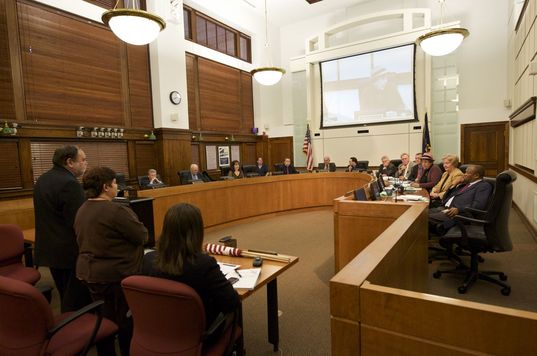
Commissioners listen to a presentation during Wednesday's Washtenaw County Board of Commissioners meeting, where the Act 88 millage passed.
Ryan J. Stanton | AnnArbor.com
County Administrator Bob Guenzel proposed the tax two months ago in an effort to free up money in the county's general fund and avoid cuts to programs like 4-H and Ann Arbor SPARK. Overall, the tax will generate $603,000 a year in economic development funds and cost taxpayers roughly $4 for every $100,000 of their property’s taxable value. It will be levied in December for use in 2010.
The millage will provide:
- $200,000 for Ann Arbor SPARK.
- $50,000 for SPARK East.
- $100,000 for the Eastern Leaders Group.
- $59,000 for 4-H activities.
- $27,000 for Horticulture Programming.Â
- $15,000 for Agricultural Innovation.
- $15,000 for the Food Systems Economic Partnership.
- $137,000 for the county's Department of Economic Development and Energy activities.
Commissioner Mark Ouimet, R-1st District, clarified he was offering a partial "yes" to the tax. He supported having it fund the agricultural-related programs, but said he thought economic development funding should come from the general fund.
"The reason I voted for essentially the MSU Extension, the horticulture program, the agricultural program and the Food Systems Economic Partnership is, because it's such a small part of the budget, my concern is that would continue to get lost," he said. "The other ones, the economic development (organizations) like SPARK, which I sit on the executive board of, I feel strongly that that should be housed in the body of our budget anyway. And because it is so critical and important, it will draw enough support and attention going forward, so it doesn't need to be carved out."
Judge said she voted no because many of the constituents she spoke to were uncomfortable with a tax increase they couldn't vote on.
"And I was uncomfortable with the amount of different small funds that were put in there," Judge said. "When it was first brought to the commission, it was just for SPARK and economic development, and the response from my constituents was that they were OK with that. But then when a bunch of extra stuff got added in, I didn't feel that it was handled in the best way possible."
The millage, allowed in Michigan under Public Act 88 of 1913, gives counties the authority to levy a tax for economic development, promoting agriculture and expanding businesses. The approval of the millage is not subject to a popular vote requirement because its legislative authorization predates the Headlee Amendment to the state Constitution by 65 years.
The board also voted 10-0 Wednesday night to reorganize the Sheriff's Central Dispatch and Emergency Services Division to address staffing shortages and record 911 call volumes.
The changes include eliminating four full-time dispatch supervisor positions and creating two operator positions, one emergency planning coordinator and one dispatch operations coordinator. One operator position will remain vacant under the budget-neutral reorganization.
The county budget, which did not get voted on, includes $99.2 million in general fund spending for 2010, down from $103.8 million in 2009. Commissioners said the delay of the budget means it won't receive committee approval until Nov. 18, which could push back its final adoption to Dec. 2.
"We're moving down to a consensus on the budget," Ouimet said. "We have worked through each commissioner's individual issues and I think we're very close to having this resolved, which I think is far different than what you've seen at the state or national level. We've been able to work together as a team, focusing on what our objectives are and how we want to fund government in this county."
Commissioners didn't go into detail on what issues caused the delay, which was announced at the start of Wednesday's meeting.
"I think a couple of commissioners still have a few points that they want to discuss," Ouimet said. "Instead of putting it up this evening, it's better just to take it off the table, have those discussions, and then be able to pass the budget in total. It's just what I would say essentially minor issues. I don't see it being a big problem."
Ryan J. Stanton covers government for AnnArbor.com. Reach him at ryanstanton@annarbor.com or 734-623-2529.
Comments
DagnyJ
Sat, Nov 7, 2009 : 9:44 a.m.
Thanks for this Tony. I wrote to my commissioner already. Would you tell Ryan Stanton to keep an eye on these folks and make sure to highlight any other backhanded tax increases?
aagirl
Fri, Nov 6, 2009 : 1:03 p.m.
Please print the commissioners names and an appropriate address for readers to send their letters of protest. We cannot condone this misuse of Act 88. The intent of Act 88 was to support agricultural activity and not to fund the County Administrator's pet projects. This is taxation without proper representation.
dotdash
Fri, Nov 6, 2009 : 11:52 a.m.
I echo Dagny's appreciation of your willingness to engage. Please ask your fellow commissioners to reconsider this outrageous tax increase. They could still repeal. It stinks to high heaven, demonstrates a tin ear for the economic situation many are in, and increases distrust of county government in general and Democrats in particular. The cost in terms of public trust will be much greater than any benefit gained by the 4H, et al. Please ask them to reconsider -- for everyone's good.
DagnyJ
Fri, Nov 6, 2009 : 10:55 a.m.
Thank you Commissioner Judge. I appreciate your willingness to engage. Thank you for looking out for my tax dollars. I'm not one of your direct constituents, but I benefit from your fiscal care in spending my money. Please tell your colleagues that voters are concerned about government spending and ready to do something about at the ballot box. Tuesday's vote should be proof enough of that.
Kristin Judge
Fri, Nov 6, 2009 : 8:46 a.m.
My view may be seen as tainted because I am a Commissioner (note I did not vote for the tax increase), but I am also a citizen who last year was not a politician. I was a community activist who tried to recall officials I felt were not representing the public. Our group collected over 2,600 signatures and did get a recall on the ballot. We gave up our weekends and evenings for about 6 months. Unfortunately, citizens do not vote for recalls very easily. My solution was to run for office myself and ask other concerned residents to run. We were able to get 9 new people elected to office, and I strongly believe the community is being heard and better served because of it. Some of our current commissioners will be running for higher office in 2010 leaving open seats. If you are interested in getting involved this may be a great time to run for office! Writing to me is an effective way to be heard, but what has an even greater impact on the Board of Commissioners is coming to speak at our meetings in person. Please consider coming to our meetings on the first and third Wednesdays and Thursdays of each month (with the exception of December and the summer months-we do not have the 3rd week.) We have over 16 minutes of public comment time allotted per person who is interested. Our meetings are televised live on CTN. Our website has all the information you need at ewashtenaw.org. All our phone numbers are listed too. I have a monthly email newsletter that I will send to any county resident who wants it. It is also on my county webpage. The citizens of Pittsfield Township vote for me, but the decisions I make impact all of the county's residents. That is something I am cognizant of each day. Every day I am working for more transparency and responsible spending. If you have ideas, please let me know. Call or email me anytime. 734-646-2088 (my personal cell - I gave up my county cell) or judgek@ewashtenaw.org
GoblueBeatOSU
Fri, Nov 6, 2009 : 7:55 a.m.
Janelle....great, great, great post....what an eye opener. This was the most informative post in a long time.
Janelle Baranowski
Thu, Nov 5, 2009 : 8:26 p.m.
I recognize a few names on these boards and advisory councils...how about you? Eastern Leaders Group https://elg.ewashtenaw.org/ Ann Arbor Spark http://www.annarborusa.org/about-us/governance/ Janelle www.some-other-viewpoint.blogspot.com
GoblueBeatOSU
Thu, Nov 5, 2009 : 6:26 p.m.
dotdash....you are right. Everyone needs to contact the Washtenaw County commissioners. Even if you are for this increase, you cannot be happy with how it was managed. To enact a property tax increase the day after the people of Washtenaw County voted down the school millage just demonstrates a complete disrespect for the voters. In these times, how could any public official support a tax increase that is not approved by the voters? To approve this the way they did demonstrates complete incompetence. The more I think about this the more I realize how bad this smells. Something is not right here. Someone is getting something out of this. If this were all above board, the Washtenaw County commissioners would have brought this to the public to vote on. I do not have proof of wrongdoing, but there is something going on. I suggest everyone write to our Attorney General Mike Cox and ask him to look into any possibility of wrongdoing. Mike Cox's address is: G. Mennen Williams Building, 7th Floor 525 W. Ottawa St. P.O. Box 30212 Lansing, MI 48909 Main Number (517) 373-1110
fergus1mom
Thu, Nov 5, 2009 : 4:56 p.m.
Thank you for a constructive, immediate course of action. I hope that all on this post who object to this insupportable additional tax will follow your suggestion, and urge others to do so as well. People are losing their HOMES--4H and the Eastern Leaders are going to have to do without.
dotdash
Thu, Nov 5, 2009 : 4:46 p.m.
As I read it, it would take petitions with the signatures of 25% of the voters in the district. Then a special recall election would be held. That's a lot of work. Alternatively, anyone upset by this could call the commissioners and ask them to repeal the measure. They haven't approved the final budget yet, so they could still rejigger to get everything under the general budget. It would be a gesture they could make to show they understand the mood and economy of the county.
fergus1mom
Thu, Nov 5, 2009 : 4:35 p.m.
I understand your point, dotdash, but the fact that they raised taxes on us *immediately* following a resounding message from the polls on Tuesday tells me that these people are hopelessly out of touch and/or indifferent to the wants and needs of their constituents. Yes, I will write to them and voice my displeasure. But since I have virtually no confidence they will listen or care, I also want to understand what it would take to remove them from a position of causing additional harm to the citizens of Washtenaw County.
dotdash
Thu, Nov 5, 2009 : 4:16 p.m.
If you want to have an impact on your county commissioners, you have to reach out to them in person. The anonymous nature of the AA.com comments make them disinclined to respond in this forum. Here is their contact info: http://www.ewashtenaw.org/government/boc/2009%20BOC%20Public%20Contact%20Information.pdf
fergus1mom
Thu, Nov 5, 2009 : 4:08 p.m.
Good grief. I never, ever considered myself a political activist but it might be time. I've seen two very plausible courses of action proposed here: recall the existing out-of-touch spendthrifts; and, as a more permanent solution, get rid of the lot of them and replace them with a single county executive. Does anyone out there know what would be required to get the latter on a ballot? I am weary beyond description of public officials spending my money like drunken sailors. It's time for them to go.
treetowncartel
Thu, Nov 5, 2009 : 2:44 p.m.
Thank you Mr. Prater, I knew I voted for you for a reason.
dotdash
Thu, Nov 5, 2009 : 2:03 p.m.
Here are the details re recall elections: http://www.ewashtenaw.org/government/clerk_register/elections/el_recalli.html It seems as if you need petitions signed by 25% of the voters in the district, and then they will schedule a recall election.
GoblueBeatOSU
Thu, Nov 5, 2009 : 1:01 p.m.
What are these people thinking doing this right after the school millage went down? These are people that are out of touch or are only interested in their pet projects. With the exception of Commissioners Kristin Judge, D-7th District, and Wesley Prater, D-4th District how do we get these people out of office now? These people clearly aren't interested in what is important to the people of Washtenaw County. Can you believe they increased all of our taxes so the can GIVE $100,000 for the Eastern Leaders Group. If we are going to pay higher taxes that $100,000 needs to go to the schools first. Can we do a recall petition?
Martin Church
Thu, Nov 5, 2009 : 12:59 p.m.
hey County Commissioners where do we get the money to pay your new Tax. We the tax payers are broke and while its nice to give money to farm programs we need the money to put food on the table. What gives you the right to impose a TAX without letting us vote on it. It is time for a recall of these commissioners. I will remmember your vote come this time next year and will vote against you. it is time for the citizens to call on our state reps to change this law.
Ryan J. Stanton
Thu, Nov 5, 2009 : 12:41 p.m.
I took a phone call earlier this week from an elderly resident living on a fixed income in Ypsilanti Township who said she was waiting for the Act 88 millage to appear on the ballot so she could vote it down. She was surprised to find out the county board could impose it upon her without her say. "I'm almost 88 years old, and to think they can put that millage on me, it's ridiculous," she said, telling me she thinks she should be exempt from new taxes at her age. "The things that it's going for are so ridiculous."
dotdash
Thu, Nov 5, 2009 : 10:34 a.m.
This is outrageous. If they can't fund out of the general budget, then they should cut. Those are the hard decisions we ask them to make as commissioners. I don't want to fund any of these initiatives if they aren't even important enough to the commissioners to fund them out of the general budget.
Ypsi-track
Thu, Nov 5, 2009 : 9:34 a.m.
Tax ourselves to properity. Makes perfect sense if you've never run a buisness.
Basic Bob
Thu, Nov 5, 2009 : 9:14 a.m.
I'm surprised how they can still be levying taxes for next month's tax bills. I tried to find current information on 2009 property tax rates and have not been successful. Not that another $4 makes any difference, it's already in escrow.
Tort Reform
Thu, Nov 5, 2009 : 9:13 a.m.
Man! Just look at those fancy digs. People who set themselves up like that (at taxpayer expense) must consider themselves Royalty. No wonder they need so much money. Must be nice...
DagnyJ
Thu, Nov 5, 2009 : 7:52 a.m.
Wow. These guys are nuts. How soon can we vote them out of office?
KeepingItReal
Thu, Nov 5, 2009 : 5:47 a.m.
Cash: The Act 88 Millage that was just voted on by the commissioners was not to support 4-H although it was the intent of the original legistlation that created it back in 1913 to provide support for agricultural related industries. IF you read the legistlation, it also vaguely referenced related economic development activities, although this was not teh clear intent of the legislation. While this is may be legal, it is a slight of hand manuever by the commissioners because they know that most of us do not research these matters and that we will soon forget they even voted on this. If you will notice, the largest items funded were not agricultural related. These items are pet projects of the county administration. This slight of hand move is the same that the County Administrator pulled when he did not get his way with the expansion of the County jail. After the millage failed, he found the money to expand it. Although Mark Ouimet, who sits on the board of SPARK, voiced his reservation about voting for this bill, did vote for the ACT, two other commissioners did not. My commissioner, Barbara Bergman voted for it which I and others will definitely remember come voting time ITS TIME FOR A CHANGE.
Cash
Thu, Nov 5, 2009 : 5:40 a.m.
http://www.detnews.com/article/20091105/METRO03/911050395/New-Macomb-County-executive-position-has-no-shortage-of-candidates This is where we need to be...someone in charge who looks out for the county AS A WHOLE, not just their own little corner of the county. We sink or swim together...not in little pieces.
KeepingItReal
Thu, Nov 5, 2009 : 5:32 a.m.
Barbara Bergman, just just lost my vote and many others
Cash
Thu, Nov 5, 2009 : 5:28 a.m.
We need to follow Macomb County and pare down commissioners here. We have too many special interests negotiating for each vote. Come on. I've farmed in my lifetime but in this economy we raise taxes to support 4-H???? Is that in the best interests of taxpayers who have lost their jobs and are waiting for more unemployment (while Republicans stall in the Congress) so they can eat? We need to follow Macomb County's lead. It's time for a strong county leader and a smaller commission.
Janelle Baranowski
Wed, Nov 4, 2009 : 11:36 p.m.
I submitted an article to annarbor.com that looks at the county budget, using a specific example to focus on the overall issue of government transparency. I don't know if it will be published, but it will be available on my blog. I will be at the November 18th meeting to encourage our commissioners to delay the vote until citizens can see (and understand) a line-by-line budget. Additionally, I will be up for Board approval for appointment to the Workforce Development Board and Community Action Board. Janelle www.some-other-viewpoint.blogspot.com
Mikey2u
Wed, Nov 4, 2009 : 11:26 p.m.
So how long until we can vote the Washtenaw County commissioners out of office? So far this year five families on my street have lost their homes because they couldnt keep up with their house payments. Houses on my street are selling for $15,000.00 and yet you have to pay $2000.00 per year in property taxes. You people are destroying families so you can fund 4-H programs?