

Greenbelt around Ann Arbor grows by 173 acres after latest purchases in two townships
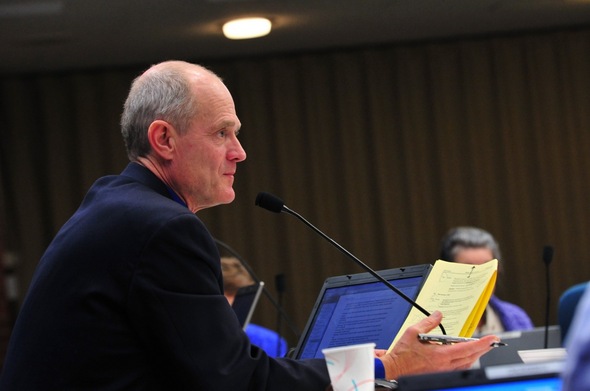
Mayor John Hieftje applauded the purchase of development rights on another 173 acres of farmland Monday night. He said it's been one of the most productive periods ever for the city's Greenbelt Program.
Ryan J. Stanton | AnnArbor.com
The city of Ann Arbor will spend $507,000 from its Greenbelt millage proceeds to preserve another 173 acres of farmland in townships surrounding the city.
The Ann Arbor City Council voted unanimously Monday night on separate agreements for the purchase of development rights to three properties.
The city will spend $145,155 for the development rights to the 74.17-acre farm belonging to Edward and Muriel Pardon in Ann Arbor Township. The city is leveraging $272,824 in federal grant funds, plus $141,980 from Ann Arbor Township.
The city will spend another $179,025 for the development rights to the 65.17-acre farm belonging to Norman Ledwidge in Webster Township. The city is leveraging $182,535 in federal grant funds, plus $59,676 from Webster Township.
The city also will spend $182,939 for the development rights to the 33.7-acre farm belonging to Bradley and Mary Clark on Farrell Road in Webster Township. The property is located adjacent to the Webster Church property that was protected by the city in 2009.
Due to the property's smaller acreage, it did not qualify for grant funds, city officials said. But the landowners were willing to donate 20 percent of the fair market value, or $34,800, and the city will be paying 80 percent of the appraised value for the development rights.
"All of these purchases are contiguous to other preserved land, and that's been a strategic goal of the greenbelt," said Council Member Carsten Hohnke, D-5th Ward, who also serves on the city's Greenbelt Advisory Commission.
"The first property, the Ledwidge Farm, completes our first 1,000-acre block in Webster Township," he said. "And the Pardon property completes a 400-acre block right on US-23 in Ann Arbor Township, an area that saw a lot of development pressure."
The purchase of development rights keeps the property in the hands of the owner but ensures the land can't be developed and will remain forever preserved as open space. One of the main goals of the program is to counter urban sprawl and preserve sustainable farming.
Mayor John Hieftje said Monday night this is one of the most productive periods ever for the Greenbelt Program, which has preserved about 2,200 acres of land surrounding the city. The program is funded by a citywide tax officially called the Open Space and Parkland Preservation Millage, which brings in more than $2 million annually in revenue from city taxpayers.
The Greenbelt Program was approved by Ann Arbor voters in November 2003, at a time when a significant amount of development activity was occurring around Washtenaw County, and farmland was being sold for development.
Voters authorized a 0.5-mill tax for 30 years, which provides funds for parkland acquisition within the city and the preservation of open space, agricultural land, and other natural habitats outside the city in a designated greenbelt district.
"The map that is emerging is really inspirational," said Hieftje, who was the public leader of the campaign seven years ago to start the program.
He said there aren't that many programs where people will look back in 100 years and say, "I'm really happy that they did that," but the greenbelt is one of them.
Ryan J. Stanton covers government and politics for AnnArbor.com. Reach him at ryanstanton@annarbor.com or 734-623-2529.
Comments
BobbyJohn
Tue, Nov 23, 2010 : 3:30 p.m.
@JohnQ, if you are familiar with how real estate appraisers work, they can't figure out what is a fair appraisal without comparables (comps). They are not allowed to guess. If they are honest, without comps, they can't really come up w/ a figure. Now, one of the reasons we are in this mess with real estate is that for years, appraisers were told to "make the appraisal work". And most of them did that so they could be hired in the future for further appraisals. Unethical, but common. Generally, the less ethical the appraiser the busier they were. Yes, the southern part of the county has been less expensive than the northwestern part of the county. But, this price was for purchase, not just for development rights. Huge difference.
John Q
Sat, Nov 20, 2010 : 8:28 p.m.
"An acquaintance of mine just bought some beautiful farmed and wooded land for $2,000/acre at the Washtenaw and Monroe counties border." Which isn't comparable in location to the properties that the easements are being from in these cases. Even if there haven't been any recent sales, a good appraiser can work out the appropriate price that the market would value those easements. As for the claim that they are being given a price and told to make it work, I very much doubt that is the case at all.
BobbyJohn
Sat, Nov 20, 2010 : 5:22 p.m.
@JohnQ We are not opposed to each other, I am just saying the city is way overpaying for development rights. An acquaintance of mine just bought some beautiful farmed and wooded land for $2,000/acre at the Washtenaw and Monroe counties border. NOT just the development rights. Spend our money wisely, not foolishly. Appraisals for raw land are difficult to assess now because of few or no recent sales in the area. As for appraisers, everyone knows that appraisers are given a price and told to make the deal happen. jhat is one of the ways we got into the collapse of the real estate market.
AlphaAlpha
Fri, Nov 19, 2010 : 6:59 a.m.
"if this issue were put on the ballot today, it would fail." Agreed. Tax increases during recessions are rare.
CynicA2
Thu, Nov 18, 2010 : 5:25 p.m.
Indeed it is "hard to tell", Alpha! In fact it is almost impossible to predict ANYTHING, with any degree of accuracy, 100 years hence. We may be a province of China in 100 years, or the human race may be extinct... who knows? I certainly am not inclined to squander large numbers of tax dollars on a raw land bet 100 years down the road. There are much more worthy uses for the money in the here and now. I venture to say that if this issue were put on the ballot today, it would fail. Enough voters have been pummeled economically to realize the value of a tax dollar (except in Hieftje Hall) and would probably defeat this silliness the second time around.
AlphaAlpha
Wed, Nov 17, 2010 : 10:31 p.m.
Hard to tell CynicA2...some estimate that in just under 100 years, the States will be home to fully one billion people, over 3 times today's total. It seems reasonable that Michigan's population would rise as well.
CynicA2
Wed, Nov 17, 2010 : 7:22 p.m.
This whole greenbelt thing is a crock. As the state (and the county, for that matter) continue to depopulate in the years to come, the last thing the city will have to worry about is excessive development, or sprawl or whatever. A couple more years worth of Great Recession and the city will be wishing it could sell some of those development rights so they can buy toilet paper for Hieftje Hall. Wait and see...!
John Q
Wed, Nov 17, 2010 : 4:08 p.m.
If you think the land is worthless, do the community a favor and go out and buy some of that "worthless" land. Let us know how successful you are at getting that property for nothing.
John Q
Wed, Nov 17, 2010 : 4:02 p.m.
"I am saying that land is close to worthless right now, so to pay so much for just the development rights of land is a ripoff to the taxpayer and a huge bonus to the landowner who gets to keep the land. I am not saying not to buy it, just don't overpay." The city pays fair market value for these properties based on appraisals of the property. The Federal program doesn't allow the city to "overpay" for properties with federal grant dollars.
BobbyJohn
Wed, Nov 17, 2010 : 2:05 p.m.
@Andy I am saying that land is close to worthless right now, so to pay so much for just the development rights of land is a ripoff to the taxpayer and a huge bonus to the landowner who gets to keep the land. I am not saying not to buy it, just don't overpay.
Speechless
Wed, Nov 17, 2010 : 12:47 p.m.
"... Can't take care of the parks or golf courses and the city has a budget crises how can the purchase of more property be justified? If they pass on the property purchase maybe they can buy furniture for city hall!" Please remember that funding for the city's Greenbelt Program comes from a dedicated millage approved by Ann Arbor voters seven years ago. It has its own tax, in other words, and hence does not draw from local property taxes or the city's general fund. Greenbelt purchases do not take away money from City of Ann Arbor public services or programs.
Andy
Wed, Nov 17, 2010 : 12:25 p.m.
"(R)aw land is practically worthless.Almost nobody is buying raw land. Why is our government ripping us off w/ these inflated values when the real estate market is suffering so badly?" I am so confused. Is it worthless or is its value inflated? It can't be both. Since real estate has declined so much in value, isn't it cheaper to buy undeveloped land right now? Plus it's certainly cheaper to leave it undeveloped than for taxpayers to foot the bill for utilities, roads, and other infrastructure for sprawl that will then reduce both the market and taxable value of Ann Arbor homes.
BobbyJohn
Wed, Nov 17, 2010 : 12:24 p.m.
To follow up, I looked up the Clark property on Farrell Road in Webster Township. The 2010 SEV is $250,000. And as most people are aware, that land would never sell for even close to that at this time. Land that far out of Ann Arbor is NOT selling. The Greenbelt plan paid 3/4's of the vastly overvalued SEV for only the development rights. I am not saying that the greenbelt plan doesn't serve a valid purpose that the voters value, but let's have our money spent wisely and with some fiscal responsibility. Farmers taking advantage of city fools at the expense of taxpayers.
BobbyJohn
Wed, Nov 17, 2010 : 12:02 p.m.
If one adds up all the upfront costs from city, township and feds, the cost is $6-$8,000/acre. And this is only for development rights. The city does not own the land, it is NOT open to public/taxpayer use. We are paying ABOVE the tax assessed value for these properties. Currently, raw land is practically worthless.Almost nobody is buying raw land. Why is our government ripping us off w/ these inflated values when the real estate market is suffering so badly? Why pay this much for only development rights? Ryan, could you look up the tax assesor values for these properties?
Ryan J. Stanton
Wed, Nov 17, 2010 : 10:24 a.m.
@JSA The PDR does not take the land off of the tax rolls. It remains in private ownership and the landowner continues to pay property taxes.
JSA
Wed, Nov 17, 2010 : 8:44 a.m.
What a wonderful idea, take more land off the tax rolls. The next time the county goes looking for funding I'll tell them to talk to Ann Arbor.
Top Cat
Wed, Nov 17, 2010 : 8:08 a.m.
Thanks to all as this program works to increase the value of my 10 acre parcel in Webster Township. I'm not sure of the real purpose of this but it appears that the Birkenstock Yuppies want to find a way other than zoning to keep the riff raff out.
Paper or Plastic
Wed, Nov 17, 2010 : 7 a.m.
Can't take care of the parks or golf courses and the city has a budget crises how can the purchase of more property be justified? If they pass on the property purchase maybe they can buy furniture for city hall!
Speechless
Tue, Nov 16, 2010 : 11:29 p.m.
Whether the purchase of development rights takes place nearby in Ann Arbor Township or further out in areas such as Webster Township, the Greenbelt program is eminently worthwhile. The modest, piece-by-piece preservation and protection of open spaces, especially in contiguous tracts of land, will gradually make a big difference over time by limiting sprawl. As the mayor indicates in his comment quoted at the end, this is a very long-term project. Purchases happen slowly but steadily, and the benefits from restricting development may take decades to become clearly apparent to city and county residents.
AlphaAlpha
Tue, Nov 16, 2010 : 9:55 p.m.
Less than $3,000 per acre. Well done! Congrats-keep up the good work. Plenty of good deals ahead...
Tim Darton
Tue, Nov 16, 2010 : 7:11 p.m.
It is wonderful to see this bold program doing so well. This will indeed leave a beautiful legacy for generations to come.