

Group supports moratorium on downtown development in letter to Ann Arbor City Council
A unified group of residents and community activists representing eight different neighborhood organizations sent a letter to Mayor John Hieftje and the Ann Arbor City Council on Tuesday, lobbying for passage of a temporary moratorium on new downtown development.
The letter comes exactly one week after the council postponed consideration of a resolution proposed by Council Member Sabra Briere, D-1st Ward, and co-sponsored by Stephen Kunselman, D-3rd Ward. The resolution would pause new site plan approvals — including one for a controversial, 14-story high-rise at 413 E. Huron — while the city re-evaluates its downtown zoning.
The six-month moratorium has been the subject of legal threats. Attorneys representing the property owner and the developer behind the 413 E. Huron project call the moratorium a thinly veiled attempt to put a roadblock in the way of their clients' project just as it was to come before council.
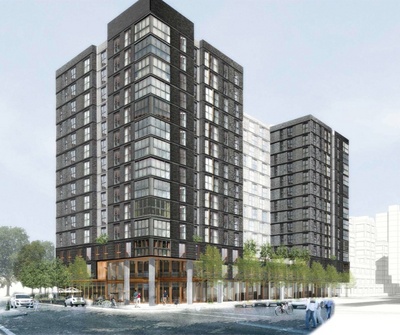
This 14-story high-rise proposed at 413 E. Huron is at the center of controversy surrounding a proposed moratorium on development in downtown Ann Arbor.
Humphreys & Partners Architects
Here's the letter the 16 residents sent to council on Tuesday:
Mr. Mayor and Members of City Council:
We represent the eight downtown and near-downtown neighborhood organizations and associations. We are contacting you on behalf of our constituents, who by a large margin support the proposed moratorium sponsored by Councilmembers Briere and Kunselman. We urge you to support the moratorium AS PRESENTED, without any amendments or any exclusion.
Three years ago many of us voiced our concerns over certain provisions in the final draft of the A2D2 Zoning and Design Guidelines. At that time, council acknowledged the documents may not be ideal and promised in writing to the community that after a year both would be revisited.
As "The Varsity" project was topped off over the past few months, the community realized the concerns we presented to council at the time of the adoption of the regulations were valid. One only has to walk the site of that project to see the dramatically negative impact that a building of that size and mass has had on the historic Baptist Church and adjacent historic low-scale properties.
We urge you to walk that site, if you have not done so, and see first-hand how these treasured historic structures have been harmed. Witnessing that project's build-out has made our constituents more sensitive to any development that may be adjacent to other historic properties, and caused all to call for the promised review of the zoning and design guidelines.
The need for the promised review was reinforced when a proposal came forward for 413 E. Huron that would be 50% larger than the troubling Varsity project, and also be adjacent to historic properties. The review was promised to the citizens of this community long before that project was proposed. The promised review will encompass all D1/D2 areas, and not be limited to one project or parcel. The 413 parcels and proposed project is so massive, and on such a key piece of property, that to exempt it from the review process will impair the ability of council to affect the character of downtown.
No one can contend that a review of the zoning comes as a surprise, when the dialog that codified it included statements that it would be revisited after a year. Municipal land use attorneys have told us that Michigan law provides no vested development rights attached to a parcel one may purchase, until construction of a structure's foundation has begun. Anyone buying property in D1/D2 areas should have anticipated the possibility that the zoning might be changed, as council's promised review had yet to commence. No developer should be exempt from the moratorium based on a failure to discover that an official review of the zoning code was overdue.
If the project that precipitated these current concerns is not included in the moratorium, then the full efficacy of the moratorium is called into question. We feel all D1 parcels abutting or adjacent to historic properties should be included to fulfill the purpose of the moratorium.
Legal zoning experts have told us that it would be a very high bar for a party to convince a judge that the city is acting in bad faith by enacting a short-term moratorium while council reviewed the whole of D1/D2 zoning and design guidelines, as the city has previously stated to the community in writing.
Council has an obligation to bring the city's zoning ordinance into compliance with its planning documents. Although there is limited legal risk to the city in acting on the right and need to revise the zoning ordinance to bring it into compliance, we recognize there may be some financial risk from being challenged by various parties for any action taken or not taken. The bottom line, however, is that council needs to decide to do what is right, and act in good faith with respect to the promise made to the community. We feel that protecting the character of the downtown is paramount in this process, and all sites adjacent to historic properties must be included in this review.
Christine Brummer, Norm Tyler, Ellen Ramsburgh, Doug Kelbaugh, Christine Crockett, Ann Schriber, Susan Wineberg, Peter Nagourney, Ray Detter, Hugh Sonk, Ethel Potts, Ilene Tyler, Tom Whitaker, Betsy Price, Alice Ralph, Jeff Crockett.
Ryan J. Stanton covers government and politics for AnnArbor.com. Reach him at ryanstanton@annarbor.com or 734-623-2529. You also can follow him on Twitter or subscribe to AnnArbor.com's email newsletters.
Comments
AlisFontin
Wed, Feb 27, 2013 : 10:26 p.m.
So Ann Arbor spends over eight years to create a new stronger direction for the development of the downtown, involving countless hours of staff time, citizen participation, consultants, etc. so they can get it right. The major premise is, higher density residential development in the downtown creates a more vibrant urban core AND helps to reduce sprawl. They then create the D1 and D2 zoning districts, specifying citizen and neighborhood participation, and giving developers a clearer path as to what criteria needed to be provided and what the expectation of performance were to be to receive site plan approval. This is all reviewed by staff, the Planning Commission, City Council and various citizens groups, consensus is reached and is approved. But wait, for this specific site they encumber it with additional constraints, knocking thirty feet of the typical D1 building maximum height and limiting how much of the site can be developed with greater setback constraints. Then they write into the often spoke of Design Guidelines, for the district, the character they are looking for is " high-rise housing" AND "There is (will be) a significant contrast between the massing and the scale of the structures within the character overlay districts and the residential scale of the adjacent historic neighborhoods." Therefore it was recognized in the approval process for the rezoning of this site a large scale building would be allowed within the defined limitations set forth in the ordinance next to the smaller scale neighborhood. Along comes a developer working within these limitations for the past nine months and just before they go to City Council a moratorium is proposed, which will only affects this property. An obvious thinly veiled attempt by a small organized vocal group to direct and control the City Council towards what they believe the cityscape should be versus the long worked on actual approved plan.
John Floyd
Sat, Mar 2, 2013 : 1 a.m.
There certainly was a lot of noise about "Consensus" and "Public Participation" during A2D2, but I saw little evidence of either in what came out of A2D2, especially on the block in question. When you ram stuff down the throats of people who do not want it, it shouldn't be a big surprise that they push back. Had council simply zoned this D2, there would be no controversy.
DennisP
Thu, Feb 28, 2013 : 1:32 p.m.
Yep. That's right. As for a D2 ring around the entire core, that was not included in the plan as clearly shown in the plan's map. Nowhere does the plan say that D2 was supposed to ring the entire D1 core. That's a wishful interpretation by those who now want to reopen the argument that they couldn't carry back in 2009. The Planning Commission made its recommendations, the Council took it to the public and made adjustments, then gave final approval to the Plan as it stands today and the Zoning Ordinance as it stands today keeping both in conformance. The D2 buffer serves only one of the many, often disparate goals that the Plan tries to achieve. These plans necessarily try to strike a balance between often competing interests. Having such a plan gives all property owners certainty to what is and what isn't allowed at the time when they seek to develop or change their property uses. Now, we jeopardize this certainty with ambiguous "reviews" and "moratoria" to stall or bury legal proposals that meet all the ordinance and plan requirements because of regrets. I find it odd that Councilman Kunselman is so anxious to enforce the taxi licensing law because it is the law but seems to be willing with Councilwoman Briere to suspend the enforcement of the zoning ordinance despite that, too, being the law. That's selective legislating, that's selective enforcement and that's bad public service and opens up the CIty to liability. If these citizens who seem so up on property law and zoning in the East Huron district are so sure of their position, then they should collectively hire an attorney and seek an injunction instead of having the City illegally stymie a project and open it to hefty monetary damages.
AlisFontin
Thu, Feb 28, 2013 : 1:27 p.m.
You are correct in general, but this parcel IS zoned D1 and it did not happen magically. A process was gone through and it was vetted as an unique condition, with additional constraints placed on this parcel to attempt to blend it between the D1 and D2 to address these concerns, And duly noted as mentioned above in the design guidelines as a site to have a structure "significantly" larger than the adjacent neighborhood. The Downtown Ann Arbor Design Guidelines are a voluntary set of guidelines. They specifically say the zoning ordinance takes precedent. I believe there are about 77 guideline, with about 62 specifically applying to this project site. Of those this project complies with 46 of them, which is about 75%. The information available shows the Design Review Board made numerous comments and that the development team address them in the redesign of the building elevations, added setback etc. If one carefully looks at the zoning placed on this site it forces the building massing into a configuration different than the ideal shown in the guidelines. Why does everyone talk about suing each other. Has it come down to this where we believe we are right in our opinions without compromise to such an extent that we force every issue to the courts for resolution? This moratorium proposed seems only to be forcing this outcome.
cbrummer
Thu, Feb 28, 2013 : 12:57 a.m.
No. The consensus was A D2 buffer ringing a D1 core. D2 is a high rise just not the height allowed in D1. Massing also allows for differing set backs and other visual impact as compared to neighboring residential properties. The special D1 category was not even mentioned during the long A2D2 process nor was it recommended. What it was you can judge. Speaking of citizen participation and design review board recommendations, these were either abbreviated or dismissed as out of keeping with the development plan for 401-413 E Huron. That is a primary reason Marcia Higgins and Planning Commission had already asked to have the process reviewed. The entire north side of Huron is in question. Look at it this way, why not a lawsuit that the City has a downtown zoning category for buffering core versus residential neighborhood but did not use it--think long-term residents and businesses were not holding off pending the promised review?
Arboriginal
Wed, Feb 27, 2013 : 11:04 p.m.
Yep.
Alan Benard
Wed, Feb 27, 2013 : 3:11 p.m.
I am very much in favor of as much development as possible in the urban core of Ann Arbor, and for green spaces to be protected against sprawl outside of it. Ann Arbor is a city, not a bucolic village. The high-density plan makes a lot of sense and, more importantly, it is the path we agreed to years ago and we should stick to it. That it harms some individuals property interests should not be a reason to drastically change course now. And speaking of planning, we have a master plan and zoning regulations for a reason. Tweaking them to suit every pressure group which comes along is counterproductive.
cbrummer
Wed, Feb 27, 2013 : 9:51 p.m.
D2 zoning was recommended and fits the actual description of the site. A "special, limited D1" classification was created on the spot in response to a reference to a legal challenge. Density in conformity with the Master Plan and zoning would be the D2 originally recommended with a limit of 80 feet instead of 150 feet in height. D2 was meant to be a buffer between residential and downtown core here as well as the rest of the DDA district.
Tom Whitaker
Wed, Feb 27, 2013 : 7:53 p.m.
Alan: You hit the nail on the head. In 2008/2009, the planning commission and council "tweaked" the recommended zoning map "to suit a pressure group" of property owners who implied their property was being "taken" by a D2 designation. That late tweak was met with much opposition at the time because it conflicted with the master plan. A promised review by council has not taken place, and subsequent design guidelines were not made mandatory. We have never objected to a project at Huron and Division, and several of us met more than once with the developer to offer help in collaborating on a more beneficial project similar to the collaboration that took place on the 618 S. Main project. They refused to make any changes. As I've commented before, there is no link between high-rise student housing and urban sprawl. On the other hand, probably every single occupant of Sloan Plaza could have chosen to build a big new house in the townships. Same for those who own, occupy and restore the older homes surrounding downtown. We need to stop punishing these people who made a conscious decision to move downtown with inappropriate developments that deplete their property values and serve to drive them away from downtown and back to the suburbs.
Craig Lounsbury
Wed, Feb 27, 2013 : 3:04 p.m.
Lets respect these folks and their desire to stop urban density. Lets create a buffer zone to their "unique" neighborhoods. We should then quadruple their property taxes to offset the lost revenue the rest of us would otherwise have to absorb. Its a win win. People get what they want, but they actually pay for it.
StraightTalk
Wed, Feb 27, 2013 : 2:07 p.m.
When a developer wanted to change the zoning on South U last April in order to build a taller building next to the Landmark building, Council held up the integrity of A2D2 as if it were set in stone, but now they say it needs to be "revisited." Why are most building designs so bad here? Because the developers have to spend hundreds of thousands of dollars fighting the City instead of putting the money into architecture.
DennisP
Wed, Feb 27, 2013 : 10:09 p.m.
Sorry Tom, I went back and looked at the Master Plan again, the Planning Enabling Act of Michigan and some materials on the Zoning Enabling Act. I find the Plan to be a comprehensive evaluation of the current conditions in the City, and a detailed enunciation of what the City could and should be, and the goals and objectives to help it get there. It is a well-prepared and well thought out plan that seeks to achieve many different goals and objectives. The idea of a D2 buffer zone was put into effect where the Planning Commission believed it belonged and where City Council approved it. The approval process was legal and proper under State Law and incorporated opportunities for public input. The Council and the Planning Commission elected to not have a D2 buffer zone at the Division/East Huron site and that is reflected in the zoning maps. I'm sure there was lots of discussion and lots of consternation. Nonetheless, the Plan and Ordinance--as currently written and drawn--was approved. The issue is zoning so the map is the essential part of the plan that the zoning ordinance needs to be in conformance with. Your arguing that the Plan struck the wrong balance when the Commission adopted the D1/D2 boundaries. That's immaterial at this point. The Plan meets the Planning Enabling Act requirements and the Zoning ordinance conforms to the Plan. Any resolutions to review and assess the existing legislation has no bearing on the ongoing legality of the Ordinance and cannot be the basis to suspend a validly enacted law. I feel sorry for the homeowners in the East Huron area. But, the time to wage the battle was in 2009. If they lost then, well, they lost and they shouldn't have relied on Council's promise to revisit the law later. Instead, you should have brought the battle to the polls in November.
Tom Whitaker
Wed, Feb 27, 2013 : 7:34 p.m.
DennisP: you are conflating the map, with the actual text of the plan which describes in detail the intentions of the community based on years of study and discussion. The text of the plan, as well as all the studies and recommendations that it was based on call for a step-down transition zone, or interface zone, between the high-density core and the surrounding low-scale neighborhoods. The zoning on Huron is all D1, with only a slight 30-foot step down between Division and State. That is not consistent with the text of the plan. Michigan law requires all zoning to be based on the master plan, not the personal ideologies of politicians and their appointees. The change to the map came later after the property owners where this proposal is sited complained that their property was being devalued by a D2 designation. This change was protested by many people at the time, including several who signed this letter, but it passed through a density-drunk planning commission and council, with no further study. When council approved the zoning on November 16, 2009, there were still many unsettled issues as evidenced by the many amendments brought forward that night. By the end of the evening, they were all cranky and tired and just wanted to move on. At that point, a resolved clause was added, calling for a review of the zoning after one year. This gave some hope that the thornier issues would be revisited quickly, after time to reflect and time to implement design guidelines. It's been three years, the review has been on the planning commission's work plan, but no action. Design guidelines were adopted, but not made mandatory. Now, once again, the citizens are forced to play zoning cops and be called NIMBYs for simply expecting the council and planning commission to their duty.
DennisP
Wed, Feb 27, 2013 : 6:11 p.m.
I keep reading that the zoning is inconsistent with the Master Plan, but the Master Plan incorporates the downtown development plan and that shows the area to be D1. Where is this inconsistency that is being spoken of? All I read about so far is the "spirit of the Master Plan". Spirits are not laws, they are ghosts and are intangible. The zoning law appears to be quite tangible and quite in tune with the very tangible and reasonable Master Plan. If the residents who form this group and who will be impacted by the proposed structure are so certain the zoning law was illegally adopted becuas it is out of conformance to the Plan, then there is lots of law about arbitrary zoning to support their own lawsuit for an injunction against the city and against the developer. That's the proper approach by those who feel aggrieved by a law they believe was illegally approved and which will impact them adversely. I just am so very perplexed by this ongoing claim that the Plan and the Zoning Ordinance are inconsistent. Someone please clarify that for me and don't talk about spirits, please.
Tom Whitaker
Wed, Feb 27, 2013 : 2:23 p.m.
The property on South U. was zoned as D2, which is consistent with master plan's call for a buffer between D1 and low-scale residential areas. On E. Huron, the north side was designated D1, even though it abuts low-scale residential property. This is inconsistent with the master plan and would be much harder for the City to defend as a result. It is an urban myth, perpetuated by developers, that it is difficult to build in Ann Arbor. Bad projects meet resistance--that's true in any city in the world.
Alfie
Wed, Feb 27, 2013 : 1:58 p.m.
So we have 16 neighbors, 4 of which are married, many that live within a block or two of the project site, out of 114,000 residents in the CIty. Also should be mentioned that it includes one member who wrote the opinion piece last week, they have a good PR campaign. This is mostly the same group of residents tht oppose most projects, but they now have all this 'expert' opinion, which conveniently ignores most of the facts. Do you really think the 'experts' hired/consulted by these neighbors are unbiased? Do ALL of the remaining Ann Arbor residents want to pay the financial damage caused if Council gives into this very limited group of residents? I do not. Not to mention the fact, that what other City in Michigan OR the nation would even think of a moratorium on DEVELOPMENT in the downtown. How extremely short-sighted. As we all know the entire CITY decided on that zoning very recently, it was a VERY public process and the result was well known to everybody for years. There is no serious threat to 99.99% of residents and guests of this great City.
mendez
Wed, Feb 27, 2013 : 12:17 p.m.
Funny how everyone of the letter writers were key players in the A2d2 power grab that would ensure the future of our city according to Roger Frazier and consultants. Reminder... these folks all went to the planning meetings for a2d2, they made sure that they could use historic district as random cudgels to support, prevent whatever they deem as proper, appropriate. They are all past and present Heijfte appointee sitting on various boards....This is not some random group of citizens. Hopefully Breire will get shut down... Not because I don't agree with what she is saying but her method and demeanor is untrustworthy. If we get a Briere brokered dealer will spiral into the land of inertia and inaction...the marijuana dispensary had a 6 month moratorium has been going for over 2 years....hmmm.
Indymama
Thu, Feb 28, 2013 : 4:08 a.m.
Well, what do you expect from someone (Briere) who states and firmly believes that the general public is not smart enough to know what is best for them? She firmly believes that!! And she classifies you and I as the General Public!! No one is quite as smart as she is!!!
Scott Reed
Wed, Feb 27, 2013 : 5:47 a.m.
This is nothing more than incumbent landlords trying to keep out competition. They know very well that people will prefer to live in modern apartments, instead of their crumbling, so-called "historic" houses. I hope City Council can see through this, and deny this moratorium, which can only benefit the current slumlords who want to continue their rent-extraction with as little competition as possible.
John Floyd
Sat, Mar 2, 2013 : 5:13 a.m.
Steve, you are mistaken to confuse those who value neighborhoods (even when they are in downtown )with "Landlords". Similarly, those who get the value of historic districts, which D1 zoning threatens, are not landlords. Steve, For the record, I myself made a pretty big ruckus about both The Varsity and 411, as they both degrade the three historic districts that are a stone's throw away. That block of Huron should be D2, because that transitions between D1 and neighborhoods. Placing D1 up against a neighborhood is wrong.
AlisFontin
Wed, Feb 27, 2013 : 10:37 p.m.
Factoid: In the defined Old Fourth Ward adjacent to this project 74% of the buildings are residential rental properties. Only 8% (or about 80 homes) have been occupied for five or more years by the current owner.
Steve Bean
Wed, Feb 27, 2013 : 1:37 p.m.
Scott, why do you think that no one opposed to a similar extent Zaragon II or City Apartments or 411 Lofts or The Varsity? Your repeated claim rings hollow.
DennisP
Wed, Feb 27, 2013 : 5:32 a.m.
I don't have a problem with these 8 groups trying to voice their opinion about problems with the zoning law that permits what they feel are inappropriate structures in their immediate neighborhood. I DO have a problem with a City Council now suspending a city plan and zoning law that it approved and to do so largely on the basis of an arbitrary and subjective reaction to an actual proposed project that otherwise meets the law. Much is being said about a promise Council made at the meeting where it approved the law to "revisit the ordinance" in a year. That may be so, but that promise is not codified into the law. Indeed, it was a wholly discretionary promise that Council didn't act on until now. Council, which made the rules of the game and published them in its book of ordinances for all to marvel at, now fears it may get burned by those very rules and wants to call a "timeout" to change them. By all means, review the plan and the ordinance and change them. But, you cannot apply the changes retroactively and you cannot arbitrarily suspend approvals until you decide how you'd like to tweak the future law. Regardless of what these citizens profess, the plan Council approved clearly recommends the D1/D2 boundaries as they are currently drawn. Anyone who is unsure can look up both the plan and zoning ordinance at the city website. What good is a law if it can be suspended anytime there is a controversy that threatens the re-election of some council member? No zoning ordinance will ever satisfy all citizens. It is the essence of compromise and we leave it to a Council to make these tough decisions. But, when the lines are drawn, it is too late for Council to backtrack and stall current projects in an effort to buy time to rewrite a law it regrets while exposing the city to a lawsuit that taxpayers will fund. It's time for Council to uphold its law even if it means swallowing a bitter pill come next election.
cbrummer
Wed, Feb 27, 2013 : 9:42 p.m.
Please believe that we have reviewed the exposure the City faces. Any change in zoning law affects existing plans for development. There are specific points at which zoning laws cannot change existing projects. In Michigan, this is when permits are pulled. Municipalities are given great leeway to enact development provisions in the best interests of all property owners. See, for example, the Parkview case. http://www.gpo.gov/fdsys/pkg/USCOURTS-mied-2_05-cv-72708/pdf/USCOURTS-mied-2_05-cv-72708-1.pdf
ordmad
Wed, Feb 27, 2013 : 5:23 a.m.
A very accurate depiction of the state of the law and facts. Will Council have the temerity to do what's right or will it again crumble at the thinly veiled legal threats of a developer without much of a legal leg to stand on other than threatening to run up the city's legal expenses? Stay tuned but note that if the threat of taking the city to court is all it takes, it loses every time.
tosviol8or
Wed, Feb 27, 2013 : 5:10 a.m.
I hope this doesn't apply to the water treatment plant on the library lot I've been hoping for.
mike gatti
Wed, Feb 27, 2013 : 3:39 a.m.
gotta move forward or die.
John Floyd
Wed, Feb 27, 2013 : 4:48 a.m.
Mr. Gatti, The type/size of structure permitted by current D1 zoning, rather than the D2 zoning originally called for, seems more like moving backward, than moving forward.
Gill
Wed, Feb 27, 2013 : 3:31 a.m.
Maybe we should set a cap on the number of people allowed within the City at any given time. Set up toll stations at every entrance, and when the number exceeds 120,000, then close the gates until someone exits. I am all for zero population growth or negative population growth, but until that happens, it is best to increase density in urban cores rather than sprawl. If a group does not like a development, then they are more than welcome to buy the land from the owner and stop it.
Wolf's Bane
Wed, Feb 27, 2013 : 2:19 a.m.
Excellent letter. I hope City Council listens.
Tom Joad
Wed, Feb 27, 2013 : 1:46 a.m.
Ann Arbor should work on making the city more friendly to pedestrians and cyclists. There are no pedestrian paths on the Ann Arbor/Saline Rd. bridge crossing I-94. It's a joke how given over this city is to cars and how much people cry about traffic calming and needed pedestrian crosswalks. When the oil crunch occurs and gas shoots up to $5 or $6 a gallon perhaps more, you're going to have a tough time of it. Us cyclists and walkers have it down. Oil Crunch= when world demand exceeds supply slated for this year. Ann Arbor needs to get serious about preparing infrastructure for that eventuality. No one is going to be able to afford the high priced rents in these highrises when the economy crashes. We're hanging on. Prosperity is a scam. Highrises don't work well in a post-carbon world. You have to rely on massive energy inputs to heat, cool and move people by elevators.
liebezeit
Wed, Feb 27, 2013 : 1:55 p.m.
Actually, high-rises are many, many times more energy-efficient compared to detached housing.
Nicholas Urfe
Wed, Feb 27, 2013 : 2:02 a.m.
The "oil crash" is being delayed by your tax dollars, aritificially keeping the price of oil down via corporate welfare and subsidies. Of course those "oil men" are all for the free market.
Sam S Smith
Wed, Feb 27, 2013 : 1:40 a.m.
Please correct me if I'm wrong, but this group asked city council to consider zoning 3 years ago? Was it before this developer? If so, what work did city council do to address the zoning issue here? Thank you!
Indymama
Thu, Feb 28, 2013 : 3:51 a.m.
I think we should demand that NO NEW TAXES be levied for at least 10 years....just so we don't have to pay for the lawsuit that our City officials are setting us up to endure! City Council should pay for it out of their own pockets since they obviously made the mistake in the first place! Or perhaps we could take the cost of the lawsuit out of the Art Bucket!!!
Kat
Wed, Feb 27, 2013 : 6:13 p.m.
It was owned by a family that has been in Ann Arbor for generations.
leaguebus
Wed, Feb 27, 2013 : 1:39 a.m.
The developer has the sue me sue you blues. Bet he wins.
Nicholas Urfe
Wed, Feb 27, 2013 : 12:37 a.m.
I propose a moratorium on the DDA. No, no. That wouldn't be good enough. Maybe a crematorium!
Arboriginal
Wed, Feb 27, 2013 : 12:20 a.m.
"Every time I drive through State & Huron I say to myself, what an outrage, the Campus Inn is totally out of scale with Harris Hall" said no one, ever.
John Floyd
Wed, Feb 27, 2013 : 4:46 a.m.
Arboriginal, I think you have a point: the city would be better off if the developers of the Campus Inn had paid more attention to their surroundings when they built it. This is not to say Camps Inn should not have been built, just that more attention to place would have been a good thing.
Arboriginal
Wed, Feb 27, 2013 : 1:14 a.m.
You meant to say "and back up to student rental properties" yes?
DJBudSonic
Wed, Feb 27, 2013 : 1:01 a.m.
I think that all the time. Especially when I look at the back service areas, which share a lot with Harris Hall, and back up to residential properties. I think, how unfortunate that this was allowed there, it must suck to look at those air handlers and hear them all day and night. And smell the garbage bins, and hear the trucks backing in and unloading. I am glad I live in an area where this type of out of scale adjacent construction is not allowed.
PersonX
Wed, Feb 27, 2013 : 12:03 a.m.
These are citizens who have long been involved with trying to get good zoning in place and have been trying to push council towards a more responsible position on development. These are not mindless naysayers; they are asking for better guidelines and for development that will respect the historic nature of the near downtown. One should be grateful to them for taking the time to care.
JimmyD
Tue, Feb 26, 2013 : 11:30 p.m.
What does the City legal staff say is the exposure to lawsuits?
My2bits
Tue, Feb 26, 2013 : 11:04 p.m.
It is OUR city. This out of town development group with their legal threats should not stand in the way of us making good sound long term planning decisions for OUR city. Let your council person and the mayor know who they represent: The city of Ann Arbor and its citizens. It appears this developer came in prepared to sue the city. We need good planning, responsible development and we will get it if we stand up to bullying, pass the short moratorium to study the issue and get the right zoning in place to develop the many areas of the city on the edge of residential neighborhoods in a manner that respects those neighborhoods and their residents.
Meggie53
Tue, Feb 26, 2013 : 10:55 p.m.
If Government is "by the people for the people" then the people with concerns deserve to be heard and given due diligence by the council. This is after all a community of citizens who vote!
johnnya2
Wed, Feb 27, 2013 : 3:11 a.m.
It is not the "peoples" property. The government has LAWS. If you want to change those laws ddo it, but you cant make a law then decide that somebody who is following those laws must change because YOU don't like what they do.
uabchris
Wed, Feb 27, 2013 : 2:30 a.m.
...AND pay taxes!
ionic
Tue, Feb 26, 2013 : 10:31 p.m.
Ryan, i wish you would choose a less-biased image to use with each article, something that more realistically represents the scale of the project and its impact on the adjacent residential neighborhood. You have included these in past articles, so I assume you have jpg files, but i can certainly make them available to you for repeated, and balanced, illustration of the project. This image fails to remind people of the devastating impact on the adjacent lower-scale structures, and doesn't include any of the surrounding context. Just a thought...thanks.
Tom Whitaker
Wed, Feb 27, 2013 : 12:42 a.m.
"Official?" In what sense? It was created by the developer to show the project in the most favorable light, as one would expect. Just look at the severe angle down from the corner on both sides--meant to make the building look smaller on the sides that abut other properties. And yes, after the city asked for it, the developer finally produced a rendering that shows the houses to the north, but again, in a very favorable light--not the shadowy reality. I still remember the developer's rendering for the Moravian that showed 100-foot-tall, brand new trees all around the proposed building, and neighboring houses jacked up 4 or 5 feet to make the building look more in scale. Unfortunately, some people are all too easily taken in by these optical illusions, including some in positions of authority who really ought to know better.
Ryan J. Stanton
Tue, Feb 26, 2013 : 11:57 p.m.
Thanks for sharing your concern. This is one of the official renderings of the project. We'll continue to use this and other drawings that exist. I think each of the images out there convey that this is a massive project, and some of them do show more of the surrounding context. We've used those and other images multiple times throughout our coverage, which you can see here: http://annarbor.com/tag/413%20E.%20Huron/
Dave Koziol
Tue, Feb 26, 2013 : 10:24 p.m.
What are the names of these 8 organizations these people represent? I was interested to note that the letter appears to be signed as individuals.
1bit
Tue, Feb 26, 2013 : 10:20 p.m.
It is zoned D1. The developers have followed the rules to the letter. Inviting lawsuits is silly and this group is welcome to their beliefs/desires but I doubt they will pay the bill for the city's legal fees. And, even if the developers get stymied, they can still sell the site to U of M who could build whatever they wanted there (but without any property tax coming to the city).
1bit
Thu, Feb 28, 2013 : 2:42 a.m.
@John: Yes - I agree the city screwed up. They didn't foresee a single development of the scale proposed on the combined site. But it's past the 12th hour and I do not fault the developer for following the rules laid out by the city. @B2: You get a big "What?" for that post. My "jab at U of M again"? What "again"? I'm merely pointing out that the site is right in U of M's expansion zone. They don't have to adhere to the zoning requirements. And why exactly do you think the City zoned this D1 to begin with? Because they were looking for increased revenue from taxes. U of M doesn't pay those. And it's not "my" apartment complex - it's the one "our" elected city officials encouraged with the zoning ordinance "they" came up with. So, my offer still stands, "you" are welcome to pay the city's legal fees for this (I'd love to see the city's argument for why they let Zingerman's do what they want in the historic district but don't let a developer following the rules go forward). Moreover, and getting back to my above point, it still might not make a difference in the end (or could end up worse) if U of M buys the property.
B2Pilot
Wed, Feb 27, 2013 : 12:52 p.m.
1bit, I couldn't resist responding to your jab at U of M again. If the city is really interested in not allowing U of M to expand in the city. Why doesn't the city buy the properties instead of buying property in surrounding townships -using taxpayer money? Taxpayers are not able to step foot on. If you can answer that I will listen, if not, drop the "we want U of M's money" cry. The city is discouraging large business's from setting up within its borders, business's that very much would love to be within walking distance to U of M and would pay property tax as you so desire. Citizens elect officials and we are seeing the fruits of the choice in this very article. Enjoy your apartment complex
John Floyd
Wed, Feb 27, 2013 : 4:39 a.m.
I think the point is that council screwed up when it zoned this area D1, when D2 is more fitting and more in line with what residents want. The problem is not the developer, the problem is our local government.
Matt Lonnerstater
Tue, Feb 26, 2013 : 10:13 p.m.
Classic case of NIMByism.
Ryan J. Stanton
Tue, Feb 26, 2013 : 10:10 p.m.
Ray Detter tells me some of the group members will be meeting with Mayor John Hieftje on Friday morning. Earlier, before the moratorium resolution was proposed, Detter said, they had met with all members of the City Council except for Margie Teall and they were encouraged that it seemed everyone agreed the city should keep its promise to review the downtown zoning, as well as the design guidelines and the design review process, and they think the resolution reflects that desire. "Whether or not 413 East Huron is included in the proposed moratorium will be debated," Detter said. "We believe it is essential that it be included and looked at along with other clear examples that our zoning and design guidelines patterns are not working properly."
ligrasp
Wed, Feb 27, 2013 : 4:14 p.m.
Sparty, you are so right on!
Brad
Wed, Feb 27, 2013 : 1:36 p.m.
@Sparty is right except for missing a major point - why do people keep reelecting her?
Sparty
Wed, Feb 27, 2013 : 4:08 a.m.
Without Margie Teall. Surprise, surprise. She is missing in action, AGAIN. How can the rest of the Council endorse this behavior? Where are the minimum attendance standards for Council Members? Who monitors for failure to stay through the end of Council meetings? Who monitors members who fail to respond to messages or emails, etc.? Anyone with integrity would resign or wouldn't have run if they didn't have the time or ability to commit the necessary time that the role requires, but this is a long-term pattern with her apparently.
uabchris
Tue, Feb 26, 2013 : 10:09 p.m.
Picture this from a long term perspective: I moved here from Birmingham, Al which at one time was a very charming "city" just like A2 full of Victorian houses mixed w/businesses within the urban core. Fast-forward 60 years and you can count all those charming properties on one hand! Lost in the name of the wrecking ball and "progress". Now no one wants to live downtown and it is no more unique than any other generic urban strip mall...is that what we want our master plan to look like?
Indymama
Thu, Feb 28, 2013 : 3:31 a.m.
Chris...you stated that perfect....the degradation of Ann Arbor has already been started...but with any luck that degradation could be slowed. Maybe there is hope!
johnnya2
Wed, Feb 27, 2013 : 3:09 a.m.
Oh no, that historic Papa Johns building is going to be gone. The "character or charm" of the city will be lost. Funny how these people equate the property of the baptist church (which pays how much in taxes again) because a new neighbor came in. Really? this is your argument? Sounds like people who used to say it is ok for blacks to move in a neighborhood, just not near them. Here are the only questions: Is the proposed property legal and zoned for what they plan to do currently? If so, then the ONLY answer is they must approve it. What if I live in a neighborhood and decide I do not like the crowd ofa church on Sunday so we should shut ti down. Maybe next I will decide I do not like the color of your house because it hurts the "charm" of the city. Any of you were free to BUY the property. You did not. The person who OWNS the property should be able to do whatever they want with it as long as it fits in with zoning laws. IF the city wants to change those laws work on changing them, but a "lets stop everything" in the name of stopping this one project (and dont be fooled it is for this ONE project) then follow what the ZONINGlaw is.
uabchris
Wed, Feb 27, 2013 : 2:43 a.m.
Just for the record, I am for dense building downtown. Both needs can be met, but it must accomplished responsibly...not by the first out-of-town developer that does not even live here. Again, I direct you to my original "generic" example...
uabchris
Wed, Feb 27, 2013 : 2:27 a.m.
Again, the long term issue here is zoning and negative impact to the city's charm 1) impact as described in this story or even worse 2) more homes being knocked down as with City Place...BOTH situations have a negative effect on our city...our zoning should be fixed.
Arboriginal
Tue, Feb 26, 2013 : 11:27 p.m.
...and they are tearing down what historic building in A2?
JimmyD
Tue, Feb 26, 2013 : 11:25 p.m.
Uabchris - agreed, but is this project knocking down historic Victorian houses?
Dog Guy
Tue, Feb 26, 2013 : 10:07 p.m.
We represent the Lullaby League, The Lullaby League, The Lullaby League And in the name of the Lullaby League, We wish to ban you from Munchkinland. We represent the Lollypop Guild, The Lollypop Guild, The Lollypop Guild And in the name of the Lollypop Guild, We shall chase you fom Muchkinland. We welcome you to leave Munchkinland, Tra la la la la la la From now on you'll be history. You'll be history, you'll be history, you'll be history. And we will glorify your absence. Your project will be a bust, be a bust, be a bust In Munchkinland.
uabchris
Tue, Feb 26, 2013 : 9:59 p.m.
Better to wait and get it right than end up with another regret like City Place...once built we have to live with it for the rest of our lifetime...
aabikes
Tue, Feb 26, 2013 : 9:50 p.m.
How does building something next to something else ruin its "character"? This is a city. In a city, one might expect to see buildings, perhaps even tall buildings, perhaps even tall buildings next to short buildings, or even new buildings next to old buildings! It's not like it's a smokestack or a landfill, it's an apartment building.
Indymama
Thu, Feb 28, 2013 : 3:26 a.m.
Go back to Chicago or NYC!!
ligrasp
Wed, Feb 27, 2013 : 4:11 p.m.
I agree with your premise, but not your conclusion. Character is a function of the whole, as well as the individual parts.
John Floyd
Wed, Feb 27, 2013 : 4:41 a.m.
The context of a building - the neighborhood in which it sits - affects how the building is seen. This is why the idea of zoning exists.
DJBudSonic
Wed, Feb 27, 2013 : 12:52 a.m.
If you have to ask you will never understand.
Arboriginal
Tue, Feb 26, 2013 : 11:31 p.m.
Boo! Hiss! Stop making sense!
nowayjose
Tue, Feb 26, 2013 : 11 p.m.
Agreed
nowayjose
Tue, Feb 26, 2013 : 9:37 p.m.
Squeaky wheel gets the grease.