

Health providers played big role in demand for the H1N1 flu vaccine, University of Michigan study finds

Matt Davis is the director of the C.S. Mott Children's Hospital National Poll on Children's Health and is an associate professor of pediatrics and internal medicine in the U-M Medical School's Child Health Evaluation and Research Unit.
The advice of health care providers made a big difference in whether adults and children have gotten the swine flu vaccine so far this flu season, according to a new survey from the University of Michigan.
Of parents surveyed in the C.S. Mott Children’s Hospital National Poll on Children’s Health, at least 38 percent indicated health care providers strongly encouraged the vaccine for children. And 22 percent indicated a health care provider strongly suggested adults get the vaccine.
Those patients whose health care providers strongly recommended the vaccine were much more likely to get it - with at least 66 percent of those children and 57 percent of those adults getting vaccinated.
Of the general population, the poll indicated about 29 percent of children and 16 percent of adults were vaccinated.
Those children with high-risk conditions were most likely to be vaccinated, with 37 percent receiving the vaccine and about 21 percent of adults with high-risk conditions receiving the vaccine.
While the message from the U.S. Centers for Disease Control strongly supported people getting the vaccine as quickly as possible, it appears health care providers' opinions were more mixed. At least 35 percent indicated their provider was not for or against the vaccine for their children, and 55 percent said their provider wasn't for or against the vaccine for adults. A small minority, about 5 percent, said their provider actually discouraged the vaccine for children or adults.
The report comes as the World Health Organization and the U.S. government have come under scrutiny for responses to the H1N1 flu virus - and the glut of vaccine that has gone unused. Circulation of the H1N1 flu and demand for its vaccine have waned.Â
Davis said the study shows just how influential health care providers are when it comes to getting vaccines to the public and the importance of educating them quickly.
“It’s always extremely hard when you have an outbreak of infection to tell how bad it’s going to be. In this case, we had … health providers follow a strategy of prepare for the worst and hope for the best,” Davis said. “What we got was a worldwide flu pandemic, and pandemic in this case meant more countries around the world were dealing with this illness simultaneously.”
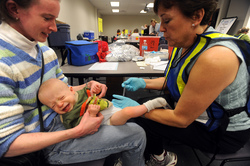
A new University of Michigan study says health care providers played a big role in whether people decided to get the H1N1 flu vaccine.
Information about the vaccine didn't come out until September, which might have been too late for many health care providers to form strong opinions about the safety of recommending it to their patients, Davis said.
In Washtenaw County, it's difficult to pinpoint the rate vaccines were distributed and the role health providers played in distribution.
The county received about 163,600 doses from the state that were either given to providers to distribute or distributed directly. In a conservative estimate, about 60 percent of that vaccine has likely been distributed, said county health department spokeswoman Susan Cerniglia. About 90 percent of the 13,000 doses the county kept to distribute directly have been distributed, she said.
Taking into account the number of cases of H1N1 flu that have already circulated the county, it's estimated about a third of Washtenaw County residents have some immunity.
Health care providers whose primary focus was people in groups receiving priority for the vaccine - such as pregnant women or young children - were much more likely to take extra steps to get the vaccine to those groups, Cerniglia said. Those steps included making special clinic times to get the vaccine to patients like pregnant women and young children.
Other physicians offered the vaccine, but were more likely to be much more passive about pushing the vaccine, Cerniglia said.
At IHA, a health care group based with several offices in Ann Arbor, a decision was made by physicians early on to recommend patients receive the H1N1 flu vaccine. Almost 22,000 doses have been administered by the group, compared to almost 42,000 doses of seasonal flu vaccine. A physician leader sends regular email updates to health providers there to keep them on top of the latest H1N1 flu and vaccine news, said Susan Bass, IHA's operations and compliance manager.
Both the county and IHA expressed concern that with months of flu season still remaining, another resurgence of the H1N1 flu could occur. There have been two hospitalizations this month from H1N1 flu complications, and reports of H1N1 flu cases in the county continue to circulate, Cerniglia said.
So far, there haven't been any reports about the circulation of seasonal flu in the county, she said.
On Saturday, IHA's Children Health Associates, 3100 E. Eisenhower Parkway, will be holding a flu shot clinic from 8:30 a.m. to noon. The county is holding ongoing flu shot availability by appointment or on a walk-in basis on Mondays and Wednesdays. For more information, call 734-544-6700.
Tina Reed covers health and the environment for AnnArbor.com. You can reach her at tinareed@annarbor.com, call her at 734-623-2535 or find her on Twitter @TreedinAA.
Comments
Rork Kuick
Fri, Jan 29, 2010 : 2:44 p.m.
Thanks to the author for covering this, and let's hope events do not unfold as in 1919.