

Historic District Commission rules new fence in Ann Arbor's Old West Side must come down
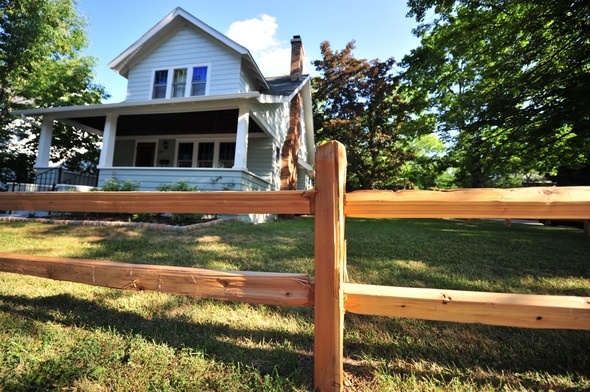
A newly installed, split-rail fence in front of a house at 617 W. Madison St. in Ann Arbor's Old West Side Historic District must come down after a ruling Thursday by the Historic District Commission.
Ryan J. Stanton | AnnArbor.com
Louis Breskman, who lives in a 1920s-era house at 617 W. Madison St. with his fiance, Meredith Newman, now has 90 days to take down the wooden, split-rail fence he had installed for about $1,200 last month and restore the property to its previous condition.
"The great joy of the neighborhood is that it has retained its historic character, and that's what our guidelines are intended to do," said HDC Chairwoman Ellen Ramsburgh. "I don't think the fence is appropriate, and I'm sorry that we're acting on it after the fact, but that's as it is."
The HDC voted 5-0 to reject Breskman's application for a certificate of appropriateness, with commissioners Patrick McCauley, Ben Bushkuhl, Robert White and Kristina Glusac joining Ramsburgh in deciding the fence doesn't fit in the historic neighborhood.

Patrick McCauley
Breskman and his fiance appeared before the HDC along with an attorney to plead their case. They left disappointed in the outcome and said they were uncertain of their next steps.
Jill Thacher, the city's historic preservation coordinator, advised the HDC that split-rail fences in front yards are incompatible with the historic character of the neighborhood and should not be allowed. She said Breskman can submit a new application to install a fence in a design that is appropriate for the district.
Thacher said a fence with square or flat pickets with at least 50 percent opacity would be a more appropriate design.
Breskman said he's not sure he wants "tangle" with the HDC again, though. He noted there already was a worn-out, wooden, picket fence on part of the property that was taken down to make way for the new fence, and he doesn't like that style.
According to the historic district design guidelines Ann Arbor follows, when installing new fencing it's appropriate to use wood (either picket or alternating board), wrought-iron or metal (wrought-iron style) or chain link (rear yards only). Thacher said this was the first time the HDC had ever considered whether to allow split-rail fences in the Old West Side.
According to Thacher, city staff received reports from three different neighbors last month about a fence being built without permits. A city building inspector visited the site and found a split-rail fence had been installed along the Fifth Street sidewalk on the corner lot.
In addition to not getting a required certificate of appropriateness from the HDC before installing the fence, Breskman also failed to secure a zoning compliance permit.
The building inspector issued a stop work order. But over the weekend, the rest of the fence was installed along West Madison.
City officials say Breskman potentially faces a civil infraction or misdemeanor for violating the stop work order, but that hasn't been issued yet.
During the course of her staff investigation, Thacher said she went through 200 or more old photographs of Ann Arbor and discovered that post-and-rail fences similar to the one installed on Breskman's property definitely existed in the city at one time.
"This is a very old style of fence, but it was predominant before the turn of the 19th century," she said, adding the fences were around in the 1800s from the founding days of Ann Arbor, through the Civil War, and up to the turn of the century.
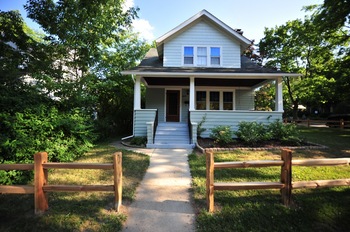
A view of the new fence from the front of the house.
Ryan J. Stanton | AnnArbor.com
She said those types of fences were not as predominant after the turn of the century because the land was getting subdivided more and lots became smaller. She said most fences closer to downtown on small residential lots were picket style and photographs prove that.
Breskman's one-and-a-half-story, Craftsman-style home first appears in the 1927 city directory as the home of Emil Hoppe, an employee of the phone company and a student.
"I'm not saying there was never a split-rail fence on a newer home built in the '20s," Thacher told commissioners Thursday night. "Because that could certainly be a throwback to old styles, but clearly it was predominant to have picket-style fences — either wood or metal — on residential lots. Especially since this house was not built until 1926."
Thacher acknowledged split-rail fences made a comeback in Ann Arbor during the post-World War II suburban housing boom. But that still doesn't make it appropriate, she said.
She cited federal guidelines that say new construction in historic districts that is "visually incompatible" or "destroys historic relationships within the setting" is not recommended.
White, one of the five commissioners to turn down Breskman's application, said he wished there was a way the new fence could be retrofitted to make it compatible.
"Right now, it's there, and I don't like the economic waste," he said, going on to inform Breskman that things could have been different if only he lived across the street.
"Right across the street from you on the west side, they could have your fence, because you're in the historic district and they're not," he said. "That's the cutoff point."
Commissioner Bushkuhl said he personally visited the property and he's sympathetic. He said Breskman and his fiance have taken care of the house nicely.
"It's a nice installation of this kind of fence," he added. "They did a good job."
But, he said, it still just doesn't fit.
"I drove through the neighborhood and looked around, you don't really see these fences on front yards of any houses," Bushkuhl said. "And any house that you would see it is not in a historic district, which is an important distinction to me."
Commissioner McCauley offered his take on the situation, saying there's a large distinction between fences in front of a house and those on the more private sides of a house.
"Within the period of significance with this historic district, these types of fences — even if they existed on the Old West Side — never, ever would have been in the front of the house," he said. "That is the public side. It would have had a more refined picket fence."
Even if a property owner had a stockyard full of animals, he said, it would have been in the back of the house and it would have been out of public view as much as possible.
"A fence like this might be more appropriate in a farm-type setting — a rural historic district," he said. "It doesn't necessarily fit into an urban neighborhood historic district."
Joy Glovick, an Ann Arbor-based attorney representing Breskman and his fiance, argued the fence does fit in with its surroundings.
"The fact is that there are split-rail fences around the area," she said, adding there even are some chain-link fences in the historic district, as well as split-rail fences at a nearby park. "How does this fence not fit in with the park that's nearby?"
Thacher said some of the fences mentioned are not actually in the historic district, and others were installed prior to the adoption of the city's current historic preservation ordinance in 2007. She said that's the case with the split-rail fencing at Wurster Park.
Ramsburgh asked Breskman if he was aware his property was located in a historic district when he decided to put up the fence. He said he was aware, but he didn't think it would be an issue since another property two blocks away had a similar fence.
Glovick said she thinks a picket fence would be more obstructive. She noted her clients planned to grow climbing plants on the fence, so it would end up looking like "one big shrub."
"It's not a chain-link fence," Glovick added. "It does have historical precedence. Whether or not it's appropriate for 1927, I mean, that's a little bit restrictive. They clearly existed before then. They were put up after that point. How is that not historically correct?"
Ryan J. Stanton covers government and politics for AnnArbor.com. Reach him at ryanstanton@annarbor.com or 734-623-2529. You also can follow him on Twitter or subscribe to AnnArbor.com's e-mail newsletters.
Comments
Mendez
Wed, Oct 12, 2011 : 11:47 a.m.
If we really want to do something about the HDC we need to start a petition that will scare the blip out of them. According to this poll we would have no problem filing a petition stating that the residents of the OWS no longer want a historic district at the state level. This petition is achieved by simple majority of all the property owners of the OWS. This part is straightforward. After that we would run into the Study and the who is qualified to determine whats historic issue, however if we fight who is on the review committees and who appointed by the mayor, then we can make the change by deeming a study that factually states the OWS is not qualified in density to be a blanketed historic district. The good news just like we were grandfathered into the PA 169 because of our national historic recognition as a Streetscape neighborhood... we still have the same protection historically. hopefully then the HDC would go back to just giving each other awards and actually preserving something!! Bottom line. We could reform the entire HDC into something fair so we have preservation and progress.
Mike D.
Sat, Jul 16, 2011 : 3:02 p.m.
Note to fact checkers (that was a joke, obviously, since such a person doesn't work at AnnArbor.com): Lesa Rozmarek resigned from the HDC months ago because she moved to New York City to work in historic preservation there.
Bob Heinold
Sat, Jul 16, 2011 : 10:42 a.m.
"Historical Preservation" or "Hysterical Preserveration?"
Jack Gladney
Sat, Jul 16, 2011 : 7:57 a.m.
Good evening. Our top story tonight: A fence. In other news... We used to actually report news but that was when we were an actual newspaper. Chet... What do you have for us on beasty dogs, goldfish and bear cubs gone wild front? Thanks David. Look for our expose tomorrow on people who drop ice cream cones on the street at the Art Fair, leaving them to melt, creating a sticky situation.
Richard
Sat, Jul 16, 2011 : 6:31 a.m.
Oh my! I hope historically there were African American people on the old west side, otherwise, the historic commission will deem us inappropriate.
WhyCan'tWeBeFriends
Sat, Jul 16, 2011 : 6:17 a.m.
McCauley objected to the "farmhouse-type fence" - well, it's a farmhouse-type house. White said "he wished there was a way the new fence could be retrofitted to make it compatible." Yes, let it become the green fence of living plants that the homeowners intended it to be, with this as its structural base. Problem solved. I'd like to see the people who had been cutting across their lot and letting their dogs use their yard, prompting them to add a fence in the first place, please step forward and reimburse the homeowners for their attorney fees. No, I didn't think you would.
Anna
Sat, Jul 16, 2011 : 5:36 a.m.
Do these people have no self-awarenss? Do they not see how pedantic, stodgy and myopic they come off? Not that anyone else in the world cares remotely about them, but, well, shouldn't they be ashamed of that? Ann Arbor is a small hub of culture, science and high education. Ann Arbor can have some intellectual standards. Ann Arbor is full of intelligent and educated young people. Ann Arbor is full of intelligent and educated people of ALL ages. Why do we let shortsighted idiots dictate the small points of our lives?
Dcam
Sat, Jul 16, 2011 : 7:51 p.m.
"To swallow and follow, whether old doctrine or new propaganda, is a weakness still dominating the human mind." - Charlotte Perkins Gilman, 1860-1935
roz
Sat, Jul 16, 2011 : 3:46 a.m.
This is the silliest thing I've heard in a long time. The guy put up a fence that's made of genuine wood. A bunch of underutilized people (they must be - they have so much time on their hands) are making a fuss about it. It's not steel. It's not barbed wire. It doesn't flash in tune to a boombox. Repeat after me: "Thou shalt not be a busybody about things that aren't that important."
Scott Brown
Sat, Jul 16, 2011 : 2:22 a.m.
The Old West Side will truly be historic when history is all we have to remember when people wanted to live there without the threat of a few irrational people. Sure, the homeowners should have followed the proper procedures, but the issue is really whether the fence fits or not? Judging by the poll (and I agree), most people agree that it does. I wonder if the people who cut across the homeowner's property are the same neighbors who complained about the fence?
John B.
Sat, Jul 16, 2011 : 2:12 a.m.
I love it when the dittoheads get their knickers all in a bunch over stuff like this!
ArgoC
Sat, Jul 16, 2011 : 2:10 a.m.
It's amazing to me that this couple bought a house in a historic district and didn't know what that meant for possible future changes to the house.
John B.
Sat, Jul 16, 2011 : 2:15 a.m.
They did know....
kirkers
Fri, Jul 15, 2011 : 11:44 p.m.
The post and rail fence is an appropriate historical fence. I totally agree with Alan G. The Ann Arbor historian commission needs to do their homework.
Arboriginal
Fri, Jul 15, 2011 : 11:09 p.m.
These "somewhere in time" clowns should consider moving to colonial Williamsburg!
Gill
Fri, Jul 15, 2011 : 10:47 p.m.
The old photos of the town show a lot of treeless dirt yards...
Roger Roth
Fri, Jul 15, 2011 : 10:35 p.m.
What's "historical" about rail fences?
ChrisW
Fri, Jul 15, 2011 : 10:28 p.m.
Here are two 1880's split rail fences on Sunset (one in the foreground, one in the background): <a href="http://quod.lib.umich.edu/b/bhl/x-bl000017/bl000017" rel='nofollow'>http://quod.lib.umich.edu/b/bhl/x-bl000017/bl000017</a> The one in the background looks almost exactly like the new one the historic district wants torn down.
Mike D.
Sat, Jul 16, 2011 : 3:08 p.m.
Yes, and it's surrounding a field, not a home. These fences were used in agriculture, not dense residential areas.
ChrisW
Fri, Jul 15, 2011 : 10:15 p.m.
These 1860-1870 fences near the diag looks similar, although not identical: <a href="http://www.whatwasthere.com/browse.aspx#/ll/42.278598,-83.740677/id/296/info/details/" rel='nofollow'>http://www.whatwasthere.com/browse.aspx#/ll/42.278598,-83.740677/id/296/info/details/</a> <a href="http://www.whatwasthere.com/browse.aspx#/ll/42.278598,-83.740677/id/316/info/details/" rel='nofollow'>http://www.whatwasthere.com/browse.aspx#/ll/42.278598,-83.740677/id/316/info/details/</a>
Sallyxyz
Fri, Jul 15, 2011 : 9:25 p.m.
He broke the law when he didn't get a permit in the first place. No sympathy for this guy. Sorry Charlie.
julieswhimsies
Fri, Jul 15, 2011 : 9:17 p.m.
This post ranks right up there with Julianna's rant on loose dogs. I must say, the comments on this post were some of the most amusing I've heard! Way to go, Ann Arborites!
John B.
Sat, Jul 16, 2011 : 2:50 a.m.
Agreed. One could even say that a2.com 'hit the jackpot' with this story....
Matt Darby
Fri, Jul 15, 2011 : 8:55 p.m.
Unreal. The HDC should be ashamed of themselves for bothering these people with this unfounded demand.
81wolverine
Fri, Jul 15, 2011 : 8:53 p.m.
An historical commission has a place in cities where it's been deemed worthy to try and preserve some sort of architectural heritage. Some cities have a richer, more "valuable" heritage than others I would say which warrants being stricter. An example might be Nantucket Island where the New England, seaside town architecture attracts a lot of tourists each year. I don't believe Ann Arbor has anywhere near that kind of architectural richness. So, it becomes a debate over how strict the HDC should be, as well as the use of some common sense in applying the rules. In this case, I think the fence looks fine. Does it match the look the HDC wants? No. But neither do all the more modern buildings built before the historic district existed, mixed in with old buildings. That's where I think common sense comes into it. Enforcing rules needs to be done in some cases to prevent wholesale destruction of historically valuable buildings. But, sometimes the HDC needs to take a more realistic, reasonable stance for what's in the best interests of the community overall. Example: was it worth delaying the Zingerman's expansion by several years trying to save a worthless, burned out old building that would have cost far more to rehab and then not been economically viable for lease or commercially very usable? Any logical person would say no. Still, I don't feel too sorry for the couple who built the fence, since they should have pursued the permit first. Then, they would have found out that the fence was not allowed and avoided spending the $1,200.
John B.
Sat, Jul 16, 2011 : 2:49 a.m.
Using your logic, I could argue that since homes in other parts of the world are often over 1000 years old, anything less than that can't be considered historically significant, and therefore nothing built by Anglos in the USA is historically significant.....
julieswhimsies
Fri, Jul 15, 2011 : 8:49 p.m.
Are you kidding me?! ...a certificate of appropriateness?!!! Unbelievable! Ann Arbor Historic Committee grossly over-reached on this one!
Scott Silvers
Fri, Jul 15, 2011 : 8:32 p.m.
Historical districts are somewhat ridiculous, but that's preaching to the choir. The appointees recieved their ivory tower thrones because they were deemed sufficiently anal to guard against anything they deemed inappropriate - what a task! I bet poor Mr. Breskman is getting a relentless 'I told you so' earful from his fiance about his decision of "I don't need a permit, it's just a fence - just think of all the money we'll save." The adjacent neighbor's picket fence must have had a tizzy when that shiny new splitrail went in. You have to really ask yourself "What the hell was Breskman thinking anyway?" Split rail in a front yard? Who does that anymore, unless you're living in a stepforwifeian McMansion subplex in Canton, or Novi for that matter. Bad taste aside, and Ann Arbor is full of it, perhaps Mr. Breskman can salvage the holes in the ground to set some nice new shiny brand new vinyl historical fenceposts and pickets......funny how the historical district will allow vinyl picket fences.......?
John B.
Fri, Jul 15, 2011 : 8:51 p.m.
"Poor Mr. Breskman" knew precisely what he was doing, every step of the way. That much is very, very clear at this point.
janeqdoe
Fri, Jul 15, 2011 : 8:27 p.m.
Does Bach Elementary fall into the historic district boundaries? If so, then it should be torn down and replaced with a period-designed one-room schoolhouse, so it would be more in keeping with the historical feel of the neighborhood. What about the Argus buildings? Are they compliant as well?
John B.
Sat, Jul 16, 2011 : 2:44 a.m.
Marion: Then don't buy a house there. It's really quite simple!
81wolverine
Fri, Jul 15, 2011 : 9:03 p.m.
I think the point here is that the existence of a bunch of newer buildings built before the HC existed in a historic district waters down the whole effort to preserve a certain architectural look of a neighborhood. Drive into any of these historic districts in Ann Arbor and you'll see newer buildings mixed in. Of course I'm not saying they should be torn down and replaced with an artificial, old-looking newer building. But, I am questioning the whole economic sense of aggressively trying to preserve outdated buildings that may not be usable today without spending an absurd amount of money that is not recoverable.
janeqdoe
Fri, Jul 15, 2011 : 8:52 p.m.
When was the HD formed?
John B.
Fri, Jul 15, 2011 : 8:42 p.m.
Um, hello, those were built prior to the formation of the HD. Please try another strawman argument.
djm12652
Fri, Jul 15, 2011 : 8:20 p.m.
I find it somewhat ironic that a split-rail style fence is not allowed in a district that calls itself "Old West"...bet they don't allow barbed wire either...both prevalent in the real Old West....
Mick52
Fri, Jul 15, 2011 : 8:15 p.m.
The historic commission in A2 is a joke. It has lead to false claims like supposed "Germantown" historic district on 4th Ave when a property owner wanted to improve run down property. But Zingermans is allowed to raze a house that may have been the oldest in the city.
John B.
Fri, Jul 15, 2011 : 8:41 p.m.
You are (again) referring to the home that had already burned to the ground? The one where Zingermans' employees saved the lives of some of the occupants? What utter nonsense. Please try again.
sbbuilder
Fri, Jul 15, 2011 : 8:04 p.m.
Honest Abe must be spnning in his grave. On another note, the Historical Commision, and Historical Districts were first implemented in the city to halt the complete destruction of homes so that 6- or 8- plexes could be built. Those are truly an abomination. I believe the first house to be thus saved from imminent destructin is one on Ashley, about four houses north of Washtenaw Dairy. I worked on the home next door, and actually received an award for exterior preservation on an exensive addition. However, as most things often go, the Historical Commision doesn't seem to know when to stop. Parsing a split-rail fence is a far cry indeed from razing the entire home and putting up a rectangular box. Perhaps on details such as this they have finally reached their limit. I hope so, at least.
sbbuilder
Sat, Jul 16, 2011 : 1:10 p.m.
John B. So, according to your metric, there should be no limits on the Historical Commish's power? Oh, and the highest per square foot selling prices are in the Angell School area where there is little Historical Commission involvement. Got it?
John B.
Fri, Jul 15, 2011 : 8:48 p.m.
I don't live in a Historic District because I wouldn't want to live under that particular set of regulations. You are free to decide to do likewise, but you are not free to tell the folks that do choose to live there what they can and cannot do, sorry. I don't hear any of the HD's homeowners complaining about being able to sell their homes in three days (in the generally abysmal local real estate market) for $225 per square foot. Got it?
Jrileyhoff
Fri, Jul 15, 2011 : 7:36 p.m.
The homeowners planned to cover the fence with climbing vine flowers. So, a picket fence completely covered with flowers is acceptable while a split-rail fence completely covered with flowers is not. Huh?
John B.
Sat, Jul 16, 2011 : 2:42 a.m.
Since he is clearly a scofflaw, I do think that some period of incarceration might not entirely be a bad idea (if he refuses to remove the fence and continues to waste our tax Dollars by flouting the law). It is extremely unlikely to occur, but it just might help him 'see the light.' Or not.
KMHall
Sat, Jul 16, 2011 : 2:32 a.m.
@John B I appreciate your voice and patience in answering these amazing comments. But removal is sufficient punishment. I hope you were being dramatic about jail time. I too have zero sympathy for exactly the reasons you cite.
John B.
Fri, Jul 15, 2011 : 8:37 p.m.
This homeowner knows/knew full well exactly what he is/was doing. He has owned another home in the HD for some time, then purchased this second one. He has stated on record that he was fully aware that his home was in the HD. He then chose to erect a fence without a permit (which is required whether or not one lives in the HD), and chose to ignore the HDC. He then further chose to intentionally ignore a 'stop work' order and finish building the fence. I have exactly zero sympathy for him. I hope the fine is large and that some jail time is included in the penalty phase of the trial.
sbbuilder
Fri, Jul 15, 2011 : 8:07 p.m.
Give it a rest, John B. Jrileyhoff has made an excellent point. What if the homeowners erected a flower vine trellace, or whatever, and made it just a little different from a split rail fence. Would that pass muster? Sometimes calling a thing by a different name is all it takes.
John B.
Fri, Jul 15, 2011 : 8 p.m.
That's correct. A seven-foot-high barbed-wire fence completely covered with flowers would not be acceptable either. The flowers ain't the issue.
Tesla
Fri, Jul 15, 2011 : 6:53 p.m.
What would be the ramifications to the homeowners if they didn't remove the fence. What exactly would the city do then? What exactly "could" they do. Judging from the overwhelming public sentiment and agreement with the homeowners, I would suggest a standoff and see what the city is able to do about it. Get the city some exposure too. Call in the national news organizations.
John B.
Sat, Jul 16, 2011 : 2:36 a.m.
Well Floyd, since we live in a civilized society, we have laws that have consequences if you break them. He is certainly entitled to spend as much as he wishes on his mouthpiece while making a big stink over this, but the case is quite cut-and-dried. He broke the law at least twice. The city can remove the fence and put a lien on his home for the cost of doing so. It can fine him as well. He could also be prosecuted for breaking the law (although that is rather unlikely to occur, I would imagine).
Tesla
Fri, Jul 15, 2011 : 10:31 p.m.
Thanks for playing but you didn't answer 1 of my queries. If anyone who doesn't have a dog in this fight and an agenda to push has an answer to my questions, the phone lines are still open!
John B.
Fri, Jul 15, 2011 : 7:30 p.m.
Maybe that has been his (and your?) plan all along? He has owned another home in this district since before he purchased the one in question, so he certainly knew *exactly* what he was doing. A $10,000 fine plus ninety days in jail might be an appropriate outcome.
Woman in Ypsilanti
Fri, Jul 15, 2011 : 6:51 p.m.
It sounds to me like people should figure out a way to take this particular power away from the historical district committee. I wonder how one would go about doing that?
KMHall
Sat, Jul 16, 2011 : 2:37 a.m.
Do you not understand the enormous demand for living on the Old West Side and the strong support among those who choose to live there for the stance that the HDC is willing to make? The complainers are quite vocal, here, but there are many people who don't share your view.
John B.
Sat, Jul 16, 2011 : 2:30 a.m.
I just love it when you dittoheads get your knickers all in a bunch over stuff like this. It's really quite entertaining.
Mick52
Fri, Jul 15, 2011 : 8:18 p.m.
I agree, make them solely for recommendations of people who wish to follow historical guidelines. It has just gotten out of hand. The govt should not have this type of control over your property.
John B.
Fri, Jul 15, 2011 : 7:27 p.m.
Well, one could choose not to pay $225 per square foot and live there. You get two votes, your left foot and your right foot. Just walk away, Renee.
say it plain
Fri, Jul 15, 2011 : 6:15 p.m.
From an aesthetic point of view, I can totally see where the take-it-down camp is coming from. I know very little about the 'historical issues' here but it just feels/looks/seems 'wrong' paired with that house. If architecture/history-ignorant ol' me can look and see that while it is a relatively pretty split-rail fence, it doesn't seem to 'go' with the house, then I'd guess the OWS keepers-of-aesthetic-purity would feel the same way. Too bad for the owners, but when you buy into an area like that you shouldn't expect to experience freedom, but the perks are that you can enjoy the precious perfection ;-) Frankly, I find it all a little too precious-perfect, but then I'm not paying for that ;-) I don't think we need to expose the accusers lol...if the regulatory infrastructure exists, then anyone affected by the aesthetic violation should have the right to complain about it. It "offends" me too lol, and if I had to walk by it thinking ew, I pay close attention to my gingerbread and roofing or whatevertheheckelse and there are *rules* requiring that I do so, but these new guys over here are putting in these nasty rough-hewn 'incorrect' things!, then I might have lodged a complaint as well. It would be wrong to force people to have household-to-household confrontations over such issues.
a2grateful
Fri, Jul 15, 2011 : 7:20 p.m.
Aesthetics? Please consider that the photos are highly unflattering. Then, take a look for yourself. Before viewing the fence, walk through the neighborhood from several blocks away. This will allow you to consider the fence in the context of neighborhood ambiance. No offense (a-fence?) to the photographer. . . but those photos do nothing for the aesthetic cause of the owners. Just think what the reaction would have been here with more flattering photos ; )
SonnyDog09
Fri, Jul 15, 2011 : 6:13 p.m.
Can you say arbitrary and capricious? Sure. Sure. I knew you could.
PLGreen
Fri, Jul 15, 2011 : 6:12 p.m.
AAmommamia; You are correct. Born and raised in AA, as a matter of fact, just outside of the OWS. Walked by this house many times as a kid. By choice I have never owned a house in AA, made a very good living in AA. Thanks for not having a City Income Tax.
Wendy Valtadoros
Fri, Jul 15, 2011 : 6:07 p.m.
I've lived in the Old West Side for 17 years. I've been annoyed, frustrated, and angry about the various HDC guidelines (windows, anyone?) but I've accepted them and understand their purpose. There are many ways to make your house ugly and historically inappropriate such as covering it with vinyl siding or painting it a weird color. My understanding was as long as what you do is reversible, it's permissible. The fence can be removed at any time the same as if the owners had covered their house in hideous vinyl siding. Owners should pay a fine for not applying for a permit and ignoring the stop order, but the fence can stay.
mun
Fri, Jul 15, 2011 : 6:02 p.m.
How is this any different from a homeowners association or condo association telling you what rules to follow?
John B.
Fri, Jul 15, 2011 : 7:24 p.m.
It's not.
Will Warner
Fri, Jul 15, 2011 : 5:51 p.m.
Many commenters here cannot get beyond the fact that the homeowners did not "follow the rules" so those commenters can't engage with the actual substance of the issue. According to the article, the fence is ordered down not because the owners failed to pull a permit and obey a stop-work order, but because the fence is deemed inappropriate for the neighborhood. So we are discussing whether the fence should be disallowed. Whether the decision to disallow it comes after the fence is built or at the time of permit application is not very important. In a sense we are discussing whether the law is stupid or stupidly applied. To those who are unwilling to consider that possibility but instead are only interested in whether people follow rules, I award the gold star for good citizenship I got in fifth grade.
KMHall
Sat, Jul 16, 2011 : 2:43 a.m.
I meant to type "not right" for the neighborhood. sorry
KMHall
Sat, Jul 16, 2011 : 2:42 a.m.
You are wrong about some of us. I agree with the HDC and appreciate their willingness to take a strong stand. The fence, in the eyes of many, is to right for the neighborhood. The way in which some of us mention following the rules is to counter the accusation that the guys "rights" are violated and that AA is out of control.
1bit
Sat, Jul 16, 2011 : 2:15 a.m.
Will, they can have my perfect attendance gold star as well.
eom
Fri, Jul 15, 2011 : 5:44 p.m.
I live up the street and can see a split rail fence from my bedroom window on Davis. I agree, the homeowners didn't do their research - and should have gone through the proper channels, and certainly should have stopped the work once told to do so. However, it seems that the fence is appropriate for the neighborhood and they've done a lot of great things to their house to improve it. I've looked at the OWS maps, but they aren't very clear to me. Can someone tell me the streets that border the OWS? I live on the same street and don't think I'm a part of it.
eom
Tue, Jul 19, 2011 : 4:43 p.m.
Wow. Such harsh comments. I didn't ever imply it was rocket science, but was merely pointing out that it isn't easy as one might think to know if they live in the historic part of the OWS. The "line" goes up the block - on one side, but doesn't go to the end of the block...which doesn't make it very "reader friendly" for those moving in. That means that the people living across the street aren't in the "historic district" and there are neighbors - directly next door that aren't in the "historic district" either. Hard to have such harsh guidelines when the lines are so blurry.
KMHall
Sat, Jul 16, 2011 : 2:44 a.m.
It can't be rocket science. Call the city and ask about your house.
Mick52
Fri, Jul 15, 2011 : 8:50 p.m.
Golly I hope your comment does not result in someone else's fence being removed.
eom
Fri, Jul 15, 2011 : 7:41 p.m.
That's the map that isn't helpful. I'm in map 14 - but it's not clear where the last house included is. It doesn't show Davis, so it's hard to tell.
AAmommamia
Fri, Jul 15, 2011 : 6:14 p.m.
<a href="http://www.oldwestside.org/map/map.html" rel='nofollow'>http://www.oldwestside.org/map/map.html</a>
E. Daniel Ayres
Fri, Jul 15, 2011 : 5:28 p.m.
Many people seem to have missed the Historic Commission's most important issue. The plaintiff did not follow the city required permit process. If they or their contractor had complied with the process, the issue would have been addressed before any money got spent erecting a fence with obviously required some review and consideration by the city authorities. My personal opinion is that the fence is not that big of a "violation" of community standards and should be allowed. That said, allowing folks to simply ignore the permit process and get away with it opens the door to all kinds of issues including the obvious one, loss of permit revenue for the city which funds the enforcement process and probably pays for the historic commission meeting spaces as well.
Mick52
Fri, Jul 15, 2011 : 8:48 p.m.
An interesting point, but sometimes in order to get a proper ruling from a court, you have to do the act. Had they applied for a permit and been turned down, they could appeal but with no visual evidence, i.e., photos of the installed improvement. I too think the fence is appropriate looking and I think the admission by Ms. Thatcher that she found photographic evidence that such fences existed in this neighborhood adds an interesting aspect to this issue. Had the fence not been built then her investigation may not have occurred. Those historic photos, per Ms Thatcher, were from a history prior to the construction of this home. That raises the question of whether or not a historic commission can pick and choose which "history" they approve/disapprove of. Suppose someone found a photo of a home in this neighborhood with a split rail fence at the time this home was built. Or a living person recalls such fences in the 1920s. Does that not make the fence historically appropriate? Ms. Thatcher's search perhaps has opened cracked open that door and if a property in the 1920s had such a fence then I would think it is quite appropriate.
JustSayin'
Fri, Jul 15, 2011 : 5:17 p.m.
Ann Arbor has always been one of the most eclectic, diverse and free-thinking communities in the country. Allowing this small group of elitists to stifle the desires and creativity of the property OWNERS and keep them hostage to the past and someone else's vision for the property IS NON-CONFORMING to the spirit of the community.
KMHall
Sat, Jul 16, 2011 : 2:47 a.m.
Absurd. And what is the "spirit of the community?"
John B.
Fri, Jul 15, 2011 : 7:23 p.m.
Shirley, you jest.
bicarbonateofsoda
Fri, Jul 15, 2011 : 5:10 p.m.
It might be argued that the neighborhood's historic designation has helped preserve a certain segment of housing stock that is more stable and desirable than adjacent areas. It's ironic that without the very regulations being disused, Mr. Homeowner might have purchased elsewhere. Moreover, without strong support from the community – the same support that helped foster the creation of the HDC-- it's plausible that the house would have been torn down long ago in favor of a much more lucrative (for slumlords, that is) flat roofed, nondescript, multistory, cinder block apartment building. Just drive up and down First and Second Streets and you can see that between 1950 and 1970, that's exactly what was transpiring. Indeed, it was the actions of neighborhood residents who helped put an end to such changes with the establishment of the Old West Side Association in 1967. The neighborhood as a whole was listed on the National Register of Historic Places in 1972 – the first "neighborhood" on the Register to receive such designation due to its unique representation of a "mostly intact" working-class German immigrant neighborhood. Searching the City of Ann Arbor Assessor's online records, Realtor.com, and Trulia.com I discovered (in a matter of minutes) that the homeowner paid $317,500 last year for his 3-bedroom, 1-1/2 bath, 1,400 square foot home. Perhaps more revealing is that fact that, despite the troubled housing market, the house was on the market for a mere eleven days. One might even surmise that he underpaid. Despite the home's humble origins, that translates to over $225 per square foot. (Gasp.) Answer me this, if the OWS Historic District is, indeed, such a horrible place to live-- with all of its Draconian rules --why does it continue to command top dollar prices? Should Mr. Homeowner desire to maximize the return on his investment; I suggest he rethink his position on the fence.
Jacob Bodnar
Fri, Jul 15, 2011 : 4:58 p.m.
I can't believe this much government time has been wasting debating about this man's fence. If he owns the property, he should be able to put up whatever fence he wants.
Tesla
Fri, Jul 15, 2011 : 6:59 p.m.
How do you know that...Mr. Blue? Do you work at city hall? :) I see you....
Mr Blue
Fri, Jul 15, 2011 : 5:41 p.m.
Believe me, local government has moved on. They are no sitting in city hall on wasting time on small potatoes like this. The articles and comments are just more hits and hot air on aadotcom. I suppose you'd be happy if he put up multiple strands of razor wire and tasteful gun turrets?. Maybe a moat with crocodiles?
Tom Teague
Fri, Jul 15, 2011 : 4:45 p.m.
Actually, the poll doesn't indicate that. It is unscientific and has no safeguards on anyone outside the community voting. I just voted on a loaned computer, without logging on, from a location I'm currently visiting that is about 500 miles from Ann Arbor. It only shows that of the people who took time to find the poll and vote, most of them voted in favor of retaining the fence.
oldblueypsi
Fri, Jul 15, 2011 : 4:43 p.m.
This entire scenario only lends more credence to the old adage that: "Ann Arbor is not a geographic location. It is a state of mind".
Maxwell
Sat, Jul 16, 2011 : 1:50 a.m.
Glad they don't live in Ann Arbor?
Mr Blue
Fri, Jul 15, 2011 : 5:46 p.m.
So what does that tell us about people's state of mind in Ypsi?
Bill
Fri, Jul 15, 2011 : 4:32 p.m.
The HDC needs to wake up along with the entire City Council and realize they are here to represent the citizens of Ann Arbor and not their own personal or politics views and agenda. The poll clearly indicates that the citizen are NOT in agreement with the HDC on this issue, therefore the HDC should reconsider their own effectiveness and compliance with representing the citizens. The commissioner comments about "I" this and "I" that are inappropriate. There personal opinions should not be a part of this or any other decision. They must base any decision on solid facts just as if in a court of law. I hope an attorney in the area will present this couple and take the commission to court and let the decision be made by a jury of their peers.
KMHall
Sat, Jul 16, 2011 : 2:54 a.m.
The poll indicates no such thing. How many people voted?
Mr Blue
Fri, Jul 15, 2011 : 5:45 p.m.
His route of appeal for the fence is in Lansing. He might have a chance if he had followed due process, but he didn't. His appeal on violating building codes is with the courts. He will most likely pay a small fine in the district courts, but he will still have to comply with the HDC rules unless he receive a variance in Lansing
Mr Blue
Fri, Jul 15, 2011 : 5:36 p.m.
And the facts are that Mr Breskman knew the rules, did not bother to get a permit and worked in violation of a stop work order. Regardless of the fence, he's in violation of the law, at least twice. If he didn't want to build a fence that conformed to the HDC rules based on Federal standards and in accordance with State of Michigan law, he could have 1) decided not to buy in the historic district, 2) not build a fence or 3) build a fence that was in compliance with ALL the requisite ordinances. He chose to do none of the above and now he's paying the price for his "I'm above the law" stance.
bicarbonateofsoda
Fri, Jul 15, 2011 : 5:01 p.m.
Ya think? Seems to me that was the homeowner's intent all along...
sig.melvin
Fri, Jul 15, 2011 : 4:29 p.m.
What happend to a Mens HOME is his Castle ....
Mr Blue
Fri, Jul 15, 2011 : 5:29 p.m.
Along with serfdom and the plague, that notion went out with castles in the 1600's
SalineBob
Fri, Jul 15, 2011 : 4:19 p.m.
So an OLD WEST kind of fence can be installed on the west side but not on the OLD WEST side.
Mr Blue
Fri, Jul 15, 2011 : 5:28 p.m.
If you're serious, and I doubt that you are, you need to read the HDC rules and know the boundaries of the OWS historic district. Without that, you'll continue to be ignorant of the facts.
dmkellman
Fri, Jul 15, 2011 : 4:15 p.m.
Can I get my neighbour to repaint their front door because it "doesn't look right?"
Mr Blue
Fri, Jul 15, 2011 : 5:26 p.m.
You can certainly ask but I think you'll need a tall fence afterwards.
Mr Blue
Fri, Jul 15, 2011 : 4:12 p.m.
The HDC does not and cannot assess any fines. Fines are assessed within the ordinances or by judges and would be for not getting a permit and disobeying a legal notice to stop work. Simply fining Mr Breskman and allowing a non conforming fence (or any kind of construction) to remain would set a bad precedent that other scofflaws could point to in defense of their own violation. Let's say that Mr Breskman put up an 8 ft chain link with barbed wire along the sidewalk or another owner built a two story garage instead of the single story one allowed on the site plan and permit. Just fine them and let it go? If that were the case, then people who could afford to pay the fine would be able to do exactly as they wish without regard to the law or their neighbors. What you're saying is that if you have enough money then you can whatever you want.
1bit
Sat, Jul 16, 2011 : 2:13 a.m.
See my reply to Maxwell above. In this case, "non conforming" is subjective. An appropriately high fine would discourage scofflaws. As this is not a court, it does not set a precedent that would need to be adhered to strictly. If a project is truly "non conforming" the HDC could decline the fine option (if it were granted that power via ordinance).
cette
Sat, Jul 16, 2011 : 1:06 a.m.
settle down. Mr. Breskman did not put an 8 ft chain link fence.
Maxwell
Fri, Jul 15, 2011 : 3:34 p.m.
Yet another example of our "Zero Tolerance" society - whether its a fence in a hysterical district or a high school kid caught with Tylenol on campus. There is the letter of the law and the spirit of the law. It is clear Mr Breskman didn't follow the letter of law by not filing the required paperwork and permits. However it is also clear through the historical commission's own statements that, with their nit picking put aside, the fence is period appropriate. Unless the historical society can provide evidence that this style fence was prohibited to front yards in 1927 they are really reaching by claiming the fence is inappropriate. The commission is acting in a purely punitive fashion by demanding the fence to be removed. A reasonable course of action would be to fine Mr Breskman a few bucks for not obtaining the appropriate permits and letting him keep the fence. This would send a clear message to future scofflaws while being fair to Breskman who has been put through the wringer enough as is.
KMHall
Sat, Jul 16, 2011 : 3:01 a.m.
Thanks again, Mr. Blue. Regarding Maxwell's comment, I don't wish any pain or jail time for Mr Breskman beyond simply removing the fence. He's young guy who can learn and this will have been an expensive lesson. He seems to know the value of the Old West Side and is likely to be or become an excellent citizen even if he was a bit of a a cowboy when he finished the fence after the stop work order.
1bit
Sat, Jul 16, 2011 : 2:09 a.m.
I think Maxwell's got a point. Maybe make the fine $1200 or removal of the fence and see what they'd rather do. Say someone else does an inappropriate renovation that costs $30,000. Do the same - they can either pay a $30,000 fine or remove the renovation. That should discourage scofflaws while keeping some component of fair measure. Obviously, one could titrate fines and penalties on a case-by-case basis.
Maxwell
Fri, Jul 15, 2011 : 9:16 p.m.
Like I say - some people only see black and white in world full of greys...
Mr Blue
Fri, Jul 15, 2011 : 5:53 p.m.
Maxwell doesn't care about the facts. The HDC is only following the law. Mr Breskman had his chance and he blew it. The message that a decision favoring Mr Breskmans' violation of law and the penalty of a small fine would only encourage scofflaws by telling them that paying a fine is the cost of doing business. In essence the scofflaw contractor's customer would suffer the pain and pay the cost of the fines. To put it in perspective, we, as taxpayers, are paying for the governmental costs of Mr Breskman's selfish decision to violate the law, twice.
bicarbonateofsoda
Fri, Jul 15, 2011 : 5:03 p.m.
Maxwell, kindly see Mr. Blue's response.
Mr Blue
Fri, Jul 15, 2011 : 4:16 p.m.
Mr Breskman's so called "wringer" is of his own doing. And if it's fairness you seek, the law would have to equally enforced for everyone and not for those who can afford the fine. Let the process play out and the judge, if Mr Breskman decides to go to court, decides the penalty. Mr Breskman may also appeal the HDC decision to Lansing.
mkm17
Fri, Jul 15, 2011 : 3:17 p.m.
I agree that the split rail fence should be allowed to stay, but I resent that the homeowner is being portrayed as a victim and the OWS governing body is being portrayed as the bad guys. The homeowner agreed to the covenants and restrictions of living in OWS when he purchased his home. This was disclosed and agreed to at the closing. But now the homeowner thinks they can erect a fence without a permit and without at least running it by the OWS governing board?
Mr Blue
Fri, Jul 15, 2011 : 5:23 p.m.
You're welcome!. Now if only others could make the same reasoned connection instead of just running off at the mouth without knowing what the score is or even liv ing in Ann Arbor much less the OWS.
mkm17
Fri, Jul 15, 2011 : 5 p.m.
Thank you, Mr. Blue, for the clarification! Sorry, everyone, for my misstatements.
Mr Blue
Fri, Jul 15, 2011 : 4:20 p.m.
There is no OWS "governing board". The HDC is a bureaucratic entity created to oversee all of Ann Arbor's historic districts. The HDC has no connection whatsoever to the Old West Side Association, a community non profit.
racerx
Fri, Jul 15, 2011 : 2:58 p.m.
What's that old adage about our town, "only in Ann Arbor".
Mr Blue
Fri, Jul 15, 2011 : 4:18 p.m.
If you think it only happens here, you need to get out more.
babs
Fri, Jul 15, 2011 : 2:54 p.m.
When my neighbors and I needed to replace our old dilapidated back fences along a busy road, (NOT located in the Historic District, didn't look to buy a house there because we weren't interested in dealing with this sort of problem with maintaining historically correct homes.) we had to pull a permit with the city, pay the hefty fee, go before a zoning board to state our case to spend a few thousand dollars to replace the fences. It delayed the project but the fencing company was familiar with city rules and told us exactly the steps we had to go through. Any homeowner in this city has to have a modicum of understanding about installing ANY type of fencing. If you want to do whatever you would like, move to the country. In a city, there are rules and I believe the HDC was thoughtful in this and the loss of $$ could have been avoided if a permit had been sought. Enough with the comments about the home owners being micro managed by the HDC. The rules cannot be a suprise to anyone living in the OWSHD, the character of the area is WHY most choose to live there. Every city with an Historic district needs a governing body. Just imagine what would become of the district if 'anything goes'.
AAmommamia
Fri, Jul 15, 2011 : 2:43 p.m.
As usual, with any Ann Arbor story, I am amused at the commentary. It is clear that most posters do not live in Ann Arbor, but are more than happy to jump at a chance to criticize the city. Please educate yourselves before you comment. If you live in Ann Arbor, or are looking to buy a house here, you know, or will learn quickly, that this is a prominent historic district that has strict ordinances that you have to follow. In fact, it is its major selling point, and makes these homes in this neighborhood more desirable. If you do not want to live by the restrictions, don't buy a house on the OWS. I find it impossible to believe that these people did not know about this when they bought here. If they had gone through the proper channels that any other homeowner in this district goes through to change the outside of their house, I am sure the commission would have given them several fencing options that they could have chosen from. The fact that they did not get prior approval, did not pull a permit, and then ignored a stop work order, tells me the homeowners think they just don't have to follow any of the rules.
AAmommamia
Fri, Jul 15, 2011 : 4:57 p.m.
Jon.. it doesn't bother me at all. I would choose not to live in that neighborhood based on those restrictions, but the people that chose to live there must be fine with it, yes? gsorter.. that is fine! the difference is this.. you lived there at a time when the decision to be a historic district was being discussed and supported or not. As far as I know, the OWS was voted to become a historical district, and the people that live there support it. I imagine that they would argue that "the COMMUNITY belongs to future generations, and we should strive to maintain it in the fashion it was created". The beauty of it is this.. you do not have to live there if you do not agree!
gsorter
Fri, Jul 15, 2011 : 4:40 p.m.
I for one do actually live in Ann Arbor. I along with my neighbors organized and fought the addition of our neighborhood into a so-called historic district (Washtenaw-Hill). My favorite argument FOR the proposal was "the homeowner doesn't really own the home, but the home is owned by future generations." I thank god that that proposal was defeated. How is it that unelected bureaucrats can have so much power, with no recourse offered to the property owner
Jon Saalberg
Fri, Jul 15, 2011 : 4:07 p.m.
But doesn't it bother you at all that this is more or less the same as the clay flats behind Target, which don't allow anything but vehicles in the driveway, require bland taupe house colors, etc.? There is really no difference - it's a board setting standards based on nothing more than what they decide is tasteful, historic, or whatever adjective they want to use to excuse their close-minded behavior.
Tom
Fri, Jul 15, 2011 : 2:29 p.m.
This guy deserves all of the hassle and every cent of any fines that come his way. He is the one who made the decision to purchase a home in a historic district, and he is the one who decided to ignore that fact and then blatantly ignore a stop work order. Unfortunately there is no cure for idiocy.
newsboy
Fri, Jul 15, 2011 : 2:29 p.m.
The issue here is not whether this fence should stay or go? The issue here is whether this commission should stay or be disbanded? I've heard many complaints about the HDC overreaching its mission, but I've never seen an effort to disband it. Surely there must be a mechanism to do so. The problem is with the people on the commission. A self-confident individual, whom embraces people and enjoys individual eccentricity, would never consider joining what is at best, perceived to be a lynch mob.
John B.
Fri, Jul 15, 2011 : 7:13 p.m.
You are funny! (this post is a joke, right?).
mojo
Fri, Jul 15, 2011 : 2:19 p.m.
And those cars they drive on the west side - clearly not 1927 - something should be done about that.
Boo Radley
Fri, Jul 15, 2011 : 2:03 p.m.
Take down the fence and fill the front yard with pink flamingos, bend-over granny cut outs and wishing wells made from scrap two by fours. ... Oh, and make sure there is one of those leaning cowboy cut outs against a tree closest to the street.
JustSayin'
Fri, Jul 15, 2011 : 2 p.m.
No matter how they try to justify it or pretend to have authority, "Historic District Commissions" are unconstitutional. If public health and safety aren't involved, property owners should be allowed to make their own choices without harassment from the aesthetic police. It's past time for local governments (and the courts) to protect the rights of property owners by removing support (and funding, where applicable) from these groups. "Historic Preservation Clubs" can offer advice to anyone who CHOOSES to call them for their opinion, should be available to provide hand-on help for projects if asked, and should donate their own personal funds toward projects that they favor...but no one else should be forced to follow their whims or financially support their hobby.
K Thompson
Sat, Jul 16, 2011 : 3:01 p.m.
I've read the Constitution. Nothing in it for or against. Nor about many other items. Rules developed by communities and voted on come later. You choose to join a group, abide by the rules.
John B.
Fri, Jul 15, 2011 : 7:12 p.m.
Baloney.
JustSayin'
Fri, Jul 15, 2011 : 5:32 p.m.
If your name isn't on the deed and if there is no health or safety concern to you personally or your property, you have no right to make decisions about the property of another. Not liking the way it looks doesn't count. These historic preservation enthusiasts should not have the support of government against the citizens, they should be considered a club only--and they should recognize our freedom to live wherever we want to, without their interference. If you want to volunteer for something, volunteer to help someone who wants your help and opinion (including some actual physical labor, not just issuing orders).
Mr Blue
Fri, Jul 15, 2011 : 4:25 p.m.
It's not a "club". All members of the HDC are volunteers and it's thankless job. If you want to change the rules, then volunteer, but I doubt that you live in Ann Arbor.
Tom
Fri, Jul 15, 2011 : 2:31 p.m.
OR... You could just choose not to live in a historic district. Pretty simple solution, then you can ignore them all you want.
Peter
Fri, Jul 15, 2011 : 2:18 p.m.
How are they unconstitutional? Please be specific.
Jim
Fri, Jul 15, 2011 : 1:46 p.m.
I don't know how long the couple has lived in their home, but anyone who has lived in the OWS is aware of these sorts of exterior alteration restrictions. If you don't like this bureaucracy, then you don't have to live there. I am sympathetic to inanity of the situation, but not to their lack of knowledge of the reality of it. I live on the OWS. It would be nice if the housing commission, the historic commission, and the zoning commission all had SOME knowledge of their own rule sets, but of course that's not the case either. Living on the OWS and being shocked by this sort of thing is akin to living in Florida and being shocked by a hurricane hitting you. It comes with the territory.
bicarbonateofsoda
Fri, Jul 15, 2011 : 5:45 p.m.
Here, here, Jim! Public records show the home was purchased a year ago April. And for a pretty penny, I might add. Any Realtor worth her (or his) salt, would have advised her client of the pros & cons of buying in the Historic District. Not to mention, when you search the public records, you'll see that Mr. Breskman has owned another property in the Historic District since April of 2004. Moreover, he hired a Lawyer to represent him at the HDC hearing.Me thinkest he knew what he was doing all along...
Tailgate Jim
Fri, Jul 15, 2011 : 1:43 p.m.
So Gladys Kravitz is alive and well living in the Old West side of Ann Arbor...Meredith don't wiggle your nose they'll think you are a witch.
PLGreen
Fri, Jul 15, 2011 : 1:32 p.m.
Plain and simple; selective appropriateness.
maxima284
Fri, Jul 15, 2011 : 1:29 p.m.
This story about the fence is ridiculous! This is the exact type of stuff that people want to stray out of ann arbor and live in the smaller communities, where no matter what type of fence you put up, it still looks good, unless you're in an association but that isn't the case here. All I can say is WOW.
K Thompson
Sat, Jul 16, 2011 : 2:35 p.m.
There are many communities with mixed architecture and fewer standards (Don't tread on me!). Unfortuanately many of them look it. People can choose fewer or more restrictions, but when they flaunt the rules after choosing to live there, when they could have spent their money elsewhere and be unbothered, they, in this case are, at best, naive homeowners, and then continued to be embolden by ignoring or not investigating the Stop Work order. Brazen!
Mr Blue
Fri, Jul 15, 2011 : 4:27 p.m.
No mater what type of fence? Maybe you think razor wire with tasteful gun turrets is ok?
aareader
Fri, Jul 15, 2011 : 1:25 p.m.
I agree with the majority of the commentors, the fence is nice and should stay. We were once in a similar position. As we were building our home, we were having put up beautiful face stone. Our neighbors would walk by and stop and tell us how nice it looked. One neighbor, the homeowners condo association president, stopped by and told us that though he thought it looked nice, it was against the rules (they required real stone), and we would have to take it down. We told him we were not removing it, and they could sue us. Needless to say, that was the end of the issue, and the facestone stayed. Of course, we only had a small HCA against us (the president, only - everyone else thought it was ok), and not the city of AA. Many times these issues come up because someone is in the position to say no.
K Thompson
Sat, Jul 16, 2011 : 2:29 p.m.
One assumes a responsibility when choosing to live in a neighborhood with guidelines or restrictions. The appearance and amenities were what attracted you. If a neighbor starts parking his fix-up car on the front lawn, you wouldn't like it. But using your logic, it's ok if he does. Lawsuits clog the legal system because people choose not to go by the rules. If you want a fake fence, build your own home on a lot that doesn't ask you to use real stone. Communities agree to follow certain mutually agreed upon rules, some more than others. The stance, "So? Sue us!" is hostile.
dmalmquist
Fri, Jul 15, 2011 : 1:22 p.m.
I serve on a Historic Preservation Commission in a community not far southwest of A2. I am flabbergasted by the shear ignorance exhibited by the people not only on the A2 Historic District Commission, but also by the Historic Preservation Coordinator, towards split rail fencing. This type of behavior would never happen in our community, and we have one hundred times the historic ambiance that A2 would ever wish to have. Shame on this decision being made, and I hope the homeowners take this to a higher court. This smacks of social elitism at its worst.
K Thompson
Sat, Jul 16, 2011 : 2:19 p.m.
Yet permits, zoning, historic guidelines and work stop orders are serious. The DIY craze and unscrupulous workers do skirt the rules for cheap. These permit issues should be remedied by fines, but the aesthetic argument is hokey. Focus on the fines, leave the fence. I dislike fenced front yards as unwelcoming, but that is a different issue.
John B.
Fri, Jul 15, 2011 : 7:09 p.m.
Tecumseh.
f4phantomII
Fri, Jul 15, 2011 : 4:39 p.m.
Historic Marshall, perhaps?
Some Guy in 734
Fri, Jul 15, 2011 : 3:28 p.m.
@AAmommamia: <a href="http://lmgtfy.com/?q=%22historic+preservation+commission%22+malmquist" rel='nofollow'>http://lmgtfy.com/?q=%22historic+preservation+commission%22+malmquist</a>
Townie
Fri, Jul 15, 2011 : 2:55 p.m.
I'm a bit surprised by your comment. If there are written rules (and there were on this fence) then you and your board would ignore them? One of the two things boards are supposed to do is make sure the finances are handled correctly and the rules enforced. If the board doesn't do that then it's not doing its job. If the fence is an issue then the board reviews the situation and gets the appropriate change made to the rule. Otherwise it's dereliction of duty on a legal basis.
AAmommamia
Fri, Jul 15, 2011 : 2:07 p.m.
This is quite a strong criticism. I am sure you will provide us all with your location?
xmo
Fri, Jul 15, 2011 : 1:17 p.m.
In these trying economic times, the city council claims that they cannot cut any more people from the payroll and must reduce the Public Safety Staff. I found one position that I deem not critical to city operations: Jill Thacher, the city's historic preservation coordinator. City's Historic Preservation Coordinator? This looks like an area of the city's budget to investigate.
djm12652
Fri, Jul 15, 2011 : 8:24 p.m.
well, if there is a home invasion in that area [God forbid this happens to anyone] call this co-ordinator cuz 911 won't be able to dispatch a cop...they got laid off...not too far in the future, county will have to take care of that...but the fences will be proper, so feel safe!
Mr Blue
Fri, Jul 15, 2011 : 4:28 p.m.
Investigate away. It's all in the public record.
sbbuilder
Fri, Jul 15, 2011 : 1:16 p.m.
Anonymous complaints should not be allowed. This is not like whistleblowing the local racketeering mobster, after all.
grye
Fri, Jul 15, 2011 : 1:15 p.m.
Nothing like having the city dwell on such important matters. I will never ever purchase a house that would have such ridiculous restrictions placed upon the owner. (Can you even put in new appliances in the house?) Hopefully when my house is 100 years old, it won't be put under some historic limitations.
KMHall
Sat, Jul 16, 2011 : 3:06 a.m.
That's the beauty of it. No one is every forced to purchase a house in the Old West Side.
Mr Blue
Fri, Jul 15, 2011 : 4:31 p.m.
You haven't read the rules, have you?
Mr Blue
Fri, Jul 15, 2011 : 4:30 p.m.
The HDC rules in the OWS only speak to the front of the home and the appearance of the streetscape. You're being silly about everything else.
Alfie
Fri, Jul 15, 2011 : 1:13 p.m.
This story is just plain sad....Sad that it actually is making what is supposed to be a news site with actual news, sad that people will find any excuse to bash 'government' and sad for the property owners who could have avoided ALL of this by simply following the rules. I dont get it, there is absolutely NO sympathy for the property owner who didnt even bother to pull a permit even after violating a Stop Work Order posted by the City Building Official. That is a very serious offense. Okay even if you buy the arguement they didnt know about a permit OR the Historic District (which is very unlikely) they still ignored the posted order to stop the work on the fence. If they had stopped then and waited for the process to run its course they would have saved themselves additional expense. The City would have SAVED them money if they woudl have listened. Instead they deliberatley ignored a warning and kept working anyway. The Historic Commission did the right thing. They have absolutely nobody to blame but themselves. Case closed.
aawolve
Fri, Jul 15, 2011 : 5:32 p.m.
"That is a very serious offense." I guess that depends on your version of reality.
Jon Saalberg
Fri, Jul 15, 2011 : 1:10 p.m.
Remember - there is no "Democracy" in the Historical Commission. I'm just happy I do not live in an area where someone else's arbitrary standards can dictate what is considered "worthy". By the way, if the Old West Side is so worried about maintaining its standards and dignity, how is that there is a house in your very upstanding area that has a falling down porch held up with temporary supports, for going on three years? Maybe more? I guess those temporary supports somehow fit the OWS guidelines?
Ron Granger
Fri, Jul 15, 2011 : 1:09 p.m.
Even trailer parks have rules and standards. All cities typically have rules about fences. Height, distance from property lines, etc. How long does it take to google 'ann arbor fence permit' ? <a href="http://www.a2gov.org/government/communityservices/planninganddevelopment/historicpreservation/Documents/Fence_Guidelines_and_Application.pdf" rel='nofollow'>http://www.a2gov.org/government/communityservices/planninganddevelopment/historicpreservation/Documents/Fence_Guidelines_and_Application.pdf</a>
OLDTIMER3
Fri, Jul 15, 2011 : 1:09 p.m.
So fine the man and leave the fence alone. My property deeded in early 1800's has a section in the abstact deed saying no negroes allowed. Would the HD honor that? I would hope not.
a2susan
Fri, Jul 15, 2011 : 1:46 p.m.
same for my property established in the 1940. i assume the deed is still valid.
Grand Marquis de Sade
Fri, Jul 15, 2011 : 1:07 p.m.
Christ it's not like they built a cinderblock wall or something. It's a split-rail fence! How much more "historic" can you get?
Mr Blue
Fri, Jul 15, 2011 : 4:32 p.m.
How about barbed wire? It's been around a long time.
sig.melvin
Fri, Jul 15, 2011 : 4:26 p.m.
Well it would be suiteable to have "David" by michelangelo in the front yard..
G Man
Fri, Jul 15, 2011 : 1:05 p.m.
So , the folks violated City Ordinance by not properly applying for a building permit; violated City Ordinance by not getting zoning approval; violated the Historic District Ordinance by not getting their approval; violated a Stop Work Order by the Building Official, and yet think they should be allowed to keep the fence? This is what is wrong with America, folks, everyone feels that the laws should not apply to them because they want to do what they want to do! I say bravo to the Commission for standing their ground! If you other commenters don't like it , then I suggest you petition for Ordinance changes.
Dcam
Fri, Jul 15, 2011 : 5 p.m.
The vast majority of laws are merely the tyrant's law, and something is only illegal because someone says it is. And disputing the fence by the HDC is in its opinion, not based on fact. ""One of the first things you see when you walk up to the house is this split-rail, rustic, farmhouse-type fence," McCauley said. "And it just does not look appropriate, I don't think."" Sounds like opinion to me. "Within the period of significance with this historic district, these types of fences — even if they existed on the Old West Side — never, ever would have been in the front of the house," he said. "That is the public side. It would have had a more refined picket fence." - MaCauley Of course he knows that statement to be true - perhaps first-hand.
sig.melvin
Fri, Jul 15, 2011 : 4:25 p.m.
LAW are made by Poeple....We ARE FREE ..yes indeed we are created FREE..
Tom
Fri, Jul 15, 2011 : 2:38 p.m.
It seems like half of the comments come from frothing-at-the-mouth lunatics who want nothing less than complete anarchy so they can finally have their gosh darn FREEDOM!
Will Warner
Fri, Jul 15, 2011 : 1:19 p.m.
G Man is a great name for a real law-and-order guy. But I'm always surprised by folks who are more interested in process than substance. Had they followed the process, would the fence be OK?
clownfish
Fri, Jul 15, 2011 : 1:03 p.m.
Run for a position on the historic commission. change the rules. Or whine and cry.
Woman in Ypsilanti
Fri, Jul 15, 2011 : 6:54 p.m.
Can people on the historical commission change the rules?
Urban Sombrero
Fri, Jul 15, 2011 : 1 p.m.
I can't believe the kerfluffle a fence has caused. Seriously, a fence! It's not like the homeowners put up a urinal fountain in the front yard, or opened a skate park there. It's a fence. A nice looking one at that. Complain-y neighbors obviously have too much time on their hands. And this "Historical Commission" ,or whatever the heck they're called, seem to like to exert their "power". I think it's ridiculous. A fence, people! Let's get some perspective!
Urban Sombrero
Sun, Jul 17, 2011 : 2:49 a.m.
@John B.....I know, I know. But, it doesn't sound right to me without that extra "l".
John B.
Sat, Jul 16, 2011 : 2:21 a.m.
That would be a 'kerfuffle.' And it *is* is great word, especially when used to describe this sitchy-ation. (One less 'L').
Urban Sombrero
Fri, Jul 15, 2011 : 10:27 p.m.
@Fred Zimmerman: hehe, thanks. It's actually one of my favorite words. :)
Fred
Fri, Jul 15, 2011 : 4:19 p.m.
+1 for kerfluffle.
Mike D.
Fri, Jul 15, 2011 : 12:57 p.m.
I'm typically pro-progress, but I have to wonder what the point of the HDC is if people can willfully ignore it. This fence may look nice in a rustic sort of way, but this neighborhood isn't agricultural! Take it back to the barn yard!
SFK
Fri, Jul 15, 2011 : 12:56 p.m.
Many neighborhoods in Ann Arbor don't allow any type of fence in front yards. When I bought my house we learned that fences were not allowed in our neighborhood. The owner should have inquired before building the fence.
John B.
Fri, Jul 15, 2011 : 6:59 p.m.
Fences of any kind are not permitted in my neighborhood.
Mr Blue
Fri, Jul 15, 2011 : 4:34 p.m.
What are you basing your claim that fences are not allowed in some Ann Arbor neighborhoods? Hearsay or the actual law?
Forever27
Fri, Jul 15, 2011 : 12:40 p.m.
If you don't want to deal with getting preapproval for home rennovations, don't live in a historic neighborhood. It comes with the territory. This homeowner skirted the rules he agreed to when purchasing his home in this location. How is this the fault of the city or the HDC? He was lazy and cut corners, tough cookies. Take the fence down.
Mr Blue
Fri, Jul 15, 2011 : 4:39 p.m.
Technical? How many times have you and many other people whined that some lawbreaker got off due to a technicality? Regardless of the fence, Mr Breskman broke the law twice. He failed to follow the rules or the process of which he well aware. Nobody forced him to break the law or spend money on something he knew was risky. It's the market at work here. He took a risk and lost. Caveat Emptor.
Will Warner
Fri, Jul 15, 2011 : 1:07 p.m.
If they were being told to take the fence down for the technical reason that they didn't pull a permit first, you would have a point. But what we are discussing is the appropriateness of the decision to disallow the fence. Having that decision come at the time of a permit application doesn't change the basic issue.
Steve Pepple
Fri, Jul 15, 2011 : 12:39 p.m.
A comment containing a personal attack has been removed.
aawolve
Fri, Jul 15, 2011 : 12:39 p.m.
Three neighbors complaining, three more reasons Ann Arbor is overrated.
aawolve
Fri, Jul 15, 2011 : 5:35 p.m.
@ Mr. Blue- Of course I would, as I'm able to use common sense to determine the difference between a fence and a violent attack on a woman. I'm searching for the logic in your post, and coming up empty.
Mr Blue
Fri, Jul 15, 2011 : 4:42 p.m.
I suppose you'd prefer if your nosy neighbor didn't call the police when a burglar is breaking into your home or you wouldn't call 911 if you heard and saw your neighbor beating their spouse?
KMHall
Fri, Jul 15, 2011 : 1:36 p.m.
We all have different tastes and, therefore, rate things differently. Many agree with you and many can't wait to live on the Old West Side.
clownfish
Fri, Jul 15, 2011 : 12:52 p.m.
Yet so many people pay big money to buy houses here! "In a state suffering from the decline of the auto industry and the loss of manufacturing jobs, Ann Arbor remains an economic and cultural oasis."-US News and World Report A2 consistently ranks in the top ten cities in the USA in "Best places to live". i am wondering why that is so, with all of the whining that goes on here one would think it was a cesspool and people are fleeing at a rapid rate, like the bastions of freedom Flint or Saginaw.
Bulldog
Fri, Jul 15, 2011 : 12:38 p.m.
Enjoy it until the weekend of October 2-3 and then take it down. You will be within the 90 day period. Sorry!
clownfish
Fri, Jul 15, 2011 : 12:35 p.m.
Funny to read people slamming A2 residents for things that occur all over the place! Brass Creek, Stonebridge, Polo fields ALL have restrictive deed requirements, down to what one can plant in ones yard. I do not recall so much whining about those places. Maybe the reason is that people CHOOSE to live under those requirements, just like this owner CHOSE to purchase in a historic district.
John B.
Sat, Jul 16, 2011 : 2:18 a.m.
Precisely. I have to say, though, that it is extremely entertaining when the dittoheads get their knickers all in a bunch over stuff like this. Get the popcorn and the Cokes!
Townie
Fri, Jul 15, 2011 : 2:52 p.m.
Spot on. I just can't get over how few people commenting seem to grasp the central point here: these owners bought a house in an area with restrictions and yet decided to ignore the rules and do their own thing. I live in a condo association for a reason after having lived in neighborhoods with no rules. It only takes one person to make the neighborhood look awful and lower your property values big time. We had a neighbor who got into trucking and had trailers and tractors parked all over the property (and idling them at 4 AM). No rules, nothing any of us could do... When I sold my house the realtor made a lot of comments about how I couldn't get as much for my house as it deserved because of that one neighbor. Potential buyers just shook their head and walked away. The fact of the matter also is that if a condo association or a historic district board decides to ignore the enforcement of the rules they are legally in trouble for not doing their legal obligation.
KMHall
Fri, Jul 15, 2011 : 1:34 p.m.
Thank you, clownfish. The contempt in these comments is unbelievable.
K Thompson
Fri, Jul 15, 2011 : 12:34 p.m.
Fences! The fence looks fine. The owner will not have livestock in the front yard, which would violate HDC and city ordinances. The so-called "rules" were made in 2007. The house & fence style predate the "rules." True, it is said to be Land of the Free, and you can live where you wish (if you have a job and get a mortgage, 2 of many disclaimers) but if you live in an Historic District, which you may freely choose, there are apparently restrictions. -Much like living in a condo community, which can dictate what color geraniums you can plant (no, not pansies or impatiens!). The HDC sounds like it is making Much Ado if there is evidence of those fences before... 2007! Or1926! It may be nice to try to preserve an attractive neighborhood, without junk cars in front and couches on the porch but the HDC aesthetics sounds confusing and contradictory. It is unfortunate that permits were not acquired, which may be the more public concern. Perhaps his complaining neighbors ("I'm gonna tell!) violated his 6th Amendment rights, "to be confronted with the witnesses against him." And the 5th Amendment would mean the city or HDC would have to reimburse him for having to take it down, "nor shall private property be taken for public use without just compensation." You need a neighborhood referendum on the fence; the HDC is being silly, inconsistent, and enforcing personal tastes as city business.
Forever27
Fri, Jul 15, 2011 : 12:44 p.m.
This is not a constitutional law issue. The guy lives in a neighborhood with building restrictions. He failed to get approval for a fence. end of story. Don't try to spin this into some sort of offense on his freedoms.
Carolyn Rockafellow
Fri, Jul 15, 2011 : 12:32 p.m.
Where was this committee when we have complained and complained about a highway GUARD RAIL fence on 714 Hutchins? This little country fence is charming. A highway guard rail exists on the Old West Side and no one has told the owner he must remove it. Some people are just plain crazy. These homeowners have done so many nice improvements to their new home and the city should be saying "hurray!". Is it historic to paint an entire house PURPLE? I don't think so. But that exists too on the old west side. We live in a free country and this "ruling" has gone way too far off the mark of what's historic in my opinion. It's not a neon plastic fence. It's not a guard rail fence. Would chain-link be better? My parents back in the 40's had good old chain link .... let's not bring those back please.
AAmommamia
Fri, Jul 15, 2011 : 3:28 p.m.
<a href="http://www.oldwestside.org/map/area13.html" rel='nofollow'>http://www.oldwestside.org/map/area13.html</a>. According to this map, Hutchins Ave. is not in the OWS historic district.
snoopdog
Fri, Jul 15, 2011 : 12:32 p.m.
"During the course of her staff investigation, Thacher said she went through 200 or more old photographs of Ann Arbor and discovered that post-and-rail fences similar to the one installed on Breskman's property definitely existed in the city at one time." So back in the day, if Mr. Breskman had put up a white picket fence, he would have been forced to take it down. That is if this ridiculous AAHDC had existed back then. Leave the fence up for the full 90 days Louis, at least you can tick them off for a while and perhaps see if a lawyer would work Pro Bono to fight this ! Good Day
rusty shackelford
Fri, Jul 15, 2011 : 12:31 p.m.
The entire HD on the OWS is a joke. The vast majority of houses there, including this one, have little to no architectural merit by any reasonable standard. There are literally dozens of neighborhoods in Detroit filled with similar or more interesting houses--and that's just the in tact neighborhoods, in just the closest city.
rusty shackelford
Fri, Jul 15, 2011 : 6:58 p.m.
Most of the OWS looks like the housing stock of Detroit's SW side, which is itself like half the size of all of Ann Arbor-- or smaller versions of the Hamtramck duplexes. As someone who lived in Detroit for 20 years (and whose grandfather grew up in Indian Village), nobody thinks the SW side is a bastion of historically significant architecture. Old does not equal historically significant.
bicarbonateofsoda
Fri, Jul 15, 2011 : 6:04 p.m.
Rusty, the neighborhoods you refer to in Detroit are, indeed, protected by committed homeowners who, long before the creation of the Old West Side Association in 1967, pioneered the concept. Do your homework. Have you been to Boston-Edison? Indian Village? The Old West Side neighborhood was added to the Register of Historic Places in 1972 because of it's unique representation of a "mostly intact" turn-of-the-century, working-class, German immigrant neighborhood.
Mr Blue
Fri, Jul 15, 2011 : 4:49 p.m.
Except that unlike Detroit, the vast majority of the OWS homes are in great condition, have sustained high property values during the recession and the owners are proud of them. Very few communities have as large a grouping of preserved gems of period architecture like the OWS. That is why the OWS is on the Federal Register of historic places. Many communities hunger for such assets and would do whatever they could to preserve and promote them, like forming historic district commissions.
PattyinYpsi
Fri, Jul 15, 2011 : 12:30 p.m.
I understand this basic concept: The owners of this (quite attractive) fence knew they were moving into an historic neighborhood and that certain rules--whether they agreed with them or not, whether the rules were sane or loony--applied. Therefore, if the owners violate those rules--through ignorance or contrariness, they pay the penalty. It's logical. I get it. Then I read this: "Right across the street from you on the west side, they could have your fence, because you're in the historic district and they're not," he said. "That's the cutoff point." And logic flies right out the window. These people are on the edge of the district, facing away from it, and they're going to have to incur the expense of tearing that fence down on top of the expense of putting it in? You couldn't cut them some slack, given their location and the fact that it's an attractive fence to begin with? When I was looking at properties in the area before I moved here, I went with a realtor to look at a property in this neighborhood. It was charming, it was in good condition, it seemed like a real possibility. As soon as we pulled up to the house, I told the realtor we weren't even going to bother going in. Because the house next door was a mess -- horribly overgrown shrubbery and a front porch so packed with junk that it looked like a house on one of those TV hoarder programs. Not the kind of neighbors I wanted next door. So much for maintaining neighborhood standards.
bicarbonateofsoda
Fri, Jul 15, 2011 : 6:15 p.m.
huh? what?
AA
Fri, Jul 15, 2011 : 12:28 p.m.
We all have to follow the same rules. No exceptions for differing tastes. Period. End of story. Move on.
K Thompson
Fri, Jul 15, 2011 : 12:44 p.m.
The comments indicate there are exceptions and cases where the "rules" aren't enforced. Inconsistency brings down the standards also. But if there is evidence of that kind of fence in existence the HDC contradicts itself, and should not "rule" against it. To be viable the "rule" should be just, fair, and in this case accurate, which it isn't.
Craig Lounsbury
Fri, Jul 15, 2011 : 12:33 p.m.
Well said, I agree, sincerely, Rosa Parks
a2roots
Fri, Jul 15, 2011 : 12:27 p.m.
Unfortunately it is what it is and if you are not savvy enough to play by the rules you will lose. By not pulling a building permit and disobeying a stop order you are a long way from savvy. Personally I think the fence looks like crap.
Craig Lounsbury
Fri, Jul 15, 2011 : noon
I've gone through 200 or more old city documents and can find no evidence a Historical Commission existed in 1927. I hereby declare the Commission non-authentic and declare it disbanded.
Bill
Fri, Jul 15, 2011 : 4:22 p.m.
This is perhaps one of the best comments posted thus far, disband the HDC as non-confirming.
Steve Pepple
Fri, Jul 15, 2011 : 11:57 a.m.
A comment containing name-calling has been removed.
paul wiener
Fri, Jul 15, 2011 : 11:53 a.m.
A more idiotic decision and "law"0- infringing not only on Freedom of Speech but on taste, humanity and respect - is hard to imagine. Shame on all in A2 who made this possible. I intend to do all I can to fight this small-minded tyranny.
quetzalcoatl
Fri, Jul 15, 2011 : 11:46 a.m.
I wonder what an actual historian would make of this "historic commission"? Why, for example, are the streets in this authentic district not littered with horse droppings? The Commission needs to have a daily delivery made if it truly wants to adhere to historical accuracy. Why are automobiles permitted in the district? Polio needs to be re-introduced, too, and cholera. Some high-priced bordellos, and turn that 1927 house into a speakeasy. You are on a slippery slope once you presume to judge esthetics The self-satisfied busybodies on the commission probably went home (in their cars) saying to themselves "So there. That'll teach 'em."
KJMClark
Fri, Jul 15, 2011 : 11:43 a.m.
All the people beating up Ann Arbor over this should give it a rest. This is what happens in Historic Districts all over the country. They are using federal guidelines, after all. But I think they're misapplying the recommendations. The question is not "how do commisioners think it looks", but rather "was it in character for the period." So with due respect, Commissioner Bushkuhl's comment that you don't see split rail at other houses isn't relevant. You don't see horses tied up in front of the houses today either, but they most certainly were in that neighborhood at the time. Likewise, Commissioner McCauley's comment that it wouldn't fit an urban historic district is also a problem. When these houses were built they were in suburbs. They were subdivisions of farm land. They were on the fringe of the urban area. If they were urban they would have been built as multistory, probably brick, storefront with upstairs housing. The relevant question would be, in young suburbs like the one in question, where horses, bicycles, and foot where the primary means of transportation (with interurban and rail for longer distances), would anyone have had a split-rail fence in their front yard? In particular, if there is a single example of split rail in front of a house in this area in that era, then the current owners are fine. In general, if it is in keeping with similar neighborhoods of the time, a lack of photographic proof that someone in the neighborhood had split rail at the time shouldn't automatically disqualify their fence. This is a much harder question than the Commissioners gave it credit.
KJMClark
Fri, Jul 15, 2011 : 11:52 a.m.
I need to correct that - Model Ts were produced from 1908 to 1927, so there were no doubt a good number of cars in Ann Arbor by the time this was built, though it's hard to know how many would have been in this neighborhood. Cars weren't ubiquitous until the 50s.
Wolf's Bane
Fri, Jul 15, 2011 : 11:40 a.m.
The fence is inappropriate for the neighborhood. Good-bye!
sig.melvin
Fri, Jul 15, 2011 : 4:19 p.m.
give it a year it will change color .and again and again etc.
Craig Lounsbury
Fri, Jul 15, 2011 : 12:02 p.m.
technically the fence is "inappropriate" for the east side of the street but not the west side of the street.
WalkingJoe
Fri, Jul 15, 2011 : 11:39 a.m.
Let's hear it for Ann Arbor. Where else in the U.S.A can we have your tax money wasted having investigations and hearings over a fence that improves the look of a property and then tell the citizens that you are laying off police and fire personnel because you don't have enough money. Remember that when you are waiting for a cop or fire truck to show up.
Mr Blue
Fri, Jul 15, 2011 : 5:08 p.m.
Has the Oak PArk " front yard garden case" been decided? She went to jail for 93 days? Oh, I see you're making this up. It's a joke.
sig.melvin
Fri, Jul 15, 2011 : 4:18 p.m.
Waste of taxpayermoney Front garden in OAK Park ,Michigan women forced into 93 day of JAIL..(at taxpayercost)
Will Warner
Fri, Jul 15, 2011 : 11:36 a.m.
The commission over-reacted to the fence and what I would like to see is the public react to that by removing the commission's power to be this controlling. I'd like to see the commissioner's forced to watch in horror as the neighborhood resumes the natural evolution that was stopped when some people decided that there is a way it is supposed to be. And have them face the fact that they brought that outcome upon themselves by pushing things too far.
deb
Fri, Jul 15, 2011 : 7:48 p.m.
im sure that is what the old west side would turn into . . .
Mr Blue
Fri, Jul 15, 2011 : 5:06 p.m.
Yeah the natural evolution to concrete block and inner city slums where people don't want to live and property values go ever lower.
nickcarraweigh
Fri, Jul 15, 2011 : 11:36 a.m.
This ruling likely will deter many people who might otherwise be inclined to actually buy a house in the historic district, and anything tending to dry up the pool of potential buyers will also tend to drive down the price of the houses. Secondly, while the property owner certainly should have at least inquired about permits, in a larger sense I don't believe permits have anything to do with a project like this. The city has no legitimate interest in it. Permits exist because of the review required to get them. Citizens have a right to ensure nothing dangerous is built in their neighborhood, and new fences aren't dangerous. I believe there's a national code for building permits, and I wonder if it even mentions fences. If it does, it shouldn't.
Mick52
Fri, Jul 15, 2011 : 8:21 p.m.
It is fine if people agree to this type of practice and want to live there. It should be required that a potential buyer is well informed of such draconian restrictions before buying property in a supposed historic district.
Mr Blue
Fri, Jul 15, 2011 : 5:04 p.m.
Permits exist for the sole purpose of tracking construction work and the required inspections to ensure compliance to the building codes and other ordinances like, property lines, zoning and historic districts.
clownfish
Fri, Jul 15, 2011 : 12:33 p.m.
This section of town has zero problems with homes selling at asking prices. As far as I know there is no lack of interest from The Market. The City has a legitimate interest because the citizens formed the historic district. The owner knew this when purchasing. If he wants to sell and move to a less restrictive area he is free to do so, and will probably get his asking price.
kdadnick
Fri, Jul 15, 2011 : 11:35 a.m.
Is parking a Prius in the driveway of an historic district home reflective of 1926? I'm sorry...I'm relatively new to Ann Arbor, having lived here four years. I agree this issue could have been circumvented by the homeowners applying for a fence permit...at least they would have known of the committee's guidelines. However, the fence looks nice. Not my first choice, but it is nice and it doesn't appear inappropriate. Given two years of weathering the fence will be the color of the home and blend in nicely. Most of all, I am perplexed that there is a committee of five who can dictate to the nth degree what can and cannot be done "historically" when they are choosing which historical trends to follow. What makes Ann Arbor unique is the ability for people to express themselves, particularly artistically. This whole story frustrates me.
Mick52
Fri, Jul 15, 2011 : 8:22 p.m.
I think it looks nice too.
janeqdoe
Fri, Jul 15, 2011 : 8:07 p.m.
Art is what you can get away with. -Andy Warhol
Mr Blue
Fri, Jul 15, 2011 : 5:02 p.m.
There is nothing artistic about the fence.
Bruce Ball
Fri, Jul 15, 2011 : 11:25 a.m.
Surely there must be a better way to resolve this. The fence looks absolutely beautiful and is era-appropriate. As an Ann Arbor resident living just outside the limits of the Old West Side Historic District, I want the homes within the District to adhere to guidelines to keep the feel of the District. It is my opinion that this home does that. I hope that the Historic District Commission will reconsider a solution, lest too many people think they have some sort of axe to grind.
Linda Peck
Fri, Jul 15, 2011 : 11:12 a.m.
This is truly a shame. The fence looks great and should be allowed to stay! Such arrogance on the part of the Council!
cette
Sat, Jul 16, 2011 : 12:57 a.m.
tsk tsk Javier
Mr Blue
Fri, Jul 15, 2011 : 5:01 p.m.
City Council has nothing to do with it. The HDC is following the law and the procedures based on the law. Mr Breskman has the right to appeal their decision. Let's see how far he is willing to take this when he has to explain to an appeals board that he was aware of the law, didn't bother to get a permit and worked in violation of a legally issued stop work order until he completed the procedures for erecting a fence in the OWS.
KMHall
Fri, Jul 15, 2011 : 1:26 p.m.
Is there arrogance involved in ignoring a stop work order?
Craig Lounsbury
Fri, Jul 15, 2011 : 11:11 a.m.
what rankles me when I drive the old west side in the winter is the lack of black smoke pouring out of the chimneys from coal powered furnaces. Surely the Hysterical Commission can address this non-authentic blunder. It makes the split rail fence pale in comparison. I should be able to see black smoke from blocks away.
Mick52
Fri, Jul 15, 2011 : 8:26 p.m.
Also the use of horses which may have been common when the house was built. This fence is what you need to tie your horse up to.
John B.
Fri, Jul 15, 2011 : 7:32 p.m.
Very witty, Wilde....
Scott Kunst
Fri, Jul 15, 2011 : 11:10 a.m.
As a 25-year resident of the "Posh Old West Side" -- where my wonderfully diverse neighbors include a couple of school teachers, a plumber, a retired Coca-Cola truck driver, several grad students, a doctor, a carpenter, etc. -- and a lover of "quintessential Ann Arbor" -- one of the most livable small cities in the country -- I applaud the HDC for not being afraid to enforce the ordinances that have protected the historic character of my neighborhood and helped to keep it blight-free and lively. If the HDC regulations were as terrible as some commenters are saying, this wouldn't be a neighborhood that so many people are eager to live in -- but it is.
KMHall
Fri, Jul 15, 2011 : 1:25 p.m.
Thank you Scott! We are diverse, indeed. Most of us are humble, hard working folks who value the qualities of the neighborhood in which we have chosen to live. Following the rules is not difficult or painful. The HDC offer lots of information, advise, and help. The attractiveness of Ann Arbor, as a city, is greatly enhanced by the existence of the historic neighborhoods.
Wolf's Bane
Fri, Jul 15, 2011 : 1:09 p.m.
Now if they could enforce the leash law, we'd all be happy.
Dcam
Fri, Jul 15, 2011 : 12:20 p.m.
Obviously the diversity you cherish does not include ideas on landscaping one's yard, and then it's strictly top-down mandates. My neighborhood could be called diverse as well. And as much as I dislike the fact that adjacent neighbors east and west of me breed dandelions, I much prefer them to having neighbors who tend their properties like House and Garden covers - of which there are a couple.
kdadnick
Fri, Jul 15, 2011 : 11:48 a.m.
I live in a condo association where the homes are not inexpensive and everyone has driveways made of black asphalt. One neighbor had the AUDACITY of putting in a beautiful decorative, driveway made of pavers. He did not receive pre-approval and was issued a stop-work order with his driveway 1/2 done. Amazingly enough the neighborhood (existing of dozens of homes) began voicing their opinion. Surprise, surprise....most neighbors were NOT in agreement with the committee of three who put the kibosh on the driveway project. Now not only does this neighbor have a beautiful driveway, so do several others that chose to invest thousands of dollars in their property...and amazingly enough, the subtle differences in the appearance of those properties and the others makes the neighborhood MORE appealing. I might be on the wrong track Scott, because certainly after 25 years you know your neighbors well, but I think speaking on behalf of all them might be a bit short-sighted. Quintessential Ann Arbor is a concept that is becoming less historic and more guided by the opinions of a few....
Craig Lounsbury
Fri, Jul 15, 2011 : 11:15 a.m.
what in your mind constitutes "quintessential Ann Arbor" ?
donderop
Fri, Jul 15, 2011 : 11:03 a.m.
Down with their fence! Off with their heads!
jns131
Fri, Jul 15, 2011 : 3:37 p.m.
Storm the bastille......O, wrong era too.
oldblueypsi
Fri, Jul 15, 2011 : 11:01 a.m.
Cities across Michigan are facing financial problems, some of crisis proportions. But apparently Ann Arbor is basking in the lap of luxury with more than ample funds to hunt down and prosecute those who would erect a fence that five members (out of 100,000+) of the community "don't like". Is the real reason "historic preservation" or revenue generation through fines? This matter, and the incident in Oak Park, are prime examples of "Cities Gone Wild". When the fence chaos subsides, will the homeowners be subject to city selection of the type and color of the vegetation which they plant to conceal the property enclosure?
cette
Sat, Jul 16, 2011 : 12:55 a.m.
putting up a split rail fence is not quite like spousal abuse or breaking into a home...a sense or porportion is indicated here.
Mr Blue
Fri, Jul 15, 2011 : 4:58 p.m.
The HDC is following the law. They do not go out and hunt people down. Just like if you saw someone beating their spouse of breaking into a home, the violation of law was reported by citizens, who know what the law is and follow it. That's part of what makes us a civilized society.
Craig Lounsbury
Fri, Jul 15, 2011 : 10:59 a.m.
My favorite part is...... "Right across the street from you on the west side, they could have your fence, because you're in the historic district and they're not," he said. "That's the cutoff point." The fence is inappropriate on one side of the street but not the other.
julieswhimsies
Fri, Jul 15, 2011 : 9 p.m.
You are right, Craig. Silly!
Boo Radley
Fri, Jul 15, 2011 : 1:52 p.m.
Hopefully they can sell the fence to the people across the street and get some of their money back.
KMHall
Fri, Jul 15, 2011 : 1:19 p.m.
Do you not understand what a Historic District is? Come on. Since you love to comment, you shouldn't be disrespectful using the word Hysterical either.
a2grateful
Fri, Jul 15, 2011 : 10:53 a.m.
I walked by the house in question last night, while neighborhood trekking. As we admired nearby property condition and care, we came upon the fence-controversy property. Before realizing that it was the HDC-contested fence, the conversation followed: "Oh, look . . . that's a new fence . . . that's very nice." The material and coloring were pleasing. The split rail design allows great visibility for sidewalk and street traffic, especially important on a corner lot. The split rail fit the character of the neighborhood perfectly. It gave the yard a pleasing perimeter element. Then, we realized, "Oh, this is the controversial fence." And, there, tacked on a porch post, was a stop work order. Little did we realize that the owners were being prosecuted in HDC court at that very moment. After observing this fence, I looked at many other fences in the OWS historic district. They may be deemed "appropriate according to transient HDC police members," but many were dilapidated, inferior due to opacity, and just plain ugly. Then we learn from the HDC staff member: There are 200 split-rail-fence precedent photo examples that the HDC "knows of." That is overwhelming evidence of precedence to this resident. Kudos to Thatcher for eating crow and telling the truth. Maybe there is hope for the HDC, after all. The bottom line: There are many houses in the OWS predating 1920, in times where this fence was the norm. There is ample photographic evidence of this fence type. The fence fits. If the fence fits, you must not convict. Sadly, the addage, "Good fences make good neighbors," does not apply on the OWS.
Mr Blue
Fri, Jul 15, 2011 : 4:56 p.m.
Then a2grateful should ask the nominated to the HDC.
a2grateful
Fri, Jul 15, 2011 : 2:44 p.m.
Conversely, ignoring a stop work order is also a pretty clear heads up. You don't have to have a PhD to live on the OWS and to know that HD rules are arbitrary and capricious, especially in the context of other existing city ordinance. For example, if one constructed an improvement, without building permit, outside the HD, they might receive a stop work order. Then, they would apply for the permit retroactively, paying a small fine, and life would go on as normal. Of special note: the "HD-desired" opacity fence for this corner lot could actually create a health and safety issue for pedestrians and motorists. Decreased intersection visibility will certainly result from HD-opacity standards. My opinion is that the fence is historically correct, and common-sense safe. This opinion trumps collective HD opinion which is neither. : )
KMHall
Fri, Jul 15, 2011 : 1:18 p.m.
Whether a particular design is appropriate cannot cut and dry which is precisely why you go to the commission and get a permit before building. The rules enhance our property values and no one is forced to live there. A stop work order is a pretty clear heads-up. You don't have to have a PhD to live on the OWS and to follow the rules.
Karen
Fri, Jul 15, 2011 : 10:42 a.m.
So... paint it white. Then it will blend in just fine. If the rough nature of the wood is a problem, renting a sander for $50 and sanding them smooth should do the trick. If the people who were actually living in the neighborhood at those "historic" times were alive to hear about this, they would probably laugh themselves sick. They would say "If people trespass over your property because they are too lazy to use the sidewalk, then you have the right to put up any fence, as long as it does the job". If the hysterical board was at all sympathetic about the costs (which they should be considering that city taxes are being raised yet again to pay for water features at the city hall while firefighter and waste pickup are being cut) - they would order the people who complained to appear as well, and ask them if painting the fence and smoothing it down would be acceptable. If nothing else, it would make the anonymous critics squirm, as they would have to explain why they didn't approach the homeowners themselves before creating this situation. And why is the rest of the old West side "not historic"? My house was built just after WWII. If I continue to live in it another 30 years, will it be deemed historic then? Will I have to take down my craftsman fence, which doesn't fit the cape cod exterior but really makes the house look great, and put up a "Cape Cod fence"? (If there is such a thing). Should we be allowed to paint any of the 1890 houses in Ann arbor any colors except purple and brown (Victorians often had rather nauseating color schemes).
julieswhimsies
Fri, Jul 15, 2011 : 8:57 p.m.
Great post, Karen. I absolutely agree!
janeqdoe
Fri, Jul 15, 2011 : 7:59 p.m.
"If the people who were actually living in the neighborhood at those 'historic' times were alive to hear about this, they would probably laugh themselves sick. " Agreed! The good people from 1927 would likely scratch their heads in amazement, wondering what all the fuss is about. It makes you wonder what the folks in 2095 will be like, and if they will even care what style of fence prevailed in 2011-built homes
bicarbonateofsoda
Fri, Jul 15, 2011 : 6:48 p.m.
Karen, I'm not sure what you're advocating for. The abolishment of the historic district? Wouldn't that rather be like cutting off your nose despite your face? After all, home values are not hurting in your area which you imply is adjacent to the historic district. Did you know that 617 W Madison sold for top dollar when Mr. Breskman purchased it in April of 2010? Yes. $225 per square foot. Most folks on the west side could only dream of such an price. Perhaps more revealing is the number of days on market. Look it up on Realtor.com: eleven days. In this market! That's incredible! As far as why the historic boundaries were set I suggest you refer to the National Register of Historic Places website. I imagine, just like one must submit a plan to one's supervisor prior to seeking approval for a new project at work, a similar process occurred back in 1972. As to your call for sympathy due to the costs borne by the homeowner, I beg to differ. A search of the City Assessor's Office online records reveals that Mr. Breskman owns three other properties in the City. One of which he purchased in April of 2004. Oh, and it just happens to also me located within the OWS Historic District. I think he's more than aware of what is necessary in terms of pulling the proper permits and seeking HDC consent PRIOR to breaking ground on a project. One would hope. If not for his own benefit, then at least for the benefit of his tenants.
Rebecca
Fri, Jul 15, 2011 : 11:55 a.m.
That's exactly what I thought when I saw the picture. Paint it white! There's nothing offensive about it really.
rs
Fri, Jul 15, 2011 : 10:37 a.m.
So much for Land of the Free. Welcome to the People's Republic of Ann Arbor!!!
Mr Blue
Fri, Jul 15, 2011 : 4:52 p.m.
You'd be happier in Alaska with Palin.
jns131
Fri, Jul 15, 2011 : 3:34 p.m.
I totally agree. The Historic District aka socialists do want to take away your freedom. This way we go back to big brother and you gotta do what we want you to do. Gee, that sounds vaguely like an Obama mantra. Glad I don't live near this neighborhood. I would be postings signs of new age era protesting.
Forever27
Fri, Jul 15, 2011 : 12:37 p.m.
It's a historic district. But of course that means we're all socialists that want to take your freedoms.
smokeblwr
Fri, Jul 15, 2011 : 10:25 a.m.
Score one for Olde Ann Arbour! However, he WAS installing a fence without a building permit which is not allowed anywhere in the city not just on the Posh Old West Side. If he had applied for the permit like he was supposed to he would have discovered that his anonymous curtain-peeping neighbors require a specific type of fence.
Mick52
Fri, Jul 15, 2011 : 8:33 p.m.
Seems odd to me you need a building permit to put in a fence. I suppose you need one to paint your house, clean your screens (if they are allowed in the HD), and of course you can't use a snow thrower, since they are not historic.
Wolf's Bane
Fri, Jul 15, 2011 : 1:07 p.m.
aawolve, no past tense in wookie. Besides, what does your name mean?
aawolve
Fri, Jul 15, 2011 : 12:45 p.m.
@ A2 Wookie- I read your post in a "caveman" accent, hilarious grammar.
Wolf's Bane
Fri, Jul 15, 2011 : 11:43 a.m.
He should be ticket for not having a permit and ticket again for having bad taste.
A2comments
Fri, Jul 15, 2011 : 10:37 a.m.
Bingo!
Alan Goldsmith
Fri, Jul 15, 2011 : 10:13 a.m.
"During the course of her staff investigation, Thacher said she went through 200 or more old photographs of Ann Arbor and discovered that post-and-rail fences similar to the one installed on Breskman's property definitely existed in the city at one time. "This is a very old style of fence, but it was predominant before the turn of the 19th century," she said, adding the fences were around in the 1800s from the founding days of Ann Arbor, through the Civil War, and up to the turn of the century." So it's the white bread elite history mob who gets to decide that early 20th Century is the 'real' history and that the 19th Century isn't real history. And the 'neighbors' who made the secret phone calls to authorities to report this criminal. Good job everyone. Let's send a couple of our last remaining police officers to arrest this criminal immediately.
1bit
Sat, Jul 16, 2011 : 2:02 a.m.
Alan, I think this quote was the most telling : "She cited federal guidelines that say new construction in historic districts that is "visually incompatible" or "destroys historic relationships within the setting" is not recommended." Basically, it's subjective. The fence existed in the era. Other homes in the area have the fence. But we don't like the way it looks, so tough luck. Obviously, the owners should have done some due diligence and they knew they were in an historic district. It seems to me that this is being done to make an example of them.
Mick52
Fri, Jul 15, 2011 : 8:35 p.m.
Exactly. I guess the historic commission has the right to select exactly which history is appropriate, century by century or decade by decade. This history is fine, this history is not.....
DBH
Fri, Jul 15, 2011 : 1:34 p.m.
And if a building inspector issues a stop work order which you ignore, expect even less sympathy from anyone who might have seen some merit in your position.
Forever27
Fri, Jul 15, 2011 : 12:36 p.m.
the homeowner knew they needed council approval before making such a change to a house in a historic district. If you don't like the process, don't buy a home in that area.
cette
Fri, Jul 15, 2011 : 10:12 a.m.
Wow, the situation is out of control...how embarrassing for Ann Arbor, but then again, how quintessential Ann Arbor.
julieswhimsies
Fri, Jul 15, 2011 : 8:53 p.m.
cette is correct.
Jojo B
Fri, Jul 15, 2011 : 4:12 p.m.
@Forever27... Actually I tend to agree with cette, and I've lived in Ann Arbor for 25 years and love our great little town. But also being quite familiar with struggling Detroit, Grand Rapids, and rural areas, I know that Ann Arbor is a little island of pompetude unto itself. The historic west side is a little island of pompetude within a little island of pompetude, which makes a story like this such interesting and embarrassing fodder. (And no I don't pick sides, I think both sides are ridiculous here.)
Forever27
Fri, Jul 15, 2011 : 12:35 p.m.
The house is in a historic district. This has nothing to do with Ann Arbor, you would see the same thing happen everywhere. This is what happens when you buy a home in a historic district. But feel free to use it as yet another example of how "out of control" our city is. Don't let facts get in the way of your preconceived opinion about an entire city.