

How does Washtenaw County fit in the plans for a regional transportation authority?
Now that Gov. Rick Snyder has made it a top priority to create a regional transportation authority for Southeast Michigan, how does Washtenaw County fit in?
That question came up at Thursday's Ann Arbor Transportation Authority meeting as the agency's board heard an update on the latest transportation talks in Lansing.
Snyder used his State of the State address this week to stress the need to address regional transit in Southeast Michigan.
"We are working in partnership with the city of Detroit, with the four surrounding counties, and the U.S. Department of Transportation to develop a new bus rapid transit system — a BRT — to service the entire region," Snyder said. "It's 40 years overdue."
There to comment Thursday was Clark Harder, executive director of the Michigan Public Transit Association, and Dusty Fancher, a lobbyist with the Midwest Strategy Group.
They both shared what they know so far about the planned RTA that would include Washtenaw, Wayne, Oakland and Macomb counties.
"The regional authority will not replace the existing local systems," Harder said. "Also, it will not duplicate the work that the existing local systems are already doing. If you're doing it successfully, I think you will continue to do it successfully."
But if there are areas where transit is not working well, Harder said, that's where a new regional authority could come in with some innovative ideas along key corridors. He said that would complement existing services provided by local transit agencies like AATA.
"I cannot speak for the governor, obviously, but I would tell you that I have a strong suspicion that one reason the Ann Arbor Transportation Authority and Washtenaw County are slated to be in this new regional authority is because of how well run your program is here, and what a really outstanding agency you have," Harder said.
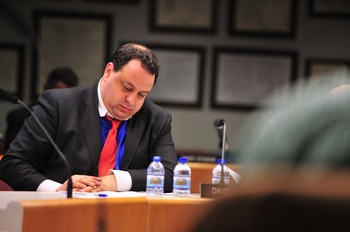
Board member David Nacht said the AATA is interested in regional approaches to providing transit services.
File photo
"The way it's been explained to us, this is going to free up dollars," he said. "Nobody's quite sure. I think a ballpark guesstimate is $40 to $50 million, but that could be off. I wouldn't want to be held to that. But something on that order would be freed up by the new revenue that would support the regional. That would be a real shot in the arm to the existing transit systems."
Fancher cited a larger figure of $100 million.
"Of that $100 million, I think they're looking at putting maybe $40 million into bus capital, maybe $40 million into bus operating, and putting the rest of it into rail improvements," she said, stressing Snyder wants to have a mechanism to replace some of the funding that exists today and provide more transportation funding for the region.
"We don't know the details of that," she said. "That may be that we have to vote as a region for an additional tax. We're waiting for that to come out."
The AATA is seeking approval from the city of Ann Arbor and Washtenaw County to morph into a countywide transit authority this year. If proponents of the expansion are feeling ambitious, a countywide transit millage could appear on the ballot as early as November.
AATA board member Roger Kerson asked Thursday night what might happen if a funding request for the RTA goes before the region's voters at the same time Washtenaw County voters are considering a countywide millage to expand AATA services. He fears there could be a "collision" and voters would be asked to vote on two taxes at once.
"That would not be good," Harder agreed. "And of course, you don't want to see that, nor would I want you to see that, having worked on a lot of millage campaigns over the years."
Fancher, who previously worked in the governor's office under Democratic Gov. Jennifer Granholm, sang the new Republican governor's praises Thursday night.
"What has been really fantastic about Gov. Snyder is the fact that he has been openly and publicly supportive of public transit in a way that we haven't seen in a governor in many years," she said. "And we are embracing that and we have sent him letters thanking him."
Harder made similar remarks.
"I hail from the other political party than the governor, and I will tell you that I have great respect for this governor for the stand he's taking on transportation," he said. "Because no governor has taken this strong a stand on public transportation since Gov. Milliken."

Gov. Rick Snyder used his State of the State address this week to stress the need to address regional transit in Southeast Michigan, including adding bus rapid transit services.
Angela J. Cesere | AnnArbor.com
Harder acknowledged Snyder is going to have to sway Republicans in the Legislature to push through his transportation agenda, and the votes aren't there yet.
"A lot of work is going to have to be done," he said. "We're going to get into some questions that are going to be very sticky issues."
Fancher said her group has worked with Snyder's policy advisors and talked to them extensively about the RTA legislation the governor called for this week.
"We do know from talking with the governor and his staff that the Ann Arbor area would have two voting board members," she said. "We do know that he wants to have major bus lines running in and out from Ann Arbor into the Detroit airport and into the city of Detroit."
Fancher said there are going to be a series of bills for the RTA and Sens. Tom Casperson, R-Escanaba, and Bert Johnson, D-Detroit, are leading the charge.
Harder said the AATA has a vital stake and an important role to play in whatever develops as far as the RTA.
Board member David Nacht asked the two speakers Thursday night to take the message back to Lansing that the AATA has led the way on controlling costs and operating efficiently.
He gave credit to former Treasurer Ted Annis for some of that.
"Ted was a very successful entrepreneur — still is — and he got us thinking about private sector techniques," Nacht said. "Even though we're a public agency in a union organized environment, we are constantly looking at how can we deliver the same level of service at a lower cost to the taxpayer, and that is now an endemic part of our culture."
Nacht said the AATA has now pilot tested and learned how to successfully do regional commuter bus service to Chelsea and Canton. He said the agency experimented with that for a while and is prepared to replicate those successes.
"We're interested in regional approaches," Nacht said, stressing that the AATA is not the "classic Mackinac Center image of a public entity" but rather "exactly the kind of public sector entity that we think a conservative Republican would be proud to have."
Nacht referenced the 30-year transit master plan the AATA put together. He said it looks at best practices in Europe, the Pacific Northwest, Canada, as well as the Midwest.
"We recognize that we're a medium-density area," he said. "We're not a major metropolitan area in Ann Arbor. But we're on the outskirts of one, and we understand exactly what we are and what we're not, what we're capable of doing or what we're not capable of doing.
"We've put a lot of effort into coming up with what we think is a reasonable approach given fiscal reality," he said, characterizing it as an environmentally sound plan with an eye toward economic development while making sure taxpayers get the best bang for their buck.
"I know that Ann Arbor Transportation Authority absolutely is a well-run organization," Fancher said following Nacht's comments.
"One of the things that we're going to be focusing on next week when we sit down and talk to the Republican-led House policy office," Fancher continued, "is focusing on how transit authorities like Ann Arbor have become more efficient over time and how we are developing those public-private relationships."
Ryan J. Stanton covers government and politics for AnnArbor.com. Reach him at ryanstanton@annarbor.com or 734-623-2529. You also can follow him on Twitter or subscribe to AnnArbor.com's email newsletters.
Comments
Ryan J. Stanton
Thu, Jan 26, 2012 : 4:19 a.m.
For the record, Fancher indicated she misspoke during the meeting and she should have cited Bert Johnson as one of the senators behind the RTA legislation, not Tupac Hunter. I've changed that sentence to be accurate.
Anders
Fri, Jan 20, 2012 : 8:05 p.m.
Public transportation certainly facilitates businesses, jobs, and life quality. Just make sure to make it fair and efficient.
sellers
Fri, Jan 20, 2012 : 5:59 p.m.
I do not think Ann Arbor or Washtenaw would be best served with a RTA that includes Metro Detroit suburbs. The culture, needs, and habits of those three counties differ from those in Washtenaw. There is a reason people in this area do not take fondness to being lumped into Metro Detroit (for the same reason Metro Detroit tries to lump us in). I speak from years of experience living in said Metro and realizing that this is 25 square (+/-) miles surrounded by... the rest of Michigan. Washtenaw is better served by creating it's pocket of excellence and letting it grow as it can. Grouping it together will cause a conflict of desires, needs, and culture much like trying to merge a company of two difference cultures. Detroit will always love it's cars - and it's why it does not have a mass transit system (look at how theRide is used compared to SEMPTA/SMART or whatever they call it today). I'd like to see ridership comparisons between the two.
Vivienne Armentrout
Fri, Jan 20, 2012 : 5:27 p.m.
Good coverage of the presentation, thanks. Fancher also said that bills for all this are not in process yet and drafts are not being released. She also said that she believed the Governor would either see it fall into place by March or would hold off until after November's election. As we were reminded, Snyder places high priority on these transportation issues (not limited to transit) but he also placed high priority on the bridge to Canada. He doesn't always succeed in getting everything past the Legislature. An additional note: she reminded us that Michigan's constitution requires that 90% of all transportation revenue be spent on roads. So transit funding is up against a 10% cap and when new revenue is added to bump it against that cap, other existing funding for transit could suffer. My interpretation of that is that it does not include Federal grants or other funding outside the state revenue stream.
Vivienne Armentrout
Fri, Jan 20, 2012 : 8:53 p.m.
Thanks for filling in details, Ryan. It was an interesting, fast-paced presentation.
Ryan J. Stanton
Fri, Jan 20, 2012 : 8:20 p.m.
And for the record, there were two related topics being discussed last night. The $1.4B transportation funding package and the RTA legislation. Fancher's comments in regard to March vs. November had to do with the first part. Here's exactly what she said: "The governor last night in his speech did call for us as a state and the Legislature to move forward on the transportation and infrastructure funding. He feels like there's enough talk and we need to start having meetings on it and start coalescing around some ideas so that we can move forward. He likes to talk about moving forward in dog years, and I think if they don't get something passed by March then we're not going to see anything passed until after the election in November. It's a pretty good assumption. I think I'd bet some money on that."
Ryan J. Stanton
Fri, Jan 20, 2012 : 6:43 p.m.
By "not in process yet," you mean not introduced formally, but I think they're in the works. What Fancher actually said was this: "The nitty gritty details of the bill have yet to come forward. The bills are not introduced and the drafts are not being released at this time."
Joe
Fri, Jan 20, 2012 : 4:46 p.m.
I can't wait for this area to become more transit-friendly. I know enough people who waste over an hour a day (and a chunk of their paycheck) driving from Ypsi to Dearborn or Detroit to work because there's no public transit system in place. Expand regional transportation and you'll open up new job opportunities for those who can't afford to commute and give those who already commute extra time in their day. As a young person starting a family and a career in this area, I am glad to invest in transportation. If my wife's place of work becomes transit accessible under the new countywide plan, we'll be able to sell our car and save thousands of dollars a year. Only a tiny portion of those savings would go towards the increase in property taxes. Sign me up for an extra few hundred dollars on my taxes if it means we can save time and money and live in a healthier, more liveable region.
a2grateful
Fri, Jan 20, 2012 : 4:22 p.m.
PPS Mr. Annis was also concerned with fairness. For example, he believed Ann Arbor's existing 2 mill city transit rate should be REPLACED by the countywide 1 mil millage. The current powers that be, rhymes with Hieftje, believe otherwise. They have a much different view of fairness for city of Ann Arbor residents. Heiftje-ites want city residents to continue paying 2 mills, + countywide 1 mill, for a total of 3 mills! Afterall, we need to keep paying those 10 AATA administrators double the competing wages of similar transit employees, right? Oh, and we probably don't want to know about their pension plans, do we? Yikes!
Veracity
Fri, Jan 20, 2012 : 4:41 p.m.
Amen, brother!
Dcam
Fri, Jan 20, 2012 : 3:08 p.m.
"They are not, when in private hands, the people's highways; but they are private property, whose owners make it their business to transport persons and merchandize in their own carriages, over their own land, for such pecuniary compensation as may be stipulated. These owners carry on, for their own benefit, a business which has, indeed, its public aspect, inasmuch as it accommodates a public want, and its establishment is consequently, in a certain sense, a public purpose. But it is not such a purpose in any other or different sense than would be the opening of a hotel, the establishment of a line of stages, or the putting in operation of a grist mill..." - Justice Thomas Cooley, Deatroit & Howell RR v. Salem Twps, citing constitutionally forbidden public funding for private railroads. 1870 "local government is [a] matter of absolute right; and the state cannot take it away." - Justice Thomas Cooley, People v. Hurlbut
JSA
Fri, Jan 20, 2012 : 1:56 p.m.
Under no circumstances should AATA be the Washtenaw County Transit Authority. They waste money and give false information constantly. Keep them restricted to Ann Arbor where these traits are encouraged.
Veracity
Fri, Jan 20, 2012 : 4:40 p.m.
Unfortunately, when the 4 county transit authority is approved the local AATA millage funds will be transferred to the new county authority. Presumably, the 4 county transit authority will spend the money by decision of the county board on which Ann Arbor will have less than half representation. Expect less money available for the AATA and an associated reduction in services. And I expect that the new CEO of the 4 county transit authority will have a big salary. Care to guess who may become the CEO?
jns131
Fri, Jan 20, 2012 : 3:28 p.m.
Plus they keep rebuilding the Blake Transit Center. Ypsi really needs it right now. Plus how far out east are they going to go? I'd love a bus to the Target shopping center. Canton could use one with the way they are growing.
xmo
Fri, Jan 20, 2012 : 1:53 p.m.
I like the idea of a Regional Transportation Group but what scares me is that it is run by the same people that Run the AATA. A bond issue might be needed to pay for some of the start up cost but this needs to be run as a business. i.e. make a profit on the operation so it can expand and improve but don't run on taxpayer dollars!
Veracity
Fri, Jan 20, 2012 : 4:12 p.m.
The present AATA does not operate on passenger revenue but depends on the millage to avoid a deficit. Ventures like the WALLY are expected to require taxpayer support as the ridership will provide less than half of the $5.3 million for yearly operation.
Veracity
Fri, Jan 20, 2012 : 1:36 p.m.
Here is the gist: "Of that $100 million, I think they're looking at putting maybe $40 million into bus capital, maybe $40 million into bus operating, and putting the rest of it into rail improvements," she said, stressing Snyder wants to have a mechanism to replace some of the funding that exists today and provide more transportation funding for the region. and then the coup de gras: "We don't know the details of that," she said. "That may be that we have to vote as a region for an additional tax. We're waiting for that to come out." The governor wants Ann Arbor taxpayers to pay for a private-public coalition to build and operate a regional transit authority. Executive cronies will draw down big salaries, consistent with Governor Snyder's recent gift of $1.8 billion to the state's business community. Citizens living in the outer county areas decided to live there despite limited transit service to and from Ann Arbor. The demand for the sizable expansion of transportation services to our smaller county communities does not exist. The 4 county transit authority and other similar proposals will cannibalize present AATA services and siphon off Ann Arbor taxpayer money to provide services that are not needed and not wanted elsewhere.
blahblahblah
Fri, Jan 20, 2012 : 1:17 p.m.
Good article Mr. Stanton. As I posted yesterday: "Why complicate matters even more by dissolving the AATA into the proposed county-wide authority? City and county leaders should wait to see how the regional authority might come together. Maybe the new regional authority could even help Conan Smith get to his office in Royal Oak? For those Ann Arborites commuting out of town to work like Smith, buses headed for metro Detroit make much more sense than buses headed for rural Washtenaw county."
a2grateful
Fri, Jan 20, 2012 : 12:59 p.m.
PS How do you say $1mil deficit? AATA
a2grateful
Fri, Jan 20, 2012 : 12:51 p.m.
Tiny, non-integrated government solutions to big problems are stupid relics from the past. Cities and counties need to be regionally integrated to be effective. This is especially true for transit. Watch for some great fireworks when the highly political, border-combative, midget-minded, local-government fiefdoms elbow with state politicos to establish control. Interesting . . . Ted Annis is credited for sound fiscal policy . . . too bad he was run out of AATA "on a rail . . ." ; ) Some Annis paraphrases from 2009: "The AATA is too fat and needs to go on a diet . . . AATA costs need to be controlled in order for a countywide millage to win voter support." Too bad for AATA that this has not happened.