

Thinking in Pictures: Temple Grandin explains autism and the animal mind to packed house at Michigan Theater
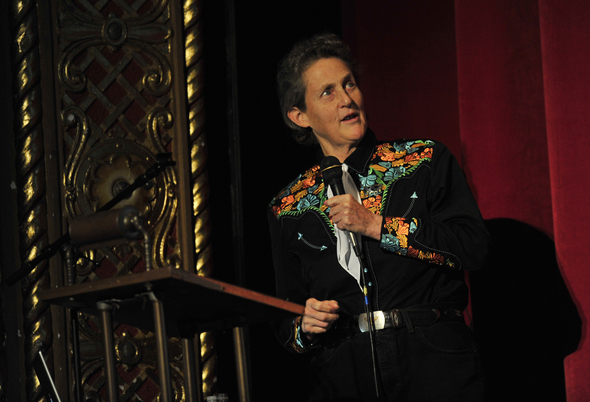
Author Temple Grandin speaks to a full house at the Michigan Theater on Thursday night.
Melanie Maxwell | AnnArbor.com
Long before Temple Grandin's life was the stuff of an Emmy-winning HBO feature film, Chrisstina Hamilton had been trying to bring her to Ann Arbor.
Hamilton, director of the Penny W. Stamps Distinguished Speaker Series, finally got her wish of five years on Thursday night when Grandin's talk kicked off the 2010-2011 lecture season before a standing room only crowd at the Michigan Theater.
The lecture series is funded by University of Michigan School of Art & Design alum Penny Stamps. It's intended as a way to connect students with innovative artists.
Grandin, a professor of animal science, a designer, and an author, focused her lecture on autism, animals, and the sensory-thinking approach both use to understand the world.
Beyond that work, Grandin has gained renown for designing humane slaughter facilities and a grading system to assess them.
"I want you to think about thinking," she said before the lecture. "And to understand animals, autistic people, mathematics — that requires getting away from verbal language."
Someone once asked Grandin, who is autistic and has Asperger's syndrome, what it's like to communicate with "normal" people.
"I feel like an anthropologist on Mars," she replied.
And much of her lecture focused on the failures of language to reach the autistic mind.
"Most kids, when you tell them 'don't cross the street without looking,' understand that to mean streets in general," Grandin said. "If you're going to tell your autistic child not to cross the street, you better tell them in 10 different places. They think in terms of specifics."
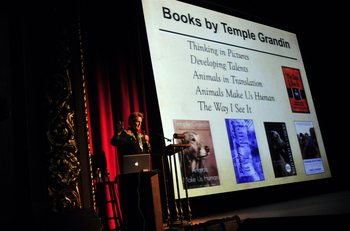
Temple Grandin appeared at the Michigan Theater Thursday.
Melanie Maxwell | AnnArbor.com
Animals, too. Grandin once encountered a horse that was afraid of people in black hats, having been abused by a black-hat wearing cowboy in the past. People without hats and people with white hats triggered none of the fearful reactions that black hat wearers did.
"Animal fears are very specific. Their memories form in terms of pictures, smells, taste, touch," she said.
A number of parents in the audience asked Grandin to name a turning point in her life - the moment when the proverbial lightbulb clicked on.
She couldn't. Outside of the pre-age 2 "educational intervention" Grandin said is crucial for all autistic children, her progress is mostly the result of high expectations and a mother unwilling to give up on her. Doctors and educators knew a lot less about autism in the 1950s. Grandin didn't start speaking until age 4.
Now she's a professor at Colorado State University, a successful author, and the subject of a self-titled HBO film that recently took home seven Emmy Awards. That wouldn't have been possible without having mentors at a young age, Grandin said.
"You've got to work with these (autistic) kids: mentor them, hire them," Grandin implored the crowd. "Even if the skill you can teach them is a little outdated, it gets the mind working and learning. Kids who are out spraying graffiti need to be working with real artists. They need to start thinking in terms of assignments, and learn how to finish."
That's what Grandin did. She designed her first humane slaughter facility as a teenager, and built a portfolio long before anyone paid her to do so. She credits a childhood trip to her aunt's farm with sparking that interest. That and her mother's insistence that she make the visit.
"I didn't want to go (to the farm) at first," Grandin recalled. "My mom laid out my options like this: either I could either go for two weeks or I could go for the whole summer. But I went, and I loved it. That was the spark."
Grandin spent part of her lecture speaking against the "abstractification" of the language, one of the major barriers autistic people face in mainstream society.
"When we say, for instance, that a student has behavioral issues in school, that could mean he throws spitballs, or it could mean he hit the teacher," she said. "Now, both are problems, but the degree is different, and that difference is lost when you're being so vague. We need to learn to be more specific."
"Normal" people tend to think "top-down," Grandin said - they form their theories first and let in or discard evidence to fit that framework. Autistic people and animals think "bottom-up," or take an experience-and-evidence-based approach to the world. Hence the horse with the fear of black hats.
Educational systems that only cater to top-down thinkers are failing to reach many talented young minds, Grandin said. Under-stimulated, their problems spill over into the job market. Autistic students need school systems that challenge them while playing to their strengths, Grandin said. That's what she had growing up.
"The world needs different kinds of minds working together," she said. "We need to have these unique minds doing productive work, not bagging groceries because no one knows what to do with them."
James David Dickson can be reached at JamesDickson@AnnArbor.com.
Comments
Kath
Mon, Sep 13, 2010 : 2:52 p.m.
You can also visit this page (see below) to see all the lectures online. It takes about a week for the lectures to be posted. http://playgallery.org/playlists/stamps/
Geek Chick
Fri, Sep 10, 2010 : 3:13 p.m.
Atticus - listen to the podcast when it is posted online!!!!!!!!! In the smaller Q&A session following the main talk, Prof. Grandin and audience members discussed alternative methods of communication for children who have trouble learning to speak. For example, some nonverbal children can learn to communicate by typing on a laptop or through pictures. Get in touch with University of Michigan Autism and Communications Disorders Center, http://www.umaccweb.com/
JackieL
Fri, Sep 10, 2010 : 11:33 a.m.
My daughter thinks in pictures and has some trouble with language. But she is dyslexic and not autistic. The word dyslexic translates as difficulty with language. Are there common threads among these 2 types of people? The thinking in pictures aspect has a big impact if you think about how our schools are run -- overwhelmingly verbal/linguistic.
Atticus F.
Fri, Sep 10, 2010 : 10:36 a.m.
Did she ever address the differences between people with 'functioning' forms of autism VS 'non-functioning'?
Ariel
Fri, Sep 10, 2010 : 9:46 a.m.
The School of Art and Design at UM videotapes all of their lectures and puts it on their podcast. It usually takes a few days for them to upload it, but the link for it is here: http://art-design.umich.edu/stamps/podcast
Dr. I. Emsayin
Fri, Sep 10, 2010 : 9:38 a.m.
Thanks for the TED talks link. There are wonderful, short talks on many interesting subjects there.
ShadowManager
Fri, Sep 10, 2010 : 9:01 a.m.
Didn't go because I knew it would be packed, but its good to see such interest.
City Confidential
Fri, Sep 10, 2010 : 8:17 a.m.
A very similar, if not the same, lecture by Temple Grandin is available on TED: http://www.ted.com/talks/temple_grandin_the_world_needs_all_kinds_of_minds.html
Go Blue
Fri, Sep 10, 2010 : 7:57 a.m.
By any chance, is there a video available to purchase of Ms. Grandin's lecture? For those that were unable to attend, it would be a treasure.
jjc155
Fri, Sep 10, 2010 : 7:40 a.m.
I wish I would have known about this in advance. My wife is a speech pathologist that works almost exclusively with children on the autism spectrum. She has met Mrs Grandin in the past a couple of times at different workshops etc and I'm sure that she would have enjoyed to see her speak again. BTW Temple Grandin was one of the best movies that I have seen, LOL
Evergreen
Fri, Sep 10, 2010 : 5:50 a.m.
Here's hoping the people who attended were listening and hire persons with autism! My daughter Asia has been employed by CHS for a couple years but for almost a year has only had volunteer work, no paying jobs. Asia has many gifts and talents as does Temple Grandin. Asia is very strong in some areas,as Temple mentioned, and weaker in others. For example she has run every day for over 12 years with only a 3 month injury break in 2002. Give Asia a list of things to do such as vacuum, take out the compost and garbage, close her drawers, get the mail... she cannot wait to get started, finished, and cross it off her list. It was nice to have Temple back in Ann Arbor. My wife, Adair Renning, brought her here about 1996 to speak to a support group for parents of children with Autism called P2REP2 [Parents and Professionals Reducating Parents and Professionals]. Temple is a perfect example of what can happen with early intervention and dedicated parents. Jerry Renning
Steve Bean
Thu, Sep 9, 2010 : 10:56 p.m.
Thanks for covering this event. I appreciate Grandin's attention to specificity in language. The Vitamin D Council has information about studies and anecdotal evidence of a relationship between vitamin D deficiency and autism.
Lorrie Shaw
Thu, Sep 9, 2010 : 10:43 p.m.
I'm sorry that I had to miss the lecture! I deeply respect Temple Grandin's work in both with animals, and in the area of autism. I find her knowledge of animal behavior invaluable. She is unquestionably the single best resource of real insight into the animal world and why they do what they do - and how our input influences them, which to me is very important. What I appreciate the most, is that Grandin approaches the topic of say, dog behavior from a vantage point that is more practical, one that treats each specific breed, each dog, as a whole, rather than lumping all dogs together in one group. If you want to truly understand animals better, I highly recommend her books "Animals in Translation" and "Animals Make Us Human". What a gem!
Macabre Sunset
Thu, Sep 9, 2010 : 10:41 p.m.
What's interesting is that if you ask many people what autism means, a lack of being able to identify with others is one of the more prevailing myths. Here we have a woman with autism who has accomplished wonderful things specifically because she can empathize with other beings. Give autistic children the environment they need, and miracles are possible.
Jean
Thu, Sep 9, 2010 : 9:20 p.m.
The evidence is there. Experience, productive work, mentors, and stimulation. Imagine if we applied these principles to all people. Yes, Temple, keep talking, so we may see our black hat fears that limit recognizing the evidence.