

Major improvements to Mallets Creek shoreline under way along Washtenaw Avenue
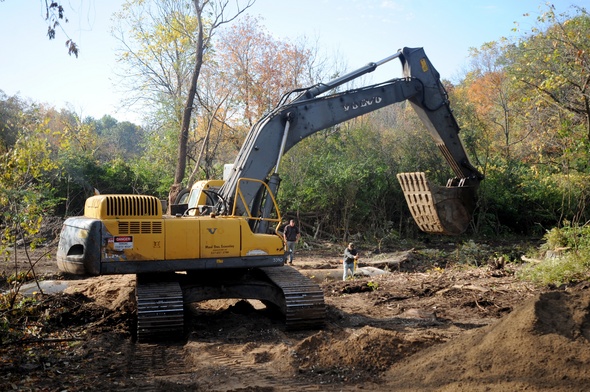
A work crew installs a culvert as part of the Malletts Creek restoration project on Oct. 11, 2011. The culvert is being put in to help stream flows and reduce flooding.
Angela Cesere | AnnArbor.com
A $2.8 million restoration project along a roughly 1.5-mile section of Malletts Creek is most visible along Washtenaw Avenue, where crews have cleared 3 acres in order to create a natural storm water detention system called a wet meadow. This part of the project is west of the Meri Lou Murray Recreation Center and south of the Washtenaw Avenue bike path, within County Farm Park.
“The wet meadow has native vegetation. It's designed to store the water when it rains, hold it and release it slowly into the creek,” said Harry Sheehan, the environmental manager for Janis Bobrin, Washtenaw County’s water resources commissioner.
Workers have removed a handful of cottonwood trees and lots of woody shrubs, like the invasive species buckthorn, Sheehan said.
Crews will create a depression that will house native species and act like a slowly draining bath tub when it rains.
For drivers, the wet meadow portion of the restoration project means that a few hundred feet along Washtenaw Avenue could be closed for short periods of time through Dec. 1, when the brunt of the work on the wet meadow will be done. The lane closures will occur as crews move equipment in and out of the site on a temporary driveway. When the project is complete, the driveway will become a pathway that connects the Washtenaw Avenue bike path to County Farm Park.
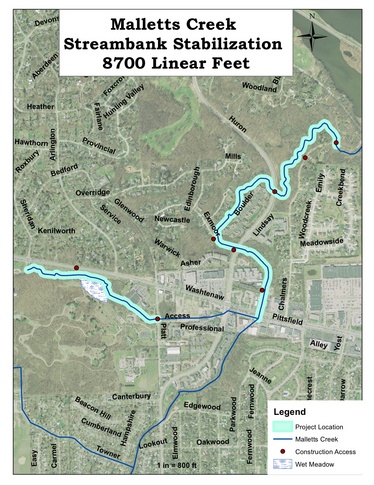
Photo courtesy of the office of Water Resources Commissioner Janis Bobrin
Branches of Malletts Creek run above ground or in underground pipes in the Burns Park neighborhood, around Briarwood Mall and at the Ann Arbor Municipal Airport. The branches merge at Stone School and Eisenhower Parkway near Malletts Creek Branch of the Ann Arbor Public Library. The creek empties into South Pond and the Huron River, near Gallup Park.
The creek’s 11-square-mile, pavement heavy floodplain overloads the waterway, which causes erosion, Sheehan said. The erosion means sediments clog the creek, hurting aquatic species at the bottom of the food chain.
To help address the problem, workers are restoring the shoreline along the 1.5- mile section of the creek, Sheehan said. The creek’s sometimes-steep banks will be regraded, shored up with stones and planted with native species to help control harmful erosion.
Besides sediment from creek beds, phosphorus also washes into the creek. The environmental impact includes algae blooms in Ford and Bellville lakes that can kill fish and harm recreation, Sheehan said. Pollutants like oils, E. coli and heavy metals that wash from city surfaces directly into the creek pollute the Huron River every time it rains.
The project is funded by a combination of low-interest loans and grants from he Michigan Department of Environmental Quality’s green infrastructure program, Sheehan said.
The most recent project is part of a plan developed by the City of Ann Arbor and the Office of the Water Resources Commissioner in 2000 to improve the flow and quality of water in Malletts Creek with MDEQ-funded projects like this one.
Another recent result of the partnership is a wetland in Mary Beth Doyle Park completed in 2008 that can hold 15 million gallons of stormwater before releasing it into Malletts Creek.
Planners estimate the current project will prevent 685 tons of erosion annually and cut the amount of phosphorus entering the river by 15 percent each year.
- Download a pdf of the Malletts Creek streambank stabilization project..
Juliana Keeping covers general assignment and health and the environment for AnnArbor.com. Reach her at julianakeeping@annarbor.com or 734-623-2528. Follow Juliana Keeping on Twitter
Comments
Christine Moellering
Thu, Oct 27, 2011 : 10:55 p.m.
Thanks for this article. I keep driving by and wondering what the heck is going on to the park, now I can read that it's for the best and I'm happy to hear what sounds like a wise investment in our environment in a beautiful area. I love and enjoy that park frequently. Also, I'd like to see an article about that little girl mentioned in the other poster's comments.
maxdex
Wed, Oct 12, 2011 : 8:17 p.m.
Thanks to the City and the Office of the County Water Resources Commissioner for moving ahead with restoration of Malletts Creek and the tributary stream that runs through County Farm Park. I have watched with concern over the years as stream channel erosion has worsened, and invasive species have taken over the waterway corridor. I know change can be disconcerting, especially when it is in our backyards. But, having seen stream restoration projects here and elsewhere, I also know that within a year or two, we will have new and healthier vegetation along the Creek, and a cleaner Creek that is once again capable of providing aquatic habitat.
Juliana Keeping
Wed, Oct 12, 2011 : 7:11 p.m.
Hello readers and commenters. I've added both a photo and download-able pdf (at the bottom of the article) of the Malletts Creek project. -Juliana
Tru2Blu76
Thu, Oct 13, 2011 : 3:01 a.m.
Thank you! :-)
Tru2Blu76
Wed, Oct 12, 2011 : 5:43 p.m.
It would have been better to write: Mallets Creek is one of the primary Huron River tributaries in the Ann Arbor Area. Beyond that, these improvements are on-going and should continue. Few stop to think that this tributary was once designated on maps as: Ann Arbor - Pittsfield Drain. It is A CREEK which was facing urbanized extinction until a 14 year-old girl adopted it and got the name officially changed back to the original (based on an 1837 postal map). That was 21 years ago, since then a number of buildings (both residential and a library branch) have taken that name. That teenage girl also organized the first (in years) clean ups under auspices of the Huron Vally Watershed Council. We read about teenagers running over ducks and shooting swans. Well - there's another CLASS teenagers in our midst who do a lot better things for their city and state. We also read comments by adults who always criticize and go all snarky at every attempt to improve Ann Arbor. Well- there's another CLASS of Ann Arbor adults who know that Ann Arbor needs people to WORK and even DREAM toward making Ann Arbor better. This kind of Ann Arbor citizen understands the value of preserving and recuperating our " oh-so-inconvenient" Natural Environment because that's what humans NEED to live healthy, productive lives. As for those who would spend 10 times the amount mentioned for the new Stadium Bridge: go ask Governor $lick Ri¢K for the money and see what he says. Keep prattling the GOP line - it's getting Michigan nowhere but backwards and YOU are partly responsible.
aabikes
Wed, Oct 12, 2011 : 1:42 p.m.
haha, sorry, I just have to laugh at the headline "improvements to Mallets Creek shoreline" alongside a picture of a giant excavator clearing away trees...
Lolly
Wed, Oct 12, 2011 : 4:03 p.m.
It does sound counter-intuitive, but I think we can survive the loss of a few cottonwood trees. The other woody plants in that area were buckthorn. The result will be a much richer space environmentally in County Farm Park and the river and Ford Lake.
Brad
Wed, Oct 12, 2011 : 12:56 p.m.
Does a five-foot-wide ditch really have a "shoreline"? Was there any thought given to the fact that they're building a large mosquito breeding ground in a park and across the street from residences?
Susan Bryan
Wed, Oct 12, 2011 : 6:31 p.m.
Wet meadows, and rain gardens actually don't breed mosquitoes. The water does not sit long enough for the mosquito to go through its life cycle and produce a mature adult. <a href="http://www.raingardennetwork.com/mosquito.htm" rel='nofollow'>http://www.raingardennetwork.com/mosquito.htm</a> If you would like to visit another wet meadow project, spearheaded by pre-schoolers for the good of Malletts Creek, visit the Buhr Park Children's Wet Meadow, off Packard. <a href="http://www.wetmeadow.org/search/label/Observations" rel='nofollow'>http://www.wetmeadow.org/search/label/Observations</a> Visit and see what you think. If you walked by unawares, you might think it was just a meadow, not a functioning stormwater utility. It is that pretty!
Epengar
Wed, Oct 12, 2011 : 3:06 p.m.
I agree that the headline should not have used "shoreline" -- I think "bank" would have been much better. The point of wet meadows is that they do drain, they are not swamps or ponds. They drain fast enough that mosquitos can't breed there, but slow enough to reduce erosion and trap nutrients and pollutants before they drain into the creek, and then the river, and then Lake Erie.
HappySenior
Wed, Oct 12, 2011 : 12:55 p.m.
So, a really big rain garden. There have been efforts to help restore Mallets Creek for a couple of decades now. There have been so many projects it is difficult to remember them all. Thanks, Juliana, for keeping us informed. Our tax money at work for our local benefit.
Nephilim
Wed, Oct 12, 2011 : 12:12 p.m.
Another 2.8 million here......so, how's that stadium bridge coming along?
Susan Bryan
Wed, Oct 12, 2011 : 6:17 p.m.
East Stadium bridges project The East Stadium bridges reconstruction project will break ground this month, launching major construction work to replace the two aged bridges, just to the south of the University of Michigan football stadium. The project will also include staircase construction and walkways for pedestrians and new lighting. A groundbreaking ceremony for the East Stadium bridges project will be scheduled for mid October, with Congressman John Dingell and other dignitaries in attendance. More information will be shared once an event time and date are set. In the meantime, discover each of the ways to stay informed about the project — detours, progress and more: • Visit the Ann Arbor Bridges website, <a href="http://www.annarborbridges.org" rel='nofollow'>www.annarborbridges.org</a>. • Follow project updates on Twitter, <a href="http://twitter.com/#" rel='nofollow'>http://twitter.com/#</a>!/AnnArborBridges. • Become a fan on Facebook, <a href="http://www.facebook.com/AnnArborBridges" rel='nofollow'>http://www.facebook.com/AnnArborBridges</a>. • Subscribe to receive updates right to your e-mail inbox, <a href="http://www.a2gov.org/subscribe" rel='nofollow'>www.a2gov.org/subscribe</a>.
Rork Kuick
Wed, Oct 12, 2011 : 12:05 p.m.
Reality check: "Largest tributary" Not even close by normal standards. Mill Creek drains over 10 times that area (about 140 square miles). "prevent 685 tons of erosion" - what are the actual units? Tons per year, per century?
Rork Kuick
Wed, Oct 12, 2011 : 4:58 p.m.
Per year - that's impressive, and saddening. Thanks Juliana.
Juliana Keeping
Wed, Oct 12, 2011 : 3:12 p.m.
Hi Rork. It's the largest tributary in Ann Arbor - I have updated the story. Also, it's 685 tons annually. Thanks for reading - Juliana
Epengar
Wed, Oct 12, 2011 : 3:01 p.m.
Maybe it's the largest tributary, in terms of annual volume, that runs through Ann Arbor? Just guessing.