

In tough times, let's focus on keeping Ann Arbor's warming center open
See related story: 415 W. Washington not a good site for 24-hour warming center, Ann Arbor officials say
If Washtenaw County already has an overnight warming center to serve the homeless during winter, does it need a second one, staffed by volunteers and open 24 hours a day?
Occupy Ann Arbor says yes, but we’re unconvinced. We think the community’s efforts and resources could better be directed toward keeping the existing warming center open at a time when its future is in doubt.
Ryan J. Stanton | AnnArbor.com
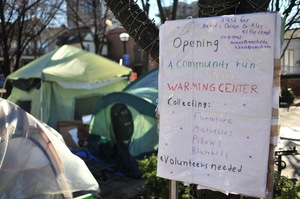
Occupy Ann Arbor says foreclosures and a struggling economy mean that more people will be homeless this winter, and the existing overnight warming center being operated by the Shelter Association of Washtenaw County can’t meet the need. Nor is there currently any walk-in daytime warming center in Ann Arbor.
The Occupy movement envisions a 24-hour warming center “democratically run by homed and homeless volunteers’’ who would “combine their skills, explore their creativity and support and empower each other.’’ Occupy supporters have been circulating petitions and conducting fund-raisers on behalf of this project, and hopes to open the center yet this month.
As much as we admire Occupy Ann Arbor’s advocacy on the issue and the earnestness of its efforts, we share the concern of city officials that there isn’t enough money available right now to properly support the overnight shelter we already have, let alone try to revive something that has proven unworkable in the past.
Ann Arbor has not had a day-time warming center for the homeless since 2003, when the building housing Ashley Place was torn down. During the years prior to that, the Ashley Place warming center was a constant source of problems, and police or paramedics were frequently called there to deal with fights, drug abuse and medical emergencies.
More recently, First Baptist Church in Ann Arbor undertook a well-meaning effort to help the homeless by erecting a wooden pavilion to shelter individuals who had been sleeping outside on church property. But the church gave up the effort in 2010 because the rudimentary shelter had become a place where people came to drink and take drugs, and fights frequently broke out.
Homelessness is a complex, intractable problem fed not just by a tough economy, but also by issues of substance abuse and mental illness. Volunteers, no matter how well-motivated, are typically not equipped to address such issues.
When we look at what has worked in Washtenaw County — and more importantly, what hasn’t — we’re convinced that programs serving the homeless are more successful when they are professionally staffed, and when they are designed to address the underlying issues of homeless individuals and move them toward permanent housing. That is the ultimate goal. To simply warehouse the homeless is to perpetuate the problem.
We would be the first to agree that current programs do not meet all the need that exists in the community, and when we have people sleeping outdoors under bridges or on park benches in the dead of winter, we as a community should feel compassion and concern. However, we think the best way to channel that concern is into greater support for existing, proven programs.
Right now, the Shelter Association operates both the Delonis Center, a year-round residential program that can house about 75 people, as well as an overnight warming center that can accommodate about 25 people during the winter. A rotating program run by several local churches also shelters about 25 people a night during the winter.
Earlier this year, severe funding cuts forced the Shelter Association to consider not operating the overnight warming center this winter. The program was saved when the Ann Arbor City Council stepped in and voted in October to provide $25,000 in funding. We applaud council for moving to preserve the overnight warming center.
But the Shelter Association is only committing to continue the program for one more year, and says a long-term solution has to be found to sustain the effort. A number of local service providers are convening a working group to look into the issue and develop a new plan for housing the homeless during the winter months. That group is expected to begin its work after the first of the year.
We will be following the work of this group, and reporting its efforts to the community. In these times of scare resources, we need this kind of collaboration, not duplication or fragmentation of services. Community members and organizations that are concerned about homelessness and want to help would do well to throw their energy into the effort to preserve the overnight warming shelter we’ve already have.
(This editorial was published in today's newspaper and reflects the opinion of the Editorial Board at AnnArbor.com.)
Comments
kk
Mon, Dec 12, 2011 : 6:32 p.m.
Neither Alpha House nor the rotating church shelter programs are run 24/7 by professional staff. They connect to area agencies to meet the needs of the homeless, and provide support in finding jobs and housing, which is what this group proposes to do.
Michael K.
Sun, Dec 11, 2011 : 6:46 p.m.
"and move them toward permanent housing. That is the ultimate goal. To simply warehouse the homeless is to perpetuate the problem." This is a false dichotomy I see repeated again and again by well meaning politicians and social services professionals. You MUST solve the short term problem of "where to warehouse the homeless" (tonight: tomorrow: in 3 weeks when it goes to -10 degrees), in order to reach your "ultimate goal" in the distant future. To use your "warehouse" metaphor: A store chain needs both a warehouse for nearby storage of all the merchandiE it hopes to sell this season, as well as retail store locations stocked with "professionals" to actually sell products, staff pa customer service desk, helpers on the retail floor, stockers, checkout people, registers, as well as display designers, customer restrooms, etc. They are two discrete steps in a symbiotic process: all of the merchandise available (homeless) will not fit on the retail selling floor (Delonis, DHS, etc.) To put it bluntly: if all of your clients freeze to death in the next 3 weeks, nobody is going to be there 3 years from now, when the economy has recovered and 17 private,local , state, and federal committees have agreed an the final draft of the study for the proposal to write a grant to further investigate the problem of homelessness and the under housed in Ann Arbor and the greater Ann Arbor-Ypsilanti corridor as a sub-task force of the Washtenaw County planning commission. Or: The Perfect is the Enemy of The Good
Leah Gunn
Sun, Dec 11, 2011 : 6:20 p.m.
Thank you to Vivienne Armentrout for recognizing Cmsr. Rabhi's resolution. Actually the total figure was $52,000 because it was voted for two years, 2012-13. The wording did not specify the warming center, but the money can be used for that, or for any other needs of the Delonis Center. It passed unanimously. There are other programs to help, most notably the Engagement Center on Hamilton St. in Ypsilanti for de-tox and the J-PORT effort at the couny jail to divert people from jail. In addition, the county restored the Coordinated Funding for 2012-13 that it had cut from the budget, and that total, for two years, is $247,066, keeping the allocation at $1,015,000 for both years. The City of Ann Arbor and Washtenaw County, along with our private sector partners, the United Way and the Ann Arbor Area Community Foundation, are all working together to serve those people who are most vulnerable in our community.
kulanova
Sun, Dec 11, 2011 : 4:41 p.m.
nevermind. just saw the disclaimer at the bottom. anhywho, thanks for the input. "we'll" take it under advisement.
kulanova
Sun, Dec 11, 2011 : 4:29 p.m.
This column is authored by Tony Dearing? Mr Dearing: who is the "we" on whose behalf you are speaking?
Vivienne Armentrout
Sun, Dec 11, 2011 : 2:31 p.m.
This is well stated. Maintaining a proper shelter requires skill and facilities and the Delonis Center provides those. Your column does not give credit to Yousef Rabhi, who caused Washtenaw County to give an additional (roughly) $25,000. I commend Mr. Rabhi as well as Councilmember Sabra Briere and Mayor Hieftje for making the $50,000 needed to keep the Delonis Center open for this purpose. We are seeing the results of budget problems at both city and county that have caused a loss of human services funding. The City also gave up a fixed amount of human services funding that was coming from HUD (it was grandfathered in under the city's old block grant) when it joined the Urban County. I've recently reviewed this in a blog post, <a href="http://localannarbor.wordpress.com/2011/11/27/is-regionalism-really-a-good-thing/" rel='nofollow'>http://localannarbor.wordpress.com/2011/11/27/is-regionalism-really-a-good-thing/</a>
Tony Dearing
Sun, Dec 11, 2011 : 3:52 p.m.
Yes, we should have credited Commissioner Rabhi and the county board for restoring some human services funding for this and other programs, and thanks for pointing that out. <a href="http://www.annarbor.com/news/washtenaw-county-human-services-funding-restored-but-no-deal-yet-with-humane-society/">http://www.annarbor.com/news/washtenaw-county-human-services-funding-restored-but-no-deal-yet-with-humane-society/</a>
EyeHeartA2
Sun, Dec 11, 2011 : 1:48 p.m.
Logic will get you nowhere Tony, but nice try.