

U.S. Rep. John Dingell has two words to describe Ann Arbor's Stadium Boulevard bridges
U.S. Congressman John Dingell has two words to describe the bridge spans in Ann Arbor that carry traffic on Stadium Boulevard over State Street and nearby railroad tracks.
"Miserable" and "disastrous."
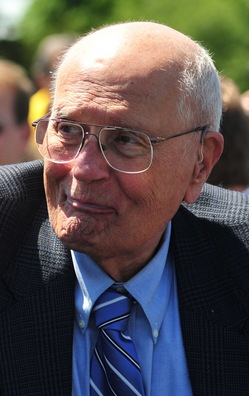
John Dingell
"It's probably a little bit of an understatement," he told AnnArbor.com in an interview while in town Monday.Â
Dingell has been in close talks with Ann Arbor city officials about going after federal grant funding to fix those two bridge spans. They're hoping the nearly $23 million project receives funding in the next round of federal stimulus dollars for transportation projects.Â
"We're going to do everything to make sure that it does," Dingell said. "There's tremendous competition for these grants, but Ann Arbor has done a superb job in preparing for the grant application and putting together the grant application, so I'm hopeful that it will work well."Â
The issue of the East Stadium Boulevard bridges was discussed during a work session of the Ann Arbor City Council Monday night.Â
Homayoon Pirooz, head of the city's project management unit, gave a progress report that began with a photo showing the span over South State Street. A series of beams for two traffic lanes have been physically removed to reduce the risk of concrete chunks falling on cars. Only two of the four lanes are in use at this point.Â
The two bridge spans were constructed in 1917 and 1928. By today's standards, both are considered functionally obsolete.
City officials also cite problems with low and narrow clearances, narrow traffic lanes, lack of bike lanes, and little or no sidewalk space.
Pirooz said the span over State Street has a federal sufficiency rating of 2 out of 100. He said the city has been trying to get grant funding to fix the bridge for the last five years. With little luck, the city scaled back the scope of the project last year and began going after stimulus dollars.
When those dollars didn't come through in the last round of funding, Pirooz said the city could have to tap out its local streets funds to pay for the repairs on its own starting next spring.Â
Pirooz said the city still has several options for state and federal grant funds, though. With the plan in place and the work done so far, Pirooz said he's confident construction can begin in spring 2011 once funding is in place. The work would take about 18 months.Â
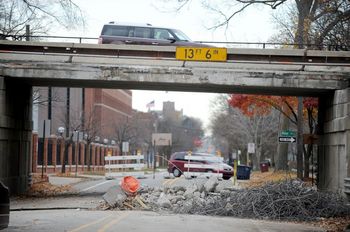
The Stadium Boulevard bridges were the subject of discussion at the Ann Arbor City Council Monday night.
Pirooz presented an updated project funding schedule, showing the city is hoping for $9.5 million in federal grants and $3 million from the Michigan Department of Transportation. The city would chip in $7.2 million from its street reconstruction millage, $509,000 from the major street fund and $319,000 from the alternative transportation fund.Â
Covering the remaining balance, $957,000 is proposed to come from the city's water funds, $1.395 million from stormwater funds, and $113,000 from sanitary sewer funds.
The city already has spent more than $1.6 million planning the project, which is part of the $23 million total cost. The remainder of the costs will be paid now through fiscal year 2013-14, city officials are proposing.
No decisions were made Monday night.
The city's street reconstruction millage has been tapped in the past to pay for major bridge projects, covering about $12.1 million of about $41.2 million in costs.
That includes a $3 million replacement of the Fuller Road Bridge in 1994, a $5.96 million rehabilitation of the Huron Parkway Bridge in 2000, a $28.2 million reconstruction of the Broadway bridges in 2004, a $1.62 million rehabilitation of the Eisenhower Parkway Bridge in 2005, and a $1.35 million painting of the Huron Parkway Bridge in 2007.
Council Member Sandi Smith asked Monday night whether the University of Michigan, which will benefit from the Stadium bridges replacement project, has been asked to help. City Administrator Roger Fraser said the city has asked, but the university hasn't been forthcoming.
Sue McCormick, the city's public services area administrator, said should the City Council decide it wants to move forward with the project absent grant funding, it will take nearly every local dollar available for streets. She said the city has been careful with spending street millage funds in recent years with the Stadium bridges project on the horizon.Â
Some have suggested that the city complete the repairs in stages. But Pirooz said it would cost about $3.6 million more to take on each of the bridge replacements as standalone projects. Pirooz said an at-grade crossing also is not an option the city is considering. One reason is the increased risk of traffic crashes, but he said it also would be more costly over the 75-year life of the bridges. He also said the Ann Arbor Railroad is opposed to the at-grade option at the railroad tracks.Â
And due to the proximity of the two bridges, it is impractical to maintain a bridge over the railroad tracks and build a new four-way intersection at Stadium and State.
City officials said the new bridge spans would be wider and longer, accommodating all means of travel. It would include on-street bike lanes, sidewalks and stairs. The project also would include the replacement of storm sewer, raw water transmission lines and some sanitary sewer. There would be retaining walls, minimizing right-of-way needs, with appropriate railings and lighting, as well as restoration of disturbed areas, including portions of Rose-White Park.Â
Pirooz presented a chart Monday night showing the city's pavement conditions. In 2009, 77.2 percent of the city's major roads were rated in good or satisfactory condition, 19.4 percent fair, 2.2 percent poor and 1.2 percent very poor. In the same year, 92 percent of the city's local roads were rated good or satisfactory, 7 percent fair, 1 percent poor and 1 percent very poor.Â
Deputy Secretary of Transportation John Porcari is expected in Ann Arbor Friday for a meeting that will focus on a grant application for replacing the Stadium Boulevard bridges. He's also expected to take a field trip to get a first-hand look at the crumbling structures.


Dingell helped arrange the visit.
"We're busy generating the kind of political support the department insists on and also working very hard to show that it is going to confer the kind of economic benefit that is needed, including creation of the number of jobs that we have to have here," he said.Â
Dingell, D-Dearborn, said he also is working on championing the Ann Arbor-to-Detroit commuter rail project, which has seen setbacks in recent weeks due to a lack of federal funding.
"It is an urgent need," Dingell said. "It will save a huge amount of energy, take a lot of cars off the road, make it much easier for my people, and improve the quality of life. In addition to that, it will mean that no longer will we have some of the terrible traffic that you can see here on the roads between the two cities, and it will help with economic development."Â
Ryan J. Stanton covers government for AnnArbor.com. Reach him at ryanstanton@annarbor.com or 734-623-2529.
Comments
Ray D. Aider
Sat, May 15, 2010 : 12:53 p.m.
Yes John, if you throw Ann Arbor a bone they'll be thankful come November. All of your wonderful constituents are in Ann Arbor after all. This man is no dummy when it comes to getting votes...I'll hand him that fact.
Hornet
Thu, May 13, 2010 : 9:35 p.m.
I have two words for Dingell - Please Retire
bballcoachfballfan
Thu, May 13, 2010 : 1:09 p.m.
Why is it that every, single subject in today's world has to produce combative, progressive vs conservative rhetoric? This is ridiculous. This story is about bridges in our city. This story is about the safety of our citizens. I worry about a major incident happening on the Stadium bridge where people are hurt or killed. That should be the focus of the comments. Just like everything else since the 2008 campaign, this has turned into a forum to blast President Obama and his administration as well as a chance for others to counter by pointing out the foibles of the previous administration. This is absurd. This is precisely the reason that this project, along with nearly every other important agenda item locally or nationally, gets stalled. Why, with the election of President Obama, did everything become either left or right? What happened to the center? What happened to finding commone ground and getting something done? That's what we need to do here. Quit relating this to national politics and get this done. It really shouldn't matter what your opinion is, overall, of John Dingall. The only relevance to this story is that he is here fighting for our community on this issue. He should be respected and applauded for trying to help us. I am certain there are many issues to call him to task on but this isn't a ideological debate. This is about the safety of the citizens of Ann Arbor!
Ming Bucibei
Thu, May 13, 2010 : 12:36 p.m.
Criminal misfeasance and malfeasence for decades!! Due to many decades of criminal neglect of maintance and inspection!! The people responsible for the situation are useless idiots!! A grade crossing will not cut it, in the past AA railroad has blocked city streets for more than 45 minutes, in violation of state law (I know because i was there and waited that long-- and it did not happe just one was a regular occurance) The mony which sould been saved in maintance fund was wasted on other things but certainly not road repairs either!! drop all the idiotic rail and trolly projects I has been obvious for years that the city council and mayor "...but we can't have a bridge repair, because City Council hates cars, and doesn't want good roads...deedee; the city will not even time lights to speed up the flow of traffic---they appear to want to force The People to walk and ride bkes only!! Vote all incumbants out in the primaries and November Ming Bucibei
snapshot
Wed, May 12, 2010 : 10:52 p.m.
Wasn't there a missed deadline to secure state funding to repair these bridges in 2008? I'm wondering if anyone knows the details. All our tax dollars are going to the salaries, pensions, and perks of the folks who are supposed to be fixing the roads and bridges. So much for "public service". Our politicians spend money like it's going out of style as long as it get's them votes and support from the special interest groups. Guess what folks, we, the taxpayer, aren't a special interest group because we can be duped with TV commercials and empty rhetoric. The special interest lobbyists can't. they win, we lose.
mike from saline
Wed, May 12, 2010 : 11:12 a.m.
@ aareader, Ok, you like Edward R. Murrosw's Ghost [the commenter formaly known as tigger] comment's about the budget priorities of of the Reagan Administration. BUT, what are you going to do about your bridge? You know, the one on Stadium Blvd, that goes over state St? I thought that was the subject. Please try to pay attention. I feel I must warn you. If you don't fix that bridge soon, I won't be comming to dinner anymore. My wife and I love the Resturaunt's in down town Ann Arbor, and we'd hate like heck to miss the "festi- val of Fools", and seeing the bewildered look on the little kid's face's as there parents try and explain the irony behind those big, scarry puppet heads, representing "Art Critics", and why this is so much fun. WE usually come in State Street, and the thought of some, 50 mpg, hybrid, 2 seater, with a "mean people Suck" bumper sticker, come crashing through the windshield of my S.U.V. like a metorite, frank- ly scares the beejeesus out of my wife and I. If someting's not done soon, we'll just have to go to Mac's, or maybe, take a short road trip to the "Common Grill" in Chelsea. Or maybe just stay home, and have a grilled cheese sandwich.
bunnyabbot
Wed, May 12, 2010 : 9:58 a.m.
is that stretch part of a "business loop" from the express way?
JSA
Wed, May 12, 2010 : 9:09 a.m.
aareader, And your anti-republican rant relates to fixing a bridge in Ann Arbor in what way? The other side can offer the same rants about Granholm, Obama, Clinton, etc. and it does nothing towards fixing the stupid bridges. Ann Arbor's politicians have known about this for decades. It may be that they need a special assessment for the citizens of Ann Arbor to fix Ann Arbor's problem.
aareader
Wed, May 12, 2010 : 8:55 a.m.
I like the history lesson from "Edward R. Murrow's ghost." I have lived through all of it. I have seen the mess created by Engler's, Reagan's, Bushes I & II, and the Republican Congresses policies. They talk a game of responsible government but we are all looking at the results today. And now they are complaining about the deficits as if they magically started under the current administration. GO figure.... or the evidence appears to be the Republicans can't.
mike from saline
Wed, May 12, 2010 : 8:36 a.m.
@ David, I think you might be on to something!! But allow me to expand a bit. Get um for 50 cents to enter, and another half a buck to EXIT. That bridge will be up and running in no time!!
PersonX
Wed, May 12, 2010 : 8:31 a.m.
Is there any topic that does not provoke the something haters? Does anyone doubt that the bridges hate to be redone and that the tooth fairy or beneficent private business will not take care of it? Federal or city funds will have to be used, and that is simply the way it is. I do concur that eighteen months seems like a long time. The problem with all road construction is that the companies that do the job keep moving crews from project to project. It seems that every time one passes by a road construction site, hardly anyone is working or the place is empty of workers. Perhaps the city should require that work on a site be continuous, with no down time for work on other sites. This would shorten work time and provide some relief for businesses that are often shortchanged by road work that thretens their trade.
Rasputin
Wed, May 12, 2010 : 7:59 a.m.
Rebuild the bridge and require a toll, say $.50 to enter? The city of A2 could easily recoup the costs of the bridge construction and pay for it's maintenance.
mike from saline
Tue, May 11, 2010 : 8:33 p.m.
Why dosn't A2 have the money to fix there bridge? Why should it need Federal money? I live in Saline. I don't realy care about your bridge. You're one of the highest taxed communities in the State of Michigan. Perhaps you might want to hold off on your million dollar fountain. You could probably raise some money by selling off one of your green space parcel's [not to us of course, were sell'n, not buying, thanks anyway]. I guess it's all about priorities. Where am I wrong?
Diagenes
Tue, May 11, 2010 : 8:10 p.m.
The orange barrels have been up for more than a year and Rep. Dingell shows up 6 months before an election in a tough year for Democrats. He thinks that if he can get Congress to borrow some money from the Chinese to give to Ann Arbor to rebuild the bridges, that we will thank him with our vote in Novemeber. He is a perfect example of what is wrong with our politics.
blahblahblah
Tue, May 11, 2010 : 3:28 p.m.
If federal dollars do not come through, the U and City need to work together to find a solution. We can not spend the city's entire road fund on one bridge. Can the railroad really dictate "at-grade" crossing right of ways? If so than re-route Stadium through the east side of the golf course to directly south of the Stimson and State intersection. Problem solved.
mike from saline
Tue, May 11, 2010 : 3:25 p.m.
This bridge is in the middle of Ann Arbor!! It's not a part of the National Interstate highway System. It's not a State Rd, or even a County Rd. Note to Ann Arbor Tax-payers. Fix Your Road!!! Leave me, and all the other Tax-payers who don't live in A2 alone.
dlarrouy
Tue, May 11, 2010 : 2:26 p.m.
It is puzzling that the UM would not help with the proximity of the stadium and the golf course. It needs to be done. But the condition of Huron and Miller, two of the major roads in town, is really terrible. I had hoped that they would be fixed sometime. they are really terrible.
jcj
Tue, May 11, 2010 : 1:49 p.m.
Fair enough about the Obama nickname. For the rest of you it was not vulgar or racist just disrespectful. @Edward R. Murrow You eloquently bestow upon us figures for past Presidents debt responsibilities. Would you be so kind as to tell us what the figures are regarding President Obama's part (if any) in the national debt? @sbbuilder You are one of the ones that really gets it. What part past administrations local or national have had in this debacle matters little now. What matters is who we put in office for the next elections.
Stephen Lange Ranzini
Tue, May 11, 2010 : 1:24 p.m.
First, with respect to the Stadium Bridges, we need to have a street that connects State to Main at that location otherwise its very tough to get from one side of town to the other, so closing Stadium isn't an option. I'd recommend that if our Congressman cannot get us the earmark to get the Feds to return some of our federal highway tax dollars back to us for key infrastructure needs (to replace the bridges) we tear them down and put a street level railroad crossing and a standard four way light interchange between State St. and Stadium. We can afford that and there is street millage money available to pay for it (and we can spend the money on the other deferred maintenance see: "Overall, 55% of Ann Arbor's 342 miles of federal-aid qualified roads were deemed poor, the report shows." posted at: http://www.annarbor.com/news/washtenaw-county-ranks-4th-worst-for-roads/index.php As to needing to spend $23mm to build a fabulous bridge so the Ann Arbor Railroad doesn't have to cross a street, where is the need? A hundred yards down the road the Ann Arbor Railroad crosses State St. already at road grade level and for those of us who live downtown, we note that the train comes through town two times a day, usually in the very middle of the night. Lets use some commonsense and stop spending money we dont have for luxuries we cannot afford. With respect to Keynesian economics, pace the anonymous poster who uses the pen name of the famous deceased journalist @Edward R. Murrow, Keynesian economics has been tried and failed. We just ran the experiment yet once again in 2008. The federal government spent $12 trillion dollars to boost the economy and what did we get but the tab for the debt? Where are the millions of jobs? We lost jobs. The Administration claims they created tons of jobs at the cost of $550,000 per job. If you gave me $550,000 to create one job, I know I could hire more people for a year than that!! The federal government threw our money away. The venture capital fund I ran created permanent jobs for under $5,000 each in the most depressed part of the state of Michigan. That is what the free market can do. Economists coming out of the Great Depression were of two minds as to how to solve the problem. The Keynesians said that government spending to prime the pump would restart the economy. The Chicago School and Austrian School of economists said that cutting government taxes and allowing the productive class to keep more money to invest in job creating opportunities was the best course of action. @Scott Hadley is correct, now we know who was right.
sbbuilder
Tue, May 11, 2010 : 12:21 p.m.
The point I was trying to make earlier was that we have ourselves to blame for the present situation. We have voted into office every single council member, including the mayor. They have done what their predecessors have done. Very few folks monitored what council members were doing over the years when times were good. Now that the tide has gone out, we are ashamed at how bad things have gotten. In large part, they have done what we have asked them to do. We need to stop blaming Bush for this, and Carter for that. So what. I fail to see how that will pour one single bucket of cement for a new bridge. What we will have to do is vote in fiscally responsible council members from whatever political persuasion. That will eventually fix our bridge, and the underground parking fiasco, and the new administration monstrosity, and the bloated parks, and the fountain, and the declining police and fire force. The current members are from a different era. (They just don't realize it yet.)
Sandra Samons
Tue, May 11, 2010 : 11:27 a.m.
So, explain this to me again, please. Somehow I just don't get it. The city administrators have always known how old the State St. bridges were, knew for a long time that they were failing and in desperate need of repair or replacement, yet they fiddled and focused on other, more glamorous pet projects, freely spending taxpayer money to make these visions a reality. Meanwhile, the library lot has been demolished over the objection of many local residents and near-by businesses, and we have a very expensive gaping hole, soon to become an underground parking garage, while the administration scrambles around trying to get financial assistance to replace the bridges before some horrible disaster occurs. Does anyone else wonder if there is someething wrong with this picture?
Matt Damon
Tue, May 11, 2010 : 11:21 a.m.
Why can't the firefighters rebuild the bridges? Come on people, put this city council out of business.
a2grateful
Tue, May 11, 2010 : 11:19 a.m.
Stadium Bridge is falling down, falling down, falling down. Stadium Bridge is falling down, Thanks team Hieftje; ( ) Took our taxes and locked 'em up, locked 'em up, locked 'em up. Took our taxes and locked 'em up, In buckets of folly; ( ) How will we fix it, fix it up, fix it up, fix it up? How will we fix it, fix it up? No plan from team Hieftje; ( ) Plans for fountains of German art, German art, German art. Plans for fountains of German art, From buckets of folly; ( ) Bridge repair money, we have none, we have none, we have none. Bridge repair money, we have none. Time to raise our taxes. To build more reserves of folly funds, folly funds, folly funds. To build more reserves of folly funds, None spent as intended. Stadium Bridge sways, bends and breaks, bends and breaks, bends and breaks. Stadium Bridge sways, bends and breaks, Falling on our heads. Build it up with council intent, council intent, council intent. Build it up with council intent, Hot air fixes nothing. Amidst council discussion it crumbles away, crumbles away, crumbles away. Amidst council discussion it crumbles away, Thanks team Hieftje; ( ) Build it up with concrete and steel, concrete and steel, concrete and steel. Build it up with concrete and steel, Use bonds and existing street funds; ( ) Plan future reserves over many years, many years, many years. Plan future reserves over many years, It's your job team Hieftje; ( ) Stop folly spending of taxpayer funds, taxpayer funds, taxpayer funds Stop folly spending of sacred taxpayer funds, Fund essential services; ( ) Stadium Bridge is falling down, falling down, falling down. Stadium Bridge is falling down, Thanks team Hieftje; ( )
townie
Tue, May 11, 2010 : 11:03 a.m.
I smell bacon.
5c0++ H4d13y
Tue, May 11, 2010 : 9:46 a.m.
Keynesian economics isn't as obvious as they like you to think. It sounds great when they want to borrow money and spend it on pet projects or when a tax credits can be used to buy political support. In the end when the government borrows or take money out of the economy to stimulate the economy it really not going to amount to much and may actually make things worse. That bill comes due sooner or later. Every study shows that the states with the highest taxes have the slowest growth and the most flight of people and business. The best solution is to defund the beast and let people use their money to make money. Does anyone think that Lansing has some master genius economists that can craft some brilliant use of tax money to create jobs? I doubt it.
Erich Jensen
Tue, May 11, 2010 : 9:37 a.m.
We don't need the same old comments from yet another set on new eyes except in this case perhaps the longest serving Congressman might have some influence. One more time, UM needs to contribute to the payment of the bridge and all the destroyed roads around it because it is the football and construction for stadium traffic adding to this ridiculous problem. Where do I get my government rebate to fix my cars?
Mitch
Tue, May 11, 2010 : 9:29 a.m.
Why does this look like a repost?? Like someone was waiting with a reports to post on here. I really like that Pioneer is dug up and saving the fishes, but we cannot get our act together under this silly AA Democrate administration to get these bridges fixed. BTW, I will not be happy with any Government that grows in a down market and anytime they print money. Both sides seem to compete to spend our Chinesse money. Neither side seems to do want to pay off our debt.
Edward R. Murrow's ghost
Tue, May 11, 2010 : 9:16 a.m.
OK, time for a history lesson. This is in reply to Jimbo, who seems not to understand the nation's recent fiscal history. And, A2.com, in the end, this will come back to the bridges. Neither Reagan nor Bush I ever came close to proposing a balanced budget. Every budget they sent to Congress proposed between $200 billion and $400 billion in deficit spending. Congress tinkered with the details but did not change the macro result. The national debt on Sept. 30, 1981 (end of last Carter budget) was $997 Billion. The national debt on Sept. 30, 1993 (end of last Bush I budget) was $4.4 Trillion--a quadrupling of the national debt in 12 years under Reagan and Bush I. Similarly, Bush II never proposed a budget that was even close to being balanced. The worst was for FY 2009 (proposed by Bush II in early 2008, beginning Oct. 1, 2008--the budget inherited by Obama when he took office.) It proposed a budget deficit of $1.4 Trillion for FY 2009, and this did not include any spending for the wars in Iraq or Afghanistan. The off-budget cost of those conflicts was an additional $150 billion (a bargain at any price), for a total FY 2009 budget deficit of $1.5 Trillion. And, again, lets be clear: this is what Bush II proposed! The national debt on Sept. 30, 2001, (the last day of Clinton's last budget) was $5.8 Trillion. The national debt on Sept. 30, 2009, (the last day of Bush's last budget) was $11.9 Trillion. Congress certainly is to blame for these deficits during the Reagan and Bush years but: 1) Republicans controlled the US Senate for the first six years of Reagans presidency and for the middle four years of Bush IIs presidency. 2) Republicans controlled the US House of Representatives for the first six years of Bush IIs presidency 3) More importantly, however, is that Congress gave to these presidents the budgets they asked for. Congress may have tinkered with the details, moving money from here to there, but Presidents Reagan, Bush I, and Bush II got the macro budgets they submitted to Congress. If Republicans wanted a balanced budget, they needed to submit one. They never did. And if these Republican presidents disliked the budgets sent to them, they needed to veto those budgets. They never did that, either. Now this will likely be censored by A2.com as off topic (even though it replies to posts that remain on the site that seem similarly off-topic), so let me bring this back to the Stadium bridges. In times of economic downturn, Keynesian economics demands massive government spending to stimulate the economy. State and local governments cannot do this as the law requires their budgets to be balanced (a very stupid law). And, as Im certain all have noticed, our state has been in recession for more than a decade (it began when Engler was in office), so tax receipts have been declining for that decade, hence state and local budgets have been declining for a decade. These collapsing budgets have made it impossible for the state and local governments to keep up with all of the necessary road repair. And because the federal government is sitting on near $13 Trillion debt, $9 Trillion of it acquired under Reagan, Bush, and Bush, the ability of the federal government to stimulate the economy (in this case, to provide $ for the stadium bridges and for thousands of other necessary road projects around the country) has been drastically reduced. So bark at the moon, if you like, about the lack of foresight about fixing the bridges, but thanks to a collapsing state economy and fiscal mismanagement by Republican presidents, the money was not there and is not there. Barking at the moon will not change this. So the question is: how to go forward? Good Night and Good Luck
Mitch
Tue, May 11, 2010 : 9:10 a.m.
UofM what a HUGE anchor. They have scared off MFG jobs left and right. Built buildings on CITY streets without asking for permission. They are in our town, we are not in theirs, it should pitch in.
Johnny5k
Tue, May 11, 2010 : 8:55 a.m.
@Gill You are also dealing with a woefully out of date chart there. More than 1yr old. Obama and congress have done a TON of spending since then.
Johnny5k
Tue, May 11, 2010 : 8:52 a.m.
@Gill The chart you referenced showed only DEBT not DEFICIT which is an important difference in terms. That changes little the fact that W did not properly manage debt because he ran a deficit, but why are we so quick to ignore the congress who is an equal contributor to national debt? We ran a surplus when BIPARTISAN republican congress and democratic president worked together towards a common solution. There is plenty of blame to go around in the debt game, the difference is Republicans today are willing to acknowledge that government is addicted to spending, and Democrats are willing to acknowledge that Republicans were addicted to spending. Also why is the line for Obama not on the vertical axis like all the other presidents? Seems like they are trying to hide something.
L. C. Burgundy
Tue, May 11, 2010 : 8:47 a.m.
Publius, I think Larry Kestenbaum posted once before the extent of the work that's being discussed here. If I'm not mistaken, it's some sort of absurd tunnel-bridge extravaganza with all the trimmings. You're right - replacing the spans with something of similar function (perhaps with some better sidewalks) would cost nowhere near $23 million. The spans themselves are pretty small. I don't get the break the bank approach the city staff apparently wants to take here.
DagnyJ
Tue, May 11, 2010 : 8:34 a.m.
@jcj, how many places is a lot? Does six states count, multiple years each?
DeeDee
Tue, May 11, 2010 : 8:24 a.m.
Wow, we have "traffic calming" everywhere, and super nice new bike lanes downtown, so we can be just like Berkeley, except that it never snows or gets cold there, but we can't have a bridge repair, because City Council hates cars, and doesn't want good roads. Plus, this bridge is going to have bike lanes, staircases, remediation of sewers, blah, blah, blah - all things that have nothing to do with replacing the existing function of the bridge, and EVERY thing to do with the same unnecessary frills that so much money is wasted on constantly. Stick to the basics, and get the job done.
Plubius
Tue, May 11, 2010 : 8:18 a.m.
How is it possible to spend $23M on two such minuscule bridges? The Broadway bridge, which is considerably larger, costs the same. Perhaps some pencil sharpening is required before the begging begins.
blahblahblah
Tue, May 11, 2010 : 8:14 a.m.
Tru2Blu76, agreed, the first 100 years of the automobile has created a vast decaying network of roadways and bridges which are obviously beyond the management capabilities of our elected officials. As a city, state and nation we have built an auto infrastructure and auto culture (2 car payments = 1 mortgage payment) which is unsustainable financially. The battle over where to spend fewer road dollars is just beginning.
jcj
Tue, May 11, 2010 : 8 a.m.
IF Dingell can do anything to help get funds it would be the first worthwhile thing he has done. @DagnyJ I agree about the roads being lousy. But have you really lived in that many places? @Gill Really you include Reagan in this debacle? Bush OK. Obama certainly. But Reagan? Why not Herbert Hoover? And finally @racerx The city certainly has had its priorities in the wrong place for a number of years now. However I am tired of the city bowing to the elitist attitude of the U of M. I say shut the bridge down completely Sept 1st. And lets hear the U squeal!
Brian Shensky
Tue, May 11, 2010 : 7:58 a.m.
And to think that Obama passed within a few hundred years of the bridge a couple weeks ago. What a wasted opportunity. I'm a rail fanatic, and yet I'd still be happy to divert funds to fix this embarrassment of a bridge.
MB
Tue, May 11, 2010 : 7:51 a.m.
- I thought this article was about the Stadium Bridge...? - Seems like anyone with any sence could have seen this coming, the thing has been falling apart since I got here 13 years ago. It is our problem...we need to fix it. - MB -
JSA
Tue, May 11, 2010 : 7:45 a.m.
This is not a new issue and only reflects mismanagement for decades by Ann Arbor's politicians. Tear them down and let the chips fall where they may.
Jimbo
Tue, May 11, 2010 : 7:28 a.m.
Nice try Gill! Now if you'd chart that graph by the percentage of Democrats in Congress you'd get the real answer to the problem. It cracks me up how people believe that a President can enact laws and raise taxes when the only legislative branch has that power. Also please note that the biggest deficit in the 12 years the GOP controlled congress prior to 2006 was $180 Billion. Since 2006 when Pelosi et al have taken over the deficit is now over $1 Trillion. I say shame on Bush for not vetoing this spending when he had the chance, but let's put the blame where it belongs, squarely in the hands of the free spending Democrats!
Top Cat
Tue, May 11, 2010 : 7:23 a.m.
"Miserable" and "disastrous" is exactly the description of the economy of SE Michigan under your long tenure and watch, Mr. Dingell. You have been an absolute failure in representing our interests and it is time for you to move on. A Congressional seat was never intended for a lifetime appointment.
Gill
Tue, May 11, 2010 : 6:50 a.m.
Inside the Hall, The worst deficit years are from Reagan and Bush. Please refer to the chart below: http://zfacts.com/p/318.html
Rasputin
Tue, May 11, 2010 : 6:46 a.m.
U.S. Congressman John Dingell is lucky that he doesn't live in A2. We have to put up with this on a daily basis. So, messed up.
DagnyJ
Tue, May 11, 2010 : 6:25 a.m.
So we have a "bucket" of road money and no one will spend it? No wonder the roads are terrible. I've never lived in a place with such lousy streets and roads.
sbbuilder
Tue, May 11, 2010 : 6:16 a.m.
'Miserable and disastrous': what exactly is miserable and disastrous? Miserable and disastrous: the leadership we have experienced from city council over the past number of years. Miserable and disastrous: the priority placed on frills and niceties instead of basic infrastructure and safety services. Miserable and disastrous: finger pointing, name calling, blame attaching, from the populace of this city. At a time of real crisis, we still haven't learned to put aside differences, and instead revert to past prejudices and role playing. I have met the enemy, and he is us.
T
Tue, May 11, 2010 : 5:31 a.m.
We have a dedicated millage for road maintenance very specifically to maintain top quality roads. Our roads are horrendous, you can bang your head on the roof of a stiff slung sports car. We should vote the bums out (in the primaries). There can be no excusing the ghetto roads we have while we have dug deep to guarantee silky roads. We gave them the money to keep our roads silky and put them there to keep our roads silky and they are not giving us silky roads. The Stadium bridges are just a side issue. If we have to shut them down to free up our road maintenance fund to do road maintenance, we gotta do what we gotta do for good roads. I'll drive around a closed bridge for good roads I've paid for. There is some nonsense about shutting down the bridges while we fix our roads being anti U of M. I think that pure idiocy. If something is important to them they stuff money in your ears, nose, mouth, neckline, bra, pockets, waistband, shorts, panties, socks and shoes. They wont put money on a bridge because the roads are what is important to them. That bridge is a stupid way to leave after a game. Why should they care if we close it? And if forced to chose I would rather drive around the bridge on silky smooth roads than drive over it. Shut it down. Vote them out. Fix the roads. The bridge needs to wait until we fix the roads.
Awakened
Tue, May 11, 2010 : 5:28 a.m.
Tbese bridges are 78 and 83 years old? If only the City had time to see this coming and put a little money away.
racerx
Tue, May 11, 2010 : 2:28 a.m.
For the UM haters, this bridge is a function of city, county and state government, regardless of where it's near. Even with the logic that some suggest that UM benefits more from it, what about when it's winter and the stadium isn't being used or the golf course? To keep debating the issue of the bridge is fruitless. How long has the city known that the bridges were falling apart? And for council memebers to request that the UM donate, give,funds...hasn't the city already asked this question? And if some council memebers are just now finding out the answer, then maybe they really are out of tune with what goes on in the city. The frustrating part about this is the foot dragging that has been occuring for years. The city found the money to build the RogMaHall, but something that will actually benefit more citizens the funds are lacking. And McCormick, what roads are repaired? The roads in Ann Arbor are terrible! But, I guess if I lived in Lansing or Scio township my use of local roads would be limited.
L. C. Burgundy
Mon, May 10, 2010 : 11:14 p.m.
She said the city has been careful with spending street millage funds in recent years with the Stadium bridges project on the horizon. ---- Well that explains the condition of Packard southeast of downtown out to the city limits (deteriorates as you go!), Stone School, much of Eisenhower, State near the mall, parts of Platt, and pretty much the entire length of Ellsworth that abuts the city. But I digress. I'm more of the demolish it and let UM worry about it camp. State can remain open obviously even with no bridge. The idea that we sink AA's ENTIRE road fund into this project is really over the top. We sure will have one nice bridge-tunnel-whatever they have planned, but with everything else in pieces and with zero funding to fix anything else. Lovely. Has no one thought of a two-lane in-place temporary bridge? This no bridge or no anything else dichotomy seems a bit much.
bunnyabbot
Mon, May 10, 2010 : 10:51 p.m.
"Miserable" and "disastrous." and all I can here is Seth and Amy doing a "Really" sketch about it. Really, the bridge is crumbling and someone says it'd disastrous, really?
libertyordeath
Mon, May 10, 2010 : 9:48 p.m.
UM has a clear obligation here. The traffic from all the sporting events adds a burden. That same traffic does pump in dollars by eating at restaurants and staying in hotels, it doesn't cover the added burden and wear and tear that comes from these events.
Georgetown Dad
Mon, May 10, 2010 : 9:29 p.m.
It took 18 months to build the Empire State Building. Build new bridges, already. Unbelievable.
BlueNever!
Mon, May 10, 2010 : 9:16 p.m.
Close the bridges and re-route traffic around State to Main or State to Hoover. Guaranteed that when UM plays the first home football game, they will kick in the needed funds to replace the bridges. Why should the City pay all the costs when UM sports account for most of the use (golf course, Chrysler arena and the stadium)?
quitwastingmymoney
Mon, May 10, 2010 : 8:53 p.m.
What's wrong with the bridge? You mean the 100+ barrels, potholes and extremely narrow streets are abnormal for Ann Arbor? Let's waste our money debating things like parking meter time limits, what kind of light bulbs should be used in street lights, and discussin developments near downtown that might actually draw people who will spend money.......
InsideTheHall
Mon, May 10, 2010 : 8:05 p.m.
There is no urgent need for an Ann Arbor - Detroit railline. Driving that route the traffic is not bad given the Obama failed economy and lack of jobs. This is yet another example of government waste and driving to change behaviors when people do not want to change. Dingell lost his pull when Pelosi dumped him for Waxman. I'm sorry John but it is time to retire.