

July temperatures set a new record
The average temperature in Ann Arbor during the month of July ranks as the highest in recorded history, at 78.9 degrees, according to weather observers at the University of Michigan.
The previous record for July was set last year, at 78.6 degrees, according to University of Michigan weather observer Dennis Kahlbaum. The normal average for July is 72.7 degrees.
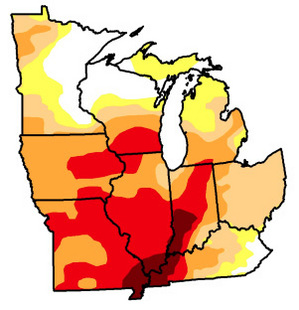
The orange color across much of lower Michigan -- including Washtenaw County -- indicates a severe drought. The spectrum in the graphic ranges from a medium yellow, indicating abnormally dry conditions, to a dark red, indicating exceptional drought.
Courtesy of U.S. Drought Monitor
Though precipitation amounts have varied across U-M’s campus, the North Campus weather station received rainfall that was almost two inches short of normal for July, making it the 38th driest July since 1880.
So far, 2012 is stacking up to be the 18th driest year on record. The North Campus station has received 14.85 inches of precipitation -- 6.71 inches short of normal -- as of July 31.
The last time Michigan saw drought conditions this severe was in 1988, said Jeffrey Andresen, associate professor at Michigan State University and the state’s climatologist.
Unfortunately, the drier weather is occurring during the time when plants need water the most, Andresen said. Because of the warmer conditions earlier than normal in the year, soil moisture reserves were used up by plants as early as June.
The forecast for August suggests above-normal temperatures for Michigan and a fair chance for near-normal precipitation, Andresen said.
However, the forecast for the next three months as a whole calls for below-normal precipitation totals.
“Temperatures have been above normal almost the entire time,” Andresen said. “We don’t see that very often.”
Southeast Michigan has been “unusually warm” in 2012, with a mild winter and the warmest March on record preceding the summer drought, Andresen said.
“The sobering news is, it took some time … even more than a couple months to get into a serious drought situation, and it will take a considerable amount of time to get out of it,” Andresen said.
Though the extended hot, dry weather is consistent with some climate change projections, Andresen said links between the two are only speculative at this point.
Amy Biolchini covers Washtenaw County, health and environmental issues for AnnArbor.com. Reach her at (734) 623-2552, amybiolchini@annarbor.com or on Twitter.
Comments
Phil
Fri, Aug 17, 2012 : 10:43 a.m.
I'm not a scientist but it seems like Gore called it ; global-warming is something we are contributing to.
Thaddeus
Fri, Aug 3, 2012 : 12:38 a.m.
We've been lucky as most of the last several years were rather temporate in the Summer. I would love to see a detailed comparison to this year and 1988. If I remember correct, numerous temperature records were set the Summer of 1988, and it took a decade or the like for the Great Lakes region to fully regain water levels comparable to before Summer of 1988....
Townie
Fri, Aug 3, 2012 : 12:25 a.m.
Just to remind you... DTE - didn't pay any taxes for years, actually got a $17 million refund (guess who paid for it?)! The DTE CEO - $3 million plus in salary; paid for increasing profits. DTE - huge amounts of money to lobby for legislature that made it easier to stuff their pockets with more of your money. Easier to lobby than to build needed infrastructure. No need to keep customers happy -- where are you going to go !?
LXIX
Thu, Aug 2, 2012 : 5:12 p.m.
Unless the aliens are monkying around with our sun to see if humans can dance faster, this certainly has to be a man-made issue. Possibly the Russians - irradiating the icecaps to enable quicker first-dibs access to the deep oil found there.
xmo
Thu, Aug 2, 2012 : 1:06 p.m.
I wish we could have every summer like this, few bugs, lots of sun, warm temps and COLD Beer!
Mike
Thu, Aug 2, 2012 : 4:32 p.m.
WalkingJoe - he can control the weather, but he needs congress to pass cap and trade so he has the money to do so.............
MRunner73
Thu, Aug 2, 2012 : 3:36 p.m.
Somehow, xmo, you garnished some Fox News loyalists. Not sure how some of those replies relate to cold beer.
tdw
Thu, Aug 2, 2012 : 2:50 p.m.
In Ann Arbor it will not be Obama's fault ( which it isn't ) it will be Bush and Synder's fault.( a while back someone did blame Synder for the hot weather on this site )
WalkingJoe
Thu, Aug 2, 2012 : 2:46 p.m.
Gee what a great president Obama is, he can control the weather now too.
bobslowson
Thu, Aug 2, 2012 : 2:23 p.m.
Somehow this will all be Obama's fault....
clownfish
Thu, Aug 2, 2012 : 1:29 p.m.
And next year when food costs sky rocket you can blame Obama! When MI farmers go collect their crop insurance and subsidies you can blame Obama. When farm families have to cut back on spending, you can blame Obama. If history is any guide.
dexterreader
Thu, Aug 2, 2012 : 12:57 p.m.
I used more electricity in July 2011 than this year, BUT my electric bill was almost 10% higher this year than last year. Go figure. I am a summer heat lover, but I think I can honestly say that I am looking forward to a bit of cooler fall weather this year.
Mike
Thu, Aug 2, 2012 : 1:41 p.m.
Get used to the higher electric bill. New EPA rules are slated to kick in in 2015 that will "make elctricity rates necessarily skyrocket" according to our president. Many coal fired plant may have to shut down. Last time I checked that accounted for around half of our generating capacity. You do the math and might want to invest in a generator. Four more years.............
David Frye
Thu, Aug 2, 2012 : 11:54 a.m.
"'Temperatures have been above normal almost the entire time,' Andresen said. 'We don't see that very often.'" But don't worry -- links to global warming "are only speculative at this point." Wonder how many more decades of this we have to suffer before that changes.
Donna Wettig Hitz
Thu, Aug 2, 2012 : 7:19 p.m.
Joe that is two summers in a row with record breaking temps. Read the story.
WalkingJoe
Thu, Aug 2, 2012 : 1:04 p.m.
Decades? Since when is one hot summer suffering for decades?
sellers
Thu, Aug 2, 2012 : 12:38 p.m.
Unfortunately, you can't know for sure until after the fact. It's just the way statistical science is.
A2comments
Thu, Aug 2, 2012 : 11:19 a.m.
My July electric bill reflects this with usage way above last year due to the A/C :(