

Washtenaw Community College teacher offers sound advice for the aspiring musician - Think like a business person
Believe in yourself. Even when no one else does, it is this belief that will keep you going through the hard times.
John E. Lawrence knows his teachings probably won't create millionaires in the music business; that kind of success is tough to plan for or predict.
But if there's one thing Lawrence hopes to accomplish as director of Performing Arts at Washtenaw Community College, it is to show aspiring musicians that they need neither suffer nor starve for their art.
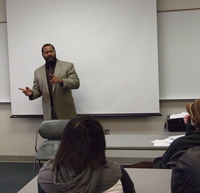
Washtenaw Community College professor John E. Lawrence explains why artists need to put a value on their work.
James Dickson | AnnArbor.com
Don't let money be the motivating factor for what you do. Let your love for the work provide your motivation.
Lawrence's job is to flatten the learning curve for aspiring artists both in terms of musical skill and business sense.
"There's no need to be a starving artist these days," Lawrence explained. Between live shows, merchandising, albums, and DVDs of past shows or music videos, there are many opportunities for monetization.
Another part of the job is getting his students to think more like businessmen and less like employees. With the means of production, distribution and promotion just keystrokes away, artists can't afford to hang their hats on their work - they've got to learn about all facets of the game, particularly self-promotion.
Learn as much as you can as it pertains to your business. The more skills you develop, the more jobs you will be qualified for, which will increase your earning potential.
With the power of the Internet, artists are always at arms-length from their audiences. Social networking sites like Facebook, MySpace and Twitter afford opportunities for word-of-mouth exposure, writ large.
Gone, Lawrence explains, are the days of artists catching their "big break" from a record label. By the time anyone gets signed nowadays, they've usually built a substantial audience independently. Some have already been on tour for years when the big labels come calling.
At a recent lecture for his class on "Self-Management for Working Artists," Lawrence handed out a 21-point list of his "Steps to Success."Â
Tips like:
Look the part - wear the right clothes for the engagement.
Stay away from negative people. One negative thought can affect you more than 50 positive reinforcements.
Set aside time for creative thinking and planning or setting goals for the future.
Those principles, Lawrence said, formed the backbone of his stable success as an educator and an artist. In addition to teaching classes at the community college for the last 27 years and heading up the music performance program, Lawrence has published 3 books on various topics in guitar play. He's also made 6 albums.
When Lawrence isn't mentoring young artists on campus, he's practicing his instrument of choice, the guitar, a passion he pursues for eight hours a day, Monday through Saturday.
Over the years, that work has amounted to 20 albums worth of material, two-thirds of which remains unreleased.
Some music he holds onto because the time isn't right - one Christmas season he sat down to record a Christmas album and churned out three, and released the other two in subsequent years. Other music he holds onto because the times aren't right.
That's not uncommon in the music business, Lawrence explained. Stevie Wonder, he said, first recorded "Ribbon in the Sky" in 1969 in his mother's basement in Detroit. He didn't release it until 1982.
"Stevie has a warehouse of music just like that" Lawrence told the class, who listened with mouths agape.
"When you listen to the music that was out in the late '60s, 'Ribbon in the Sky' didn't fit. Stevie held it for just the right time - that's the luxury of having a lot of material on hand."
Lawrence estimated that he and his various bands have about 500 songs they could perform at any given show. He has 150 such solo arrangements.
Lawrence doesn't tell his students these stories to discourage them, but to set the bar high. He tells those stories to show what's possible at a time when the right kind of computer can serve as a recording studio and an Internet connection opens the door for global distribution.
"Too many people think about 'doing an album' and don't produce music when they're not working on a specific project," Lawrence admonished the class. "You have to work your craft every day - the last thing you want is an opportunity to come along that you're not prepared for."
It is the journey as much as it is the destination. There is no one thing you will do in life to make your dreams a reality. It will be a culmination of things.
At a recent section of Lawrence's "Self-Management for Working Artists" class, one student asked whether it was good business for her to book live shows for free in return for the exposure of playing before a crowd.
Sensing her teacher cringing at the very thought of performing at a non-charity gig for free, the student was quick to mention that sometimes she gets to meet big-name performers when they play at the club.
"What have you gained through meeting those artists? Any shows? Any collaborations? Anything?" Lawrence asked.
"No. Nothing," the student admitted.
Lawrence used the student's story to hammer the point home. Artists need to value their work. How you demand to be treated is how you'll be treated. Accepting low or no pay, except at the very beginning stages, only drops your value and that of other independent artists.
And exposure to other artists is overrated, Lawrence said, because most of the successful ones earned their stripes from the school of hard knocks. Such people are usually more concerned with building on their success than in helping young artists solidify their careers.
Before long, the lesson of the parable was clear: Put a price on your work, and understand that you'll have to earn everything you get.
Next semester Lawrence's students will have to step out into the real world without him, as their teacher takes the first sabbatical of his career.
True to form for a man who spends one-third of his time honing his craft, Lawrence's break from the classroom isn't time off, just time away.
Lawrence will spent his 8-month sabbatical penning 4 books: 3 on various elements of guitar play, with music publisher Mel Bay Publications, the fourth a distillation of his self-management class, which will serve as the class textbook in the future.
Lawrence is thinking of going the self-publishing route for that one. Music isn't the only business where the big publishing deals just aren't what they used to be.
Have a sense of urgency. Most people approach their goals as if they had all the time in the world. Set goals and go after them as if your life depended on it - because it does.
James David Dickson reports on human interest stories for AnnArbor.com. He can be reached at JamesDickson@AnnArbor.com.
Comments
srburns
Mon, Dec 21, 2009 : 12:35 p.m.
I fondly remember my classes with Mr. Lawrence. But what this article doesn't mention is Mr. Lawrence's contribution to the music program as a whole at WCC. As the director of the program, Mr. Lawrence has filled the department with teachers as talented and engaging as himself. So even as he takes his well-deserved sabbatical, the students in the program will continue to benefit from his leadership.