

Local officials respond unfavorably to Snyder's call for cuts in state funding for municipalities
(This story has been updated with additional details of Snyder's proposed cuts to revenue sharing, including amounts of the cuts for individual municipalities.)
Gov. Rick Snyder delivered the harsh blow that local officials across Michigan feared today when he unveiled a state budget proposal calling for deep cuts in funding for municipalities.
Snyder proposed a complete elimination of nearly $300 million in statutory revenue sharing payments for cities, villages and townships in the fiscal year that starts Oct. 1.
Taking the place of those payments, under Snyder's plan, would be a new incentive-based revenue sharing program that would make a lesser, $200-million pot of money available to cities, villages and townships that meet certain standards and adopt best practices.
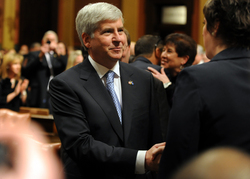
Rick Snyder is pictured during the State of the State.
Melanie Maxwell | AnnArbor.com
"To get those dollars, it's not just writing people a check, or municipalities a check," Snyder said. "We're asking them to partner — to join us in showing best practices."
Snyder said he plans to offer more details next month about how the new program would reward municipalities for working to reduce employee compensation, collaborate and consolidate services, and be more transparent about spending.
"With great conviction, I can look anyone in the eye and say I am proud of what's been put together here," Snyder said in his speech today. "By making these sacrifices, we can all win together in the long-term, and that's what we need to achieve."
Essentially, Snyder's proposal equates to a $92.1 million — or nearly a one-third — reduction in statutory revenue sharing funding. The move will impact hundreds of local units of government across Michigan, including Ann Arbor and Ypsilanti.
Snyder noted there still would be a $25.5 million or 4 percent increase — for a total pot of $659 million — in constitutionally protected revenue sharing payments to local units of government next year. That's based on estimated sales tax collections.
He also proposed a dedication of $2.6 billion in both 2012 and 2013 to state and local bridge construction and maintenance projects.
A 60-page copy of Snyder's executive recommendation for revenue sharing reductions shows Ann Arbor would lose $1.7 million — or 18.3 percent of its total payments — when balancing the elimination of statutory payments with a slight increase in constitutional payments. Ypsilanti would lose nearly $1.2 million, or about 44.3 percent of its total payments.
The city of Saline would lose $124,447, Milan would lose $50,490, Chelsea would lose $62,898, and Ypsilanti Township would lose $447,047, the document shows.
How much of that money each individual community could potentially earn back depends on what performance metrics Snyder lays out next month.
State Rep. Jeff Irwin, D-Ann Arbor, said Snyder is talking about about cutting a huge part of revenue for cities, townships and schools "in a very significant way." He said the governor's proposal makes it clear why there's so much urgency by the administration and Republicans in Lansing to reform Public Act 72, also known as the Emergency Financial Manager’s Act.
Snyder said in his State of the State address last month there needs to be better clarity over the powers of the financial managers in both municipalities and schools.
"There's a bill that the Republican leadership is really pushing hard, and it would basically make it easier for the state to take over local government in circumstances where the local governments are in financial dire straits," Irwin said. "They're moving very quickly because they know these cuts to revenue sharing are so drastic it's going to mean a major reduction in public safety services, and many communities are going to be pushed over the brink into bankruptcy."
Ann Arbor City Administrator Roger Fraser said he's not sure what impact Snyder's proposal will have on Ann Arbor. But a nearly one-third reduction in statutory revenue sharing could mean a cut of more than $600,000 in annual funding the city receives from the state.
"I don't know how that's going to shake out," Fraser said, adding he's still unsure about what Snyder has in mind for an incentive-based program.
"I didn't hear the details about that," he said. "I don't have any idea what that means or how they're going to take into consideration those of us who've been doing that sort of thing for some time. Somebody could say, 'As of this day forward, anything you do will get you a higher score for revenue sharing.' And I see one potential risk: What if you've done it already?"
Tom Crawford, Ann Arbor's chief financial officer, agreed details of how the new program would work remain unclear, but he said it appears Snyder is proposing to take the nearly $300 million pot of money that currently goes to mostly urban communities and reduce it to a $200 million pot of money that communities all across the state — urban or not — would compete for.
If that's the case, he said, urban communities like Ann Arbor stand to lose even more money than just a simple one-third reduction.
"It sounds like each community is going to be affected differently," he said. "For Ann Arbor, it looks like it's going to be a minimum of $500,000. I just don't know how high it's going to go yet."
Local officials also lamented cuts to fire protection grants and elimination of brownfield credits, a move they said will negatively impact redevelopment of urban properties.
Ypsilanti Mayor Paul Schreiber said the best approach might be to assume that Ypsilanti will lose all of its statutory revenue sharing from the state next year.
"We're going to have to wait another month to determine what metrics are going to be used to determine who will get some of the funds," he said. "So for trying to determine our budget for the next year, I think we're just going to have to say we're not going to have statutory revenue sharing and then figure out how we're going to win some of that back.
"It's confusing, to say the least, but I think we're going to end up having a revenue reduction and the question is — how much is it going to be?" he added.
With property taxes already down by about $1 million, further cuts to the city's budget will hurt, Schreiber said. And the city has few options for increasing revenues.
"We're really in a box," he said. "We've already made cuts to police and fire and we're down to some departments with a single person working in them. All of our departments are stretched, so it's going to be really tough for Ypsilanti."
Both Ypsilanti and Ann Arbor officials say they can only hope the Legislature is mindful of the importance of having healthy urban core communities when it comes time to dole out money.
Ryan J. Stanton covers government and politics for AnnArbor.com. Reach him at ryanstanton@annarbor.com or 734-623-2529.
Comments
snapshot
Tue, Mar 1, 2011 : 3:20 a.m.
Snyder's budget proposal provides an incentive for local municipalities to become more fiscally prudent. Of course they are fighting it. Who wants the gravy train to end?
katie
Sat, Feb 19, 2011 : 1:26 a.m.
As expected, Snyder will bust unions and tax pensions, then give tax breaks to the richest and businesses. Perhaps seniors can move to states where pensions aren't taxed. Another reason to leave Michigan for those who planned to stay here in retirement. The overall movement of wealth from the poor and middle class to the very richest continues at all levels of gov't from the federal on down. Look at the statistics over the past few decades to see the story. Now they are raiding pension funds and taxing the remains. That giant sucking sound is the sound of all our wealth being drawn upwards to the richest. I guess that's the cure for "socialism."
Steve Hendel
Fri, Feb 18, 2011 : 4 p.m.
Yes, it's true that DDA $$$ cannot be directly transferred to the General Fund; nonetheless, when you look at what has transpired financially over the past years, that is EXACTLY what had been done. The City and the DDA seem to have a tacit agreement that the DDA will be allowed to do whatever they want IF they continue to shovel subsidies to the City's General Fund which they connect in a highly tenuous way to downtown development. Examples abound: the contribution from the DDA to the City towards the cost of the City Hall building projects is one. Can it be imagined that helping build new offices for the city can be justified as "downtown development"? More like 'baksheesh."
oldblueypsi
Fri, Feb 18, 2011 : 2:36 p.m.
The performance metric for the City of Ypsilanti and Ypsilanti Township is clear, and has been so for many years. It is time to put aside the animosity generated in the late 1940's and join the 21st century. Merger is now mandatory for financial survival. There is no longer room at the public trough for duplicity.
John Q
Fri, Feb 18, 2011 : 2:23 p.m.
"But the bigger the family, the harder this one hits. With the reduction in Federal deductions as your income goes up, and the state mirroring those changes, the income tax for people who itemize is progressive.' What does this have to do with Snyder's proposal?
DonBee
Sun, Feb 20, 2011 : 9:56 p.m.
By phasing out the standard deduction, which is on a per-person basis in the state and federal taxes - the more folks in your family the more you end up paying in extra taxes.
DJ6227
Fri, Feb 18, 2011 : 2:03 p.m.
I thought the Tea party people, & the Republicans were for no new taxes! unless they meant if it was redistributed to the rich. NO NEW TAXES, NO NEW TAXES!!!!!!!!
DonBee
Fri, Feb 18, 2011 : 2:01 p.m.
Sorry John Q - But the bigger the family, the harder this one hits. With the reduction in Federal deductions as your income goes up, and the state mirroring those changes, the income tax for people who itemize is progressive. The mortgage deduction is phased out, child care deductions don't count and the threshold for medical and other deductions goes up with income. Cross that magic household income line and your taxes can jump significantly. With all the wage cuts and loss of good UAW jobs, the number of folks in the state that make lots of money has declined. Young high wage engineers, scientists and others already look at the ratio of taxes to services and decide to leave with their feet. Mostly these days south to non-union, low tax states.
John Q
Fri, Feb 18, 2011 : 2:22 a.m.
"Contrary to some opinions posted here, the higher income earners are taking a hit as well." Wow, that's a real hit. That extra $174 in taxes that someone making $75,000 pays by losing that exemption is really going to crush them. Sorry if I'm not shedding too many tears for them.
T. Kinks
Fri, Feb 18, 2011 : 2:14 a.m.
Snyder is just another Union busting republican. He wants the cities to go bankrupt so that they can get out of paying the pensions of the retirees. Do you see what's going on in Wisconsin? They took a lesson from Egypt. Look out Snyder, we're coming for you next!
mun
Fri, Feb 18, 2011 : 2:32 a.m.
Ohio and Indiana are following suit.
Caferacer
Fri, Feb 18, 2011 : 2:01 a.m.
Cut, cut, cut... We need massive reductions in order to restore long term stability. Don't shoot the messenger as we are just dealing with the hangover of the unsustainable cost increases of the mid 2000's. The politicians in charge back then are who we should be analyzing.
mun
Fri, Feb 18, 2011 : 1:52 a.m.
Looks like cities will have no choice but to assess local taxes to make up the shortfall. You can only cut so much before it goes to the bone.
Engineer
Fri, Feb 18, 2011 : 1:51 a.m.
Of course the liberals in Ann Arbor will not like anything Rick comes up with. They prefer to whine and not want to admit he knows what the heck he is doing. Time to balance the budget and quit spending like there is an unlimited supply of money. That money folks is our tax dollars. Get the budget balanced then perhaps we can cut taxes. Pork and needless hand outs has killed us over the years.
bruno_uno
Fri, Feb 18, 2011 : 1:30 a.m.
its not confusing if you use logic.....roger you and the townships are all trying to avoid the white elephant in the room... the unions of course, deal with it and do your job we pay you to do.
1bit
Fri, Feb 18, 2011 : 12:55 a.m.
Winter has come. Crying about it won't change it. It's time to embrace change lest we be run over by it.
E. Manuel Goldstein
Fri, Feb 18, 2011 : 12:27 a.m.
Typical rich republican BS.
Marshall Applewhite
Thu, Feb 17, 2011 : 11:26 p.m.
This is an extremely fair and necessary budget. This is exactly what we elected a non-career politician to do. Thank you Rick Snyder.
Roadman
Thu, Feb 17, 2011 : 11:17 p.m.
Governor Snyder is bringing the same common-sense approach to Lansing as Mayor Bloomberg brought to reform New York City. Let the bleeding-heart liberals whine as they did in NYC about how painful it is. Fiscal responsibility calls for what Snyder has done. Governor Snyder for President in 2012!
HBA
Thu, Feb 17, 2011 : 10:07 p.m.
Reply to Kristine: Sorry you were without a job but happy you at least are earning something. With the amount you say you are receiving in salary + exwmptions, you probably would be exempt from paying income taxes.
blahblahblah
Thu, Feb 17, 2011 : 10:01 p.m.
Finally some straight talk from an elected official. Too bad it takes a "non" career politician to deliver the bad news. Contrary to some opinions posted here, the higher income earners are taking a hit as well: " Individuals with incomes more than $75,000 and couples with incomes more than $150,000 will see their personal income tax exemptions phased out. " As for the pros and cons of the business tax break, how else are we going to attract more business and jobs to this state? The only way to stem the outflow of our college graduates to other states is to provide jobs.
johnnya2
Thu, Feb 17, 2011 : 11:51 p.m.
Tell me why Gooogle is hiring in a HIGH tax state? Maybe its because taxes are very low on the priority of where businesses locate. In fact, the number one reason given is QUALITY OF WORK FORCE. The rest is window dressing for those who just want to giive away money to corporations.
grye
Thu, Feb 17, 2011 : 9:53 p.m.
I have a great idea on how to cut some of the fat from govt. Student teacher ratios are around on average 30 to 1. Why doesn't Lansing adopt the same ratio of workers to supervisors, supervisors to managers, managers to directors, etc.? If teachers can do it, so can the rest of the state govt. If someone doesn't have enough employees to oversee, let them oversee multiple departments or multiple agencies. Fair is fair.
FattyJ
Thu, Feb 17, 2011 : 9:49 p.m.
Thank you Mr. Snyder! I was beginning to think that our state had forgotten how prosperity works. Prosperity is not created by government. It's created by those who take risks and borrow money from banks(or use their own) with the hopes of making returns on their investment. Liberal economic policy creates false prosperity(or promises) with the hopes that democrats will receive more votes down the road when the populous has become dependent on government handouts. And it's not a republican/democrat thing, because both sides are equally guilty of creating too much power for themselves.
grye
Thu, Feb 17, 2011 : 9:37 p.m.
I'm not all that happy about potential cuts in K-12 funding. Some of the universities are so flush with money, it is beyond absurd. Retirees pay tax on taxpayer funded pensions? You bet. My 401K is going to be taxed and you didn't contribute a dime to it. There is fat to be cut, efficiencies to be developed, and yes, businesses need to grow in order to grow the economy. But anyone that wants their taxes raised to get more services from the govt, please send all you money to Lansing. You obviously don't have need for it.
grye
Thu, Feb 17, 2011 : 9:39 p.m.
Oops, apologies for the typos.
Stephen Landes
Thu, Feb 17, 2011 : 9:17 p.m.
I don't like raising anyone's taxes. As a new retiree I frankly expected to be paying 4.35% of my pension in income taxes - that pension funds were exempt was news to me! However, I don't see any difference between taxing pensions and taxing withdrawals from an IRA or 401, so this should put all retirement funds on an equal basis. In fact, the whole package sounds like it is doing away with special interest exemptions in favor of more equitable taxes. If Lansing (both parties) had not been living in a fantasy world for the last 8 to 10 years we would not be having to take such tough approaches now.
average joe
Fri, Feb 18, 2011 : 12:18 p.m.
Johnnya2- Correct me if I'm wrong, but that money that was contributed to your pension by you & your employer was not taxed when it went in was it?? So now you are complaining that it isn't what you "bargained " for...
johnnya2
Thu, Feb 17, 2011 : 11:49 p.m.
If we really want more equitable, lets do away with the mortgage interest deduction and charitable giving deductions too. Those who choose not to own or choose not to donate pay more because of the people who CHOOSE to own and donate. Just because you failed to learn about your pension does nto mean others did not. Imagine you negotiate your salary and then afterwards the boss tells you to keep the jobb you need a $75k car. Would you ask for a different amount of money? That is what the state has decided. We bargained based on one set of facts, and changed it on you later.
logo
Thu, Feb 17, 2011 : 9:12 p.m.
Don bee: From earlier reports here on A2.com revenue sharing came about because of a deal made in the state legislature back in the 1970's. The cities used to have the power to put more taxes in place, income, sales, etc. The state took that power away (probably because some cities were abusing it) and instead said they would pass the money on to the cities. Now for the last several years the state has not been living up to their side of the bargain. In some ways this is all about the state passing the buck, they get to balance their budget by forcing the problem on the locals, many of whom are are already stretched to the limit.
DonBee
Fri, Feb 18, 2011 : 2:43 a.m.
The 1970s deals are the Constitutional Revenue sharing Logo - this part is untouched and in fact grows 4%. The rest was done in deals that favor one town over another.
GoBlue1984
Thu, Feb 17, 2011 : 9:07 p.m.
Just another republican who thinks cutting city services and redistributing the wealth to private businesses is going to fix everything. You got what you voted for Michiganders... and that's why I got out of the state in December. Good luck. You're going to need it.
Ryan J. Stanton
Thu, Feb 17, 2011 : 9:01 p.m.
More details have been released and the story has been updated with the following information: A 60-page copy of Snyder's executive recommendation for revenue sharing reductions shows Ann Arbor would lose $1.7 million — or 18.3 percent of its total payments — when balancing the elimination of statutory payments with a slight increase in constitutional payments. Ypsilanti would lose nearly $1.2 million, or about 44.3 percent of its total payments. The city of Saline would lose $124,447, Milan would lose $50,490, Chelsea would lose $62,898, and Ypsilanti Township would lose $447,047, the document shows. How much of that money each individual community could potentially earn back depends on what performance metrics Snyder lays out next month. <a href="http://www.house.mi.gov/hfa/PDFs/RevShare%28EstFY2010-11andFY2011-12%29.pdf" rel='nofollow'>http://www.house.mi.gov/hfa/PDFs/RevShare%28EstFY2010-11andFY2011-12%29.pdf</a>
snoopdog
Thu, Feb 17, 2011 : 8:35 p.m.
State Rep Jeff Irwin said: ""They're moving very quickly because they know these cuts to revenue sharing are so drastic it's going to mean a major reduction in public safety services, and many communities are going to be pushed over the brink into bankruptcy." Not if you react quickly , sharpen your pencil and make the cuts necessary to balance budgets. Perhaps you need to attend some Weight Watchers meetings Jeff ! You have plenty of fat to trim, it should not be all that painful. Good Day No Luck Needed
Jay Thomas
Thu, Feb 17, 2011 : 8:31 p.m.
Each level of government should pay their own way. If Snyder manages to balance the state budget I think that will be an accomplishment.
johnnya2
Thu, Feb 17, 2011 : 11:45 p.m.
So the local should pay their own way, but have rules against ways to increase revenue? The city can not change property taxes thanks to a STATE constitutional Heedlee amendment, they can not pass an income tax without a vote, they can not charge a local sales tax. So basically you want the locals to take what the state decides is fair money and have ZERo control of it. How about we do that to Gateway? Rick would have been the worst CEO in history.
DonBee
Thu, Feb 17, 2011 : 8:29 p.m.
Let's start with the fact that the statutory revenue sharing was not evenly distributed, some units of government got none and some got a lot. So how fair is that? Then lets remember that Constitutional Revenue sharing is roughly $1,000,000,000.00 more then 3 times the amount of the statutory revenue sharing. If we keep giving money for statutory revenue sharing where does it come from? Schools? Universities? Community Colleges - collectively about $13 billion of a $46 billion dollar budget. Medicare, Medicaid? Who goes without to find local issues? The pie is only so big. Raising taxes is an option, who wants their taxes to go up? Raise your hand! Already the AARP and others are fighting the increases in taxes in the Governor's budget. We all knew it was going to hurt. I think this is a fair budget, everyone has something to complain about. Everyone is going to see something they care about reduced.
DonBee
Sun, Feb 20, 2011 : 9:55 p.m.
That is one hand - we need about 1 million more.
KJMClark
Fri, Feb 18, 2011 : 11:58 a.m.
Donbee, I thought of another one. If we vote to change the state constitution to allow a graduated income tax, I'd probably have slightly higher taxes from that too. But our one-size-fits-all, tax-giveaway-to-the-wealthy income tax system in Michigan should probably go now. We could even give a small tax break to 80% of the population, by taxing the top 20% higher. I'd be happy to vote for that change too.
KJMClark
Fri, Feb 18, 2011 : 1:46 a.m.
Hey Don, my hand's up. I'd be happy to vote for a city income tax. That would wipe out a good chunk of our property taxes (no more operating millage). Still, my wife and I both work in Ann Arbor, so we'd pay slightly more with an income tax. I'd still be happy to vote for that. I'd also be happy to vote for higher weight taxes for vehicle registration. I'd even be happy to kick in $10 for each of our bikes. Heck, I'd even be willing to have the sales tax extended to services. Some of the luxuries that aren't taxed are nuts.
John Q
Thu, Feb 17, 2011 : 8:22 p.m.
You can view all communities revenue sharing in this document. <a href="http://www.michigan.gov/documents/treasury/FY12RevenueSharing_ExecBudgetRec_20110217_346027_7.pdf" rel='nofollow'>http://www.michigan.gov/documents/treasury/FY12RevenueSharing_ExecBudgetRec_20110217_346027_7.pdf</a>
HBA
Thu, Feb 17, 2011 : 8:22 p.m.
Gov. Snyder's proposed plan is HORRIBLE--cutting education and taxing pensions of many of those who already have lost so much by way of health and pension benefits. What is so sacrosanct about not raising income taxes by 1 or 2%--perhaps temporarily to repair the huge hole? That would be much fairer and more progressive. And what happened to Gov. Snyder's talk about closing all the loopholes in corporate taxes?
FattyJ
Fri, Feb 18, 2011 : 12:32 a.m.
you don't understand how a budget works do you?
Kristine
Thu, Feb 17, 2011 : 9:30 p.m.
Raise income tax by 1 or 2%? I lost my job in 2009 and finally got another job 6 months ago making $9 per hour. Slave wages, I know, but it's a job. I'm making ends meet by the grace of God and by selling my plasma (another $55/week). How do you propose that someone like me can stand another 1 or 2% income tax increase?
logo
Thu, Feb 17, 2011 : 8:10 p.m.
Tom: I have tried to follow the city budget and for all the information I have found the building projects do not have much of an impact on the general fund where as someone above said, all the problems are. The Justice Building for the courts and PD does not hardly hit the general fund because the city is saving something like $800,000 in rent they can put into the bond payment and the DDA put in money too. Under the DDA requirements from the state those $$ could not go into the general fund but must be spent downtown on infrastructure. The city does have to spend a few hundred thousand to operate the building but then, I don't think anything else could have been done. The county is moving the juvenile courts into the their courthouse so the city had to go. I toured the police station several years ago and they really, really needed a new headquarters. I am happy the citizens are buying their own building instead of renting forever. It looks like the parking structure is paid for by again, all DDA money designated for downtown and some parking money. But the city has been taking about all the parking money that is not needed to run the system. Here again, I think the parking was really needed but if you don't agree, the city could still not have spent the DDA money in the general fund to pay the police and fire fighter benefits.
BornNRaised
Thu, Feb 17, 2011 : 7:56 p.m.
Found my own answer finally. These losses take into account the loss in statutory and 4% increase in constitutional revenue sharing. Ann Arbor: -$1,711,330 (or -18.3%) Ypsilanti: -1,176,142 (or -44.3%)
Tim Darton
Thu, Feb 17, 2011 : 7:41 p.m.
One more point: Even if the overall property tax revenues of the city were to go up, that doesn't necessarily help the General Fund where almost all the high union benefits (PD & FD) are located. There are a lot of other millages the voters have wanted over the years that don't have high benefit costs weighing them down.
Tim Darton
Thu, Feb 17, 2011 : 7:35 p.m.
Tom, I think you are correct; in most years A2's property tax revenue goes up although I don't know if it did the last couple of years. But it would also be correct to say the city lost 5% of its property tax revenue because of the UM takeover of Pfizer. If that had not happened there would have been revenue from another 5% of the total valuation. Anytime the city's revenues are flat or go up less than 6-7% or so, it seems cuts will be needed to keep up with the increases in wages that are locked into contracts and the constantly rising health care costs. And of course A2 has a huge and costly park system as well. For cities revenues can't stand still. Look at the report on Lansing, a city of about the same population as A2 but with a $15 million hole to fill and and a 4 mill increase going on the ballot. According to some other reports, it looks like Mayor Schrieber is correct, all of the statutory revenue sharing is going away. There will be a little added back that a community can "win" but instead of that all going to cities, it could go to townships as well. Flat or low property tax revenue increases minus the $5 million less A2 city gets in revenue sharing means big cuts have to be made. Its that way all over the state. Something needs to be done to reel in the cost of benefits. With more cuts coming down from the state, I don't see how the cities are going to manage unless the state gives them someway to get out from under the union contracts. The Mayor of A2 needs to stop blocking a tax increase, be it income or property.
A2K
Thu, Feb 17, 2011 : 8:33 p.m.
I also do not want an A2 property tax increase...ours went up 4% this year, and as it stands, my property taxes eat up 18% of my take-home income. 18%! Enough is enough! Do with what you have. Period. Pensions are outdated, switch to 401k or 3a/b's etc.
limmy
Thu, Feb 17, 2011 : 8:09 p.m.
How dare you suggest an increase in property taxes. No way. I would fight it tooth and nail. We are already paying for everything. Tax the people that work, drive, and play for free constantly in the city of Ann Arbor. No more free rides on the backs of the property owners.
Paul Schreiber
Thu, Feb 17, 2011 : 7:27 p.m.
For Ypsilanti, a 4% increase in Constitutional Revenue Sharing is $1.4million x 0.04% = $56,000.
Bob Martel
Thu, Feb 17, 2011 : 7:26 p.m.
There is nothing surprising with the proposed budget and tax changes. I now fully expect all sides and special interests to argue strongly in favor of their self interests, this is a democracy after all. I have not seen any specific mention of the following point in any of the media reports: do the proposed budget and tax cuts actually balance out?
MB111
Thu, Feb 17, 2011 : 7:20 p.m.
Local officials can no longer live off the state's proverbial teet. Now the difficult cuts will be forced - shared services is an obvious money saver, but those in City Hall will not likely embrace this.
alan
Thu, Feb 17, 2011 : 7:36 p.m.
But nobody has been living off of anyone. The primary rational for revenue sharing has always been the improved collection of sales taxes by consolidation into one entity, the state. The revenue sharing was the concession for municipalities not levying sales tax individually. So now if those municipalities impose sales taxes to make up for the share that they don't receive, will the state reduce its sales tax? I think that the state is the one that needs to reign in spending. He wants municipalities to reduce employee compensation while the state employees are paid better and typically, in my experience, provide rather poor service.
frozenhotchocolate
Thu, Feb 17, 2011 : 7:13 p.m.
The state has to spend money based on the money they bring in, its in the constitution. I didn't vote for him, but good for him, bring some sense back to Lansing.
BornNRaised
Thu, Feb 17, 2011 : 7:08 p.m.
It would be good to get an OFFICIAL break down in what the city of Ann Arbor receives in both types of revenue sharing. When I search back at past articles, the numbers sway from 1.2 Millon to 600K. Is there an official budget that shows this breakdown? And I don't mean something from the mouths of the politicians. Something that's on paper.
Ryan J. Stanton
Thu, Feb 17, 2011 : 7:56 p.m.
Check out Page 59 of the city's budget book at the link below. The numbers for 2010-11 are estimates, but they're close to actual. Constitutional is a little over $7 million and statutory is a little under $2 million. <a href="http://www.a2gov.org/government/financeadminservices/Documents/Adopted%20BudgetBook%20FY2011.pdf" rel='nofollow'>http://www.a2gov.org/government/financeadminservices/Documents/Adopted%20BudgetBook%20FY2011.pdf</a>
xmo
Thu, Feb 17, 2011 : 6:58 p.m.
Since Michigan has lost population (about 10% and one electoral vote) i the last ten years, cutting 10% of the City and State budget should be easy. Pull out the 2000 budget and fund everything with the same amount of money! Am I a Genius or what?
johnnya2
Thu, Feb 17, 2011 : 11:39 p.m.
So what were your expenses in 2000 versus today? I guess you are a lucky one who has the same gas bill, the same rent,. the same salary, the same cost for food, the same cost for clothes, the same cost for a car. Hardly a genius, more like a typical republican with no brain.
Tom Whitaker
Thu, Feb 17, 2011 : 6:54 p.m.
Snyder's budget calls for an INCREASE in constitutional municipal revenue sharing of 4%, but no mention of that in the article. I'm not familiar with how this pot is distributed, but assuming Ann Arbor will receive 4% more than last year, that would be an increase of about $288,000. I'd like to see an analysis on how Ann Arbor will fare under this proposal to reduce and reconfigure the statutory funding piece. Perhaps we'll do far better than a straight 33% cut depending on what are defined as "best practices." annarbor.com previously reported that property tax revenues in Ann Arbor have actually INCREASED every year for the last ten years despite the mayor and administrator's claims that property tax revenue had DECREASED due to Pfizer and a general decline in property values. So I hope all the facts will be gathered and reported to the public before more police and fire layoffs are threatened. It would appear at a glance that we have more of a local spending problem--especially for big capital projects--than a dire revenue problem.
jcj
Thu, Feb 17, 2011 : 6:53 p.m.
What's the difference between the State being broke or your city being broke.
jmac
Thu, Feb 17, 2011 : 6:43 p.m.
did not expect anything else but it is abundantly clear that cities and towns will need their own income taxes just to survive ... that State has no money and Snyder's plan will distribute even less to municipalities. $$ have to come from somewhere...
lumberg48108
Thu, Feb 17, 2011 : 6:37 p.m.
I am not being critical but the headline is so, well, obvious: "Local officials respond unfavorably to Snyder's call for cuts in state funding for municipalities" when was the last time anyone reacted favorably to cuts that impact them directly?