

Will Washtenaw County lose lucrative union conventions in wake of right-to-work passage?
Right-to-work laws signed by Gov. Rick Snyder Dec. 11 that overturned decades of closed-shop agreements between employers and unions in Michigan may have future economic implications for Washtenaw County.
The potential loss of several major union conventions that bring millions of dollars and thousands of visitors annually to the area could be the biggest impact to the county as a result of the legislation, said Paul Gallagher, an Ann Arbor lawyer who represents both the county and local unions.
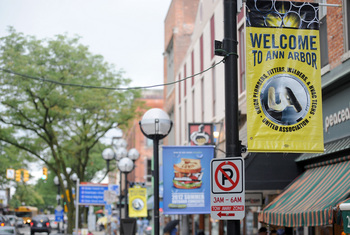
A banner welcomes United Association members to Ann Arbor during August. County officials are questioning the likelihood the union will return to Michigan for the annual convention after the passage of right-to-work legislation in December.
Angela Cesere | AnnArbor.com
“Frankly, the thought of losing such a large percentage of people who come here and drive our economy is pretty scary,” said Commissioner Andy LaBarre, D-Ann Arbor.
Large union conventions — including the United Association of Journeymen and Apprentices of the Plumbing and Pipe Fitting Industry (UA), the International Brotherhood of Electrical Workers and the National Joint Apprenticeship and Training Committee of the National Electrical Contractors Association — choose to host their annual events in Washtenaw County partly because of the union-friendly atmosphere, Gallagher said.
The UA moved its convention to Ann Arbor after 37 straight years of holding the event at Purdue University in Indiana because of a subcontract the university executed with a non-union company, Gallagher said.
The three union conventions bring about $12 million into the county’s economy per year, and account for 22,000 hotel nights per year, said Mary Kerr, president and CEO of the Ann Arbor Area Convention and Visitors Bureau.
The UA convention at Washtenaw Community College alone brings in an estimated $5 million to the county’s economy and accounts for about 2,200 visitors. The convention lasts for one week in August, a time when there are few other major events in Ann Arbor.
“If those conventions are lost from Washtenaw County’s economy, a major manufacturer or two would have to come to the area … the Ford Saline plant would have to re-open,” Gallagher said.
Under right-to-work policies, employees will be able to receive the same benefits and compensation as union employees without having to pay membership dues or be affiliated with the organization. The right-to-work legislation made union security clauses that required employees to pay union dues or an agency fee in union contracts illegal.
About 85 percent of the workers employed in Washtenaw County operations belong to a union, with the exception of about 300 employees who work for the sheriff’s office. The county has contracts with 17 different unions, two of which are for police services.
The right-to-work legislation goes into effect as of March. The county’s contracts with the two largest unions representing its employees — AFSCME Local 2733 and Local 3052 — end Dec. 31, at which point provisions made possible under right-to-work will become available to those workers.
A total of 1,048 union-represented county employees paid nearly $455,000 in dues last year — an average of about $434 per worker, according to data provided by the county.
Nancy Heine, president of AFSCME Local 3052, said union dues are mostly used to pay to fight for labor causes at the national level. When there are local arbitration issues, the state-level union offices get involved.
Heine said she fears right-to-work will mean fewer employees will choose to be in a union, resulting in less union dues to help the body fight for workers’ rights when it’s needed.
“It will render us useless when we get in to trouble,” Heine said. “Arbitration cases will stay in limbo for years.”
The Board of Commissioners will likely resume its debate on how to address right-to-work in the future, as commissioners LaBarre and Conan Smith, D-Ann Arbor expressed interest in board action.
“I do think we should dig in to some of the options we have in terms of framing the labor practices here in Washtenaw County. One … since the law doesn’t take effect until March, we have the option of working with our bargaining units to extend their contracts for some period of time such that we remain a right-to-work shop,” Smith said.
Smith said he believes the county should act to be prepared in the event non-management employees opt out of their union once they are eligible to take advantage of the right-to-work provisions.
“The benefits that the union provides be they economic, social, protective … in my opinion, they should not accrue to those people who don’t pay to play. It would be akin to us saying to the people in Washtenaw County, that we’re going to put a tax out on the ballot, a majority of people are going to approve that tax, but then you have the option not to pay but still receive the services,” Smith said. “That is obscene, and we shouldn’t be forwarding that as a policy environment in Washtenaw County.”
At the commission’s full meeting Wednesday night, the two Republicans on the board -- commissioners Alicia Ping, R-Saline and Dan Smith, R-Northfield Township -- said they supported the update on impacts of the legislation, but were not interested in the board adopting symbolic resolutions on its position regarding the right-to-work bills.
Amy Biolchini covers Washtenaw County, health and environmental issues for AnnArbor.com. Reach her at (734) 623-2552, amybiolchini@annarbor.com or on Twitter.
Comments
Ichibod Crane
Mon, Aug 12, 2013 : 3:28 p.m.
You need to study Labor Law. 'Closed Shops' have been illegal. This required union membership, before you could get a job. The issue that is outlawed by Michigan's Right-to-Work-for-Less is a 'union shop'. With a union shop, employees are required to pay dues (to be a member) OR an equivalent fee (without membership) to pay for the expenses the union incurs to represent & protect ALL the employees. Right-to-Work-for-Less is unfair to union membership as the union members are required to represent everyone whether they have paid the union anything. There are many cases where unions are required to spend around $10,000 or more to take a termination case to arbitration for a free-loader who has paid nothing, to try to get the the employee's job back. Right-to-Work-for-Less is promoted by companies & politicians, not union members, to weaken unions' powers. And as we have seen as the unions' power has been cut over the last 20 or more years, the whole middle-class has been damaged. Strong unions in the 50s lead to 40 hour weeks, overtime, vacations, pensions and healthcare coverage which the non-union part of the population's boat was raised along with the unions. Unions basically built the middle-class.
A Voice of Reason
Tue, Jan 8, 2013 : 3:57 a.m.
...and, spending 12 million dollars? Who is paying for this?
A Voice of Reason
Tue, Jan 8, 2013 : 3:54 a.m.
Why do Unions need conventions?
ThinkingOne
Sat, Jan 12, 2013 : 8:45 a.m.
For the same types of reasons that political parties need conventions.
Ypsi.Support
Sun, Jan 6, 2013 : 1:49 a.m.
Honestly the Right-to-Work legislation passing wasn't something I supported at all from the get-go, but I hadn't even considered factors such as the Union Conventions not coming to the area. As an employee in the Hospitality Industry in Ann Arbor, I am very familiar with the Union Conventions and the revenue they bring to the area. Our Hotel alone housed something around 30 rooms for 1- 2 weeks a piece during the most recent UA stay. Many of the Men are return guests and over time have become favored regulars that stay during their business in town. I've printed countless pages of directions to local bars, theaters and events, not to mention the influx of union workers to Ypsilanti for their welcome at Haab's restaurant ( and the nighlife thereafter) I can only imagine what impact that could cause. Wasn't an agreement made with WCC just this last convention? Such a shame. More negative impact from Governor Snyder's decisions.
Brandy
Sun, Jan 6, 2013 : 12:37 a.m.
First of all, the headline of this article poses a question. It is then followed by pure conjecture. Could-might-would etc. Secondly, all the union folks that are so worried that people might "opt-out" of paying dues but still receive benifits should ask themselves this question: If you are in church (assuming you go to church) and the collection plate is passed and you put your envelope in the plate but the person next to you does not, does this mean that they should not be allowed to hear the sermon? Should they maybe have to stand at the back of the chruch? Should they be denied a hymnal? I guess they should be denied entry since they didn't contribute, right? You should be paid on what the market will bear, not whether or not you have the power to shut down the company or organization in order to get what you want regardless of the impact to everyone else. The union greed has blinded rational thinking.
Jay Thomas
Sat, Jan 5, 2013 : 9:58 a.m.
The majority of people are not democrats; the idea that people should be forced to give money to democrat politicians is a travesty that should have ended long ago. Do you know that many union bosses continue to be paid their full salaries when their members are out on strike? Enough already!
johnnya2
Sun, Jan 6, 2013 : 12:29 a.m.
@Jay, "the idea that people should be forced to give money to democrat politicians is a travesty " AND that is not nor has it ever been the case. Union dues for REPRESENTATION are the only thing that have ever been mandatory. If you did not want to pay for political items you did not have to pay that. Of course facts really don't matter to anti-union people. I also wonder how you feel about atheist being required to subsidize churches, as they buy property and truly take it off the tax rolls. The University or any STATE run agency would be taxing itself, but churches get to buy whatever they want while citizens pay. If you believe it is about fairness, then you are deluded, it is PURELY about stopping unions, while "trade associations" will devour working people
Jay Thomas
Sat, Jan 5, 2013 : 11:54 p.m.
RadicalLib: That's a fantasy. At most registered dems have been in the 25-30% range. A class in government could help to explain that just voting for a democrat does not make one a democrat... or Republicans would have made up "a large majority" of the country between 2001-2009. [Yawn]
Radlib2
Sat, Jan 5, 2013 : 4:52 p.m.
A large majority of people in the country are Democrats. The majority is growing too.
genetracy
Fri, Jan 4, 2013 : 10:35 p.m.
RTW actually means "Refuse to Work" and we all know there are plenty of members in Michigan.
snapshot
Sat, Jan 5, 2013 : 12:05 a.m.
And if you're in a union, you don't even have to "refuse to work" it's already in the labor contract.
johnnya2
Fri, Jan 4, 2013 : 10:28 p.m.
Ok, let;s make something CLEAR here. This article starts with a lie that the right wing wants people to believe. There have not been closed shops in the US since 1947. There is no person who has been required to join a union as a condition of employment. The only thing that was required is that if a non-union member got the BENEFIT of a union negotiated contract, they must pay for that portion of the unions services and that portion only. Here is what right to work does. 1, Employee can opt out of paying for the service in which they get a benefit (union wages) 2. LEGALLY, the union must represent the non-union employee the same as the one who actually pays the freight. 3. The person who is non-union can not be paid any differently or have different job rules. Any person who sees this as right is lying to themselves. It is basically making paying taxes optional, but expecting the same level of service if you opt out. The right wing doing their best to ride off the actual people who pay the bills.
maallen
Mon, Jan 7, 2013 : 5:08 p.m.
Thanks for providing the FLRA link. Here is a quote taken directly: "The labor relations statute sets out a specific procedure for employees to petition to be represented by a labor union and to determine which employees will be included in a "bargaining unit" that a union represents." The union decides who gets to be a part of that "bargaining unit," whether it is exclusive (all employees) or if it is members only (have to be a membr of the union.) Another quote from your link: "The legal tests established by the Authority for determining whether the duty of fair representation under the Statute has been violated by a union require a complete examination of the totality of the circumstances. For example, there may be situations where a union commits an unfair labor practice when it treats union members more favorably than non-union members in the bargaining unit......A determination must be made as to whether the matter was one grounded in the union's role as exclusive representative." If you read your link, it talks about if the union has an exclusive representation or not. Again, the union is not required to represent all employees (exclusive). They can opt to represent only members of the union. It's their choice.
maallen
Sun, Jan 6, 2013 : 9:51 p.m.
JohnnyA2, No, take what the Supreme Court said back in 1962. Also take what the Taft Harley law says too. The Supreme Court's unanimous decision acknowledged exclusive bargainin (meaning all employees) and members only bargaining (meaning you must be a member of the union). When a union organizes a company, the union chooses who to represent when they sign the contract with the company. They can choose to represent only members of the union or all employees (exclusive.) Of course the union is going to represent all employees because they bring in more money that way. The unions can change their contract if they are worried about the free ride. They can choose to represent only members of the union.
johnnya2
Sun, Jan 6, 2013 : 12:22 a.m.
@maallen, So should I take what the FLRA says about the issue or some random person from AA.com? http://www.flra.gov/Guidance_duty of fair representation
maallen
Sat, Jan 5, 2013 : 4:02 a.m.
JohnnyA2, Unions have the option of either representing all employees or representing member only employees. The right was granted to them by the Taft Hartley Act. Also granted to the unions if they decided to represent all employees then they can have those employees who opted not to be a part of the union pay a certain fee. It forced employees who were not part of the union, but part of the "collective bargaining agreement" between the union and employer to pay the unions a fee. So, LEGALLY, the union is NOT required to represent those employees. It is a choice by the unions whether they want to represent the non union employees. Historically, unions have represented the non union employees because it brought in more money for the union. And the non union employee had no say in the matter. So, if the unions no longer want to represent the non union employees, then they can change their contract with the employer. They are not forced.
snapshot
Sat, Jan 5, 2013 : 12:03 a.m.
You are wrong, I have incured this catch 22......you have to be a union member to get the job and you have to have a job to join the union. This is why there are generational traditions in union dominated industries. How many great employees are bypassed to employee mediocre relatives?
snapshot
Fri, Jan 4, 2013 : 10:18 p.m.
Here we go again....elected officials in the pocket of union special interest. Lots of talk about "moochers" but are not public employee unions "mooching" off the majority of general taxpayers. After all, public union membership comprises about 12% of the working folks in Michigan but seem to be responsible for about 80% of tax revenue to pay their salaries, benefits, and pensions. Talk about taxation without representation. And they call themselves democrats upholding democracy? Bull, they are licking the hand that feeds them. Let these folks take their money elsewhere if that's what they want to do, that's democratic and reflective of a free economy. Something unions seem to be opposed to.
Linda Peck
Fri, Jan 4, 2013 : 9:47 p.m.
Oh my, the travesty!
Roger Kuhlman
Fri, Jan 4, 2013 : 8:53 p.m.
I predict a huge percentage of Unionized workers will opt out of paying their forced Union fees. They do not see that they are getting anything of value from their Union leadership and are tired of paying the salaries of Union fatcats with their special interest agendas.
st.julian
Fri, Jan 4, 2013 : 7:45 p.m.
I would expect the unions to move their events to a more union favored environment. The legislatures action will impact the local merchants, but I am sure they will survive, although they may have supported the Right to Work for Less Legislation.
Greg
Fri, Jan 4, 2013 : 7:31 p.m.
Unions came about for truly good reasons, but when they get so big they can buy elections and bully anyone who doesn't wish to join, they have gone too far.
maallen
Fri, Jan 4, 2013 : 7:27 p.m.
Not sure why this comment was removed, but here goes again..... The Taft-Hartley Act gave unions two choices when they organized a company. 1) They can chose to represent ALL employees, regardless if they are members of the union or not, or 2) represent ONLY those that are members of the union. Over the history, unions CHOSE to represent all employees because regardless if you are a union member or not you have to pay money to the unions. Members pays their member dues and the non member pays a smaller portion. What was hurtful to the worker is the fact if he/she didn't want to join the union, he/she was still forced to pay something to the union, even though they wanted no part of it. Of course the union is going to chose to represent everyone because it brings in more money. Again, there is no federal law that requires the union to represent all employees. It is a choice. So, if the unions are afraid of the "free ride" scenario, then they should choose to represent only those that are actual members of the union. Even Rep Sanders Levin recognized this by saying "Workers pay dues if they join the union, but if they choose not to, the most that can be required of them -- if it is negotiated into the contract by labor and management -- is that they pay an "agency fee" for their share of administering the contract." Noticed he said "if it is negotiated into the contract..." The Supreme Court even said the unions have a choice of representing all employees or just union only members.
maallen
Fri, Jan 11, 2013 : 12:17 a.m.
Still haven't answered the question to the FLRA link: "A determination must be made as to whether the matter was one grounded in the union's role as exclusive representative." Why mention exclusive represtative if they have to represent everyone? Also the FLRA link says: "statute sets out a specific procedure for employees to petition to be represented by a labor union and to determine which employees will be included in a "bargaining unit" that a union represents." Why would the union have to determine which employees will be in a bargaining unit if they have to represent all employees? Could it be they have a choice as to who they represent? And we can't leave out the Supreme's Court decision: "an employer in an industry affecting interstate commerce and local labor unions representing SOME, but not a majority of its employees. The term 'labor organization representing employees,' as used in 301(a), is not limited to labor organizations which are entitled to recognition as exclusive bargaining agents of employees." Assuming the Supreme Court is right, then how can a union represent only SOME of the employees and not the majority? Could the Supreme Court be wrong? Nah, I doubt it.
arborarmy
Thu, Jan 10, 2013 : 6:53 p.m.
Very simple answer: union members have rights within the union (e.g., legal representation in criminal cases related to work) that are not part of the contractual relationship with the employer and to which non-members have zero rights.
maallen
Thu, Jan 10, 2013 : 2:01 p.m.
arborarmy, Care to explain this from the FLRA website you provided: "For example, there may be situations where a union commits an unfair labor practice when it treats union members more favorably than non-union members in the bargaining unit......A determination must be made as to whether the matter was one grounded in the union's role as exclusive representative." It clearly states that one of the steps in investigating a claim is that a "determination" must be made as to whether a union is an exclusive representative or not. I don't expect you to believe me, but I thought maybe you would believe the former chairman of the NRLB and Union Attorney, William Gould, or perhaps your own FLRB link, but above all I thought you would believe the Supreme Court: "to enforce a strike settlement agreement btwn an employer in an industry affecting interstate commerce and local labor unions representing SOME, but not a majority of its employees. The term 'labor organization representing employees,' as used in 301(a), is not limited to labor organizations which are entitled to recognition as exclusive bargaining agents of employees." Obviously "labor unions representing SOME, but not a majority of its employees" and "is not limited to labor orginizations which are entitled to recognition as exclusive bargaining agents" are very key here.
arborarmy
Thu, Jan 10, 2013 : 1:28 p.m.
Like ERMG, I think this is an absolutely pointless conversation with someone who is simply making it up as they go along, and is doing so on such a massive scale that it is impossible to refute every single point (classic conservative tactic). But one leaps out: maallen says: "Of course the unions are always going to opt for the exclusive representation because that way they bring in more money because they are going to represent all employees. That is why the FLRA stated when investigating a claim they need to see whether it was an exclusive contract or not." This is nonsense. If there were a difference between an exclusive union and a members only union as he claims, the FLRA would need to check status before investigating a claim. That they do not need to investigate that status makes clear that all employees, whether or not members of the union, are owed the duty of fair representation. End of Story
maallen
Wed, Jan 9, 2013 : 7:52 p.m.
And in regards to your "fair representation" comment, the FLRA said: "For example, there may be situations where a union commits an unfair labor practice when it treats union members more favorably than non-union members in the bargaining unit......A determination must be made as to whether the matter was one grounded in the union's role as exclusive representative." What would be the purpose of the FLRA to investigate whether the union is an exclusive representative or not if they are required by law to represent all employees anyway? Once a union organizes a company, if they choose to write their contact with the company as an exclusive representative, then by law they must represent all employees. However, if the union writes the contract as members only, then they only have to represent their union members. So when the unions come up to the end of their contract, they can decide then if they want to be an exclusive representative or be members only representative. It is the union's choice.
maallen
Wed, Jan 9, 2013 : 7:35 p.m.
Apparently you don't understand when the union organizes a company, they write up a contract with the employer. In that contract the union decides "who" they represent. The "who" in this case does not mean names of employees, it means whether or not they are an "exclusive representative" or "members-only representative." That is the basics of a union contract. And just to help with your understanding of exclusive and members only: exclusive refers to all employees and members only refers to union members only. Of course the unions are always going to opt for the exclusive representation because that way they bring in more money because they are going to represent all employees. That is why the FLRA stated when investigating a claim they need to see whether it was an exclusive contract or not. Since the unions have opted for the exclusive representation for all these years, it's not hard to see why people, like yourself, believe that by law they are required to represent all employees when in actuality the union chooses this route when they set up their contract with the company.
Edward R Murrow's Ghost
Wed, Jan 9, 2013 : 5:49 p.m.
I surrender the field with this last addendum: Nothing, absolutely nothing that you have quoted addresses duty of fair representation. Nothing. Nada. Zilch. GN&GL
Edward R Murrow's Ghost
Wed, Jan 9, 2013 : 5:48 p.m.
The procedure to which you refer is in the certification process. The question of "who" is not by-name. It is by job (e.g., the AAEA represents all teachers but not the principals). Once the bargaining unit is certified, all people who hold positions who fall under the the certified job categories are represented by the bargaining unit whether or not they are members. Basic labor law, and you either misunderstand it or are making it up as you go along. And with that I surrender the field.
maallen
Wed, Jan 9, 2013 : 4:24 p.m.
Ghost, I gave you the exact quote from that case, but apparently you did not read the 12:04 pm 1/8/2013 post. Two paragraphs of direct quote from the Supreme Court. Please read carefully where it says labor union represents some, but not majority of employees and the last paragraph in its entirety. And neither you or arborarmy has commented on the FLRA's quote from the link that was provided from arborarmy: "The labor relations statute sets out a specific procedure for employees to petition to be represented by a labor union and to determine which employees will be included in a "bargaining unit" that a union represents." If the unions are required by law to represent all employees (both members and non members) once a company is organized then why does the FLRA say the statute sets out a specific procedure to determine which employees will be included in a bargaining unit that a union represents? If the federal law requires the union to represent all employees then there would be no need to decide who is in the bargaining unit.
Edward R Murrow's Ghost
Tue, Jan 8, 2013 : 8:10 p.m.
Where, precisely, in that cited passage, does the court say that the union has no obligation to represent non members. The EXACT words, please. GN&GL
maallen
Tue, Jan 8, 2013 : 6:16 p.m.
Ghost, Here is the link to the Supreme Court's majority opinion: http://supreme.justia.com/cases/federal/us/369/17/case.html#28 Look for the heading that says "pg 369 U.S. 28" and continue reading through "29." It specifically speaks about "members only bargaining" and exclusive bargaining (all employees) as it relates to the Retail Clerk case.
maallen
Tue, Jan 8, 2013 : 5:47 p.m.
Ghost, I already addressed arborarmy's link to the FLRA and this is what it said on that link: "The labor relations statute sets out a specific procedure for employees to petition to be represented by a labor union and to determine which employees will be included in a "bargaining unit" that a union represents." It clearly states that the unions get to choose who is part of that bargaining unit. If they choose exclusive representation then they must represent all the employees (therefore collecting money from not only union members but also non union) or they can choose to represent members only (union member).
maallen
Tue, Jan 8, 2013 : 5:39 p.m.
Chief Justice Charles Hughes in the Consolidated Edison vs NRLB case said this: "On this point the contracts speaks for themeselves. They simply constitute the Brotherhood the collective bargaining agency for those employees who are its members. Upon this record, there is nothing to show that the employees' selection as indicated by the Brotherhood has been superseded by any other selection by a majority of the employees of the companies so as to create an exclusive agency for bargaining under the statute, & in the absence of such an exclusive agency the employees represented by the Brotherhood, even if they were in the minority, clearly had the right to make their own choice. In 1961, International Ladies Garment workers union vs NLRB the Supreme Court found that recognizing a minority union as an exclusive representation violated the NLRA, but found that bargaining with a members only union did not violate the amended NLRA if there were no exclusive representative.
maallen
Tue, Jan 8, 2013 : 5:24 p.m.
President Clinton's Chairman of the NLRB, William Gould, Union Attorney and Stanford Law Professor, wrote in his 1993 book "Agenda for Reform" that federal law "permits member only bargaining without regard to majority rule or an appropriate unit and without regard to exclusivity." Law Professor James Pope, former electrician union organizer director Ed Bruno, and former textile local union boss Peter Kellman in 2001 "Toward a New Labor Rights Movement" wrote "The fact that the overwhelming majority of industrial countries reject exclusive representation...should give us pause. At a minimum, we should reassess our commitment to the principle, and consider possible alternatives and modifications that might better serve labor freedom."
maallen
Tue, Jan 8, 2013 : 5:04 p.m.
Ghost, I expected more from you....come on you are better than this. :) Supreme Court Justice William Brennan in the unanimous decision Retail Clerks vs Lion Dry Goods said this: "Section 301(a) of the Taft Hartley Act, which confers on federal district courts jurisdiction over suits 'for violation of contracts btwn an employer & a labor organization representing employees in an industry affecting' interstate commerce, applies to a suit to enforce a strike settlement agreement btwn an employer in an industry affecting interstate commerce and local labor unions representing SOME, but not a majority of its employees. The term 'labor organization representing employees,' as used in 301(a), is not limited to labor organizations which are entitled to recognition as exclusive bargaining agents of employees."
maallen
Tue, Jan 8, 2013 : 4:17 p.m.
Thank you, thank you for reiterating my point! Using the quote you provided....."The duty of fair representation is grounded in the principle that when a union attains the status of exclusive representative." "....when the union attains status of exclusive representative." The union must become exclusive representative in order to represent all employees. Theyhave a choice of whether to represent all employees (exclusive representative) or member only representative (union members). And the quote from the same link you provided "A determination must be made as to whether the matter was one grounded in the union's role as exclusive representative." So, if the unions have no choice, but to represent all employees (exclusive representation) then what would be the purpose of the Labor board to check the contract to "determine" an exclusive representative?
Edward R Murrow's Ghost
Tue, Jan 8, 2013 : 1:37 p.m.
Section 301 (a) of the T-H Act reads: "Suits for violation of contracts between an employer and a labor organization representing employees in an industry affecting commerce as defined in this Act [chapter], or between any such labor organization, may be brought in any district court of the United States having jurisdiction of the parties, without respect to the amount in controversy or without regard to the citizenship of the parties." Source: http://vi.uh.edu/pages/buzzmat/tafthartley.html Perhaps you might show us the language in this para that says what you claim? Regarding the decision the Retail Clerks case, it appears to have zero to do with duty to fair representation. The link below is to the majority opinion in the case. Perhaps you might find the key passage that supports your cite? Source: http://caselaw.lp.findlaw.com/scripts/getcase.pl?court=us&vol=369&invol=17 And, of course, your are yet to explain the passage cited by arborarmy. We await your explanation on that, too. GN&GL
arborarmy
Tue, Jan 8, 2013 : 3:44 a.m.
Let me quote from the link: "The obligation set forth in the second sentence of section 7114(a)(1) of the Statute is commonly referred to as an exclusive representative's duty of fair representation. The Authority has interpreted this section to require an exclusive representative to represent the interests of all bargaining unit employees: 1) without discrimination; and 2) without regard to whether the employee is a dues paying member of the exclusive representative. The duty of fair representation is grounded in the principle that when a union attains the status of exclusive representative, it must use that power to fairly and equally represent all members of the unit.(1)" Game. Set. Match.
maallen
Mon, Jan 7, 2013 : 5:18 p.m.
Thanks for the link....here's what it said ""The labor relations statute sets out a specific procedure for employees to petition to be represented by a labor union and to determine which employees will be included in a "bargaining unit" that a union represents." It confirmed what I have been saying all along, unions have a choice as to whether they represent all employees (exclusive representation/agreement) or members only representation/agreement (be a member of the union in order to be represented). Also, it stated in determining whether a union was fair to a non-union employee it must be established if the union has exclusive representation. "For example, there may be situations where a union commits an unfair labor practice when it treats union members more favorably than non-union members in the bargaining unit......A determination must be made as to whether the matter was one grounded in the union's role as exclusive representative."
maallen
Sun, Jan 6, 2013 : 9:45 p.m.
Arborarmy, In 1962, the Supreme Court in its unanimous decision Retail Clerks v. Lion Dry Goods acknowledged exclusive contracts (representing ALL employees) and members only contracts (representing only members). Section 301(a) of the Labor Management Relations Taft Hartley Furthermore, President Clinton's Chairman of the NLRB, William Gould, also a union lawyer, said in 1993 that federal law permits members only bargaining and exclusive bargaining (all employees) if it is written in the contract. When a company is organized, the union chooses to represent all employees or just members only. Whichever they choose, they have to abide by that contract, unless they change it. What do you think the union is going to choose? To get more money, they will choose to represent all employees.
arborarmy
Sun, Jan 6, 2013 : 12:52 a.m.
Your reply ought also explain this link: http://www.flra.gov/Guidance_duty%20of%20fair%20representation
arborarmy
Sun, Jan 6, 2013 : 12:50 a.m.
Maybe it was removed because it is pure fiction. Cite the language from the Taft-Hartley Act, please, as well as the language and case of the phantom Supreme Court Decision.
a2citizen
Sat, Jan 5, 2013 : 5:43 a.m.
Maallen, please keep repeating this info. The myth that unions must represent non-union employees has been gaining traction in this forum. Having grown up with four siblings and two parents that are/were union members I know this myth is a bunch of crap.
Radlib2
Fri, Jan 4, 2013 : 6:14 p.m.
The non-partisan Economic Policy Institute did a study in 2011 that compred workers' compensation between RTW states and non-RTW states. Since their findings are succinct and poignant, I'll just relay them. "...our findings--that right-to-work laws are associated with significantly lower wages and reduced chance of recieving employee-sponored health insurance and pensions--are based on the most rigorous statistical analysis currently possible...while RTW legislation misleadingly sound like a posotive change in his weak economy, the opportunity it gives to workers is only to work for lower wages and fewe benefits."
Martin Church
Fri, Jan 4, 2013 : 5:55 p.m.
The freedom to work act does not stop the union, but allows the members of the union to hold the union leadership accountable for their actions and inactions. You don't treat your membership with respect we have the right to walk away without fear of losing our jobs. You continue to support members who put the lives of their fellow members at risk by drinking and doing drugs during lunch and then coming back to drive a forklift, I can now cancel my dues and walk away from an organization that is as bad as management. In fact they are another form of management. You want dues you have to work for the members not support people and causes that go against the membership. Or but property like the golf course for the UAW or over pay the leadership like the Food Workers guild while it's membership work part time for low wages. Don't believe me ask the union members at krogers what their wages are.
Sully
Fri, Jan 4, 2013 : 6:35 p.m.
Amen to that. The head of the UFCW makes about 360k, but they don't negotiate higher wages for new workers even though they have to pay dues.
sayzme
Fri, Jan 4, 2013 : 5:50 p.m.
I thought Republicans were against entitlement programs? That's all RTW is. It entitles free loaders to reap the same benefits as those who pay. Republicans....always wanting free stuff....
Radlib2
Sat, Jan 5, 2013 : 2:16 a.m.
Thanks sayzme!
sayzme
Fri, Jan 4, 2013 : 6:25 p.m.
No worries...I'll just vote you down. No I won't, I totally agree with everything you post!
Radlib2
Fri, Jan 4, 2013 : 6:17 p.m.
Sorry, sayzme--meant to vote you up!
grye
Fri, Jan 4, 2013 : 5:16 p.m.
The head of the UAW, Bob King, makes over $150K per year, yet I don't see any comments from union lovers compaining about his salary. If Bob wanted to set an example, shouldn't he accept a salary that is equal to the least wage of any of his members? Why that would be unfair and poor Bob wouldn't be able live his lavish lifestyle.
drew_blows
Sat, Jan 5, 2013 : 5:04 p.m.
Do you say the same thing for the President/Director of Mi Chamber of Commerce. Shouldnt he or she make the same wage as a water/waitress at a restaurant whose owner contributes to the Chamber of Commerce?
maallen
Fri, Jan 4, 2013 : 6:59 p.m.
It's pretty sad when the UAW has over $1 billion in assets, brings in over $275 million a year, but only employs 800 people, they complain when a company has a $1 billion and employes tens of thousands employees. The UAW is nothing but another business to make a buck.
Radlib2
Fri, Jan 4, 2013 : 6:30 p.m.
Wow, a whole $150k!
Sully
Fri, Jan 4, 2013 : 6:28 p.m.
The saddest thing is that Bob King, who takes bargaining dues to help him advocate for all kinds of left wing causes beyond labor issues, is on the low end of things. The heads of both the major teachers unions make about $400k and the president of AFSCME makes over half a million dollars.
Great Lakes Lady
Fri, Jan 4, 2013 : 5:29 p.m.
Where are the Occupiers??
genetracy
Fri, Jan 4, 2013 : 5:14 p.m.
Why doesn't UA just move their comvention to that union stronghold 35 miles east of here names Detroit? They can commune with the 18 union members left in the city.
JB SHOOTER
Fri, Jan 4, 2013 : 5:03 p.m.
I doubt many people made it to the last paragraph, but I agree with Ping and Smith. There should be no interest in the board adopting a symbolic resolution. Enough of this waste of taxpayer time and money. Get to work on roads and crime. The AA bubble is not inpenetrable.
Macabre Sunset
Fri, Jan 4, 2013 : 4:26 p.m.
What a nice, balanced story. What I especially liked was the source-work on all the fantastic claims made by Amy's friends - the union lawyer, the union president and the democratic councilman they supported.
treetowncartel
Fri, Jan 4, 2013 : 4:25 p.m.
RTW = Entitlement legislation, plain and simple. If you opt out, you should be out on your own. Oh the hypocrisy of those legislators who are always clamoring about people getting something for nothing. That is like letting me paying just the PLPD on my car insurance and getting collision damage and car rental for free.
snapshot
Fri, Jan 4, 2013 : 11:57 p.m.
Yeah, that's how I feel when my tax dollars supprt public unions. Lets just get rid of those pesky unions and the "problems" go away.
Judy
Fri, Jan 4, 2013 : 4:16 p.m.
How many of these union employees would come to "these" conventions if it was on their "own" dime?
drew_blows
Sat, Jan 5, 2013 : 4:58 p.m.
Cinnabar: The conventions mentioned in this article aren't in Hawaii are they? They are here in Washtenaw Co and apparently contribute greatly to the local economy. I am sorry that you, as a Union employee, are such a Union hater, that the rage you have blinds you from common sense.
cinnabar7071
Fri, Jan 4, 2013 : 6:25 p.m.
How many would come if they were held in Detroit in the middle of winter, even if it were payed for. Nobody misses these conventions when they are held in Hawaii
E Claire
Fri, Jan 4, 2013 : 4:13 p.m.
" It would be akin to us saying to the people in Washtenaw County, that we're going to put a tax out on the ballot, a majority of people are going to approve that tax, but then you have the option not to pay but still receive the services," Smith said." You mean like when you put something on the ballot, say a millage increase, and a majority of people approve it but only those of us who pay property tax are required to pay for it? Is that what you're saying?
snapshot
Fri, Jan 4, 2013 : 11:55 p.m.
Or when the commissioners use an antiquated law to bypass the electorate and increase property taxes for their pet projects and cronies?
Judy
Fri, Jan 4, 2013 : 3:49 p.m.
How much is Nancy Heine, president of AFSCME Local 3052 sallary per year?
arborarmy
Sun, Jan 6, 2013 : 12:47 a.m.
Apparently it is a bad thing for union officials who represent tens of thousands if not hundreds of thousands of members to make in the low- to mid-six figures but perfectly OK for the CEOs who run those companies to make seven- and eight-figure salaries. Ahhhhhh, the conservative mind is a thing to behold.
DonBee
Sat, Jan 5, 2013 : 7:23 p.m.
a2citizen - Thank you, I doubt any of the rank and file members of AFSCME make that kind of money. I suspect that we are talking union officials who make 8 to 10 times the average member. The real question is how long were these officers actually working in union jobs before they became officers e.g. working on the line?
drew_blows
Sat, Jan 5, 2013 : 4:53 p.m.
Buckybeaver: Are you an empoyer that has Union representation from your employees? Dont you as an employer have the opportunity to create a workplace where a Union isnt needed? Sounds like to me you have failed on that front and blame Unions for your shortcomings as a boss.
a2citizen
Fri, Jan 4, 2013 : 8:45 p.m.
Judy, Nancy Heine is president of the local so that info is more difficult to research. However, nationionally from the AFSCME: Name.................Title............PAY LARRY WEINBERG.......GENERAL COUNSEL..$536k GERALD MCENTEEINTL...PRESIDENT........$512k LEE SAUNDERS.........INTL SECRETARY...$433k JAMES SCHMITZ........DIRECTOR.........$330k GARETH FRANK.........ASSOCIATE........$297k PAUL BOOTH...........EXECUTIVE........$290k DAVID PALADINO.......STRATEGIC........$274k STEPHAN FANTAUZZO....DIRECTOR.........$266k RUSSELL CLEMENS......INT'L UNION......$265k JOHN SEFERIAN........CHAIRPERSON......$262k
Buckybeaver
Fri, Jan 4, 2013 : 5:07 p.m.
As an employer in Mi, I can tell you that having the union dictate to me what I am going to pay my employees is ludacris. It doesn't matter to the union if I am not competative with other non-union companies. As other states follow , there will evdentually be NO unions telling the states how to run their business. Whether we like it or not we are competing in a global economy, which includes 3rd world countries. I'm not saying I like it...It's just the reality.
Buckybeaver
Fri, Jan 4, 2013 : 4:56 p.m.
This is a good and fair question!
America
Fri, Jan 4, 2013 : 3:38 p.m.
I hope union intimidation does not prevent people from flexing their new found right to choose. Comments below suggest that it is OK to intimidate and outcast people who don't fall in line. That is a shameful tactic and a good example of how unions have over stepped their originally stated function.
cinnabar7071
Fri, Jan 4, 2013 : 6:32 p.m.
I've already informed my union of my intent, and also informed them of the changes needed to keep me as a dues paying member. My demands include 2 very simple changes that need to happen. Stop giving money to political causes, peroid. And 100% of my dues need to stay local to protect the members paying dues, no more vacations, no more dues paying big union bosses who I'll never even meet. I feel thats a fair request.
nekm1
Fri, Jan 4, 2013 : 3:28 p.m.
What do the Unions fear? Use the conventions to solidify the reasons for supporting the union..Not sure I understand the logic (fear) here. If the Unions are doing what the rank and file intend for them to do, it shouldn't be a problem, should it?
sayzme
Fri, Jan 4, 2013 : 3:27 p.m.
Expect more RTW losses to follow. ALEC has paid for this garbage law, in fact the language was taken directly from their playbook http://markmaynard.com/2012/ 12/exploring-the-role-of-alec -in-lansings-lame-duck-attack -on-michiganders/
maallen
Fri, Jan 4, 2013 : 7:35 p.m.
The unions have a choice of whether to represent all employees (union members and non union members) or just union members only when they organize a company. The Taft Hartley law gives them this option. The Taft Hartley law also says if they choose to represent all employees (both members and non union members) then they can charge the non union members a fee. Obviously, the unions are going to represent all employees because it brings in more money for them. If the unions are worred about the so called free riders, then they can simply choose to represent just union members. It's the union's choice.
dsponini
Fri, Jan 4, 2013 : 3:46 p.m.
As JB already said "You can already negotiate directly with your employer and, under the previous law, you could decide whether or not your dues were spent on political donations.". This is nothing more than billionaires buying red states one at a time to further their agenda. Mr. Snyder has been bought and paid for.
America
Fri, Jan 4, 2013 : 3:42 p.m.
It is a great law that might someday free us from the shackles of the UAW. We are such cowering, intimidated slaves to the UAW. I love the idea of a unified front when appropriate. I do not like the UAW and what it has become. I don't pay dues in order to support a particular political party or pay for lavish vacation. Let me out. Let me negotiate with and talk directly to my employer in a rational and mature fashion. I don't need daddy going to the boss on my behalf. Let me choose.
Sully
Fri, Jan 4, 2013 : 3:13 p.m.
It's embarassing that Conan Smith is talking about extending contracts solely for the reason to prevent city workers from voluntarily leaving their union and blatanly saying that the city should protect the union over the rights of it's own employees. This is mostly political posturing by Smith, LaBarre and Rabhi, who all have ambitions for higher office and will need big union money to help clear out their primary.
Indymama
Sun, Jan 6, 2013 : 8:50 p.m.
...and none of those you mention are worthy of the job!!!
DonBee
Sat, Jan 5, 2013 : 7:21 p.m.
Sully - County workers, not city workers, Mr Smith is in the country government, the city council has not weighed in yet.
Great Lakes Lady
Fri, Jan 4, 2013 : 2:54 p.m.
Unions were necessary during the 1900s. Today union dues do nothing more than elect Democratic politicians, who then do what the large corporate lobbyists and Wall St. tell them to do. Nothing has changed except that all of us will experience an increase in taxes...unless of course you're Warren Buffet who can shelter your income in Switzerland / Carribean. Read the liberal Huffington Post article: http://www.huffingtonpost.com/2013/01/02/fiscal-cliff-wall-street_n_2397933.html?icid=maing-grid7%7Cmaing6%7Cdl1%7Csec1_lnk2%26pLid%3D252378
talker
Mon, Jan 7, 2013 : 4:02 a.m.
Yes, unions were necessary during the 1990's. They are also necessary now because benefits such as days off (not working seven days a week at one job) and other benefits that unions fought for and even improved the working conditions of people not in unions can be whittled away. Have you heard, "First they came for the ...but I wasn't a ... ...... Then they came for me, but there was noone left..." who could help.
Jay Thomas
Sat, Jan 5, 2013 : 9:44 a.m.
Warren owes taxes going back ten years with Berkshire Hathaway. He lectures other people about not paying enough in taxes while dodging his. Typical of liberals these days.
Dog Guy
Fri, Jan 4, 2013 : 2:41 p.m.
I do not hunt non-union Michigan deer. I will not spear non-union Michigan fish.
walker101
Fri, Jan 4, 2013 : 2:18 p.m.
If the unions claim to be so good for employees then why would they stop paying dues? Having your dues go to national disputes and not your local cause makes about as much sense as paying more taxes so your money can go to countries that want to destroy the US. Sounds good to me.
spikefb
Sat, Jan 5, 2013 : 1:17 a.m.
Why would anyone join a union if they get to receive any of the effects from that union's negotiations without having to pay? This legislation would be more fair if it decreed that employees could elect to be part of the union. However if they did not opt in, they had to negotiate their contract and all related issues on their own.
a2cents
Fri, Jan 4, 2013 : 1:59 p.m.
Ah, MI. From 18th -to- 39th in earnings per capita & now with politics and laws to match. It's sort of interesting becoming a 3rd-world state.
DonBee
Sat, Jan 5, 2013 : 7:08 p.m.
a2cents - The change in status all came prior to Governor Snyder being elected. This year for the first in almost a decade per capita earnings rose. Not claiming that they are a result of a change in governor, they probably are not. Only that the fall started long ago. The funny thing is the only segment of the work force to not see a drop are public sector union employees. Can you explain that one to me?
Jay Thomas
Sat, Jan 5, 2013 : 9:42 a.m.
And all the while as a pro union state....
snapshot
Fri, Jan 4, 2013 : 11:39 p.m.
League, you are omitting so many variables that relate to union dominance in Michigan....how about labor costs in other industries necesary to the drug research and manufacturing? How about the state having fewer financial resources for services because of public union costs and debt? How about higher property taxes to compensate for funding shortages due to union demands and costs? and those union members represent only 12% of the work force.....the rest of us are getting the shaft. why is it that union supporters feel perfectly justified taking from others to line their own pockets and feel it is their "right" to do so?
leaguebus
Fri, Jan 4, 2013 : 4:51 p.m.
I believe Ypsi Township is suing GM for the tax breaks they gave to GM for the transmission plant, so it's not taxes that caused that move. Pfizer was not a Union shop. VW built a plant in Chattanooga because they got a $1B package of tax breaks from Tennessee. Michigan had a package and presented it to VW but Tennessee sold the farm to get the plant. All these tax breaks lose revenue that the individuals of the state have to pick up. Water, sewage and road costs still have to be paid by someone iocally if tax breaks are given.
Johnm
Fri, Jan 4, 2013 : 2:25 p.m.
That wouldnt have anything to do with all the big time businesses that moved out of town prior to Snyder being elected because of higher than normal business taxes and the union climate??? Pfizer, Comerica, auto plants??? Remember when GM moved the Willow Run Assemble to Texas? How many Japanese or European assembly plants do we have in MI??
BenWoodruff
Fri, Jan 4, 2013 : 1:55 p.m.
Mr. Gallagher, The Saline plant is still open. It's now Fauricia, not Ford, but seems to be humming, based on the parking lot...
America
Fri, Jan 4, 2013 : 1:46 p.m.
Let me choose if I want to negotiate directly with management. Let me choose if I want to send my money to the coffers of the democrats. It is mind numbing that people are opposed to choice. It just shows how much the union has changed the mindset folks. We all need to remember we work for our employer and not for the union. The employment agreement is with our employer not the union. I bet if we completely abolished UAW and just asked people if they wanted to be represented the UAW head count would plummet. There will be a lot of intimidation to try to force people not to flex this new found freedom to choose for themselves. Are the unions really concerned for us workers or are they concerned with keeping their institution going?
Edward R Murrow's Ghost
Sat, Jan 5, 2013 : 1:27 p.m.
JT said: "It has been shown that the vast majority of dues money they collect has nothing to do with the union's operation or even striking workers." Since this is illegal under federal law, and since "it has been shown" that this has happened (nice use of the passive voice), perhaps you can also show the prosecutions that have accompanied those illegal practices? GN&GL
Jay Thomas
Sat, Jan 5, 2013 : 9:40 a.m.
The Ghost said: "The only thing RTW does is to deprive the union of the funds necessary for its operation while requiring the union to continue to represent the freeloaders." The funds it needs to operate... are you kidding? It has been shown that the vast majority of dues money they collect has nothing to do with the union's operation or even striking workers ----> the majority of it goes to POLITICAL DONATIONS.
maallen
Fri, Jan 4, 2013 : 7:43 p.m.
arborarmy, Have no idea why they removed my comment. The Taft Hartley Act gives the unions a choice as to who they represent in a collective bargaining unit. So when the union's negotiate the contract with the employer they define what the "collective bargaining unit" is. Is the collective bargaining unit just members only, or is it all employees? It is the unions choice, by law. Also, by law, the taft hartley says if they choose to represent all employees then they can charge a fee to those workers that are not a union member, but part of the collective bargaining unit. That's the law and has been upheld by the Supreme Court.
arborarmy
Fri, Jan 4, 2013 : 7:24 p.m.
I see that, for some unknown reason, maallen's reply was censored. Unfortunate, that. Unfortunate because it is representative of the nonsense he has been spreading for weeks, using authoritative yet empty language to claim that union have no obligation to represent non-members. Wrong. http://umaine.edu/ble/files/2011/01/RighttoWork_Laws.pdf The key passage from the above link: "Under the legal duty of 'fair representation,' a union must represent all workers in the bargaining unit fairly and equally, whether or not they belong to the union. In short, right-to-work laws allow workers to pay nothing and still receive all the benefits of a negotiated agreement." End of story.
Edward R Murrow's Ghost
Fri, Jan 4, 2013 : 4:33 p.m.
People who choose not to be union members under RTW are still represented by the union and still receive full union rights and benefits. The only thing RTW does is to deprive the union of the funds necessary for its operation while requiring the union to continue to represent the freeloaders. GN&GL
leaguebus
Fri, Jan 4, 2013 : 4:30 p.m.
Go to work for GM, Ford, or Chrysler and see if you can negotiate your salary with them. They will tell you what they are paying, which, of course was negotiated by the UAW, and that's what you will make. Then you get into an argument with your Foreman over a safety related issue and you are taken to Labor Relations in your plant to litigate the issue. Who has to be there to represent you, your Union representative. He or she has no choice whether to represent you or not with the company. You get all the benefits of the Union, but can legally shirk your duty to pay for them. Nice....
Judy
Fri, Jan 4, 2013 : 4:12 p.m.
"There will be a lot of intimidation to try to force people not to flex this new found freedom to choose for themselves." How many employees will be afraid of getting there legs broke if they opt out?
Ponycar
Fri, Jan 4, 2013 : 3:58 p.m.
Yeah, but try to exercise those Beck rights! All you'll get is intimidation and stonewalling from your Union. Also, the Obama Labor Department (National Labor Relations Board) just basically revoked Beck rights, so this IS the only option now. A good article on this: http://freebeacon.com/fight-for-your-beck-rights/ http://www.mondaq.com/unitedstates/x/214424/employee+rights+labour+relations/NLRB+Finds+Duty+to+Bargain+About+Discipline+Even+Before+Agreement+on+First+Contract
JB
Fri, Jan 4, 2013 : 3:19 p.m.
You can already negotiate directly with your employer and, under the previous law, you could decide whether or not your dues were spent on political donations.
Nick Danger
Fri, Jan 4, 2013 : 1:42 p.m.
I have friends from out of state that have vacationed in Michigan for 30 years.They will now spend their money elsewhere. Michigan is not friendly to union members. So it's not only conventions that will leave
snapshot
Fri, Jan 4, 2013 : 11:31 p.m.
Nick, your statement reflects perfectly, the union mentality that has impeded innovation and manufacturing progress that doomed the auto industry and required taxpayer welfare. Thanks for revealing the true nature of that unproductive union "attitude"
Snapman
Fri, Jan 4, 2013 : 6:06 p.m.
Where did they vacation at? If they've been going to the same location for 30 years must be nice. Did they break a rental agreement for a cottage? I'd be interested in taking their week.
Unusual Suspect
Fri, Jan 4, 2013 : 5:12 p.m.
Nick, please let your imaginary friends know that we won't miss them.
Ponycar
Fri, Jan 4, 2013 : 3:51 p.m.
If true, that's just stupid! Their loss. We won't miss them. I'm not a big fan of polygamy but it won't stop me from skiing in Utah! I'm not a big fan of liberalism but that won't stop me from visiting California (although I'd HATE to live there!) People who let silliness like this run their lives are just small-minded.
thinker
Fri, Jan 4, 2013 : 3:17 p.m.
My Mother's old comment applies: So they would cut off their nose to spite their face. Means they would give up the best vacationing etc. Protesting this? Silly!
cinnabar7071
Fri, Jan 4, 2013 : 1:33 p.m.
The truth is the unions just wont have the money coming in for lavish vacations anymore.
Jay Thomas
Sat, Jan 5, 2013 : 9:34 a.m.
@hermhawk: Regarding pensions being taxed... welcome to the club! All other forms of retirement income have been for a while now. Thankfully, there are only a few states left that are still engaging in this GIVE AWAY to the unions.
Judy
Fri, Jan 4, 2013 : 4 p.m.
I agree with you cinnabar7071, Big Uion Bosses are more afraid of losing there income they fighting for our incomes. How many of these union employees would come to "these" conventions if it was on their "own" dime?
hermhawk
Fri, Jan 4, 2013 : 3:42 p.m.
What about the millionaires who get tax cuts while retirees, all who are NOT wealthy, have their pensions taxed. Why no criticism of these folks. Enough of the hate already.
cinnabar7071
Fri, Jan 4, 2013 : 1:47 p.m.
Clown that's not why I pay union dues, and is why I will no longer pay union dues when given that choice. Now if the union wants to keep my dues local to fight for local employees instead of big boss salaries and vacations, I'll stay in. My union President went to Hawaii, while I went camping here in Michigan.
clownfish
Fri, Jan 4, 2013 : 1:39 p.m.
Lavish vacations create jobs.
Carole
Fri, Jan 4, 2013 : 1:32 p.m.
This country was founded on the rights of individuals -- unions were extremely important in the beginning when the country was getting established, but in my opinion, they have gone way over board with their demands. I am a part of a union, had no choice, they provided me support on one occasion, but on others not so much--no huge raises, had hours cut, and in my opinion, management just did what they wanted.. My biggest concerns these days is that the unions have become way too political with the government, have no problems spending those dollars that they receive, the higher ups seem to be getting more and more dollars in their pockets, and in some cases unions have been the reason that businesses have closed.
Christy Sargent Anderson
Fri, Jan 4, 2013 : 1:22 p.m.
The Right to Mooch law is exactly that. Those who don't pay their dues in a union shop should ALL have their names POSTED in the lunch room for ALL those who do pay, can see!
DonBee
Sat, Jan 5, 2013 : 7:02 p.m.
Ms. Anderson - Being a non-union person in a union shop is already putting your sanity at risk. Hazing, pranks, catcalls, vandalism are regular results of working in a union shop. You don't even have to be non-union, just not that local to have that happen. For years the people I work with, all union members, end up having to deal with problems when they go in to do a couple of weeks of work to install new equipment in a union shop. Right to work will not change that - you will take you livelihood in your own hands if you opt out. Getting your car keyed will be the least of the problems.
snapshot
Fri, Jan 4, 2013 : 11:26 p.m.
Comments reflecting such "attitude" Christy, are reason enough for opposition to union dominance. All public employee unions "mooch" off the non union taxpayers.
HB11
Fri, Jan 4, 2013 : 9:51 p.m.
Union thuggery mentality at its finest, folks.
grye
Fri, Jan 4, 2013 : 5:08 p.m.
Wow. I guess the rights of the unions trump the rights of the individual. Better change the Bill of Rights and call it the Union Bill of Rights. We certainly wouldn't want any individual to be able to have choices.
average joe
Fri, Jan 4, 2013 : 12:53 p.m.
I wonder why the unions don't adhere to their principles when scheduling conventions, since one can only guess how large a percentage of that $12 million spent on their conventions goes to non-union wages.
Ignatz
Fri, Jan 4, 2013 : 12:48 p.m.
Who could blame unions for not holding their conventions here? I'm sure that the vast increase in promised jobs will offset any loss, though. Pay no attention to the GoverNerd behind the curtain.
John B
Fri, Jan 4, 2013 : 12:38 p.m.
I believe Washtenaw County has more to offer than relying on Michigan being a right to work state.
mmppcc
Fri, Jan 4, 2013 : 12:33 p.m.
This is Michigan! Some things are more important than money, like punishing the undesirables among us, union members, teachers, homosexuals, women, minorities, the poor, the elderly... Wait, I forgot, nothing is more important than money in Michigan.
A2comments
Fri, Jan 4, 2013 : 12:26 p.m.
Smith said he believes the county should act to be prepared in the event non-management employees opt out of their union once they are eligible to take advantage of the right-to-work provisions. "The benefits that the union provides be they economic, social, protective … in my opinion, they should not accrue to those people who don't pay to play. It would be akin to us saying to the people in Washtenaw County, that we're going to put a tax out on the ballot, a majority of people are going to approve that tax, but then you have the option not to pay but still receive the services," Smith said. "That is obscene, and we shouldn't be forwarding that as a policy environment in Washtenaw County." The arrogance of Conan Smith is mind-numbing. If he tries to deny a non-union employee any employment benefits, the lawsuit will be quick and the settlement large.
genetracy
Fri, Jan 4, 2013 : 5:06 p.m.
Clownie," freeloading off other people's work" has always been a left wing principle.
cinnabar7071
Fri, Jan 4, 2013 : 1:30 p.m.
Clown that is what the is doing, freeloading off other peoples hard work. Ask Nancy Heine about the supervisor in her union who was fired 4 times, or better yet ask the supervisor how he feels now that he no longer works there.
clownfish
Fri, Jan 4, 2013 : 12:43 p.m.
you're right..
clownfish
Fri, Jan 4, 2013 : 12:41 p.m.
your right, people should be able to free load off other peoples work. This has long been a conservative value. Clearly unions are unnecessary, as those benefits will come naturally from Gods grace.
HB11
Fri, Jan 4, 2013 : 11:37 a.m.
"The UA moved its convention to Ann Arbor after 37 straight years of holding the event at Purdue University..." And somehow, miraculously, West Lafayette is still standing.
smb
Fri, Jan 4, 2013 : 6:17 p.m.
JB, I think what you meant to say was that RTW is opposed by a bunch of left-wing thugs because it undermines their their ability to extract money from unwilling participants in order to line the pockets of union bosses and Democrat politicians.
Unusual Suspect
Fri, Jan 4, 2013 : 5:10 p.m.
If they moved for that, they are way too fickle to relay on anyway. They would leave Washtenaw County also the next time any non-union person applied any type of wrench to any type of pipe.
sayzme
Fri, Jan 4, 2013 : 3:54 p.m.
@ Ponycar...It's common knowledge. What JB says is absolutely the truth.
Ponycar
Fri, Jan 4, 2013 : 3:45 p.m.
How did you come to that conclusion JB? It certainly wasn't in the article!
JB
Fri, Jan 4, 2013 : 3:12 p.m.
This pathetic law was passed because UA moved their convention from a place that didn't support their values? Absolute nonsense. RTW was rammed through by a bunch of right-wing idiots in an effort to break unions and damage democratic fund raising.
A2comments
Fri, Jan 4, 2013 : 12:26 p.m.
What UA did is EXACTLY why this law got passed.