

Low-income living in Ann Arbor takes resourcefulness
Some of Ann Arbor resident Robin Barker’s dreams are packed up boxes in her crowded basement.
She’s been buying those dreams one or two at a time in the form of small Hot Wheels cars, and packing them away, since her son was a toddler.
She got the idea after the old dinged-up toy cars her brother collected as a kid grew in value — and those weren't even in their original packaging, she said. Now hundreds of these toy cars sit waiting in their boxes, an investment Barker hopes could help pay college tuition for her son someday, or at the very least, get him a real car.
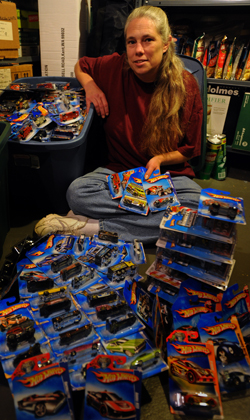
Robin Barker has purchased hundreds of Hot Wheels cars and stores them in her basement in the hopes that she’ll be able to sell them someday to help her son go to college or buy a car.
Melanie Maxwell | AnnArbor.com
It’s the only way she figures she’ll be able to save any money for her son, who is now 12, since she can’t start a savings account for him.
Barker lives in a public housing unit on Green Road, where her rent goes up or down based solely on any income or financial assets she and her son get. The food benefits she receives from the government are also affected by their income.
The system might seem to make sense - until you consider what it means for the people who depend on it, Barker said.
“If I wanted to save up the money and put a down payment on a house, I can’t. It’s impossible to move out of here,” Barker said. “It’s the catch-22.”
Living in public housing
The public housing apartments run by the Ann Arbor Housing Commission look pretty similar to a typical apartment complex.
But instead of having a leasing office, the complexes have community centers run by local non-profit agencies. The offices provide programs for children, help navigating the public and private assistance system, and emergency assistance.
Children can get things like free piano lessons, books and tutoring. Adults can take occasional classes, like personal finance or parenting, and a women’s club meets regularly.
The apartments don’t tend to offer all the amenities - like a washer and dryer - that one might look for in a place to live. “You get a shell and you fill it,” Barker said.

The first floor of her apartment has a kitchen with enough room for a small table and a China cabinet that holds a smorgasbord of items that mean something to Barker. Her living room is filled by a couch, an entertainment center, a table of plants and various family photos and toys.
Upstairs, she’s squeezed a queen-sized bed into her bedroom and keeps a book of inspirational scripture passages by her bed. Son Alex’s room has a twin-sized bunk bed and is crammed with toys and bedding he hasn’t put away. The apartment’s single bathroom is between the two rooms, and because it has no counter space, Barker’s dad added a shelf above the sink.
Her basement is the storage room for everything that won’t fit upstairs. That’s where Barker keeps winter boots, holiday decorations, boxed pasta meals and other pantry items - as well as nearly a dozen boxes of toy metal cars.
Barker and her family
Nearly 20 years ago, as Barker was changing a roll of plastic on a large lamination machine at work, she got her arm caught and was pulled into the machine.
By the time co-workers could pull her out, her nerves were so severely injured that it affected her ability to move her arm or even walk. She spent several years in a wheelchair. That injury and other life circumstances led to clinical depression, she said.
Barker has since improved, but she and her son live off disability checks. She receives help from Medicare and Medicaid and gets reduced rent based on her relatively fixed income.
While her son is at school during the day, Barker spends much of her time running errands, checking e-mail and playing computer games on the computer she bought hoping it would help her complete online college courses last spring.
She wanted to turn the training she’d received from Washtenaw Community College a few years ago into a nursing certification. The associate's degree she earned at the time still hangs on her living room wall.
But Barker ended up failing classes back then and couldn't complete the training, in part because so much of her time is consumed by caring for her son. He suffers from Asperger’s syndrome and other developmental disorders characterized by difficulties with social interactions, language, eccentric behavior and mood swings that include excessive arguing with adults.
She takes him to several doctor and therapy appointments almost every week, making it nearly impossible to finish classes or take on a regular day job.
“Until I can get him better on the straight and narrow, I don’t want to start anything I can’t finish,” she said.
Barker said she craves the feeling of being helpful and useful. So she spends much of her time doing research that might help her and her neighbors. A large binder she keeps in her living room is filled with lists and contact numbers of different resources, so when someone asks for advice, she can point the person in the right direction. She helped one resident figure out financing and helped another find a nonprofit that would help with her large family.
Barker helps out at the community center as much as she can, cooking meals, gathering paperwork when Community Action Network workers aren’t available and organizing projects. She drives to Food Gatherers to pick up weekly donations of food for the center, earning the extra benefit of scoping out the things she and her neighbors might want. She takes a group of neighborhood kids with her to church on Sundays.
"This is the community of which I live in," Barker said. "It is what you make it."
Although she gets assistance and many of her neighbors live off low fixed incomes, she bristles at describing them as “poor” or living in “poverty.” Those words connote many negative characteristics, among them laziness and desolation, that just don't apply to her and her neighbors, she said.
Some residents do side jobs for money. Others say they and other residents sometimes barter or offer to help each other when they can. People learn quickly to be resourceful.
“Everybody’s trying here,” Barker said.
Shopping down to the dollar
Barker never wastes her money on foods like peanut butter or tuna fish.
She knows those items are generally available from the non-profit Food Gatherers, as are items like canned soups and vegetables.
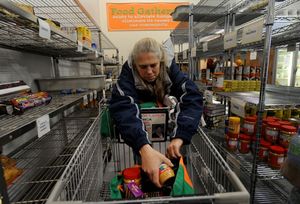
Robin Barker walks through the aisles of Food Gatherers as she looks for items to bring back to the Green Baxter Community Center.
Melanie Maxwell | AnnArbor.com
Occasionally, items like snack bars or a recent shipment of fruit juice boxes come to the community center through Food Gatherers. When they were given to residents, the juice boxes had no straws, which is likely why they were donated in the first place.
Barker has a shopping system. She gets a check once a month and has to budget it to last until the next month. She’s gotten good at finding deals and heads to the store to pick them up after reading the circulars.
On a recent trip to the grocery store, Barker drove to nearby Kroger. She often avoids driving by taking the bus, but said she takes a car when she knows she’ll have more than a backpack full of food.
At the store, Barker made a beeline to the end of the meat freezer where the “Manager’s Specials” are displayed. She usually avoids buying meat because of the cost, but found success when she spotted a pound of ground beef set to expire the next day on sale for about $3. She can freeze it and make Hamburger Helper at some point, she said.
She already knew milk was on sale, so she picked up a gallon. Then it was on to the weekly sale items on special for $1 each.
She grabbed some sour cream: $1. Some cottage cheese: $1. A few packs of cinnamon rolls, Lunchables, off-brand toaster pastries and powdered doughnuts: $1 each.
“It’s all junk fast food,” she said as she checked out. But it’s all stuff she knows her son will eat and will last a while. The bill came to $16.97, plus $6.50 for her prescriptions. She swiped her state-issued Bridge Card for the groceries and paid cash for the rest.
Back in the car, she talked about the other ways people learn to save money. It’s $1 to rent movies at the local library, she said as she drove by.
Sheets, blankets, appliances and clothes can be found at places like the Ann Arbor PTO Thrift Shop on South Industrial Highway and the Salvation Army on State Street. She and a friend once found a brand new suit on sale for $4.
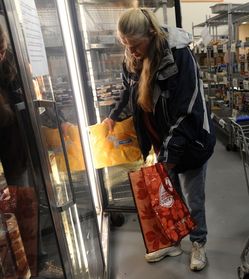
Robin Barker selects items at Food Gatherers for the Green Baxter Community Center.
Melanie Maxwell | AnnArbor.com
“Especially if you’re entering the workforce, you can get some good deals there," Barker said. "You can do it reasonably priced.”
She’s found furniture and appliances at the Ann Arbor ReUse Center on South Industrial. To buy the electronic games her son and the neighbor children love, the best place to go is GameStop, she said. She can find refurbished games for as low as $1.99 there, she said.
Driving down Washtenaw Avenue, Barker pointed out a gas station that almost always has good deals. Gas was $2.59 a gallon that day, less than the $2.62 down the street and $2.72 a little ways back.
At the Ypsilanti Kmart, Barker searched for multivitamins her doctor suggested and looked for new Hot Wheels, which sell for $1 apiece. She peeked at some of the toys on sale while she walked past.
It reminded her the holidays are fast approaching, a time that can induce stress as residents try to find ways to afford gifts for their kids. Some agencies provide gifts - under varying rules.
“I think it’s a huge deal. A lot of residents might not say it is. For me, it’s a big deal. I put ‘From Santa Claus’ on it,” Barker said. “When he was younger, it would’ve been easier because you can get dollar store wrapping paper and dollar store toys. When they’re older, they start wanting more expensive things.”
Her and her "job"
When her son arrived home on a recent afternoon from school, he headed for the living room and fell to a heap on the floor in front of his mother.
They have a system, and she rattled off the subjects.
“Math?” she said.
“Yes,” he replied.
“Science?”
“No.”
“Social studies?”
“No.”
“OK,” she said. “Can you go into the other room and start working on your math now?”
The nightly battle began.
It starts with joking threats of tickling, followed by coaxing and cajoling reminders - then threats of taking away cable TV or the chance to go to Boy Scouts.
But her son was distracted, and the moment his mom stopped pestering him, he began playing with a balloon before pulling out a gun with foam darts.
When told again to start his homework, he shouted in frustration that he would do it later. "Do it now," Barker told him.
“It’s like this every single night,” Barker said.
It’s a challenge that at times becomes overwhelming. She alternates between frustration and worry about her son.
Barker wants to teach her son more independence but also wants to be more supportive than a lot of parents often are, especially considering his special needs. She said she wants to set him up for success in the future, if only she can get him through high school and can find a way to afford college tuition. A girl who used to live by them got a scholarship to play basketball at Ohio State University. It’s been a big boost of confidence to residents about the kind of success their kids can achieve.
It makes her hopeful for her own son, though she admits she knows the toy cars may never amount to much.
“At least it’s something,” she said.
Comments
An
Fri, Nov 13, 2009 : 7:49 a.m.
@1Block - most people getting assistance have similar stories to mine, but, most of us only remember the abuses we see. The people who shared their stories with the AnnArbor.com staff are very brave and they have put themselves in jeopardy. I hope they were fully informed before they consented to this. One thing that the various social services could do to improve things a bit and to prevent abuses is to network together somehow. If the Ann Arbor Housing Commission, the Social Security Administration, the Family Independence Agency and Unemployment were all linked together, not only would they be able to catch the people who might be double dipping, they would be able to offer services to people who are eligible. For instance, a family who now receives unemployment might be eligible for food stamps and medicaid. I don't know exactly what needs to be done but I know that the system as it is today was not prepared for these really tough economic times.
Commoncents
Thu, Nov 12, 2009 : 9:58 p.m.
An: I'm really sorry I didn't come on and read this earlier. My girlfriend had to read your story first and tell me to come read it. You are the exact reason I still believe in social safety nets, even if the government can't get it right. It's a great story and I'm glad that you overcame the odds with hard work and made it happen!! Your story is extremely humbling. Thank you so much for sharing it w/ us....
An
Tue, Nov 10, 2009 : 8:51 a.m.
1Block, I am disappointed. I let all of this out because you asked for the real experience...and it appears you did not even read it. LOL. Have a great day.
bunnyabbot
Mon, Nov 9, 2009 : 11:45 p.m.
well a flood or fire could wipe out the hotwheels. her brothers weren't massed produced like they are today. there is a gagillion of those now.
An
Mon, Nov 9, 2009 : 12:57 p.m.
Can I make a suggestion to AnnArbor.com? Could you make it so you could "subscribe" to a thread and then when you have a comment added to a thread that you have already commented on, you would get an email notification? I've found myself coming into my old posts a few times today to see if anyone has commented, and it would be easier if I just got an email when there was an actual post.
An
Mon, Nov 9, 2009 : 10:05 a.m.
1Block, Part of why I did not go into much detail to start off with is because I knew once the flood gate was open, all sorts of things would pop into my head. So here is yet more information. Some of this is kind of painful for me. Child Support. If you are receiving cash assistance from FIA, they keep all but $50 of your child support. Of course, if your ex does not pay even $50 in child support, you dont get the $50. How did I get to be a single mom on welfare all those years ago? My story is atypical. I was raised upper middle class by four loving parents (my father and step-mother and my mother and step-father). All were supportive of my goals and I wanted for nothing financially, physically or emotionally. I had music lessons, dance lessons, art lessons and plenty of experiences to supplement my public school education. I went off to college on a full ride music scholarship and did well for the first couple of years. Then I met a townie and I got pregnant, and he walked. (If there was one piece of advice I could give to young women out there it would be ABSTAIN until marriage). After my son was born I became critically ill and was in the hospital for 6 months and then, for another two years, I was in and out of the hospital on a regular basis but I did go back to school when my son was 15 months oldand he went with me. I like to say that I took the scenic route through life. I try to make it sound positive, but in reality, the scenic route took me through hell more often that I am willing to admit. When you are poor, if you make a $10 error in your check book, it is devastating. You get the fees from the bank, the fees from where you wrote the check and NOW you are not going to have enough money to pay either the rent or the gas/electric. Small bumps in the road become nearly insurmountable. Not having car insurance I was VERY careful driving. I was a safe driver and very defensive because I could not afford to get pulled over and be asked for my proof of insurance. I could not afford an accident. I only drove to school, to my part time job (which depended on the time frame, I was direct care staff, a math tutor, a Burger King employee and eventually a Burger King manager, which is when I dropped out of school, and we still did not have insurance) and I also drove neighbors to run errands and such, because they would put gas in my car and then I could make it to my school and work. Daycare assistance through the state paid $1.25/hr. The cheapest daycare I could find was $3/hr. Oh and of that $1.25/hr daycare assistance, there was a sliding scale, and you could never get more than 95% of it and if you dropped below 60% of it you lost it all. Try playing on that tightrope. I fell off a few times simply by working an hour or two over my normal schedule. Catch 22, now I didnt make enough money to pay for the daycare and my daycare subsidy is cut too. Lovely. It was a constant balancing act. Two hours of extra work at $5.35 an hour can net me 9 extra bucks for the week, but the next month it would crash my daycare. Money to save my butt one month and to hurt it the next, all out of the same paycheck. If I could improve the system I would put more emphasis on making sure that people had childcare, medical and transportationand I suppose food. If a person cannot find a job, they should have to volunteer (and they should have child care provided). Training programs should be offered. Letting a person go to school for a college education (with a limit on how long they can take to complete that degree) should be supported. The woman in the articles son has Aspergers. He requires much more care than your average child and his needs will include having to be picked up at all different hours from school. Going to school and/or working will not be easy for this woman. Her sons needs are always going to interfere. In her case, her best option is to stay available for her special needs child and muddle by the best she can. Maybe someone out there would not mind offering her a part time job that she can do from home on her computer? She seems to have computer skills, she could do some data entry type of job or something from home, but there are not many jobs like that out there. Anyhow, at this point if you have specific questions I will answer them. If not, I am done giving my real life account. It has been humbling to remember the scenic route and now I feel I need to retreat to my cave and forget it againbecause it hurts. And it reminds me of the mistakes I did make. (Dont get me wrong, I love my children with all my heart and cannot imagine life without them, but my mistakes led to them having to tag along on the Scenic Route and I wish I could have taken them on the Luxury Tour.)
An
Mon, Nov 9, 2009 : 8:48 a.m.
1Block, I am willing to discuss. I mistakenly thought you were after the numbers. LOL. Sorry about that. It is 30% but that is after they take out a deduction for child care and a deduction for each member in your household. If you make more money, you pay more...that is true. Unfortunately, every program does that so as you make more, you get less food stamps, have to pay more for housing, get less child care assistance and run the risk of being tossed off medicaid. I was lucky. I was able to get a good job with health benefits and then continually got raises and promotions until I was able to break free 100%. I also have to credit Habitat for Humanity for helping me to become a homeowner. Their down payment requirement was lower so I was able to save that much up. (Actually, I think I got a bonus that year and used that). If you have money in savings, they want you to exhaust that before they allow you help. If you own a vehicle, they take that into account (and since my swanky job with benefits was in Dearborn, I don't see how I could have gotten there without a car.) One up side of the income based rent is that when I lost a job, and did not qualify for Unemployment, the two months that I lived solely on my child support checks led to me actually having a "negative rent amount" because they do take your utility costs into account. That's right, the Ann Arbor Housing Commission cut me a check for $61/month for two months. You can sustain life on all these systems, but it is very hard to get ahead. I'd also like to point out that all you can buy on food stamps is food. You cannot buy toilet paper, shampoo, detergent, diapers, soap, do your laundry, etc on food stamps. When I was on full assistance in 1993, My monthly stipend from welfare was $401/month. My rent was $375. My gas/electric ran about $50. I had a car that I didn't keep insurance on (got it once a year, at my birthday, with my birthday money from my dad so that I could register the car every year). I played "Rob peter to pay Paul" with the utilities. I drove people places in order to get them to gas up my car. I did not have cable. I did not have a phone. I was a student, so luckily I did have a little money (Title IV funds from Financial Aid do not count against you) so I was able to keep my electric/gas on and buy toilet paper/soap and do laundry. We were definitely poor though. Towards the end I worked and went to school and eventually I worked full time and quit school so that I could get off the system, but my young son and I did not have health insurance at that time. It was a while before we were able to be a self sustaining family. Now I have three kids, a degree, a house and a part time job (but have some savings that we were able to live off of, and unemployment helps a bit too, for now, until that runs out). I am working my way through the MBA program at EMU and hoping that my part time temp job eventually becomes a full time permanent job (but the company currently has a hiring freeze, so that might be a while.) I continue to look for full time, permanent work but honestly there is not a lot out there. For a while I was getting interviews pretty regularly but I was always told I was either "over qualified" or that I "did not have enough formal education". So I choose to get "formal education" and keep moving forward. So there's my sordid tale. Yes, the system did it's darndest to keep me down, but I am not one who can be kept down. Knock me down and I come back up fighting, harder.
Diagenes
Mon, Nov 9, 2009 : 8:16 a.m.
As 1block points out the heart of this article is the govt inefficiency of social programs. As a political conservative I believe we have a moral obligation to help people who cannot support themselves. The big problem is that govt has overwelmed family and non govt organizations from helping people who truely need help and screening out people who make bad decisions and abuse the system.
Commoncents
Sun, Nov 8, 2009 : 11:22 p.m.
An: All I meant was that I'm sure you have some good stories about the negative aspects of being on government handouts. The types of stories that I'd personally like to hear aren't just, "yeah they strung me along and made it tough to get off the assistance". I'd be more interested in knowing the detail behind how the govt programs made it tough to get off of - for example the fact that rent is 30% of your paycheck so the more you make, the more you pay. What else is out there? Anyway, you don't have to do anything for me - it just seemed like you were willing to discuss. If you are I'd be interested to listen.... Good luck on the exams...
An
Sun, Nov 8, 2009 : 10:29 p.m.
1 Block...what do you mean by "Quantitative numbers"? Do you want the formulas that Ann Arbor Housing Commission and Family Independence Agency use? I can probably get those if I work hard at it, it's in my records somewhere for certain since I used to be a welfare scum living in public housing. Unfortunately, I am not going to have time to do that until my last final for grad school, on December 17, 2009. You can feel free to email me at an48103@gmail.com and I will certainly get those numbers to you then. Until then, I am not going to take that time.
Commoncents
Sun, Nov 8, 2009 : 8:39 p.m.
Tina: Thanks for the 30% stat, that doesn't sound SO bad. It still seems very worth getting a job if you're able (doesn't seem like you'd be "stuck" in the free handout cycle). For some reason I was expecting 50% or worse. An: Do you have any examples using quantitative #'s? I'd be very interested in hearing those. Dave Briegel: Lot of finger pointing and name calling in your post, bud. I didn't get much out of that rant you typed out. Sounds like you hate Republicans? Good for you, I don't like government run social programs because of how inefficient they are so I'm not for republicans either. Anyway, what is your solution to this woman's problem? Should we all chip in and pay more taxes to make sure there are no poor people in the country, ever? Cradle to grave entitlements are certainly one way to go, but it's not what the United States was founded on. Can you clarify what you're suggesting? All I was suggesting is there may be a little wiggle room based on the story being incomplete to the level of detail I was looking for... (has cable tv, owns a car, the dad doesn't appear to be paying money, she's buying toy cars instead of using a bank, etc) It is my belief that as soon as people in a democratic society realize they can vote themselves things for free, it will be the end of the nation. We're not there, it's just an analogy I happen to believe in. In my opinion there will always be poor people because there will always be lazy people. There should be safety nets in place so that people who fall on bad luck (sounds like this woman) can be taken care of while they get back on their feet (The U.S. is not a true capitalistic country). Some people don't get that. Here's an example that popped into my head; Last year I took a few families christmas shopping (I didnt pay for the items, just offered my time as a monitor to make sure the money was spent wisely on non name brand coats, boots, etc.) Anyway, the kids in this family all had cellphones and were texting friends. The kids were wearing name brand clothes and the dad had a $100 football jersey on. For every story you have about a sad family that is down on their luck (this story) I can at least find one (and probably 10) just taking advantage of the system and being completely stupid with their personal money. I don't have a good solution, because it's so sad to see kids struggle.... just offering up my point of view is all. No need to name call those who disagree. In situations like this (the woman in this article) if you want to donate money I think that's GREAT. I just think that before I feel sorry for someone my tax dollars aren't enough for them I'd like it to be clear if she's really making smart decisions with what she has. If it's a personal donation then it is up to the direct person donating to evaluate the situation to see if it's worth their money. If it's the government making the call then there is almost no chance a judgement call will be made. Government is simply too big and inefficient. Ohh and if you hate Reagan and think Bush is a criminal - why bring it up in this article? At least if you're going to make a real point using those comparisons; and cite some examples otherwise it just comes off as a rant w/ no facts to back anything up.
David Briegel
Sun, Nov 8, 2009 : 3:53 p.m.
Can't you just feel that conservative compassion in these posts? Did either of them offer her "bootstraps" so she could pull herself up? Real "Good Samaritans" here. You see, they really believe in that "pablum for the masses" as spewed by Reagan and his disciples. I would trust the Social Workers and those awful "govt bureaucrats" that administer these programs. Of course, we don't need any more of them. And just what would the "private sector" have to offer these individuals? You see plain and simple the results of the failed polices of Ronnie Reagan and his disciples, the Bush Crime Family who sold the lie that if the Billionaires got to keep all their money the "trickle down" effect or "rising tide" would "lift all boats". It only lifted their yachts! In a civilized, Christian nation, can't we do better than this?
An
Sun, Nov 8, 2009 : 11:29 a.m.
Yes, her rent would go up if she works. She is on disability and her son is disabled and even a 9-3 job would only work for her during the school year. And no, you cannot save up money when you are on assistance. If you snot green into a tissue, they want to know about that green...so they can count it against you. SOOOOOO glad I escaped that system.
Tina Reed
Sun, Nov 8, 2009 : 10:37 a.m.
Robin Barker demonstrated how, in almost every area of her life, she and many people who live on a low-income must remember money saving tricks, cut back or do without in order to make the budget for her son and her to work - however I can't itemize her finances for you. Certainly, there are likely areas where everyone chooses to cut back and where they choose to spend based on what they value or think they may need. For instance, I know Barker avoids driving when possible, but uses a car for larger shopping trips and when she must quickly get to her son's school or needs to get him to doctor's appointments across town. Barker's son does have has trouble making it through the school day and many jobs would not allow someone to leave unexpectedly so often. I know many residents have said they often do side jobs, help each other out or even barter for services from each other to make or save money. The rent charged is 30% of the adjusted family income of the tenant, according to the Ann Arbor Housing Commission. Residents have the option of choosing a flat rate for their rent. Food Assistance Program benefits vary based on a family's wages, self--employment earnings, rental income, child support, Social Security benefits and Veterans benefits. I cannot give you exact rates right now, but I will get them for you. Barker's ex-husband is still a good friend and does help out. Barker herself said she'd prefer putting savings aside for herself and her son in the bank. But she fears savings she might have would count against her and her son when it comes to tallying up what she would receive in food assistance and what her rent payments would be. That is the catch-22 she is referring to when she talks about how hard it is to try to save up money to get a house for she and her son. We've included a link to local resources that help local residents, including Barker and her son, and might offer some good options for those interested in donating: http://www.annarbor.com/news/resources-where-to-go-for-help-in-the-ann-arbor-area/
Halima
Sun, Nov 8, 2009 : 10:33 a.m.
This woman seems to have enough problems and I am not going to examine every item in her budget and compare it to my own ideas about how money should be spent: it would discourage people from being honest with journalists if everyone in town were going to criticize them. That said, I share the previous poster's concern about the Hot Wheels collection. The government doesn't allow you to save money out of your benefits? You must spend them all every month? I can, off the top of my head, think of several ways which would be more-portable and less-susceptible to potential floods or other losses. And legal. Plus they would be more liquid. For other readers, the statement that video rental at the Ann Arbor Libraries costs $1 should be corrected by the AnnArbor.com staff. Library video checkouts are free.
Commoncents
Sun, Nov 8, 2009 : 8:44 a.m.
I'm going to come off like a scrooge, but I have a few questions that I'll itemize. I read the story and feel bad for this woman, seems like luck has not been on her side, however.... since the article is supposed to highlight the resourcefulness of a low income single family there are a few questions I had that you did not ask the woman (or just didn't report) 1. I realize that it's probably not going to happen, but could you list up bills vs. income so we can truely understand her financial situation? If the article is highlighting her resourcefulness we should be able to understand the full financial situation, at the very least with percentages. A car and cable tv seem to be 2 large expenses that are not completely necessary that she is paying for currently. Cars have many upkeep items (oil, gas, filters) not to mention if something big happens. Is the only time she needs a car when she has more than a backpack full of groceries? Cable tv should be a luxury, unless govt. pays for it? 2. Is she not able to find a job with hours from 9am-3pm? (school hours) or does her son have problems not being able to make it through the full school day? What about finding cash / under the table jobs like raking leaves for people or doing odds and ends type jobs. I realize it's "not-legal" but if I was in that situation I would be trying to raise money w/o the government knowing all day. An old neighbor of mine (when I wasn't living in ann arbor) did something exactly like this so he could get off of the government's tab... and he did! 3. If she had a job what is the percentage rent increases? I can understand mentally it would have to be tough to get a part time job that makes $300/week, if rent goes up $150/week. I don't understand what that rate is - can you report this for those of us that aren't in tune w/ goverment handouts? It wouldn't surprise me if the system was setup to encourage people to stay on it, but without the numbers it's impossible for me to agree. 4. Where is the father of the son? Maybe there is a sad story here, but it should be reported. 5. Why is buying toy cars a better investment than putting that same amount of money into a savings account that gets guaranteed interest. Toy cars increasing in value is only a hope - when it's in the bank it will for sure, right? Can you shed light on why investing in toy cars is a better idea than using a bank? Maybe it's something to do w/ all of the government subsidies and they monitor her bank account, but until I get that info I can't understand this whole toy cars thing. 6. If we wanted to donate some money to this woman, can we get her address or can we send it to you to give to her?