

Manchester first responders learn school bus rescues
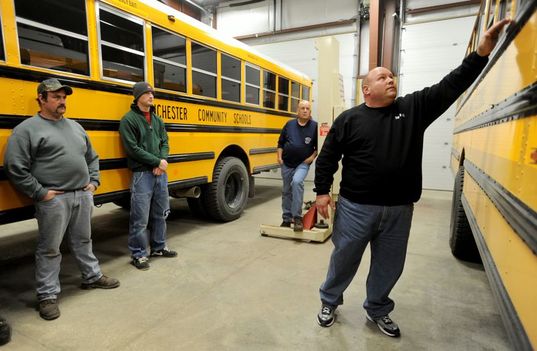
From left: Manchester Township Fire Capt. Brian Kunzelman, Firefighter Ben Huber, and Capt. Kris Kensler watch as Corporal Mike Williams of the Washtenaw County Sheriff's Department gives a talk about first responder training with buses in Manchester Tuesday.
Angela Cesere | AnnArbor.com
It's an everyday ritual: School buses slow to a stop, the lights start flashing red, and kids get on or off.
Safety never stops being a concern, officials say, and so a group of first responders gathered in Manchester Tuesday night for a special training exercise.
Rural communities like Manchester rely heavily on their busing system. Covering 125 square miles, 700 students are bused every school day, said Jeff Knasiack, director of transportation for Manchester Community Schools. He said student ride times can average more than one hour.
Knasiack, along with Cpl. Mike Williams of the Washtenaw County Sheriff's Department, led members of the Manchester Area Fire Department and emergency medical workers through school bus design and extrication training.
They may not look much different, but school buses have changed throughout the years. Safety features such as escape hatches have been added, and seat backs are much higher.
But why aren't there seatbealts?
“This is not the family van,” said Knasiack. “The bus is designed to absorb and disperse the energy,” meaning that impact is absorbed by the bus and not the riders.
The metal rails that frame the seat backs are now deeper in the seat, so children won't hit them during a collision.
Knasiack maintains children are safer on the bus than they are in a family van. Manchester schools has invested in buses with strobing lights and dual stop signs that swing out when the bus comes to a stop. They're designed to grab the attention of other drivers.
Of course, sometimes even that isn't enough to stop some drivers. For that reason, Manchester has designed the bus routes so there are as few children crossing the road as possible. They're not allowed to cross busy roads like M-52 and Pleasant Lake.
For those few students who do have to cross the road, the bus driver will signal them to cross only after all cars have come to a complete stop.
During the training, Williams covered situations from the most extreme to the simplest fender bender. He used examples from past accidents and explained what tools to use and how to safely pull the students from the bus if necessary.
Ann Dwyer is a freelance writer for AnnArbor.com. Reach the news desk at news@annarbor.com or 734-623-2530.
Comments
bereasonable
Wed, Nov 11, 2009 : 8:30 p.m.
Kudos for these individuals who truly care about their communities' safety!