

Mary Sue Coleman says Gov. Snyder's formula for higher education treats U-M like 'a failing institution'
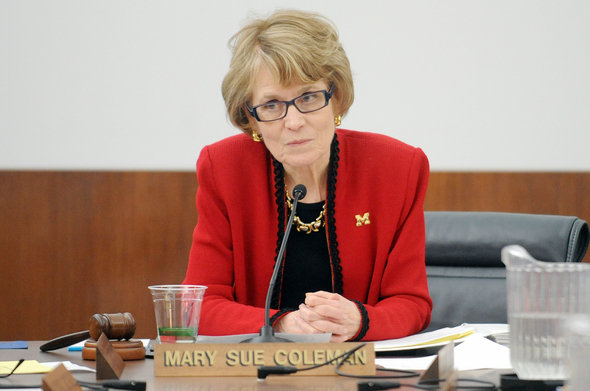
Mary Sue Coleman during a Feb. 16 U-M Board of Regents Meeting.
Melanie Maxwell I AnnArbor.com
Coleman told the Michigan House Appropriation Higher Education Subcommittee that Snyder's proposed 3 percent raise in funding "represents what we hope is a turning point for higher education in our state and the past decade of reductions" but is not being distributed properly.
Snyder released his $48.2 billion 2012-13 fiscal budget proposal in February.
The proposal grants universities $1.4 billion —up from $1.36 billion in 2011-2012— and distributes the increase to Michigan's 15 public universities using four newly developed metrics: growth in graduation rates, the number of degrees awarded in critical skill areas, the number of Pell Grants awarded to enrolled students and tuition restraint.
Under this formula, increases to individual universities vary from 0.9 percent to 7.6 percent.
U-M's Ann Arbor campus is set to receive a 1.4 percent increase.
Coleman said that under Snyder's proposed formula "you could erroneously come to the conclusion that the university is a failing institution."
The U-M Board of Regents, Coleman and her administrators have been outspoken critics of Snyder's move toward formula funding.
"Here's my concern: The current metrics proposed in the governor's recommendation, they pit the very different 15 public universities against each other," Coleman said Wednesday. In the coming weeks, each of Michigan's public university presidents is set to testify about the budget before the subcommittee.
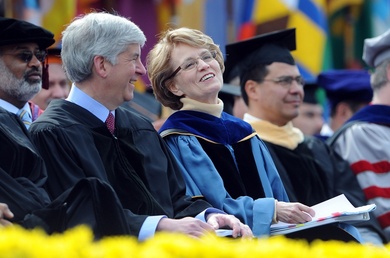
Gov. Rick Snyder and Mary Sue Coleman during the April 2011 U-M Commencement.
Melanie Maxwell | AnnArbor.com
She noted that U-M's graduation rate —in 2010 the school's six-year graduation rate was 89.7 percent and its four-year rate was 72 percent— is already one of the top in nation and difficult to improve. The average six-year graduation rate in 2010 was 56 percent.
Coleman also took issue with wasn't included in the metrics, including maintaining positive performance indicators (such as graduation rates), the quality of a school's research enterprise, the quality of graduate programs and the number of students who get jobs shortly after graduating.
U-M Director of Government Relations Cynthia Wilbanks told AnnArbor.com recently that while the governor "is trying to incentivize certain outcomes," his proposed formula fails to encourage graduate education and research, which she said can "stimulate and help to support the economic diversification of the state."
Snyder's formula includes a 4 percent cap on tuition increases, which Coleman criticized. Last year, U-M rose undergraduate tuition 6.7 percent and, according to U-M Provost Philip Hanlon, the university plans to increase tuition again in 2012-2013, although that raise is projected to be less than 6.7 percent.
"It is very important to keep that tuition decision at the appropriate level: individual boards," Coleman said, adding that she believes boards are "very responsible" when considering tuition increases.
In additional to tuition restraint and degree completions, Snyder's projected formula also considers the amount of Pell Grants awarded to undergraduates each year.
At 15 percent in 2010, U-M has the lowest percentage of students receiving Pell Grants of any public university in the state. At Wayne State University and Michigan State University, other state research universities, 43.5 percent and 23.2 percent of students received Pell Grants in 2010, respectively.
Wayne State, U-M and Michigan State are budgeted to receive the smallest percentages of the $36.2 million increase under Snyder's plan.
Under Snyder's formula, U-M Dearborn is set to receive a 2.7 percent increase. In 2010, Dearborn had a 51.8 percent graduation rate and 36.9 percent of students received Pell Grants. U-M Flint is projected to receive a 3.2 percent increase. In 2010, 40.4 percent of U-M Flint students received Pell Grants. The school had a 38.8 percent six-year graduation rate.
Taken together, Michigan's 15 public universities had a 60.7 percent graduation rate in 2010, ranking 14th in the U.S.
Kellie Woodhouse covers higher education for AnnArbor.com. Reach her at kelliewoodhouse@annarbor.com or 734-623-4602 and follow her on twitter.
Comments
LarryJ
Thu, Mar 15, 2012 : 6:56 p.m.
What one person referred to as "the prestige chase" could be differently described as the following: - Recruiting the best professors - Attracting the best students - Providing the best possible eduction - Being "Leaders and Best". What part of that are we supposed to disagree with?
mohomed
Thu, Mar 15, 2012 : 6:31 p.m.
You are a failing Institution when you charge a student $25,000 a year to get a liberal arts degree in Women's Studies or Sociology. These are what I got my degree in and now I owe $75,000 in student load debt and the only job I could find was be an assistant shift supervisor at Starbucks where I'm still employed. Thanks UM, I was made to feel like a leader and the best at school but now reality shows I'm no different than my boss who graduated at Ferris State, in fact he makes more than me.
SalineBob
Thu, Mar 15, 2012 : 4:33 p.m.
For once (and probably the only time) I think I agree with the governor. U of M is an elite university that looks and acts like a private university. The cost of tuition and fees and frequent increases are ridiculous and it seems the only ones who can afford it live out east. Or their parents are going broke--like me. They'll just have to find a fine line between maintaining "elite" status and being reasonable. I'm sure the brain trust over there can come up with a way to deal with it.
javajolt1
Thu, Mar 15, 2012 : 4:23 p.m.
Once again, as has been mentioned so many times by so many people, the editorializing in your polls often makes it impossible to select a reasonable and objective choice. - She's spot on. The formula needs some major changes. - The formula is good as it is, it doesn't need to be changed to fit U-M's requests. - It could use minor tweaking, but overall I'm okay with the formula. - There shouldn't be a formula at all. - I'm undecided. What is wrong with: - I agree with Coleman - I disagree with Coleman - Not sure Please cut out the editorializing!
JSA
Thu, Mar 15, 2012 : 2:43 p.m.
It is interesting how someone who disagrees with your point of view can "report abuse" and censor a valid comment. I will state it clearly. U of M does not exercise fiscal control or administrative costs and salaries. That makes them a failure from my point of view.
Basic Bob
Thu, Mar 15, 2012 : 2:13 p.m.
MSC is trying to tie government funding increases to success and prestige. They are ranked #12 in the world opinion ratings, nestled among the private university elites, who do not get any government money. With all the other things wrong with this state (roads, unemployment, Detroit) we need to be careful how we distribute the money. If the University needs more money, they need to raise tuition or increase their endowment. MSC is concerned because the increase in funding is not up to her expectations, but on the other hand she wants to behave like an out-of-control child taking daddy's car and money but not following the house rules. I have no sympathy.
joe.blow
Thu, Mar 15, 2012 : 10:02 a.m.
What is the world was wrong with my other comment? Notice how she didn't comment on, "the number of degrees awarded in critical skill areas." I wonder if this is the statistic that hurts UofM the most, the rest of the criteria probably help. Guess having lots of people graduate in "women's studies" just isn't critical, or "general studies." Coleman is upset because she is a liberal and she can't stand a successful conservative governor telling her what to do. Her budget is out of control and he's only giving her a 3% increase (really, she's complaining about an increase?). But that's the problem with liberals. Instead of saying thank you for the extra money to waste, she's upset that other schools got more. Crazy.
Stuart Brown
Thu, Mar 15, 2012 : 8:32 a.m.
We've been subject to the same con-job song-and-dance routine by heads of UofM for the last 30 years. UofM officials constantly harp on UofM's "quality" without ever showing or explaining what that quality really is. The public has been played for fools and told that since most of them did not get in to UofM, they are not worthy of even questioning where the money goes and if it is being effectively spent on improving the quality of life for all Michigan residents. The picture that emerges is one of an arrogant, out of touch administration that simply refuses to be accountable to anyone. When it comes to accountability to the owners of the UofM (the people of the State), UofM is certainly a failing institution. It is about time that someone in the Gov's office insisted that there should be metrics for guiding and judging quality improvements that are reasonably objective and actually correlate to things that matter to the people of the state.
Stuart Brown
Thu, Mar 15, 2012 : 6:28 a.m.
The UofM probably is a failing institution when it comes to providing a basic undergraduate education to state residents. Half the students on the Ann Arbor campus are out of state and the school has only given lip service to the proportion of in-state minority students attending. Given the selectivity of the school, you would expect a higher graduation rate so focusing on improvements in graduation rate has merit. UofM charges what the market will bear when it comes to tuition and fees and given the fact that a college education is considered a necessity by most, it is appalling to see a public institution behaving this way. I really applaud the idea of cutting public funding to schools who raise costs above the rate of inflation consistently year after year. The problem for the last 30 years is that household incomes in Michigan are down while tuition and fees at UofM are way up, pricing out many middle class families. Unless cost controls are put into place, any public money provided to assist students and their families with costs will be absorbed, defeating any attempt to make undergraduate educations more affordable.
Bear
Thu, Mar 15, 2012 : 2:39 a.m.
Maybe the universlty should re-think who it backs in the next gubernatorial race. They totally backed Snyder. Didja get what you paid for?
Roger Parlett
Thu, Mar 15, 2012 : 1:49 a.m.
My thoughts are in unison with a recent story in the NewYork Times- THE PRESTIGE CHASE IS RAISING COLLEGE COSTS. I am sure more can be done to reduce costs- do we need the prestige we have? Here is a paragraph from the story- Universities have responded vigorously to escalating student demands for elite degrees. Their main strategy has been to bid more aggressively for the most distinguished researchers, which explains not only the rapid salary growth for top faculty members in the last several decades, but also the fact that teaching loads at many elite schools have decreased by more than 25 percent. Similar, albeit smaller, changes in salaries and workloads have percolated throughout higher education.
Pickforddick
Thu, Mar 15, 2012 : 1:48 a.m.
Please have Mary Sue explain why it is not a failing institution.
Steve
Thu, Mar 15, 2012 : 1:12 a.m.
Wait. This for-profit, non-profit pays no taxes, pulls in hundreds of millions in state and federal grants, is subsidized by the taxpayer, receives a cut of every tax dollar state residents pay in taxes and the President has the audacity to whine about lack if support (cash) in very hard times? Her hubris is amazing!
Stuart Brown
Thu, Mar 15, 2012 : 8:56 a.m.
Not only that, Mary Sue stood-up the President of the USA on his recent visit and a workshop he held at UofM. Mary Sue did not like the idea of Obama suggesting that if the U could not keep its tuition cost increases at least in line with inflation, then Federal funding should be cut.
Arborcomment
Thu, Mar 15, 2012 : 12:27 a.m.
Not a peep on University's efforts to contain costs. Of course, when about all you have is a 16 page report started 10 years ago - not much to peep about. Meanwhile: http://www.usmd.edu/usm/workgroups/EEWorkGroup/eeproject/index Other places are trying and succeeding to control costs in operations and tuition. The Michigan Difference: whine more, hope you get more.
joe.blow
Thu, Mar 15, 2012 : 12:12 a.m.
Notice how she didn't comment on, "the number of degrees awarded in critical skill areas." I wonder if this is the statistic that hurts UofM the most, the rest of the criteria probably help. Guess having lots of people graduate in "women's studies" just isn't critical, or "general studies." Coleman is upset because she is a liberal and she can't stand a successful conservative governor telling her what to do. Her budget is out of control and he's only giving her a 3% increase (really, she's complaining about an increase?). But that's the problem with liberals. Instead of saying thank you for the extra money to waste, she's upset that other schools got more. Crazy.
catfishrisin
Thu, Mar 15, 2012 : 12:01 a.m.
Love all these hater posts regarding UM, higher education or just education in general....jealously and bitterness abounds
Bear
Thu, Mar 15, 2012 : 2:57 a.m.
jeez, joe blow, perhaps you do need a little education. How do you know that catfishrisin even has children or that he's sending them to a public university or a university at all? You just jump to conclusions, without a shred of evidecnes? Maybe we should just shut down the University of Michigan so that people like you will be satisfied in their selfish attitude that 'their tax money' shouldn't go to benefit anyone else but them. Who's footing your bills? i hope you don't expect to get any social security. And if you lose your job due to an injury and lose your insurance, I certainly hope you don't expect us taxpayers to foot your bills through medicaid or medicare or UofM hospital, where they won't turn you away if you don't have insurance. Listen to yourself, for criipe's sake!
Pickforddick
Thu, Mar 15, 2012 : 1:51 a.m.
Please have Mary Sue explain why it is not a failing institution.
Arborcomment
Thu, Mar 15, 2012 : 1:16 a.m.
And frustration of alums watching a premier State University try to be something it's not, admit increasing numbers of out-of-state students as cash cows, fail to attempt anything meaningful on cost and efficiency, and view any change with ignorant smugness and elitism.
joe.blow
Thu, Mar 15, 2012 : 12:13 a.m.
A lot of people didn't choose to or have the ability to go to college. Why should those people have to foot the bill for your children?
carolyn wallace
Wed, Mar 14, 2012 : 11:33 p.m.
With regard to controlling costs, I don't understand how professors are given one year, fully paid sabbaticals on one hand and then saying there is "nothing more that I can do to reduce my expenses".
joe.blow
Thu, Mar 15, 2012 : 12:14 a.m.
Sabbatical? I'll take a paid one year vacation!
Joe Kidd
Wed, Mar 14, 2012 : 9:43 p.m.
Another person employed in the public sector whose organization relies on public funding complaining about there share of the pie. What a shocker. Next it will be someone in K-12, or fire fighters or police, or road repair, and on and on. What they are proposing is "don't cut us, cut them." UM has always been given more funding than other schools and a small percentage increase of a big amount can still me more $ than a larger percentage of a smaller amount. And I agree with Outdoor6709, there are plenty of places cuts can be made.
pbehjatnia
Wed, Mar 14, 2012 : 9:33 p.m.
What I hear is that Snyder is searching for ways to spread funding more to include schools which otherwise drop by the wayside. The UM is simply being treated fairly for a change and every spoiled child who has to adjust feels pinched for a while. I would also say that there is plenty of room for cuts at the U. Look at the top heaviness of admin in areas from grounds to the executive suite. Hire the guys who cut the fat from Ford early on and the U may just realize that playing fair in the sandbox isn't really do bad after all.
Spanky
Wed, Mar 14, 2012 : 9:33 p.m.
Mary Sue should think about supporting local business' in this community and look into the allogations of kick backs and pay to play for it's vendors.
Eep
Wed, Mar 14, 2012 : 9:40 p.m.
So . . . where can we find these allegations? Who is allegedly accepting the kickbacks?
seekingsun
Wed, Mar 14, 2012 : 9:32 p.m.
Here is some real information (rather than random platitudes) about how much UM has cut cost and shrunk it's expenses in this time of budget difficulty. http://www.vpcomm.umich.edu/pa/key/budget/. Despite the cost cutting, why has tuition gone up so quickly? Health Care costs have doubled in the past 10 years, Utilities costs have grown by 70% in the past 10 years. In this time of state fiscal difficulty UM has increased its need based financial aid budget by double-digit percentages. In 1960, the state covered 78% of the U's budget, in 1990 it was 50%, and this fiscal year it is a paltry 17%. Disinvestment in a public good, makes the good less public. Here's an overview of UM's budget http://vpcomm.umich.edu/budget/fundingsnapshot/index.html. Here you will learn that the money for buildings and athletics and hospital are totally independent and are not fungible with the University's educational mission. The reality is this is a problem that you get when tax cutting is fetishized. Guess what, if the feds cut your taxes there is less money that they pass along to the state. Then your state (like so many others) are broke. Local control! Yay! Whoops, but if the same politicization of taxes happens at the state level and we're unwilling to tax ourselves at the state level, than our university's will go the way of our road, bridges, schools, etc. Smart, educated people create and attract jobs. If we decide to let the University's tank we'll all be worse off. But darn, you'll have money to do that long awaited kitchen redo (um... assuming we all still have jobs).
Stuart Brown
Thu, Mar 15, 2012 : 9:33 a.m.
The disingenuous use of statistics is rampant here. In particular, the percent of the U's budget provided by the state is exhibit A. The U has grown its non-undergraduate related activities substantially since 1960. The U does not simply educate undergraduates but the state money the U receives is fungible for other activities. Professors spend a high percentage of their time engaged in research activities so their salaries do not directly benefit undergraduates but yet, instructor salaries are used to justify increases in tuition. Why should tuition dollars be used to subsidize research? Research is also one of the big cost drivers on the administration side again, why should tuition dollars be used to cover research costs?
seekingsun
Thu, Mar 15, 2012 : 12:08 a.m.
just saying that the less the state of michigan invests in the university, the less public the university becomes. that's just a reality. that means that the 60% of seats that are set aside for in state students suddenly generate out-of-state tuition equivalent dollars. Means that the people of this state suddenly are without a world-class educational option for a (relatively) bargain price. There is tons of fund-raising trying to support the educational mission. That's how the scholarship budget is increasing, etc.
YpsiVeteran
Wed, Mar 14, 2012 : 11:32 p.m.
You must think we're all stupid. Perhaps, instead of raising hundreds of "non-fungible" millions for buildings, money that can't be spent on the university's educational mission, the university should at least pretend that its educational mission is on its priority list. Perhaps they should direct a couple fund raising campaigns toward their "educational mission," and maybe they should stop wasting the money they do get for education on layer upon layer of useless administration, bureaucracy, bloated salaries, etc. etc.
YpsiVeteran
Wed, Mar 14, 2012 : 11:25 p.m.
It's an interesting argument. We are doing quite well now with a "paltry 17%," yet the place will "tank" if you taxpayers don't start coughing up some more cash. It's somehow managed not to tank so far. I'm fairly confident that will continue to be the case.
A2centsworth
Wed, Mar 14, 2012 : 9:08 p.m.
University of Michigan is a state school with ivy league expenses. Paying their administration far more than they deserve. In this economy to increase tuition 15.4 percent in two years is ridiculous. Claiming they cannot reduce expenses is also ridiculous. Time for a reality check!
Stuart Brown
Thu, Mar 15, 2012 : 9:11 a.m.
johnnya2 is comparing a public institution to private ones. UofM is a public university owned by the people of the state of Michigan and should be accountable to the people of the state. Secondly, Princeton has a huge endowment and almost no students who graduate from Princeton leave with any substantial debt, unlike at Michigan. Charging what the market will bear is not acceptable for a public institution; the fact that demand is high should not be used to raise costs.
johnnya2
Thu, Mar 15, 2012 : 12:34 a.m.
WRONG I know facts are a horrible thing for you to look at, but here we go: From the PRINCETON web site The estimated cost of attendance for 2012-13 is $54,780 and includes: Tuition: $38,650 Room charge: $6,950 Board rate: $5,680 Estimated miscellaneous expenses: $3,500 A senior at UM would be $26,810. http://www.finaid.umich.edu/TopNav/AboutUMFinancialAid/CostofAttendance.aspx That is LESS THAN HALF of Princeton Cornell is just over $43k per year. If the tuition is so over priced, why is the demand so high? If it is too high, why wouldn't people be rushing to pay WCC prices instead of UM prices? If you do not see the value, go elsewhere. Rick Snyder went to UM when funding was at great levels, It is what made Michigan the envy of many states. Cutting higher education is saying, we want to improve our state, but we would prefer to do it on the cheap. IT DOES NOT WORK.
djacks24
Wed, Mar 14, 2012 : 8:53 p.m.
I'm reading this as she wants the criteria skewed in UMs favor while raising tuition to any level they see fit. Most of the criteria she mentioned that she would like put in place are things that UM already would have an unfair advantage over just about any other University in the state.
Stephen Landes
Wed, Mar 14, 2012 : 8:52 p.m.
I am in shock that we are measuring a six year graduation rate! Six years? To earn a bachelor's degree? That is insane. It seems to me that this is more indicative of students entering an institution without knowing what they want to achieve or what they want to study than it is a real measure of university success. No wonder a college education is so expensive -- it takes 40 to 50 percent longer to graduate than it did for me or my son. There is no excuse for a nearly 7% increase in tuition when inflation is less than 3%. I do not believe the University even knows where its costs are. I have been asking for years for a solid cost accounting study of costs for providing an undergraduate degree education and have been told every time that they can give me total budget numbers, but can't show where their actual costs are incurred. If the actual contributors to the cost of an education cannot be itemized and documented then there is no way to control those costs. With all the student body's data captured on the U's computers there is no reason that such a study cannot be conducted and the results used to truly understand what drives these costs. It is insufficient, and a sign of poor management practice, to simply say "our costs went up" or "it is just so expensive to hire certain faculty" etc. I personally believer that the cost contributions are so screwed up that the U of M cannot distinguish between costs attributable to providing an undergraduate education and costs for research. My suggestion to President Coleman is to stop whining and focus on helping undergraduates complete their degrees in less than five years; make sure those undergraduates clearly understand before they begin their degree program just what they can expect to earn should they find a job in their field and what that means in terms of a return on investment; actually manage the costs of delivering that undergraduate education.
YpsiVeteran
Thu, Mar 15, 2012 : 1:06 a.m.
Well, johnnya, you might be surprised to learn I'm quite aware of where the Yost money will come from, having been involved with Big 10 athletics for more than 18 years. Had you applied a bit of critical thinking and reading comprehension to my post, you'd have perhaps avoided proving my point. At this point, the "educational mission" is pretty much the poor stepchild of a spending mad organization that is addicted to sports and research glory. If UM could figure out some way to just run their sports teams without the colossal inconvenience of actually having to run a school, Mary Sue would probably make it happen. You don't think a university that figures out a way to generate hundreds of millions off sports programs and research could figure out a way to meet the metrics being asked for by the governor? Or figure out a way to stop continually raising tuition, all the while pleading proverty? Stick your head back in the sand and try not to use personal insults to cover your own lack of understanding.
johnnya2
Thu, Mar 15, 2012 : 12:24 a.m.
Ypsiveteran, Do you even have a clue where the money for Yost is coming from? It is ATHLETIC department money. THEY PAY THEIR OWN WAY. Every sin gle dollar is paid for by people who CHOOSE to attend events, or through television or radio, or merchandising. I guess you want sub standard athletic facilities? Guess who pays the tuition for EVERY scholarship athlete? The athletic department. If the arenas and stadiums sit empty then what? The programs can not pay for themselves and you have what most other universities have, a GENERAL fund expenditure for the athletic department. If you can not comment intelligently, it is best to be quiet.
YpsiVeteran
Wed, Mar 14, 2012 : 11:22 p.m.
Leaguebus, it's not stopping them from spending $50-plus million on Yost and another $2 million on a nursing school, is it? There has been ZERO attempt by the university to even attempt to control, much less reduce, tuition costs. Too bad for Mary Sue. Every time she opens her mouth she embarrasses herself. I think the only person in this state more out of touch with reality than Ms. Coleman is Kwame Kilpatrick, and it might be close.
Stephen Landes
Wed, Mar 14, 2012 : 10:01 p.m.
leaguebus You equate the state appropriate with excellence? You must work in the public sector. I worked in the private sector where annual cost cutting and revenue challenges were the norm AND continued excellence, progress, efficiency, and quality were the expectation. The university's metrics are way out of whack and they need to be challenged if they are going to improve. Just handing them money because they say they need it is not going to help.
leaguebus
Wed, Mar 14, 2012 : 9:11 p.m.
I guess cutting $56 M from the UM state appropriation last year should not matter when they set tuition?
justcurious
Wed, Mar 14, 2012 : 8:19 p.m.
She should quit whining. We give them enough of our money and they are spending like there is no tomorrow. New buildings every time you blink. Use some of that money.
Bear
Thu, Mar 15, 2012 : 2:48 a.m.
just curious, you either stay ahead of the curve in education or you get left behind. Perhaps we should all be using a piece of chalk & a little chalkboard instead of using paper, pen & pencil? Your reasoning is flawed and an oversimplification of the matter at hand. I'd like to see the end product if you were in charge. Laughable.
justcurious
Wed, Mar 14, 2012 : 10:32 p.m.
Well Mush Room, make them suit the purpose, or repurpose them. Just don't expect the taxpayers to keep pouring slop into the Government Feed Trough!
Mush Room
Wed, Mar 14, 2012 : 8:43 p.m.
I'm curious regarding what justcurious proposes the university do with buildings that no longer suit their purpose or are too expensive to maintain.
jimmymac
Wed, Mar 14, 2012 : 8:09 p.m.
Didn't the deans of Engineering and Business recently receive annual raises of $100,000 or more? It's hard to wring your hands and say "How poor we are" when you pull stunts like that.
julieswhimsies
Wed, Mar 14, 2012 : 7:50 p.m.
Ms. Coleman and Snyder seemed to be pretty good pals at the UM graduation ceremony at which he spoke. She is not a stupid person. I can't believe she didn't see this coming.
G-Man
Wed, Mar 14, 2012 : 7:48 p.m.
I don't know why it's a surprise. Apparently the bummer is she thinks it's business as usual... keep jacking up the tuition costs with no concern to cut or conserve!!! Keep giving big bonuses to foreign students while locals get the table scraps. Did U-M EVER THINK about the possibility that cost reductions could be made to hold tuition down????? NO Let's just keep jacking up the cost of college every year, and then whine because a fiscally responsible Governor can see the light and not spend more than they're taking in!!!!!
trespass
Wed, Mar 14, 2012 : 7:39 p.m.
If you read between the lines, President Coleman is saying what she always says, just give us the money with no strings attached because we are given autonomy by the constitution. Well, the one thing the constitution allows the state government to do is allocate the money and if they want to incentivise certain services to the state they are free to do so. I would add one thing to the formula. With regard to the number of degrees granted in certain skill areas, I would add "for Michigan residents" because, for example, training a Michigan resident to be an engineer has much more impact on the State's economy than training an out of state or foreign student who is more likely to leave after their degree.
Silly Sally
Thu, Mar 15, 2012 : 11:46 a.m.
@Sparty (E Lansing?) Think jobs? Is this such a novel concept? Think of companies such as Ford Motor that preach Diversity and say to groups of students that "we want to hire people from all over the world to fill our spots in Michigan" Big firms love H1b visas and the lower cost foreign (oops "international") labor. Since most of Michigan's students from Michigan do not fit this demographic, some go where they are more welcome.
cinnabar7071
Wed, Mar 14, 2012 : 8:12 p.m.
Sparty using your logic they would never come here in the first place. So what your saying is they come to this 1950's state to learn, but leave to make money? I fail to see your logic
Sparty
Wed, Mar 14, 2012 : 7:53 p.m.
Why would an out of state student leave Michigan? Could it be due to the backwards laws created in Lansing moving us back towards 1950? Probably for the same reasons in state students leave Michigan as quickly as they can, seeking more progressive and fair minded States where Governments are not so quick to intrude into their private lives.
noreaster
Wed, Mar 14, 2012 : 7:24 p.m.
U of M should just be thankful the formula doesn't penalize the place for each foreign student. They may bring in the big bucks but displace seats better spent on our own bright students, not to mention we kick foreigners out afterwards so we're educating our foreign competitors rather than our own fellow citizens. And we wonder why manufacturing is dying in the US?
Marshall Applewhite
Wed, Mar 14, 2012 : 10:26 p.m.
@Julie I think you may want to re-examine your information. It's actually harder to get in out of state. Maybe your student just wasn't as bright as you thought he/she was?
julieswhimsies
Wed, Mar 14, 2012 : 7:52 p.m.
It is a lot easier to be accepted at the UM if you live out-of-state. We learned this the hard way.
Sparty
Wed, Mar 14, 2012 : 7:48 p.m.
So you advocate discriminatory admissions? Favored Michigan-student admissions isn't the policy of any Michigan University, to the best of my knowledge, so why should UM alone be penalized? Perhaps manufacturing is dying in the US because math and science isn't a focus in K-12, partially due to reduced funding from Lansing?
JSA
Wed, Mar 14, 2012 : 7:17 p.m.
Considering U of M's complete failure to control cost with regards to administration and administrative salaries they are a failure. They are spending money all over the place to rennovate or build or upgrade buildings all over the place.
leaguebus
Wed, Mar 14, 2012 : 8:49 p.m.
The last capital outlay from the state to UM was in 2010, when the state pledged $383 M for $1 B worth of renovations. The other 2/3's of the money came from the UM endowment. That is a deal for the state.
outdoor6709
Wed, Mar 14, 2012 : 7:17 p.m.
This is the same univ president that said " there is nothing more I can do to reduce my expenses." Really, I think I could find cost reductions in your current budget.
Rob Pollard
Thu, Mar 15, 2012 : 4:32 a.m.
Did she say that to you in a personal conversation? Or was this from a story or speech you read/heard? And if so, what is the context for that quote? Cite it, please or else who knows where this "quote" came from?
leaguebus
Wed, Mar 14, 2012 : 8:09 p.m.
Can you cite a reference for this statement?
DonBee
Wed, Mar 14, 2012 : 7:03 p.m.
leaguebus - Opportunities for lower income (e.g. Pell Grants), restraint on tuition costs (e.g. Controlling the overall cost increases for education) and graduation rates are all critical indicators for success for the citizens of Michigan and their children. While the UofM is unique (at least in the minds of the administration of the university), they seem to have little regard for what the lower and lower middle class can afford. While I deplore one size fits all types of systems - I think the overall metrics chosen work for the citizens of Michigan as a state. They may not work for the UofM. They probably don't work for the research component of the university. But, why is state money supporting EDUCATION helping to float the research part of the University? That should be a separate appropriation, since it is "unique".
steven
Thu, Mar 15, 2012 : 11:53 a.m.
Eagleman - the problem is, UM isn't an elite institution, it's a state school. And it's failing misearbly to serve its mission, and continues to get worse. If you want an elite institution for rich folks and foreigners, pay for it yourself. The people of Michigan have had enough of this nonsense.
Bear
Thu, Mar 15, 2012 : 8:29 a.m.
eagleman you are missing the point leaguebus was making and losing your focus in imagining what other people are saying and putting words into their mouth. I didn't see anywhere where he said any of the things you attributed to him. Where did you get such fantasies? Out of thin air?
Stuart Brown
Thu, Mar 15, 2012 : 8 a.m.
Eep, How is using "growth in graduation rates" effective? First, UofM is more selective so they should have a higher graduation rate. The issue is how efficient is the institution at preparing students for the future, not how good is the institution at picking winners. Judge the institution by what the institution is responsible for and what they either contribute or don't contribute. Second, continuous improvement is a concept that the auto industry has used for the last 20 years to raise the quality of automobiles, why not apply a proven concept to education? Being the best is no excuse for failing to find ways to improve quality. The Gov's formula penalizes institutions that remain complacent.
johnnya2
Thu, Mar 15, 2012 : 12:16 a.m.
So basically Don Bee is saying UM needs to bring in LESS qualified poor students? What happened to the right wing mantra of letting achievement determine positions in a university? Pell grants are a HORRIBLE way of judging a university. It is saying, we will give you more money, if you can get more from the federal government. So basically a student who CHOOSES not to take a Pell Grant and works his way through college is not the type of student the U or the state wants? The entire graduation rate metirc is about as dumb as it gets. So what would make it easier for a student to graduate? Oh I know, make everything EASIER. Sounds like a great plan Ricky. Finally, the metric (which of course is business speak at its finest) that the U has ZERO control over is the choice of majors for the students. That seems right for a TRADE school. The University of Michigan is there to educate in multiple fields. I know of plenty people who are history majors and end up as very successful lawyers. I guess that is part of Ricks plan to make Michigan like China,. We can have all engineers and scientists and wiith the busting of labor unions have everybody working at the federal minimum wage. We can build those Apple products in the US if we are willing to work 12 hour days at $17 a day. Forced labor can make for a great economy for the Snyder class. He knows it intimately. Just ask the folks at Gateway. http://www.nytimes.com/2012/01/26/business/ieconomy-apples-ipad-and-the-human-costs-for-workers-in-china.html?pagewanted=all
eagleman
Wed, Mar 14, 2012 : 11:30 p.m.
Leaguebus, you are wrong. Competition is part of education. Kids have competed since time immemorial to get into UM. It is an elite school that only kids who achieve elite grades get into. You know, the "Leaders and Best". Michigan has always been about competition. Your problem, Leaguebus, is that you refuse to acknowledge the fact that some are better students or more intelligent then others. You insist on believing in the myth that we are all born with the same faculties. That's nonsense. Einstein was what he was because of his natural genius. The goes for every innovator in our times. By promoting the lie of universal equality in terms of intelligence and talent you are deluding people into thinking that anyone can be a Beethoven or Da Vinci when that simply is not the case. The truth is that in the wild there are "haves" and "have nots". The only way you can create universal equality is repress the human urge for self improvement through artificial means.
leaguebus
Wed, Mar 14, 2012 : 7:43 p.m.
UM tuition is not much different than WMU's which I have been paying for 4 years. The UM has cut or is cutting about $300 M from their general fund budget. How many other state universities have done the same? Rick and the crew have Capitalism on the brain and think that competition drives everything. Well It doen't. Especially competition in public education. All it creates are haves and have nots.
DennisP
Wed, Mar 14, 2012 : 7:43 p.m.
I agree with Don Bee although I don't think it necessary to admonish Pres. Coleman for advocating for her university. It's a tough call. Where do you allocate limited dollars? In the schools that already have the highest success rates and reputation or the schools that need to reach higher but which educate a broader local community? You don't want the diminish the UM but you need to fund the other institutions of learning. I think this funding formula tries to address reality by pushing the other colleges with incentives to keep tuition lower yet raise quality and performance. UM is going to take care of itself quite well thank you. It can charge the tuition it feels it needs to because it will have no lack of out-of-state attendees, legacy admissions and others willing to pay it. Allocate precious State dollars to other colleges to maintain or raise quality.
Eep
Wed, Mar 14, 2012 : 7:18 p.m.
Exactly how is using "growth in graduation rates" without taking into account the initial graduation rate a "critical indicator for success" for the citizens of Michigan and their children? If a school starts out with a 100% graduation rate, they can never improve, and they will always lose funding to schools with lower rates who show "improvement." Doesn't a school with a graduation rate of 90% provide more value to the citizens of the state than a school with a 50% graduation rate - regardless of the fact that the school with the 50% graduation rate "improved" from 40% the year before?
leaguebus
Wed, Mar 14, 2012 : 6:32 p.m.
Another cruel joke on the people of the State. His formula singles out the UM because it has less Pell Grants? More research money than all but three or four universities in the whole country? Oh, UM is loaded, so they don't need state money. In this economy, very few universities have control over graduation rates. Degrees awarded in critical areas? Lets narrow the focus of all our state universities to nursing, computers, and engineering. Certainly teaching is a dead end, especially in this state which cuts education by $1 B and lays off 5000 teachers, so that should not be a focus. This carrot and stick idea of Rick and his Republicans is so short sighted that it amazes me.
Bear
Thu, Mar 15, 2012 : 2:44 a.m.
yeah, eagleman, but now it makes NO difference at all. Lousy logic there. We have a governor touting how business is just going to flock here because if his stupid tax breaks and that will not happen if we don't have the workers who have the critical skills necessary to bring businesses here. So, let's cut education at a time when we need it most. Seems to work in the Deep South.
eagleman
Wed, Mar 14, 2012 : 11:20 p.m.
Michigan was underachieving with the $1 billion and 5000 teachers.Michigan was in the top 12 in salaries for teachers, but 30th in performance per the NEA. It's not like that money was making a huge difference.
steven
Wed, Mar 14, 2012 : 9 p.m.
Apparently, you believe education is only for foreigners or rich people. Mary Sue Coleman shares that view. That view is not shared by the people of Michigan, thank goodness.