

Michigan's senators, Dingell applaud passage of health-care reform
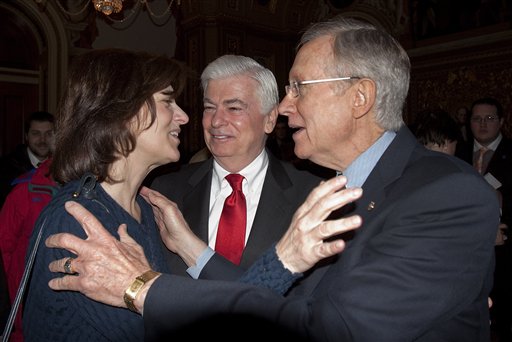
Victoria Kennedy, widow of Sen. Ted Kennedy, hugs Senator Majority Leader Harry Reid of Nevada on Capitol Hill in Washington this morning as Sen. Banking Committee Chairman Sen. Christopher Dodd, D-Conn, looks on following Senate passage of health-care reform.
AP photo
WASHINGTON —Michigan's Democratic senators and U.S. Rep. John Dingell, who represents Ann Arbor, hailed the early morning passage of a landmark health care bill in the United States Senate today.
The 60-39 vote on a cold winter morning capped months of arduous negotiations and 24 days of floor debate. It also followed a succession of failures by past congresses to get to this point. All Senate Democrats and two independents voted yes. Republican opposition was unanimous.Â
The legislation could define President Barack Obama's legacy and usher in near-universal medical coverage for the first time in U.S. history.
“I commend my colleagues in the Senate on achieving this historic milestone," said a statement from Dingell, D-Dearborn, who authored the health-care reform bill passed earlier in the House. "The journey is long, but the reward will be great. ... When President Obama signs a final, combined bill, we will be well on our way to fulfilling our longstanding moral obligation -providing quality, affordable coverage for every American.”
Dingell, who has introduced health-care reform legislation in the House every year since 1957, was acknowledging the major differences that remain to be worked out between House- and Senate-passed health-care reform bills. Both bills would extend health insurance to 30 million-plus more Americans.
Debbie Stabenow, Michigan's junior senator, called the day a historic one for the nation. "We have passed legislation that will provide health insurance reforms that save lives, save money, and save jobs. ... 14,000 people woke up this morning with health insurance but will go to bed without it. This happens every day in America. This legislation will help them and thousands of others ensure that if they lose their jobs, their family won't lose their health care."
Carl Levin, Michigan's senior senator, acknowledged the shortcomings in the bill, but said it still represents a "major historic step toward providing secure health care for all Americans."
Reaction from Republican lawmakers, however, was scathing.
"Not even Ebenezer Scrooge himself could devise a scheme as cruel and greedy as Democrats' government takeover of health care," House Minority Republican Leader John Boehner said in a statement.
The Ohio Republican complained the legislation would increase health coverage costs for families and small businesses, raise taxes during a recession and cut into federal health care benefits for the elderly.
The bill's passage will offer Obama a bright end to an often rocky year that began with huge hopes following his election victory. His public approval level now hovers around 50 percent as he copes with high unemployment, increasing violence in Afghanistan and the divisive health care debate.
Obama delayed his Christmas vacation in Hawaii until the Senate vote, a sign of its importance to his presidency. The legislation will likely shape the 2010 congressional elections and possibly Obama's 2012 re-election bid.
Obama quickly hailed Senate passage of the bill and said his government is now "finally poised to deliver on the promise" of overhauling a troubled system.
He noted that presidents since Theodore Roosevelt in 1912 have been trying unsuccessfully to overhaul medical care.
Obama also repeated his theme that the bill will help end long-criticized insurance industry practices, such as denying coverage for pre-existing conditions.
The Senate bill "includes the toughest measures ever taken to hold the insurance industry accountable," Obama said.
Vicki Kennedy, the widow of the late Massachusetts Sen. Edward Kennedy, who made health reform his life's work, watched the vote from the gallery.
The legislation would ban the insurance industry from denying benefits or charging higher premiums on the basis of pre-existing medical conditions. The Congressional Budget Office predicts the bill will reduce deficits by $130 billion over the next 10 years, an estimate that assumes lawmakers carry through on hundreds of billions of dollars in planned cuts to insurance companies and doctors, hospitals and others who treat Medicare patients.
For the first time, the government would require nearly every American to carry insurance, and subsidies would be provided to help low-income people to do so. Employers would be induced to cover their employees through a combination of tax credits and penalties. The legislation costs nearly $1 trillion over 10 years and is paid for by a combination of taxes, fees and cuts to Medicare.
Some liberal Democrats have not been enthusiastic about the Senate bill because they don't believe it goes far enough, leaving some 24 million people uninsured.
And there are no plans for a government-run national health care system that would cover all Americans. Even a more modest proposal to have a government-run health plan compete with private insurers had to be stripped from the Senate bill in the face of opposition from moderate Democrats.
Negotiations between the House and Senate to reconcile differences between the two bills are expected to begin as soon as next week.
Comments
Steve Pepple
Tue, Dec 29, 2009 : 11:28 a.m.
A comment has been removed. Please keep the conversation on topic, without resorting to personal attacks against other commenters
maallen
Tue, Dec 29, 2009 : 10:56 a.m.
@the grinch: You sure do a lot of talking without saying much, but the one statement of yours that got me rolling was this: "That blacks continue to support Democratic candidates overwhelmingly suggests that they are far less interested in the color of a politician's skin than are RepubliKans..." You have to love this quote from USA TODAY back in 2004 "Even some democrats grumbled during the presidential campaign that Bush had more African-American and Hispanics among his closest advisers than did Democratic challenger John Kerry." Yikes! Who is more worried about "race and minorities" status? It doesn't matter the color of your skin or whether you are a minority or not, obviously to most it is about whether you can do the job or not. Let's hope the grinch sees it through the proper context instead of illconceived string of thoughts and perceptions. Despite the fact that minorities vote Demokrats, the Republikans keep "hiring" the best to fill positions. Whereas the DemoKrats are more worried about just filling positions based on race and minority status because they get their votes and want to keep them coming. Oh, one other thing, you refer to minorities as blacks. Be careful there, because minorites are considered black, hispanics, Asians, American Indians, etc. Unlike you, the grinch, I do not believe to be the Secretary of State is a "token." Or to be the Attorney General is a "token." And for the topic to be about healthcare reform, you completely overlooked the factual statements I made about the healthcare reform and focused exclusively on your opinions of what happened in history. The things that are actually in the healthcare reform has nothing to do with healthcare reform!
The Grinch
Mon, Dec 28, 2009 : 8:08 p.m.
maallen: Yes, the South was solid DemoKratic between 1865 and 1948. But, beginning with the Dixiecrats (Google it if you don't know who they were), those DemoKrats slowly but surely became RepubliKans (Strom Thurmond, the leader of the Dixiecrats, being the poster child for the transition). As elaborated on before, the Dixiecrats; Goldwater's winning 5 deep south states in 1964 (the year of the CR Act--no Republican in the 20th century had won ANY DS states to that point); Nixon's Southern strategy, Reagan going to Philadelpia, MS, and singing the glories of states' rights; GHW Bush and Willie Horton--and the examples could continue--all provide overwhlming evidence of the RepubliKan Party's pursuing white southern voters using race and racism as the motivating factor. As for blacks in the Bush I and Bush II regimes, I suggest you look of the meaning of the word "token". That blacks continue to support Democratic candidates overwhelmingly suggests that they are far less interested in the color of a politician's skin than are RepubliKans who are quick to point to their tokens but seem to forget that only about 5% of blacks vote RepubliKan You are correct that LBJ said those things with which you credited him, but that was back in the days when there was a Republican Party in the Northeast that consisted of centrist and (perish the thought) liberal Republicans--the so-called Rockefeller Republicans--the party of George Romney, Ev Dirksen, Charles Percy, and Edward Brooke, among others. It was Republicans such as these who supported the CR Act of 1964 and the VR Act of 1965. That party and those Republicans are gone. Rockefeller and the elder Romney would be called RINOs by today's RepubliKans. And it is important to note that you failed to cite or are ignorant of another statement LBJ made upon signing the CR Act of 1964. As he put down the pen after signing the bill in to law, he said, "We [meaning the Democratic Party] have lost the South for a generation." He understood that his signing the CR Bill, supported by virtually every Northern Democrat in both houses of Congress, meant that the white South soon would be voting RepubliKan, which is exactly what happened. So you, Macabre, and others can howl at the moon (as it were) about "playing the race card", but such howling means you are ignorant of the evolution of the Democratic and RepubliKan parties over the past 50 years. Whether or not that ignorance is willful only you and he and the others can know.
The Picker
Mon, Dec 28, 2009 : 7:31 p.m.
Maallan, great research, The democrats have always pandered to minorities by offering a free lunch which turns out to be a veiled form of slavery. Its always an easier path in the short run but doesn't lend itself to long term results, (ie. the vicious cycle of generational welfare poverty) The adage of the fish or the fishing pole is very relevant to the difference between liberal and conservative thought. But when dealing with the undereducated, unfortunately they fall prey to populist propaganda and are persuaded by false leaders to take the short sighted path of easy money.
maallen
Mon, Dec 28, 2009 : 2:08 p.m.
Tort Reform is opposed by the trial lawyers and not the insurance industry. The insurance industry was lobbying the democrats to include tort reform into the bill, but Obama put that to rest by stating "not advocating caps on malpractice awards" at the American Medical Association! If the Demokrats wanted true health insurance reform then they would have included tort reform, which is linked to the health insurance premiums we all pay! Also, if the Demokrats were serious about health care reform then there would be no provision of $400 million dollars going to setting up a department to help teenagers become adults! Also in this bill there is a provision for the government to start offering long term care! Now how is that health care reform? Oh, speaking of minorities and so forth, only 63% of the democrats (house and senate) supported the Civil Rights Act of 1964 while 79% of the republicans (house and senate) supported it. Guess who participated in a 74 day filibuster to weaken the legislation? AL GORE SR! A staunch democrat. Al Gore Sr proposed an amendment that would have let Federal money go to schools who defied court desegregation orders! Guess what, 23 demokrats and 1 Republican voted for it! Upon signing the Civil Rights Act, President Johnson praised the republicans for their overwhelming majority support of the bill. He did not offer the same praise to his own demokratic party. And one only has to go back to the Clinton and Bush years to see who had the most diverse (minority) cabinet in history. Guess who it is? It's the republicans who have had the most minorities in their cabinet, not the demoKrats. I think some really needs to read the health care reform bill before speaking about it! Nothing in the bill is about health care reform. Cutting pay to the physicians and hospitals who see medicare patients is not health care reform.
TFF3
Mon, Dec 28, 2009 : 11:54 a.m.
David Briegel - Sorry for my delayed response, I didn't check this story in a few days. Don't make the assumption that since I dislike Obama that I was a Bush supporter. That is short sighted on your part. You'll notice I didn't say "Republicans" in anything I wrote. Now, if you'd like to address anything I actually wrote, instead of making your own assumptions from it, feel free.
Mick52
Sat, Dec 26, 2009 : 6:58 p.m.
The fact that congress passed this by the slimmest margin shows how weak this bill is. Regardless, the most troubling issue is the two senators from La and Ne, Senators Laundieu and Nelson arranged pork for there states in return for their vote. This is disgusting and unethical behavior and should not be allowed, it should be illegal. Its become shameful how congress members insert pork into bills. If a congressman wants extra funding for a state project, the process should be by filing an bill and submit it for congressional approval. I think we deserve ethics and honesty from our representatives. As for our two senators and most of our reps, including Rep Dingell. I'm embarrassed by their behavior. If not for failing to stand up for Michigan but for failing to oppose the Landrieu/Nelson behavior.
Diagenes
Sat, Dec 26, 2009 : 11:38 a.m.
The health scam bill is about transferring wealth to create a political class that is beholden to Dems. If it was about heath care they would have crafted it similar to the prescription drug plan for seniors that has cost less than CBO estimates and provides good (but not perfect) coverage for Rx costs. As far as all the comments about not wanting to help the least among us; remember the old adage give a man a fish, feed him for a day, teach him to fish, feed him for a lifetime. Our country is rapidly getting to the point where we rely on government for so much we will lose the ability to care for ourselves.
The Picker
Sat, Dec 26, 2009 : 10:31 a.m.
Again I ask, Why weren't we offered the same health plan the political class receives? It seems to have served them well, it needed no further legislation, it is already in place, it would have required no further debate as it is already bi-partisan. Are we being gamed,dazzled with B.S.? I think so! Vote All the bastards out!!!!!!
Ignatz
Sat, Dec 26, 2009 : 7:01 a.m.
I'm disgusted with the Dems (of which I'm one) for passing this bill that further fills the coffers of the insurance companies and big pharma. President Obama campaigned on single payer and did not deliver or even try to. Instead, some folks will be compelled to either come up with money for the insurance companies or have the American people do so. It's a sell out. We'll never have a government for the people and by the people until we reform campaign funding. By the way, nobody with a brain ever said anything about "free" healthcare. There's no such thing. You have to pay for it or anything else if you want a decent society.
voiceofreason
Sat, Dec 26, 2009 : 12:30 a.m.
Mr. Briegel, After a quick scan of US Legislator Biographies, I see that the only former member of the KKK in the US Legislature was Robert Byrd (D-West Virginia). Mr. Byrd did in fact vote for this healthcare reform bill. By your logic, is it safe to say that the KKK is a strong supporter of healthcare reform?
Macabre Sunset
Fri, Dec 25, 2009 : 11:41 p.m.
It's impossible to have a rational discussion when the parties are so far apart. I think Democrats genuinely do believe the Republicans espouse the KKK. And Republicans genuinely do believe Democrats want to overthrow the economy and enact Communism. I've never voted for a Republican for president, but I look at the Democratic party today and can imagine I'll be so disgusted by 2012 that it will change. On the other hand, what if the Republicans nominate Palin or Huckabee? I don't think either party is remotely capable of reforming health care. The system is simply corrupt. And yesterday's bill is a very expensive celebration of that corruption.
The Grinch
Fri, Dec 25, 2009 : 9:48 p.m.
cinnabar7071: Go take a drive through the backroads of northern Michigan, away from the resorts, where Republicans have been in control forever, and you will see similar scenes as your youtube video. Go take a drive through the rural South (the drive along the backroads from Huntsville to Selma, Alabama, is a real eye-opener), where Republicans have been in control for the last three decades, and you will see similar scenes there as well. The economic problems of Northern Michigan, of Detroit, and of the rural South go far deeper than the political party who is in control. But go ahead and believe Detroit's problems can be blamed on Democrats and (implicitly) on the blacks who live in the city. Ooops!!! Is that playing the race card? Sure it is!! That's why you raised the issue of Detroit by linking that video!! So who's playing the race card? As for my "playing the race card", you, apparently, have not been paying attention either to history or to my posts. That's OK. I know that the truth hurts. It is the Republicans who have been playing the race card with GREAT success for the past 40 years. Pointing this out is not "playing the race card." It is merely pointing it out. And, as Lindsay Graham showed us so eloquently in his floor speech this week in which he railed against the health care bill, Republicans continue to place the race card. The only difference now is that it seems no longer to be working. Thank God for that.
cinnabar7071
Fri, Dec 25, 2009 : 8:24 p.m.
And Grinch, that was good, real good, pulling the race card on health care. The race card has been way over played and almost useless anymore. But if thats what you feel you need to win, bow down.
toofache32
Fri, Dec 25, 2009 : 8:19 p.m.
To stay in business, the insurance companies have 2 choices: pass on their new costs to consumers, or reimburse less to providers. Like all business, costs are merely passed on to consumers one way or another. We all pay for it in the end.
cinnabar7071
Fri, Dec 25, 2009 : 8:17 p.m.
Take a good look at what 40 years of Democrate control will get you. What have you to say now? http://www.youtube.com/watch?v=T6WKMNmFsxM Oh I know it was Bush's fault.
The Grinch
Fri, Dec 25, 2009 : 7:40 p.m.
Watch out, Dave. You can't say these things or Jeffersonian Liberal (whose threatening post has been removed) will threaten violence against you in order that he can defend the Constitution!!! And on Christmas, yet! Ya gotta love it!
Sarcastic1
Fri, Dec 25, 2009 : 6:03 p.m.
The end has begun.
The Grinch
Fri, Dec 25, 2009 : 5:59 p.m.
@Macabre: You would be correct if you were talking about 50 years ago. But the racist Democratic Party of the South is all but gone as those white politicians and their followers long ago moved to the Republican Party. The first step in that direction came in 1948 with the Dixiecrat defection; the last in 1994 with the Gingrich revolution. See my post above for the interveing events. @tdw: Neither Gore, nor Carter, nor Clinton were members of the KKK nor has anyone ever called them a racist. Indeed, blacks so loved Clinton that many referred to him as "the first black President of the United States." You are correct that Wallace was a strident racist--more than 40 years ago. That racist element of the pre-1970 Democratic Party long ago moved to the Republican Party. Do yourself a favor and quit embarassing yourself--go take a good history class instead.
Macabre Sunset
Fri, Dec 25, 2009 : 5:41 p.m.
On today, the approximate birthdate of the mythical baby Jesus, one could easily conclude that his so-called followers are far less moral than the rest of us. My understanding of the deep south at its racist height was that it was a bastion of Democratic support. But extreme followers of either party tend to be blithering, religious babblers.
tdw
Fri, Dec 25, 2009 : 5:29 p.m.
Grinch maybe you need to learn facts,and history the south is historically Democrat. The KKK has always been overwhelmingly southern Demorcrats.Gore Clinton Carter Wallace etc..are all from the south
The Grinch
Fri, Dec 25, 2009 : 5:16 p.m.
Putting a "K" in "Republican" is spewing hate? Well then, please tell me what you think of Glenn Beck, Michelle Bachman, the tea partyers, Rush Limbaugh, Sean Hannity, Jim Demint, Michelle Malkin, the signs with Obama as the Joker, the signs with Obama as Hitler, the false claims of death panels....... etc....... Again, me thinks you folks doth protest too much. But, as my post above makes clear to anyone even slightly interested in historical FACT, the "K" I put in "Republican" is well deserved.
The Grinch
Fri, Dec 25, 2009 : 5:07 p.m.
@Macabre: Me thinks you doth protest too much. Please tell me how the White South went from being solidly Democratic in 1962 to being solidly Republican by 1994 if not due to race and racism. Your essay should include an explanation of the impact the CR Act of '64 and the VR Act of '65 had on southern politics, of Barry Goldwater's winning four southern states in 1964 (the first Republican since T. Roosevelt to win so many former Confederate states), of Nixon's "Southern Strategy", and of Reagan's decision to start his presidential campaign in Philadelphia, Mississippi, with the battle cry of state's rights. Extra Credit if your answer can explain Strom Thurmond and the Dixiecrats as well as Trent Lott's comments about the Dixiecrats at Thurmond's 100th birthday party. No, many and maybe even most Republican supporters aren't racists, but there's a reason that there is no Republican member of Congress from the Northeast and why the white South is solidly Republican. Lindsay Graham, in a speech on the floor of the Senate, played the race card just the other day, blaming South Caolina's poverty on it's black population. Yeah, right. Aside from the fact that SC has almost as many whites below the poverty line as blacks (http://www.statehealthfacts.kff.org/profileind.jsp?ind=14&cat=1&rgn=42)(The black percentage is nearly three times that of whites), this little "fact" overlooks the impact that 200+ years of slavery followed by a century of Jim Crow had and continues to have on black society, culture, and economic opportunity in South Carolina. But blaming poverty on blacks is a sure-fire way to rally white support, which Graham needs because even he has been taking hits lately as being too moderate. The Republican party has for a generation made hay by sowing the seeds of race hate and that is what is behind the birthers, the tea partyers with Obama as Nazi/Socialist/Communist. Oh, yeah, and funny how all of those tea partyers (as well as the KKK) believe they are defending "Christianity".
tdw
Fri, Dec 25, 2009 : 4:57 p.m.
why are the ones who claim to be the most caring,human loving,the ones who are the first to spew venom and hatred for anyone who does not share their point of view?
David Briegel
Fri, Dec 25, 2009 : 4:28 p.m.
Gee, If only would could return to those good old days of yesteryear when the Repubs were in charge of everything and that fine upstanding example of conservatism, Shrub, was in charge of every single thing. remember? They sure made this a better place to live! HAH! We are standing in the ruins of every single thing the Reaganites stood for and they HATE being confronted with their moral bankruptcy and failures! Merry Christmas
David Briegel
Fri, Dec 25, 2009 : 3:54 p.m.
Grinch, thank you for spending your Christmas like this. I just took a break from my family to find that these pseudo-Christians don't care about their fellow man. Not one single post about either testament nor one single human being. A GLARING example of the moral bankruptcy of their position. To hell with everyone except the insurance companies and the billionaires that rent our gov't. It is mind numbing on a day like today to hear the heartless, cold and cruel comments from these poor souls! Proof of the "hard slog" ahead as we attempt to civilize this morally bankrupt and corrupt nation!
The Picker
Fri, Dec 25, 2009 : 3:18 p.m.
I like your inclusion of the K in your spelling. Gives cred to the new revolutionaries
Macabre Sunset
Fri, Dec 25, 2009 : 3:01 p.m.
Grinch, It's a bit hard to take you seriously because of all the name-calling. Not everyone who opposes the bill watches Fox News and is a Republican. Not everyone who is a Republican belongs to the KKK. Most don't. The major unions are getting a very large cash kick-back to support Obama's plan. So the taxpayers get to support those Cadillacs in their entirety. Tort reform is not just a talking point. It's something that could greatly reduce health-care costs, both driving down the price of malpractice insurance and the enormous cost of CYA medicine. Go to the doctor for a hangnail these days, and you might end up getting an MRI, "just in case..." I thought Bush sealed his fate back in March 2003 when he pretty much unilaterally invaded Iraq. I was wrong then. He somehow managed to win again, though I believe his invasion made Obama possible. So I may be wrong today when I suggest that the Democrats have ruined their chances in 2012 by passing this incredible tribute to the insurance, union and trial lawyer lobbies. Once we find about what was really passed, even CNBC is going to have to leave the Obama bandwagon. Mostly, it's the cost. This will raise taxes like nothing in history. But it's also the false claims. This won't insure everyone. It will force those who can pay for insurance but choose not to pay to buy, at artificially-high prices, something they would rather not buy. It's a disaster for the working poor, who are over-represented in this group.
The Grinch
Fri, Dec 25, 2009 : 2:49 p.m.
@Jon Blakey: WELL SAID!!
The Grinch
Fri, Dec 25, 2009 : 2:40 p.m.
@insidethehall: That a majority of Americans does not want a bill to pass does not mean that it should not pass or that it is an inherently flawed bill. A majority of Americans did not want either the Civil Rights Act of 1964 or the Voting Rights Act of 1965 to pass Congress, either. This is why we are a democratic republic rather than pure democracy. The founding fathers feared the damage that a rabid uninformed democracy might cause, and most of the posts on this conversation belie that fear. @MacabreSunset: you weren't paying attention either, were you? Democrats, you say, "refused to take on the insurance, union and trial lawyer lobbies, which is what the Republicans would have required to agree." Yeah, that's why the AFL-CIO, AFSCME, SEIU, and the UAW are wildly opposed to the plan's proposal to tax "cadillac" health plans, plans that only two groups of people in this country tend to have: union members and highly paid executives. You are half right about the insurance lobby. As it takes 60 votes to get anything done in the Senate, and since it was clear not a single Republikan would vote for this bill under any circumstances, Democrats had to pander to Joe Lieberman, the senator of insurance companies and of Israel (he long ago gave up representing the people of Conencticut). But the idea that REPUBLIKANS were willing to take on the insurance lobby is a joke! It was Democrats who supported the public option and (God forbid) a single payer system, both of which would have forced insruance companies to become more efficient and to give up their obscene profits. But this was opposed by a handful of ConservaDems, by Lieberman, and by the entirety of the Republikan Party. But this makes sense because the Republikan Party is a wholly owned subsidiary of corporate America, but especially of insurance companies. The Republikans were not going to kill that cash cow. Trial lawyers? Tort reform is opposed as much by the insurance lobby (overwhlmingly Republikan/Lieberman) as it is by trial lawyers because, at the end of the day, insurance companies are getting rich under the current system. Any meaningful tort reform would result in drastically reduced malpractice insurance rates, and the Republikans/Lieberman were not going to let that happen. "Trial lawyers" is another meaningless Faux News talking point that captures the gullible but that has no basis in fact.
The Picker
Fri, Dec 25, 2009 : 2:23 p.m.
I didn't hear a peep out of OUR Michigan delegation regarding their inclusion in Obamacare. Where was their leadership on this subject? Did they just go along with a plan that isn't good enough for them but is ok for us? Disgraceful! The political class must view themselves as more equal than we are.
Jon Blakey
Fri, Dec 25, 2009 : 2:22 p.m.
I am glad we have finally entered the 21st century and joined the other developed nations of the world. This is the least we could do for our working poor and those unfortunate enough to have lost benefits during an economic crisis, company downsizing, or simply no insurance program provided. I suspect this bill will be tweaked and modified frequently over the coming years by both parties. Someday, the Republicans will even defend it as they did Medicare this time around. Democracy is a messy process and difficult to bear at times (just read the comments). It's always amazing to me that we accomplish anything during the often chaotic process of legislation. I am also sure that some Democrats will pay price for this. I admire the ones who did something simply because it was the right thing to do for the civilization we are trying to maintain. I resent those who needed to be bought out to vote for it. I remain puzzled by the total disdain that Republicans seem to have for ensuring everyone has viable health care. It should not just be available to the more fortunate or be dependent on emergency room reactive medicine instead of proactive medicine that many of us have with our health care policies. We are the richest, most economically successful country in the history of the world. This will not change that.
InsideTheHall
Fri, Dec 25, 2009 : 1:52 p.m.
Earlier this morning, the United States Senate passed its version of health care reform on a party-line vote. The Senate Democrats must now reconcile the bill with the version passed by the House of Representatives and then hope to sell voters on the idea. Most voters (55%) oppose the health care legislation working its way through Congress. Those who feel strongly about the legislation are overwhelmingly opposed to it. Most voters (54%) also believe they personally will be worse off if the health care plan passes. Just 25% think they will be better off. Some Democratic leaders and strategists have suggested the plan will become more popular once it has been passed and people see how it works. Fact is the majority of America does not want this yet the DEMS pushed in the middle of the night to thumb their noses at America. We will remember what has transpired.
Macabre Sunset
Fri, Dec 25, 2009 : 1:37 p.m.
Answer: because the bill required unanimous passage among the Democrats in the Senate. And that meant kowtowing to the one thing they all have in common: the lobbies that fund their re-elections. A bi-partisan bill would have meant a smaller role for the lobbyists. But the Democrats refused to take on the insurance, union and trial lawyer lobbies, which is what the Republicans would have required to agree. The result is a pork package tailored specifically for those lobbies. It won't mean better health care. The poorest of us will still flood emergency rooms every time they get the sniffles. OB/GYNs will still be driven out of business in poor areas. The CEOs of the biggest insurance companies will get an extra-large bonus next Christmas, if that's any consolation to the liberals here. And, of course, the middle class will be hit with the biggest tax increase in the history of the civilized world.
The Grinch
Fri, Dec 25, 2009 : 1:10 p.m.
@sbbuilder. BRAVO!! So youve been to India and Mother Theresa didnt want money. Somehow I dont think any of that is relevant to the exploding cost of health care in the United States nor to the growing number of Americans who have no access to our health care system except through the emergency rooms at our hospitals. And somehow I doubt there is much that I or most other Americans can do at either the U of M hospital or at St. Joes other than sweep the floors, so I fail to see how giving of my time helps solve the problem of health care access for between 30 million and 40 million Americans who do not have it. But congratulations on working with Mother T. Clearly youve checked your box for entry into heaven and no longer need to try. And to answer the question you asked of Dave Breigel: have you not been paying attention? Did you not see/hear statements by Demint, McCain, Coburn, McConnell, et. al., that their sole goal with this bill was to delay it, defeat it, and by so doing to bring down the president? Not much there to work with. Nevertheless, there were very clear efforts by Senate Democrats to court Snowe, Collins, and Grassley, to bring at least some Republicans on board. None of it worked, but not for lack of trying. Moreover, the House bill which must be reconciled with the Senate bill in conference committee, has HUNDREDS of Republican amendments, yet that bill received only one Republican vote in the House. Clearly the Republicans did not want to work together with Democrats on this issue. Thats finethats their positionbut then lets not blame Democrats for the lack of bipartisanship. To turn your question around just a bit, the better question is: Why, with the bill stripped of the single-payer, stripped the public option, stripped on anything that remotely hurt the insurance companies, with a womans right to choose significantly reduced, why was there not a SINGLE Republican vote for this bill in the Senate? Picker: You ask a great question. Let me suggest that you ask it of the Senate Republicans as well as the ConservaDems there, as they were the ones opposed to such a plan. Clearly this would be a better bill were there such an option.
bedrog
Fri, Dec 25, 2009 : 1:02 p.m.
re. the previous..i wonder how many less starving and poor in india and elsewhere there'd be with better and less corrupt birth control options and less mother theresa types exercizing their own moral rectitude on the poor while opposing those very policies that'd reduce poverty. ( and i too have considerable hands on experience in that part of the world at the grassroots level..although where i was there wasnt much grass...overgrazed, over firewooded) and re the healthcare issue my anectode a few posts above was designed precisely to show that enlightened self interest...which is far more reliable/realistic than appeals to religion/higher values toward those one doesn't know or particularly care about personally-- dictate that the current direction on health care is probably right.
BobR
Fri, Dec 25, 2009 : 12:51 p.m.
It's an improvement, but it was sad to see some reforms (public option, expansion of Medicare) get stripped away be 2-3 Senators who'd taken too much insurance lobby money.
sbbuilder
Fri, Dec 25, 2009 : 12:19 p.m.
Mr Breigel: Of the thousands of pages of this disastrous bill, how many words were drafted by Republicans? Answer: None. Now how can a bill not have a single word written by the minority party? Not even in an amendment? A bill written behind closed doors, with no disclosure as to its contents? What's up with that? So if this is to be all-inclusive for the American people, why the secrecy and the total shut-out to the Republicans? Why the giant rush? Why? Why? Why? Mr Grinch: I remember distinctly when Mother Theresa (who spent her entire life helping the uninsured, disadvantaged, poor) was asked by a wealthy man how much money she would like him to contribute, she immediately said 'No, I don't want your money. I want YOU.' The Sisters of Charity do not accept monetary donations. Didn't know that, huh? They prefer that you give of yourself, and your time, to directly help those in need. Now that's an example I would willingly follow. Do you volunteer at the local shelter? How about the jail? If you are so concerned about the disadvantaged, what have you done to help them?. Here's the sticking point: I don't believe the Gov. has the authority, nor the right, to place itself between me and my health care. Nor anybody else for that matter. I don't want them as the arbiter. The Gov's response is to take money from some people and give it to others. They claim that health care is no longer a privelage, but has now moved to become a right. Therefore, taking our money is now the right thing to do.. There is a revolution coming. Strong and hard. It's time to take back the word 'revolution' from the Left, and return it to it's proper place.. Oh, and by the way, I spent two years in India with the poor. I worked with countless orphans, and with starving people of all ages. That was life changing. I would recommend it to all.. God Bless
Arno B
Fri, Dec 25, 2009 : 12:05 p.m.
Well my long-time mentor Mark Twain (who lived well over a century ago) hit the nail on the head again: "We have the best politicians money can buy"!! Of course Dingell, Levin, and Stabenow are gloating. Why not? It is their collective wisdom which has been foisted on us. Note that these deep thinkers have made sure that their own government health care coverage is sacrosanct and not to be confused with what wonderful schemes are deemed to be best for us, the great unwashed! Back to Twain again: He called the Washington establishment "our native born criminal class". Nothing new here!
The Picker
Fri, Dec 25, 2009 : noon
If this plan is so great, then why is it NOT good enough for the members of the House and Senate? Will someone please answer this for me.
Val Losse
Fri, Dec 25, 2009 : 11:55 a.m.
We need to vote the Democrats out of office and get some balance back. Even Ann Arbor has the same problems since there are only Democrats on the City Council and Mayor. Nothing is free and we will pay dearly for it. By the way our taxes are very high, higher then Europe. We have income tax of 38%, sales tax of 6%, and property tax of 10% to 20% depending on income and the house value. Our taxes can be a whopping 70% when you add them all up. Most of Europe does not have a property tax. And our taxes are going up when this free health care bill passes. I hope someone out there can come up with a lower figure. But most people don't give the property tax or sales tax a second thought.
bedrog
Fri, Dec 25, 2009 : 10:35 a.m.
let's try a personal anecdote to shift away from the more cosmic issues of 'taxn'spend commie-liberals" vs "heartless brain dead hypocrite-faux christians" etc... about 4 years ago, i...who am actually quite well insured, athough not rich ( i.e. at the time affiliated with a particular well known local educational institution)...self admitted to the UM er for what turned out to be a truly life threatening situation ( ie a huge blood clot that at any moment might have broken loose with fatal results)...as it turned out i had to wait nearly 7 hours (!!!!) to be seen through no fault of the UM er triage people (since i had self-admitted,and had no clue as to what was really going on inside my leg), but nonetheless had to queue behind alot of people who were clearly, from the conversations around me, using the ER as a primary care facility, since they didnt have a regular doctor, or likely the insurance to cover one. ( and the one character who was clearly trying to score drugs, forget about!!! as tony soprano would say)... so, yeah, im for the bill as a step in the right direction, however currently and admittedly imperfect and flawed...
David Briegel
Fri, Dec 25, 2009 : 9:12 a.m.
Leave it the The Grinch to make my Christmas Merry! Excellent post! bedrog, Cash, Calvin Luker, it is hard to speak to people who are so angry and full of hate for their fellow man. We aren't so naive as to believe that Lieberman and Nelson are good Americans or that the insurance companies health care deniers and their billionaire CEO's are now going to reform themselves, but it is a start in the right direction for those less fortunate in our once great society. While much is wrong with our system, diligence and continued reforms will be required. We can't stop now! The notion that all the lazy are the poor is foolish. During the last crisis were the foreclosed and bankrupted helped? Or did we just bail out the billionaires who rent both parties of our two headed beast? Once again there was no trickle down. The big lie! Good comment on the New Testament and liberalism! We need to take back the word Liberal from the haters! As if conservative stood for something that was somehow Christian and good? We must keep the pressure on both parties in the coming Happy New Year!
cinnabar7071
Fri, Dec 25, 2009 : 8:59 a.m.
Hey Grinch, I'm Christian and I'm completely against the healthcare bill. Christians are all for giving a hand up to the least as you call them. And your right Jesus was a liberal, but he wasn't stupid, Jesus did the helping himself. He didn't give his resources to a wastefull organization, he did the helping himself. Do you realize theres money in this bill for of all organizations ACORN? I love to give and help others, but not when only pennies of my dollors are making it to the needy.
The Grinch
Fri, Dec 25, 2009 : 8:15 a.m.
Lot's of silly stuff here. No one was paying attention, voiceofreason? Really? Then how did you know? How was it the sole piece of national news in Annarbor.com? Why on the front page of the New York Times? Why did it lead every piece of network news for the last week--including the numerous times I heard and read a precise schedule of when the votes will be taken? I realize that this "nobody paying attention" was one of the talking points pushed by Senate Republicans and by Faux Noise, but come on, are you really that gullible? This health care bill is not about people not "busting their butts". It is about the working poor, people working 40-60 hours per week at two and three jobs, none of which provide healthcare. It is about the people who have health care coverage through work but consistently have their claims denied. It is about people who, upon finally getting a job that has HC coverage, still not having it due to pre-existing conditions. It is about those people who have HC coverage through their employer but who lose it because the employer can no longer afford it, or because the employer went out of business, or because the employee got laid off. We are the ONLY nation in the Western industrializzed world whose healthcare "system" relies upon the benificence of employers combined with "providers" (i.e., robber baron inurance companies) that make billions of dollars by denying the health care they are supposed to be providing. And many of those very same insurance companies are making a fortune off the malpractice business, too, and thereby are driving up costs at both ends. And, on top of all of that, having HC paid for by employers causes the products those businesses make far more expensive both at home and in overseas markets. Great system, that. The presumption of the "bustining the butts" folks on this page is that anyone without a good paying job with adequate benefits must be lazy and that they deserve what they get. HARDLY, and one would think that, with a state whose unemployment rate is near 15%, people here might understand that. Unfortunately, they don't. Time on this Christmas morning to go out an take a look at the New Testament, folks, and to remember that the story of the Christ child has nothing to do with Santa, or with reindeer, or presents under a tree. I has to do with how we treat our fellow man, with the social contract that exists between us, and especially how we treat the least among us. I can't help but wonder how many of the angry folks here and elsewhere on the issue of health care reform consider themselves to be Christians. It certainly is a strange form of Christianity. Remember, Jesus was a liberal. Feliz Navidad
bedrog
Fri, Dec 25, 2009 : 6:19 a.m.
im mostly with posters luker and briegel on this one, although with earlier noted caveats about bad choices leading to preexisting and covered conditions...but really mostly because if the most vitriolic,over the top rhetoric "obamahatas" are against it, it 's probably o.k.and the right thing to do.
Smiley
Thu, Dec 24, 2009 : 8:16 p.m.
@David Briegel - I doubt we have any billionaires posting here. The opposition is from middle class wage earners. The upper-most classes have irrelevent $$ in the game. People busting their butts are tired of looking over the fence and watching their neighbors not busting their butts. 2010 will be an awakening for the Democrates, and hopefully for the Republicans as well...I will be voting straight ticket Libertarian for the first time in my life.
David Briegel
Thu, Dec 24, 2009 : 6:20 p.m.
This is not Obamacare. It is Lieberman/Nelsoncare. The result of the same corrupt system that brought us Tauzin/Pharmacare masquerading as a prescription drug bill. As long as you believe money is free speech this is what we will get. Those big corporations win no matter who we elect. It is the billionaires and the corporations who are "demanding" the services of govt. The Republicans are just angry the Dems will now get all the crooked "free speech" campaign money as they implement the new programs. Calvin Luker is correct about the evil vitriol coming from Repubs like Minority Leader Boehner. And imagine if a Dem had wished some Repub would DIE so the bill would pass. Not a word from any of you. Not one! Good Americans and good Christians all! Merry Christmas
Hunterjim
Thu, Dec 24, 2009 : 5:51 p.m.
The new American motto: Ask not what you can do for your country, Demand that your country do everything for you! I can not wait to get to the voting booth on 2010.
Macabre Sunset
Thu, Dec 24, 2009 : 5:50 p.m.
Like I said, the system needs reform. Obamacare is not reform. Obamacare is a massive giveaway to the corporate entities that supported his candidacy.
notklein
Thu, Dec 24, 2009 : 4:01 p.m.
Congrats to Dave Briegel for signing his name to his post. What most of these posts miss -- as have most of the critics of the health reform process -- is that we all already are paying for "universal" health care now, through costs associated with providing routine medical care through emergency rooms, care provided to those either unable to pay for it or forced into bankruptcy to discharge medical debt, higher medical intervention required because our health care system doesn't value preventative medicine, high administrative costs, etc. The present system buries the reality of those costs and promotes the ability of reform opponents to claim that we're all going to be paying the piper from now on. The health care system already is bankrupt. We're all already paying and are going to continue to pay with or without health reform. John Boehner's comments drip with the hate and contempt of a man having no compassion and no understanding for what real America has been suffering through for decades. Many of the comments here reflect the same vitriol. Whatever the outcome of the current health care debate, I hope that America can find a way to recover from the verbal bloodbath this fight has created. Calvin Luker
clara
Thu, Dec 24, 2009 : 3:55 p.m.
The article says "Some liberal Democrats have not been enthusiastic about the Senate bill because they don't believe it goes far enough, leaving some 24 million people uninsured." This is not health insurance for all. This is another giveaway of our $ to big insurance and drug companies, the AARP and all the pet projects in the bill. To see cost projections, see the article in the Wall Street Journal today http://s.wsj.net/public/resources/images/ED-AK723_rove12_NS_20091223205749.gif (Florida Sen. Bill Nelson got $3.5 billion to pay for seniors in his state to keep their Medicare Advantage policies when seniors in other states will be forced out of theirs) Another deal exempts insurance policies provided to longshoremen from the 40% excise tax slapped on "Cadillac" health-care plans. Taxes start going up now, Medicare cuts begin after next fall's election, and spending for subsidies commences in five years. The price tag is not the first decade's announced $871 billion cost: It is $2.4 trillion. That's the cost of the tax credits in insurance exchanges, and the additional Medicaid costs the reform generates, over the first 10 years it's fully up and running. The bill lets Medicare seek almost any restrictive payment authority it wants from a Medicare Commission established for the purposes of cost control. The Senate health-care bill also exempts Medicare's actions from judicial review, taking away the right of patients to sue the government. Unlike existing Medicare coverage laws, patients won't have the ability to appeal any of the decisions of this new Medicare Commission. Primary-care doctors who refer patients to specialists will face financial penalties under the plan. Doctors will see 5% of their Medicare pay cut when their "aggregated" use of resources is "at or above the 90th percentile of national utilization,"
bedrog
Thu, Dec 24, 2009 : 3:49 p.m.
re the previous by loka..max pout? is he a new FOX network talk show host? my qualm re the bill is the idea that those with self generated preexisting conditions ( from smoking,drinking or stock car racing) get to ride on my dime...but hopefully they'll have higher premiums... otherwise a step in the right diection
Lokalisierung
Thu, Dec 24, 2009 : 3:29 p.m.
i know they don't max pout at 40%...i used that as an average. Somer places are under, some places are well above that.
tdw
Thu, Dec 24, 2009 : 3:18 p.m.
@Cash I don't agree with you much,but your last sentence is 100% true.Merry Christmas
larry
Thu, Dec 24, 2009 : 3:17 p.m.
European tax rates do not max out at 40%. Germany has an added 5.5% tax surcharge, so the tax rate is more like 46%. And of course, everything in Europe costs twice as much. I met a lady at the local PO who was mailing something to her daughter married to a Swede. She was sending her stuff like lipstick and mascara. She said everything in Sweden costs FOUR times as much as in the US. I hope this is not our new reality. We have to push back while we can,,,
Cash
Thu, Dec 24, 2009 : 3:03 p.m.
John, No we VOTE for our government...while you may oppose the current party, just as I opposed the prior one, we all have the opportunity to vote and choose our government. And at the holy time of the year, we should be thanking God we live in America.
David Briegel
Thu, Dec 24, 2009 : 2:22 p.m.
TFF3, we just took back the govt last NOV! Macabre, why don't you enumerate all the accomplishments for YOUR ideals of the last 8 years? And those EVIL trial lawyers that YOU will call when some big corp harms you or yours. And those EVIL unions that gave ALL of us a middle class way of life, the benefits of which those of us who are still employed, enjoy every single day. The one problem is that those corporations rented Lieberman and Nelson so we will not get anything like what we needed. You and I (US) pay for the health insurance of every single person lucky enough to work for the govt, public entity or progressive, civilized or unionized corp. Now, maybe, we might begin to do the right thing and help the less fortunate among us! Merry Christmas!
Lokalisierung
Thu, Dec 24, 2009 : 2:18 p.m.
TXTeacher Maybe the governement should teach everyone not to capatalize words after commas, Know what i mean?
John Galt
Thu, Dec 24, 2009 : 2:10 p.m.
Cash: I don't think we need to move to a South American country. We are becoming one.
tdw
Thu, Dec 24, 2009 : 2:04 p.m.
@TXteacher they tried but it did'nt work too well
Macabre Sunset
Thu, Dec 24, 2009 : 1:59 p.m.
I think the author of this story needs to reference a dictionary and figure out what "near-universal" means. So, the trial lawyers, the unions and insurance lobbies won big today. Small insurance companies will be crushed. Those of us not lucky enough to have big-company insurance will be forced to pay five times as much for the same coverage we can purchase independently today. And, worst of all, nothing will change for the people who most need help. The "near-universal" comes from capturing people like me, who choose no health insurance or catastrophic-only (my own choice) because we can afford health care when we need it. Maybe, if Obama had offered real health care reform, it would be worth paying a trillion dollars. This is not reform in any way. It's just increased regulation, and it's forcing people like me to buy more insurance than I need - out of a risk pool that includes people with serious existing conditions. Reform, in this case, just means a massive payoff to the lobbies that supported the Democrats. All of the liberals who think Obama just accomplished something for your ideals need to take a good long look at what he's really done. You will soon become big government cynics like the rest of us.
Cash
Thu, Dec 24, 2009 : 1:58 p.m.
TFF.....so you don't think Americans should take care of their own sick by providing affordable insurance. Wow. And on Christmas. Nice. The majority of Americas voted our leaders into power. Like that fact or not, we live in a country of rules and orderly processes. If you want a different process perhaps choose a small South American country.
TFF3
Thu, Dec 24, 2009 : 1:44 p.m.
I am extremely disapointed in our elected officials with their back-door deals, buying votes, etc. Completely unethical and unfair to the ones who voted for the bill but didn't expect special favors in return. This legislature is garbage. I work hard and pay my own way. Why in the world should I be expected to pay for someone else too? I am happy to see the majority of responses here are agains this bill. I expected to see the exact opposite, especially from a news outlet in this town. Liberals need to stand up and protest for their officials who cut deals to help themsevles and screwed you in the process. Libertarians need to step up to maintain our freedoms and not allow more government intervention forced down our throats, and Conservatives need to stand up to STOP the ridiculous amount of spending which is going to sink this ship if it continues. We need to TAKE BACK our government!
TripleVSix
Thu, Dec 24, 2009 : 1:38 p.m.
If you think health care is expensive now, just wait until it's free.
Cash
Thu, Dec 24, 2009 : 1:37 p.m.
It's a start. Thank God. "When I was sick you took care of me..." "Truly when you did it for one of my brethren, you did it for me"...... Making saving their very life affordable for many Americans who would have otherwise died makes me proud to be an American. This time for once, the insurance industry didn't win out completely. For once the majority of congressmen stood up for the least of our brethren. For those Americans, especially the children, dying without health care, this is indeed a gift that demonstrates the true meaning of Christmas.
TooT
Thu, Dec 24, 2009 : 1:31 p.m.
Hey thank you Libs for Dingell & Stabenow... What a team they are. They both voted for this socialist garbage. I already know who I'm not voting for in the next election. Does anyone have an aspirin or do I have to beg Nobama for it?
David Briegel
Thu, Dec 24, 2009 : 1:20 p.m.
Oh my, the laments of the wounded. Maybe we should cut the taxes for the billionaires or start a couple more wars for our children and grandchildren to pay off. And then when that doesn't work AGAIN we can blame Chris Dodd and Barney Frank and still say to hell with the less fortunate among us. And we would still call ourselves fiscal conservatives! But we wouldn't be liberal or socialist. We would just be delusional and wrong! Merry Christmas!
TXteacher
Thu, Dec 24, 2009 : 1:19 p.m.
Bitter, Bitter, Bitter! It's tough to see policy being passed that doesn't just benefit the rich. @tdw-the government needs to force spelling classes on some!
bruceae
Thu, Dec 24, 2009 : 1:05 p.m.
And don't forget we get to pay for the medicare increases in Nebraska. What did Michigan get out of this whole process?
tdw
Thu, Dec 24, 2009 : 12:59 p.m.
this may be un-conistiutional There is a question about the government forceing people to buy insureance
maallen
Thu, Dec 24, 2009 : 12:55 p.m.
So, how is it that they are allowed to force people to pay into the "system" for 4 years and the people get nothing in return until after 4 years? And they go on to say the budget is deficit neutral, but they are only accounting for the first ten years, and 4 years of it there are NO COSTS! So how about showing it over a 14 year period? Will it be deficit neutral then? Heck no!
Lokalisierung
Thu, Dec 24, 2009 : 12:51 p.m.
This won't bankrupt us, they'll just move your tax up to 40% of your income like every other country that has 'free' health care.
scooter dog
Thu, Dec 24, 2009 : 12:44 p.m.
I think it is a farce.Why should I or anyone else be forced to buy health Insurance or pay a fine if we don't.Total b/s
John Galt
Thu, Dec 24, 2009 : 12:41 p.m.
Enjoy yourself for now Dems. We are going to overthrow your left-wing rule very soon.
clara
Thu, Dec 24, 2009 : 12:26 p.m.
"The legislation costs nearly $1 trillion over 10 years and is paid for by a combination of taxes, fees and cuts to Medicare." and "Some liberal Democrats have not been enthusiastic about the Senate bill because they don't believe it goes far enough, leaving some 24 million people uninsured." Doesn't sound like it is doing what it alleges it is supposed to do.
voiceofreason
Thu, Dec 24, 2009 : 12:13 p.m.
Yes! It required a Christmas Eve vote while nobody was paying attention, but we are finally on our way to bankrupting this thing! Congrats Senate!