

Native American scholar James Riding In: Stored remains a human rights violation
The continued holding of Native American remains in storage lockers and boxes by museums and federal agencies is a human rights violation, a visiting Pawnee scholar said during a speech at the University of Michigan.
James Riding In, an associate professor of American Indian Studies at Arizona State University, stopped by U-M's Rackham Graduate School Monday to discuss the 1990 Native American Graves Protection and Repatriation Act.
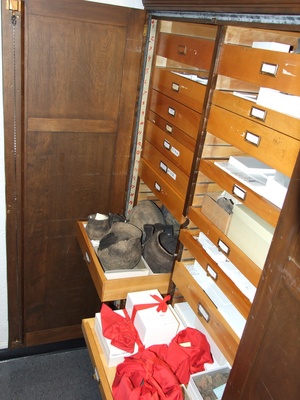
The University of Michigan Museum of Anthropology has collections containing 1,400 Native American remains and thousands of other cultural objects. Representatives from a Native American tribe visited the museum to examine its holdings and wrapped some of the objects in red cloth, NAGPRA coordinator John O'Shea said. The group decided it wanted U-M to keep these objects.
"Why is it that there's a ghoulish curiosity regarding Indian graves?" Riding In asked the audience of about 75.
The U-M Museum of Anthropology holds collections of 1,400 culturally unaffiliated Indian remains and thousands of cultural items on campus, to the ire of some Native American groups. Riding In pointed out the University of California Berkeley has had as many as 12,000 human remains in its anthropology museum's collections.
NAGPRA regulates the legal process by which institutions, museums and federal agencies that accept federal funds document and return Native American human remains and cultural items. Under NAGPRA, remains must be culturally identified through a process of consultation before being returned to either federally recognized tribes or direct descendants.
Unaffiliated remains can also be returned if the institution and tribes first come to an agreement and then follow a regulated review process.
Otherwise, the remains are designated as culturally unaffiliated and remain in storage or collections. There is no time limit on consultation and the designated status can change.
But the law makes the process too difficult, Riding In said, and it gives museums and institutions too much power.
"These institutions do not give remains back automatically," he said. We have had to fight to get these remains back."
"NAGPRA is flawed," he continued. "It leaves the determination of cultural affiliation with museums and federal agencies. It's like leaving the chicken coop under the control of the fox."
But scientists maintain there are valid reasons for holding onto human remains.
"One of the biggest reasons I think it's important we retain remains is because of the advances that are being made in the recovery and analysis of human DNA," said John O'Shea, NAGPRA coordinator for the U-M Museum of Anthropology.
A U-M panel was formed last month to examine ethical and scientific concerns like those of O'Shea and Riding In surrounding the storage of the remains. U-M spokesman Rick Fitzgerald said he does not have information today about what the panel has done so far.
O'Shea said the panel has made plans to meet with museum director Carla Sinopoli later this month.Â
U-M Vice President for Research Stephen Forrest announced the advisory group's formation at the October Board of Regents meeting. The panel was formed to prepare for an expected change to the federal law.
National NAGPRA officials said they don't know what that change might entail. National NAGPRA is a federal government program that assists the U.S. Secretary of the Interior with responsibilities related to the act.
The event was sponsored by the U-M Office of Multi-Ethnic Student Affairs, Native American Student Association and support from Native American Studies. November is Native Heritage Month.
The next Native Heritage Month event is a 6 p.m. Nov. 30 screening of "Noho Newa: Wrongful Occupation of Hawai'i," in the Modern Language Building, Auditorium 3, with Director Keala Kelly.
Juliana Keeping covers higher education for AnnArbor.com. Reach her at julianakeeping@annarbor.com or 734-623-2528.
Comments
Native Caucus
Thu, Nov 19, 2009 : 1:12 p.m.
It's understandable that there is a lot of confusion on this issue. Native people rarely appear in empowered ways in media, textbooks, etc. In fact, this article doesn't interview anyone from any of the 14 federally and state recognized tribes in Michigan who have a legal claim to these ancestral remains.... To clarify a couple of points of confusion: 1) According to the National NAGPRA inventory, these remains have been classified as unidentifiable, which primarily means more information is needed. 2) Under Article 3 of NAGPRA, it is entirely legal to "disposition" unidentifiable remains to tribes, and I quote: "nothing in the Act precludes the voluntary disposition of these cultural items by museums or Federal agencies to the extent allowable by Federal law." 3) NAGPRA was created to be human rights. Congress articulated it as such, and I quote: "This is racism The bill (NAGPRA) is not about the validity of museums or the value of scientific inquiry. Rather, it is about human rights. Senator Daniel Inouye, co-chairman of the Senate Select Committee on Indian Affairs, in a speech supporting the passing of NAGPRA (136 Cong. Rec. S17174, October 26, 1990) 4) Many suspect the practices of the UM Museum of Anthropology on this matter would not meet the baseline ethics standards of the American Association of Museums, the accrediting body for all US museums. Why isn't the UM Museum of Anthropology accredited? 5) In 2007, the world community identified the right to protect ancestral graves as a basic human right via the United Nations Declaration on the Rights of Indigenous Peoples: "Indigenous peoples have the right to the use and control of their ceremonial objects; and the right to the repatriation of their human remains. 2. States shall seek to enable the access and/or repatriation of ceremonial objects and human remains in their possession through fair, transparent and effective mechanisms developed in conjunction with indigenous peoples concerned." (Article 12) For more information, see the Native Caucus blog on this issue: umgraveinjustice.wordpress.com BTW, what tribe did O'Shea claim gave him permission to keep these items??
yohan
Wed, Nov 18, 2009 : 1:22 p.m.
If they want to examine dead bodies let them start with their football team.
NDNWARPONY
Wed, Nov 18, 2009 : 11:15 a.m.
It is not a human rights violation of the buried it is a humans rights violation on the people and community those bodies are being stolen from. And for those of you who said it is fine to dig up the dead because their body is sacred you shouldn't talk about things you are obviously ignorant to. Native peoples have a totally different religion and belief than I am sure you hold so for you too speak on behalf of them is demeaning. And cinnabar7071, you act as this is the only issue that Riding In fights for, or any Native for that matter. Native people have been fighting for every right we own since the explorers landed so dont act like this is the only issue we hold important to us. And just because they havent helped you doesnt mean that they havent helped hundreds of other people, so again next time dont speak on ignorance. And trust me no one will want your body when you die. With your offering of it, it sounds as though your family doesnt either.
yohan
Wed, Nov 18, 2009 : 5:21 a.m.
If they want to examine dead bodies then they can start with their football team.
cinnabar7071
Tue, Nov 17, 2009 : 4:56 p.m.
Silo, yes you can dig up grandma's body, she's not using it anymore. We buried her out of respect, and as part of the greiving process. We still treasure her memory, but the body not so much.
silo
Tue, Nov 17, 2009 : 4:29 p.m.
Great. It might just be he is from a culture / community where their past and their ancestors are as much part of the present as the living. Think about it. If burial sites are sacred, then...? Can I dig up your family plot? Maybe that's o.k. with you, but it might not be o.k. to the people you impose it upon. We go into war-torn areas - hostile, foreign countries - to reclaim our fallen and our dead. Why shouldn't First Nations have the same option - and our respect?
cinnabar7071
Tue, Nov 17, 2009 : 4:20 p.m.
It's interesting the battles people choose, of all the living people he could help, he goes after protecting the remains. Maybe the living causes don't offer up as much press as the dead. If they're interested, they can have my body when I'm done with it. Free and clear.