

New cases of HIV in county down in 2010, but those impacted are 'glaringly young'
New reported cases of HIV were down in 2010, but those diagnosed with the immune disease are “glaringly young,” a Washtenaw County Public Health official said this week.
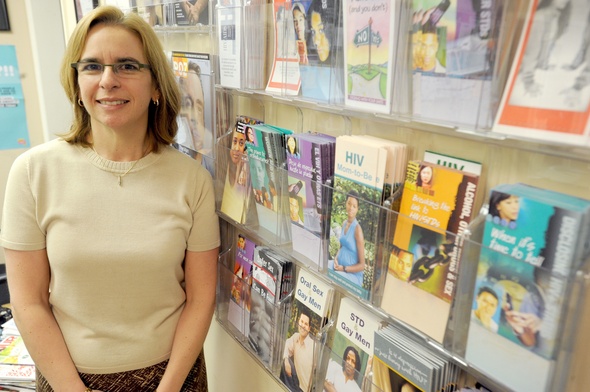
HARC President and CEO Jimena Loveluck stands by a wall of pamphlets about HIV and AIDS at the HIV/AIDS Resource Center office in Ypsilanti. A new report from Washtenaw County Public Health says new cases of HIV were down in 2010, but those diagnosed were mostly younger than 30 years old.
Angela Cesere | AnnArbor.com
Laura Bauman, an epidemiologist for the county, said the 20 cases of HIV reported in 2010 were down from 26 cases in 2009 and 30 in 2008, according to a new report. HIV, or the human immunodeficiency virus, is the virus that can lead to acquired immune deficiency syndrome, or AIDS. HIV damages cells that are crucial to helping the body fight disease.
In Washtenaw County, 70 percent of cases are in individuals younger than 30 years old. It’s more typical to see HIV spread among age groups, Bauman said.
Blacks are disproportionately affected, constituting 60 percent of the new cases. Men who have sex with men accounted for 85 percent of the reported cases in 2010.
Loveluck said the state and the nation are seeing similar trends: young black men who have sex with men make up the majority of new HIV cases.
Why?
Loveluck said the answer is complicated. While young people have grown up with information about HIV/AIDS, the disease has become a backdrop in public health. In part, that’s because the disease has become more like a manageable chronic condition than a death sentence, unlike even 10 or 15 years ago. But there is still no cure.
The cost and side effects of the cocktail of drugs taken to control the progression of the disease are of no small consequence, Bauman added.
Members of the group most affected by HIV/AIDS are less likely to have access to health services or health insurance, Loveluck said.
They live with a double stigma, of having HIV/AIDS and being a black, gay male, Loveluck said.
"We find there are men who are African American who are gay who don't feel comfortable or able to be open about their sexuality because it is something they can't as open about in their particular community. That's more around their sexuality and, there is some level of homophobia in communities of color."
The stigma can sometimes prevent testing for HIV.
HARC provides HIV/AIDS testing and services to a four-county area, including Washtenaw, Jackson, Livingston and Lenawee counties. The organization has partnered with the Michigan Department of Community Health to address HIV within the population most affected by the disease, Loveluck said.
The campaign, called Status Sexy, aims to promote HIV education and testing, and “the idea that knowing your status is an important part of your health,” Loveluck said, primarily to young black men who have sex with men.
HARC does most of its outreach and prevention work to this specific population. Staff members give educational presentations and distribute safe sex materials and information at gay bars.
Keeping the outreach and prevention effort high could be a problem as early as 2012, Loveluck said.
The Centers for Disease Control and Prevention is cutting 30 percent of its funding from a federal program that supports prevention activities for state health departments.
That funding typically filters down from the MDCH to HARC, which relies on it for $157,000, or about 15 percent, of its yearly budget.
Loveluck said the organization will have to reprioritize some of its community outreach and education efforts. HIV testing will still be a major priority, she said.
Cuts could mean a reduction in the number of outreach and prevention sessions the organization will be able to conduct and possibly a reduction in hours for free and anonymous testing, she said.
Juliana Keeping covers general assignment and health and the environment for AnnArbor.com. Reach her at julianakeeping@annarbor.com or 734-623-2528. Follow Juliana Keeping on Twitter
Comments
Charley Sullivan
Mon, Sep 26, 2011 : 8:53 p.m.
Yes, we need to be careful about language about stigma. Perhaps the concern could be re-cast in the following way, however, which I do based on now nearly 25 years of work in AIDS activism. African-Americans, and people of color in general, have increased barriers to accessing health care, including health counseling, in the United States. Youth, particularly on their own, have significantly increased barriers to accessing health care, including health counseling, and particularly on matters related to sexuality and reproductive health. Poorer people and those without insurance face similarly increased barriers. In Washtenaw County, these elements converge in parts of the African-American community. The barriers to information and access hit young men of color who have sex with other men particularly hard, AND in a sexual community with higher rates of HIV prevalence. It hasn't been my experience that homophobia is worse in African-American communities than in various white, Asian or Latin communities. It is my experience that homophobia is worse in religiously conservative communities, no matter what the racial or ethnic makeup. (This is not always true, but it is at the heart of current discussions about the sources of homophobic bullying, for instance). HIV has long been spreading faster in communities of youth of color for quite some time, so these statistics mostly align us with larger patterns of HIV transmission in the US. It points to a need for continued education and for targeted outreach that is culturally specific. (And as an aside, abstinence- and fear-based approaches have been shown clearly to be sub-standard here.) All this said, I remember a single week back in 1988 when I found out that more than 20 people I knew in one part of one city had AIDS, so part of me is grateful that this is the number for a whole year in our county. This doesn't lessen my profound concern, however, for each case of sero-conversion here. Even one is too many.
Mike D.
Mon, Sep 26, 2011 : 9:32 p.m.
Charlie, I agree with most of what you said, but I don't think it's right for white man from a background of significant education and privilege (like, say, you or me) to say that homophobia isn't worse in the black community than it is for us. My black friends tell me otherwise. How many out gay black role models can you point to with any notoriety?
Jimena Loveluck
Mon, Sep 26, 2011 : 8:35 p.m.
In our experience, we find that that many young African American gay males experience homophobia in their community which is often cited by them as a barrier to getting tested for HIV or talking about AIDS. These experiences can make it more difficult to be open about their sexuality and thus reduce their openness to HIV testing. HARC makes concerted efforts to reach out to this population and get them connected to services they need.
KeepingItReal
Mon, Sep 26, 2011 : 7:13 p.m.
Basic Bob: Please show me in the above statement where there was any specific overtures concerning PC. I think you exemplified exactly what you criticized. I think when public officials make statements to the media concerning sensitive issues or matters that are important, they should take the time to communicate them clearly. That's PR .101. However, we know that is not always the case so it's important to seek clarification on such matters.
Sparty
Mon, Sep 26, 2011 : 6:03 p.m.
HIV/AIDS prevention and treatment is certainly not an area where funding should be cut -- in fact, it's an area where funding should be increased as it's proven to decrease future costs if prevented in the first place or if treatment occurs before HIV or AIDS significantly erodes the immune system. The fact that anyone with this disease has to fight for treatment or drugs is a disgrace - at a minimum the diagnosis should immediately qualify these individuals for Medicare so that life saving treatment is available without interruption.
cinnabar7071
Tue, Sep 27, 2011 : 12:33 p.m.
You guys are mad at my comment? I live a responsibly life, safe sex, wrap it up and all that. And you're mad at me? Then you bring kids into the mix, they arent at risk according to the story its young gay men who should know better, and somehow you put them on a deserted island when the rest of us were paying attention to all the aids ads telling us not to share needles or at least wash them with bleach, not to have unprotected sex. But you are mad at me. LOL! Good luck living like that.
Sparty
Tue, Sep 27, 2011 : 3:06 a.m.
Yeah, and the kids who don't get educated? Older adults who thought they never had to think of such things? Babies born to infected mothers who weren't treated correctly? Women who weren't told or were cheated on? Men who were cheated on? People who were lied to and trusted their partner to their misfortune? A healthcare worker accidentally infected in a workplace accident? I guess nothing unfortunate has ever happened to you!
eastsidemom
Mon, Sep 26, 2011 : 8 p.m.
cinnabar your comment seems heartless when referring to children, so your 12 year old child is an expert on condom use and you taught him all this at home...the facts is that you are in a very small minority, most moms do not teach this at home, and hope to rely on the school to do this. Well sex ed is just beginning to come back to public ed...a whole generation has missed it. Society will pay the cost, including your talented 12 year old.
cinnabar7071
Mon, Sep 26, 2011 : 7:34 p.m.
Or they could just wrap it up like the rest of us. My 12 y/o knows how to prevent aids. We all make choices we have to live with, I have made plenty myself, but shouldn't have to pay for yours.
KeepingItReal
Mon, Sep 26, 2011 : 2:14 p.m.
I picked upon that statement as well and would like to see some clarification. It says a lot about the person making the statement.
Basic Bob
Mon, Sep 26, 2011 : 4:06 p.m.
Sometimes it is important to make observations about how groups of people perceive others. I certainly didn't infer that Ms. Loveluck or Ms. Keeping share that perception. We should not allow political correctness to make us ignorant.
Kevin S. Devine
Mon, Sep 26, 2011 : 12:57 p.m.
Overall, a well-written and sobering article, however the sentence "They live with a double stigma, being gay and black," troubles me. It is unclear what it means. The sentence as written seems to imply there is a stigma associated with being black and a stigma associated with being gay. Perhaps the stigma you are suggesting is associated with being HIV positive and being of color and gay adds another level of challenges. I'm sure you didn't mean to imply being of color (or being gay) is a sign of dishonor or disgrace. Perhaps a rewrite of that graph is in order?
KeepingItReal
Mon, Sep 26, 2011 : 4:09 p.m.
I question whether this statement is accurate as there seems to be openly practicing Gays in the African American. I have not notice any particular discrimination toward them by fellow African Americans or a lack of acceptance. There is a problem with people who have something to hide...such as their professional standing in the community, I believe it is called being "on the down low" that presents a far more serious problem than someone who openly acknowledge they are Gay. I believe more education should be targeted to this group to educate them on the dangers they pose to others.
Juliana Keeping
Mon, Sep 26, 2011 : 2:31 p.m.
Hi Kevin. I have added more to the story along those lines. Jimena Loveluck said: "The double stigma was about AIDS and being black, gay male. But it's really more about the gay in African American community." "We find there are men who are African American who are gay who don't feel comfortable or able to be open about their sexuality because it is something they can't be as open about in their particular community. That's more around their sexuality and, some level of homophobia in communities of color." Loveluck added that the stigma sometimes prevents members of this community from getting tested.