

New report contemplates tax increase to fund expansion of AATA transit services in Washtenaw County
The Ann Arbor Transportation Authority's governing board voted 5-0 on Wednesday to accept a new report detailing possible funding strategies for a countywide transit expansion.
The 61-page report will be given to a special Finance Task Force responsible for analyzing the funding options and recommending a course of action to pay for the service improvements AATA has outlined in its 30-year transit master plan.
“The transit master plan offers a very clear vision for meeting our county’s transit needs over the next 30 years,” said AATA CEO Michael Ford. “The funding options included in this report provide us with the next steps toward making that vision a reality.”
The report shows current funding levels are sufficient for existing transit services in Washtenaw County and may even offer opportunity for limited improvements, but additional funding is needed to realize the services envisioned in the transit master plan.
Funding options detailed in the newly released report include public-private partnerships, tax-increment financing, local sales taxes, payroll taxes, parking fees, property millages, and increases in the state gas tax and vehicle licensing fees.
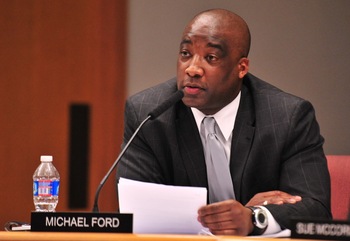
AATA CEO Michael Ford
Ryan J. Stanton | AnnArbor.com
Meanwhile, the report shows the AATA's operating costs growing from $25.1 million in 2010 to $40 million by 2015, $66.3 million by 2025 and $85.8 million by 2040.
Hypothetical revenue sources include a 1-mill countywide tax eventually growing to 1.5 mills, layered on top of the 2 mills already levied in Ann Arbor. The report also suggests a local sales tax or equivalent payroll tax levied on salaries paid by local employers could generate about half the authority's revenue by 2040, eliminating the need for property millages.
"Reliance on a property tax for transit funding is relatively unusual," the report states, going on to note that in 2009 about 67 percent of the dedicated operating revenues for transit agencies across the country derived from sales taxes and just 6 percent came from property taxes.
The report concludes that sales taxes are perhaps a more progressive solution than property taxes, as contributions are drawn from all beneficiaries of the transit system, including people working in and visiting the area, rather than just local residents.
But to be sure, the report takes a look at what additional revenue a countywide tax could raise if laid over Ann Arbor's existing 2-mill transit levy, which brings in about $9.5 million annually. An additional 1-mill countywide tax would bring in $14.5 million, including $4.6 million from Ann Arbor; at 1.5 mills, a countywide transit levy would net $21.7 million ($6.9 from Ann Arbor); and at 2 mills, a county transit levy would net $29 million ($9.2 million from Ann Arbor).
The report notes Michigan could raise an additional $350 million annually if it increased the state gas tax from 19 to 23 cents per gallon for unleaded fuel, followed by a further increase to 27 cents within three years. Similar increases in the tax on diesel to 27 cents per gallon could raise another $92 million, the report states.
Based on the fact that Washtenaw County represents about 3.3 percent of Michigan's total population, the report estimates the county could see a $14.7 million boost in transportation funding. Those yields are assumed elements of the report's hypothetical budget, which also estimates a local parking tax could raise $3.2 million annually in later years of the plan.
The report also suggests the new countywide transit authority could create a special tax-increment financing district to capture local taxes to fund capital costs and operations.
A hypothetical funding strategy outlined in the report also involves using federal funds in two ways: 1) a pay-as-you-go approach that spends grant money on projects as that money flows into the region, and 2) a debt-financed component where loans are taken out to pay upfront costs of certain projects and then are repaid later using federal grants.
AATA officials noted some options, such as increases to the state gas tax and a local sales tax, would require action by the state Legislature or a voter-approved constitutional amendment before becoming available as a funding opportunity.
Board Chairman Jesse Bernstein said it's difficult to predict what funding tools may be available over the long-term, but the report does a good job of examining what has worked in other parts of the country as well as funding options that can be leveraged here now.
Asked what level of millage it would take to fund the first five years of AATA's transit master plan vision, Bernstein said: "I don't know and I don't care."
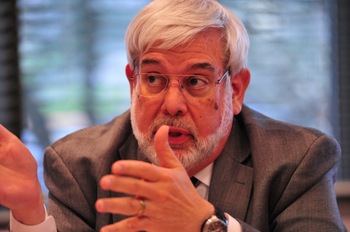
AATA Board Chairman Jesse Bernstein
Ryan J. Stanton | AnnArbor.com
Bernstein said a mere increase in the gas tax isn't going to fund all of the AATA's needs. He described it as a Catch 22 — as more people move away from cars and use public transit, or even switch to greener vehicles, that leaves less gas tax revenue for public transit.
"The state has the same issue in terms of raising funds for roads," he said. "So we all need to look at that down the road and what impact we're going to have on that. We've got to look at other ways to fund roads and transit."
The plan makes note of existing sources of transit funding in Washtenaw County, including federal and state operating assistance, passenger fares and third-party fares from institutions such universities that pay for all or part of the fares of their students and employees.
Also providing revenue to AATA are purchase-of-service agreements with municipalities outside Ann Arbor and the levy paid by Ann Arbor property owners. The city of Ypsilanti also has a dedicated 1-mill transit levy, passed last November, that pays for AATA services.
The Finance Task Force is expected to hold its first meeting in September and issue its funding recommendations in January to an unincorporated Act 196 transit authority, a body of representatives from throughout Washtenaw County that will be charged with developing the governance, service, and funding framework for a countywide transit system.
It will be up to the unincorporated board and the eventual countywide transit authority to act on the task force’s recommendations.
The Finance Task Force is being co-chaired by McKinley CEO Albert Berriz and former Washtenaw County Administrator Bob Guenzel. Additional members, including representatives from the business and civic community, are to be announced later.
AATA spokeswoman Mary Stasiak said the plan is to go back into the community now and find out what services people want to see implemented in the first five years of the plan. She said that will help define exactly how much money is needed in the short term.
"We're not endorsing a millage as a way to fund this, although right now from a short-term standpoint that may be the only way," Stasiak acknowledged. "But it's really going to be up to this task force to determine what the options are going to be."
A digital copy of the funding report is expected to be posted here eventually. It was made available only in hard-copy format tonight.
Ryan J. Stanton covers government and politics for AnnArbor.com. Reach him at ryanstanton@annarbor.com or 734-623-2529. You also can follow him on Twitter or subscribe to AnnArbor.com's e-mail newsletters.
Comments
DonBee
Fri, Aug 26, 2011 : 1:52 a.m.
If the routes were setup in a way to make it possible to walk less than 1 mile from any house to a bus stop and get on a bus at least 1 time per hour, I might be interested. But there will be a small number of high frequency corridors and a lot of out county that will see no bus service at all. I am surprised that van service into the towns to pick up larger buses is not on the agenda. If you live out county, you are going to have to drive some where and park, to ride the bus, unless you are very lucky. Until they can come up with a way to make the bus system at least 50/50 (50 percent rider fare and 50 percent taxes) - I will be voting no.
braggslaw
Fri, Aug 26, 2011 : 12:05 a.m.
This is wrong on so many levels I don't know where to begin - no evrironmental benefit....yes no environmental benefit despite what the left would have you belief - waste on an enormous scale - no accountability I think people will recognize the waste and shut this down quickly
Stephen Landes
Thu, Aug 25, 2011 : 8:08 p.m.
Two issues that I think are relevant here: 1) Studies from other regions describing how their funding models work are probably useless these days as our entire thinking about government funding form the Federal level to the city level are changing. Strategies that worked even one year ago may no longer be valid because we have a great national conversation going on about what constitutes the proper role of government, how much we can afford to pay in taxes, and now much debt we can afford to carry. 2) I am a driver, not a rider. One of the comments posted to this article cites the relative contribution by riders to taxpayers/drivers as 18% to 82%. What I need to see in order to support this kind of taxation is an economic study of what I am getting for my portion of the 82%. This needs to be in hard numbers rather than platitudes about what is "good" for society or the environment. Put dollar figures on these supposed benefits and prove to tax payers that there is a solid return on investment for us. In my economics and management classes we discussed valuing such indirect costs and benefits as aesthetics, incidental uses, etc. Estimate what costs I am avoiding by having fewer cars on the road: travel time, driving enjoyment, collision avoidance -- I'm sure there are others. Demonstrate that for the few people who simply cannot drive this approach is more economically sound than taxi/hire car service. Prove to me that the 18% passengers contribute to AATA's operating costs is really about the same as what they would experience if they paid for personal transportation including parking. If the fares paid are the highest that can be borne because otherwise people would not give up the freedom and flexibility of their personal transportation then that should tell us something about the wisdom of even having an AATA. It is possible to do such a detailed analysis and it should be done before telling us that this expansion project is "good" for
Vivienne Armentrout
Thu, Aug 25, 2011 : 7:47 p.m.
I haven't had a chance to read the report yet (Ryan is moving fast, it was only released this morning). So - I don't know under what circumstances the tax increment financing district is proposed or for what purpose. But I'd point out that all local governments, and especially Ann Arbor, where major capital investments are most likely to occur (think Fuller Road Station), are under considerable financial stress right now. A TIF district would remove income from those governments. (Question for staff: does AATA pay property taxes now on its facilities? It seems odd, if so.) The trend at the state level is to punish localities for financial stress. (Emergency manager, now limiting amount they can pay employees toward health care, etc.) This is no time to remove revenue sources from local governments. The report was done by Steer Davies Gleave, a London-based consultant. Perhaps that explains some of the more unrealistic aspects of the plan, that would involve major changes in state law. As summarized here, it reveals a profound ignorance of the way tax policy is viewed in Michigan. Further, some of the tax ideas, if feasible, would have a lot of demand from local governments. Local sales taxes? Local payroll (i.e., income) taxes? Increased gas taxes? If Michigan did increase the state gas tax, the money raised would fall into what is already a transportation funding chasm. We do not have enough gas tax revenues to keep local roads adequately surfaced, repair bridges, or provide matching amounts for many Federal grant programs. Ann Arbor could greatly benefit from a city income tax to pay for basic services (fire, police and others), but the obstacles to passing one are considerable. Would the entire county be more likely to pass an income tax? And how would increased sales taxes be "more progressive", since they would presumably be levied on necessities that our income-stressed citizenry must buy. I'm glad that the panel reviewing them is local.
Macabre Sunset
Thu, Aug 25, 2011 : 6:57 p.m.
For that kind of money, I'd expect bus service to Utopia.
LBH
Thu, Aug 25, 2011 : 6:25 p.m.
Psssst RWS - For each person you saw packed on those buses at peak times like morning and afternoon rush hours, (while undoubtedly sitting in your car, probably by yourself) there were that many fewer car on the road clogging up traffic and burning fuel making your drive that much smoother. I ride the buses often and I rarely see fewer than 10 people on them unless they are just leaving the transit center, or just pulling in.
say it plain
Thu, Aug 25, 2011 : 4:14 p.m.
What *is* it with the arrogance of AA city officials?! Mr. Bernstein actually uttered "I don't know and I don't care?!" about how much money might be needed to fund the operations he's charged with understanding?! How's about we get to answer questions about Mr. Bernstein's future career options with "I don't know and I don't care"?! How can he expect us to trust him enough to hand over more of our hard-earned and decreasingly plentiful money to provide us with the right transportation services to ensure our quality of life and growth as a community?! It's one thing to claim that a tax increase isn't necessarily in the plans (although the other rep of the AATA body seemed to contradict Bernstein's dismisal of the question, when she says that a tax increase may be the only way to fund their proposed increases in service 'in the short term' at least!), but it's quite another to imply that he doesn't "care" how much money might be needed from those 'sources other than gas taxes', i.e., *we citizens*! Yes, nice of the AATA to maybe also imply, via their "spokeswoman" if not their board chairman Mr. Bernstein, that perhaps the people should be asked what services they'd be interested in having/paying for!
Len J Sunday
Thu, Aug 25, 2011 : 3:56 p.m.
I think if we add publicly fund art on the buses, ridership would go up.
macjont
Thu, Aug 25, 2011 : 3:33 p.m.
I don't even need to think about this one. With all the idiotic opposition voiced in these comments, I have to be for the project. I'm voting YES!
charlesw mancherian
Thu, Aug 25, 2011 : 3:33 p.m.
NO! NO! NO! We City taxpayers don't need this and already pay our share for AATA service. Don't double tax us.
G. Orwell
Thu, Aug 25, 2011 : 2:13 p.m.
We can't even afford a Chevy plan, yet these guys are going for the Cadillac plan. Public transit is good and necessary; however, let's be reasonable. Too many people are suffering financially and it is not going to get any better any time soon. AATA should take a haircut like everyone else. I take that back. Except the banks that created the ponzi scheme.
sbbuilder
Thu, Aug 25, 2011 : 7:32 p.m.
Cadillac plan, my eye. This plan is more akin to a tricked out Saudi prince's Rolls Royce.
G. Orwell
Thu, Aug 25, 2011 : 5:12 p.m.
outdoor, Please look beyond the surface. Banks control and own our politicians and economy through fraud. Why do we have to pay the Federal Reserve (privately owned by the mega banks) interest for them to print money? Or, punching a few keys into their computer? When our government can do it for free. Why has the Fed secretly loaned $16.1 trillion to banks, including foreign banks and we can't do anything about it? Because they own us.
outdoor6709
Thu, Aug 25, 2011 : 5 p.m.
Your anger at banks is misplaced. Think Community reinvestment Act, and Barney Frank who said in 2004 that there were no problems with Fannie Mae and Freddie Mac. Banks take other peoples money and invest it. If Government makes them give loans to people who cannot repay it, they figure out ways to speard the risk.
Not a valid excuse for a newspaper
Thu, Aug 25, 2011 : 2:09 p.m.
I, for one, would love to see the county-wide access added and would support having a variety of funding sources to do so. Food for thought: when gas prices rise, bus ridership increases. When gas prices rise higher than before and remain there, I'd bet some will think twice about driving the car everywhere, and even a millage increase will be less expensive than owning and operating that additional vehicle. I'd be happy to have the additional transportation options afforded by a county-wide mass transit system.
blahblahblah
Thu, Aug 25, 2011 : 1:44 p.m.
Mr. Bernstein in the related DDA article, "As long as everybody is on a different planet, we're not going anywhere," Well said!
amazonwarrior
Thu, Aug 25, 2011 : 1:27 p.m.
Time for AATA to pull up their socks and make some cost cutting/saving efforts before they start begging for more money. I haven't heard of any being done, have you? Another millage on the taxpayers backs...in your dreams.
dconkey
Thu, Aug 25, 2011 : 1:11 p.m.
I wonder how many of the people on the board rode the bus to the meeting?
hepcat
Thu, Aug 25, 2011 : 1:10 p.m.
As an aging, legally blind, bus riding taxpayer, I support AATA. We are all getting older and will have to give up driving as I had to 18 years ago. The more service the better.
Macabre Sunset
Thu, Aug 25, 2011 : 6:58 p.m.
Then how 'bout paying for it yourself, rather than begging from all your neighbors?
JSA
Thu, Aug 25, 2011 : 12:41 p.m.
No way can anyone with more than a minimal intelligence support this garbage. I request that the AATA restrict their activities and delusions to Ann Arbor. We do not need your money grabbing initiatives in the rest of the county so quit trying to rip us off.
aabikes
Thu, Aug 25, 2011 : 12:39 p.m.
This is a solid investment. Every car pulled off the road and out of the way is less congestion, less accidents, less stress, and less time wasted for the remainder who like to drive by themselves. Not even to mention healthier air, less road damage, and sound transportation options for the future as gasoline prices continue to rise each year.
Barb's Mom
Thu, Aug 25, 2011 : 12:38 p.m.
Does everyone with a U of M student id still get to ride for free? Start charging them to ride the bus before you ask for a tax increase. If High School students have to pay, then college students should pay also.
LBH
Thu, Aug 25, 2011 : 6:21 p.m.
Correct - UM does pay for their riders.
Andrew
Thu, Aug 25, 2011 : 2:59 p.m.
The University actually pays ATA an annual lump sum to encourage staff/students/etc to park farther away and take the bus into campus.
sbbuilder
Thu, Aug 25, 2011 : 12:32 p.m.
I've been active in my kids' schools. I've been active with the homeless community. I've been active with some volunteer efforts. But, apart from voting, no involvement with politics. That's about to change. I'm mad as hell, and won't put up with this nonsense. Of all the asinine political shananigans this town has engaged in, and there are plenty for sure, this particular stunt transends all others in scale (the money needed is incomprehensible), and in audacity (they may as well have started their own Mars colony project). Enough words, time for boots on the ground.
Jimmy McNulty
Thu, Aug 25, 2011 : 12:28 p.m.
Cannot wait to vote NO for this one!
aaudubon
Thu, Aug 25, 2011 : 12:22 p.m.
To see what services are proposed in the Transit Master Plan, visit: <a href="http://www.movingyouforward.org/news-resources" rel='nofollow'>http://www.movingyouforward.org/news-resources</a> Service IS proposed to extend to all Cities and villages (including Saline). in fact, a local connector service is proposed for Saline too. Additionally, the entire county will be provided with Door-to-Door service, vanpool, and flex-ride.
xmo
Thu, Aug 25, 2011 : 12:16 p.m.
Is the AATA Board on "medical marijuana"? We are in the middle of the "2nd GREAT DEPRESSION" and they talk about raising sources of revenue to fund a department that doesn't break even without tax payer dollars. How about "pay as you go plan" slap a 25$ tax on each ride on the bus and save your money until you can fund your expansion.
belboz
Thu, Aug 25, 2011 : 12:07 p.m.
We are subsidizing every rider $4.03 per ride, or $24 million per year. How about AATA figures out a way to reduce costs instead of more subsidization... Either that, or maybe riders can contribute more than just slightly over 10% of the actual cost. For the people riding it back and forth to work now (2 times per day x 5 days x 4 weeks=40 times), this is a $160 subsidy per month. That's more than some people spend per month in gas! Not so efficient and environmentally sound, in my opinion.... Sure, if more people rode it...yada yada yada. But, they don't. So, we need to deal with the reality and make it work with the current level of ridership. Even if ridership did double, it would still be a $21 million subsidy. That is how inefficient the system is. I'm not saying it doesn't serve a purpose, or to kill it. But come on, more taxes for this operation? __________ 2009 (latest published data....) 6,081,000 Riders $3,117,011 Riders Paid... $27,606,000 Operating Expenses <a href="http://michigan.gov/documents/treasury/817548AnnArborTransportationAuth20100323_315871_7.pdf" rel='nofollow'>http://michigan.gov/documents/treasury/817548AnnArborTransportationAuth20100323_315871_7.pdf</a> This means that, for those people riding it back and forth to work,
belboz
Thu, Aug 25, 2011 : 12:09 p.m.
Way to finish your post with a redundant, incomplete sentence. I'm guessing you just forgot to delete a cut and paste, so I'll give you a break. But, do a better job next time.
RWS
Thu, Aug 25, 2011 : 11:59 a.m.
To answer your question @rosewater, ZIPPO. If I recall, didn't AATA try a route out to Saline a few years ago and discontinue it for lack of interest? Maybe AATA should down-size their buses for the majority of routes, I can't recall the last time I've seen a bus with more than 10 riders (if that many) around AA except early morning and late afternoon rush during the weekdays.
kenUM
Thu, Aug 25, 2011 : 6:31 p.m.
Actually, the Saline service was paid for by a "new Start" grant from the State of Michigan. The route was attempted twice, both using grants. In the end, the service was discontinued when the grants expired. The service AATA offered was not conducive to encourage continued use.
rosewater
Thu, Aug 25, 2011 : 11:31 a.m.
What services are available in Saline?
JHW426
Thu, Aug 25, 2011 : 11:25 a.m.
Currently AATA is funded about 18% by riders. The remaining 82% from taxes. Where will the additional money come from? Who cares, lets go to the magic cookie jar for more. There is no way a countywide millage will pass. Their only hope is to get it out of the generous city of Ann Arbor folks.
OLDTIMER3
Thu, Aug 25, 2011 : 11:15 a.m.
County wide tax millage. Just what areas does this service cover. As to my knowledge it isn't available where I live.
al
Thu, Aug 25, 2011 : 10:26 a.m.
Asked what level of millage it would take to fund the first five years of AATA's transit master plan vision, (AATA Board Chairman Jesse) Bernstein said: "I don't know and I don't care." When asked where AATA was supposed to get the money for their expansion without raising property taxes, I responded "I don't know and I don't care."
Alan Goldsmith
Thu, Aug 25, 2011 : 10:19 a.m.
"Hypothetical revenue sources include a 1-mill countywide tax eventually growing to 1.5 mills, layered on top of the 2 mills already levied in Ann Arbor. The report also suggests a local sales tax or equivalent payroll tax levied on salaries paid by local employers could generate about half the authority's revenue by 2040, eliminating the need for property millages." Amusing--McKinley CEO Albert Berriz is the guy who threatened to pull his company out of the city limits in Ann Arbor if an income tax was approved. Is he on board with all of these increases?