

New report evaluates Ann Arbor's progress on environmental goals
Ann Arbor's Environmental Commission approved an updated State of Our Environment Report for the city Thursday, spelling out its environmental goals: cleaner air and water, energy efficiency and overall responsible use of resources.
The report says the state of the local environment is "relatively encouraging" and credits Ann Arbor with being at the "forefront of numerous areas of environmental protection," including sustainable energy.
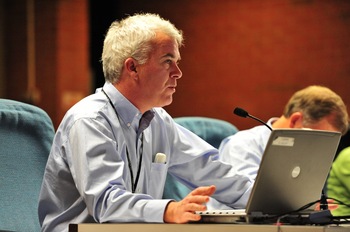
Matthew Naud, Ann Arbor's environmental coordinator, gives a report to the Environmental Commission Thursday night.
Ryan J. Stanton | AnnArbor.com
While Ann Arbor has made strides toward its environmental goals, there's no ignoring the potential of climate change to negate that progress, the report says. One of the 10 environmental goals for Ann Arbor is a stable climate.
"Ann Arbor has got a lot of good news, but there's still a lot of challenges," said Matthew Naud, the city's environmental coordinator. "Climate change is a big one, and it's not like Ann Arbor could do everything right and that would stop climate change. Those are really national and international efforts, but what we can do mostly has to do with energy and trying to use less and use more renewables."
The city ranked itself in "poor" condition when it comes to working toward a stable climate, including its greenhouse gas emissions, vehicle miles traveled and electricity and natural gas use.
Naud said the city is looking at creating an energy efficiency financing district that would allow property owners to borrow money to invest in energy efficiency measures, then pay the money back through a voluntary property assessment.
"Energy efficiency is the gift that keeps on giving," Naud said. "Ann Arbor spends roughly $250 million a year on natural gas and electricity and that's a rough guess. Saving 5 percent is $12.5 million in the economy and you could probably do 5 percent easily with just caulk - no question."
The new state of the environment report notes that several local projects are expected to begin mitigating Ann Arbor's greenhouse gas emissions, including expanding recycling to divert 70 percent of the waste stream from landfills.
The top 10 goals in the report include:
- Clean air.
- Clean water.
- Efficient mobility.
- Health-promoting urban environment.
- Local food sufficiency.
- Responsible resource use.
- Safe community.
- Stable climate.
- Sustainable energy.
- Viable ecosystems.
One goal in the report is to have 40 percent of Ann Arbor canopied by trees. Naud said the city is meeting that goal with about 52 percent canopied, though that number is based on data collected before the emerald ash borer wiped out many ash trees throughout the city.
Another goal is to have diversity within the city's urban forest, but the new report says the city is currently doing a poor job of that.
"It turns out we have a lot of maples and so we don't want to put ourselves at risk for some critter coming along that likes to chew up maples," Naud said. "So part of the whole urban forestry management plan process that's under way is to move ourselves into a more diverse tree population as we do more plantings."
The report includes 61 indicators to evaluate the city's progress toward its goals. Thirteen new ones were developed in the past two years, including some related to the health of the city's seven creeksheds, three for the city's urban forest and others for total phosphorus reductions in the Huron River and footing drain disconnections.
Naud said a phosphorus fertilizer ordinance adopted by the Ann Arbor City Council a few years ago is starting to have a significant impact on the environment.
"We're still seeing reductions in phosphorus loadings to the Huron River," he said. "The average in 2008-09 compared to baseline years is a 17 percent reduction. And to have a measurable effect in the Huron River ... is a really big deal, so that's really good news."
Naud said there isn't enough data yet to say, for instance, whether algal blooms are down at Ford Lake, but the city is hopeful it will see those kinds of changes.
Ann Arbor recently was named as one of the Top 20 On-site Green Power Users by the U.S. Environmental Protection Agency. It also was ranked the 12th best among medium-sized cities in the National Resources Defense Council's "Smarter Cities" contest this year.
The city has an ongoing green energy challenge to increase citywide renewable energy use and has worked to complete a new tree inventory this year.
The Environmental Commission is a 13-member committee appointed by the City Council. Its report will be forwarded to the City Council for consideration and also will be disseminated to city residents at various events in the next year.
The full State of Our Environment report is available online at www.a2gov.org/soe.
Ryan J. Stanton covers government for AnnArbor.com. Reach him at ryanstanton@annarbor.com or 734-623-2529.
Comments
SBean
Tue, Dec 8, 2009 : 5:29 p.m.
GoBlu, you might want to broaden your source base for info on climate change. Here's an item from today on a new study: http://www.enn.com/pollution/article/40800 I'm just sharing this because I just saw it and thought of your comment. You think it's a scam. I disagree. Some data may have been faked. That doesn't mean that all data have.
OverTaxed
Sun, Dec 6, 2009 : 11:06 p.m.
I would like to know what these green decisions are costing us. And the payback period. For example, all the LED lighting. The city also found a way to take more of our money at the parking meters. The new solar meters make people pay for time every time they park, even when the last person may have left tine on the meter. You can't see that time any more. That should be illegal, that spot can get paid for twice or more during the same time period. You should put your card in when you get there and when you leave, to determine cost. You only pay for your actual time in the deck, not overpay! How about timing the traffic lights better. I can get on the freeway and drive to Novi or across town to Ypsi in the same time.
SBean
Sun, Dec 6, 2009 : 12:18 p.m.
Thanks for the coverage, Ryan. One minor clarification: we have only 10 environmental goals. They are intended to be comprehensive and 'high level' with minimal overlap. What you've referred to as other goals are actually objectives, which might be considered stepping stones toward the goals. Soon, in order to account for all aspects of sustainable community, we will be initiating a process to develop goals for economic vitality and social equity to go with our current environmental quality goals. At our meeting I thanked the committee for their work on the report. I want to add that Matt Naud and city intern Adrienne Marino and other members of city staff did all of the work gathering data for the indicators both internally and from outside sources such as the EPA and the Huron River Watershed Council, with Adrienne and Matt updating the web site. Thanks to all of them for their valuable work. Rork, my understanding is that the county water resources (formerly drain) commissioner's office is working on addressing the issues you reference. You might give them a call or send an email to get details and share your thoughts. The state is looking at our phosphorus ordinance, and, with encouragement from citizens like you, might enact similar legislation statewide. Your PS was almost too subtle! xmo, this matters not only because of the environmental impacts of climate change, but also because efforts such as improving energy efficiency are the primary opportunity (of which there are currently few, given declining fossil fuel resources) to improve our economy. GoBlu, I have my own concerns about cap and trade, but the list of petition signatures is basically worthless to the extent that all but perhaps a few of the signatories (and I doubt even that), if they are indeed scientists at all, are not climate scientists. My partner has a PhD in education. Would her signature on the petition count for anything? Of course not. Edward Teller is a physicist. Having studied physics at U-M, I can confidently state that climate is not a topic of study for physicists unless they specialize in it at the graduate level. Climate scientists (of which there are only on the order of a thousand worldwide, if I'm not mistaken) overwhelmingly agree that climate change is occurring and that human activities are responsible for the bulk of it.
Gill
Sun, Dec 6, 2009 : 9:08 a.m.
A big advantage of alternative energy is a break up of the large power monopolies. They have all the money and 'power' and do not want to change - most oil men no little about anything else. Also, as with almost every topic, over population is the underlying problem. The planet is 6x over the naturally obtainable human population. Too many cockroaches in the garbage can, so to speak.
Rork Kuick
Fri, Dec 4, 2009 : 12:23 p.m.
I not sure how to get it done, and it's not strictly Ann Arbor's issue, but the upstream watershed needs serious work. Upstream low-density housing folks use too much fertilizer, too much water pumped from the ground, alter yards to speed up water runoff rather than slowing it down, and don't plant enough trees. Even just educational fliers from the drain commission might help. Some problems are infrastructure though - streets with natural levees (sometimes formed from from "chip-and-dip") that create streams on the impervious surface for 10s or even 100s of yards, speeding runoff to our river. Perhaps regulations (or just enforcement) concerning vegetation near waterways might help. What can we do to get our agriculture to be a bit less silt and runoff producing out there? PS: I hear some scientists have proven burning fossil fuels improves air quality, but sadly are silenced due to the age-old conspiracy against the coal and oil companies, who never have the money to exert any real influence, and so need your help.
Jim Knight
Fri, Dec 4, 2009 : 10:29 a.m.
A comment was removed because it was off topic.
Moose
Fri, Dec 4, 2009 : 9:23 a.m.
Mr Naud is one of the smartest people working for the city. One of the best hires the city has made in the last decade.
xmo
Fri, Dec 4, 2009 : 8:38 a.m.
After release of the "Climategate" emails, why does this matter? Man Made Climate change is a HOAX! It nice to live in a clean place but we don't have to ruin the econmy to do it. How about an article on "Climategate" I am sure we have some U of M researchers who could talk about the lack of controls used by the Man Made Global Warming crowd.