

New report says University of Michigan, others straying from public mission
In a new report, the University of Michigan has found itself in unfamiliar territory — the bottom.
The Washington, D.C.-based nonprofit group Education Trust gave the University of Michigan some of the lowest overall marks out of 50 public flagship research institutions studied for the report, "Opportunity Adrift," released Jan. 12 .
Instead of the traditional markers of prestige - like the academic status of the incoming freshmen class - the report focused on how well the nation's best public research institutions reflect the student populations of their states.
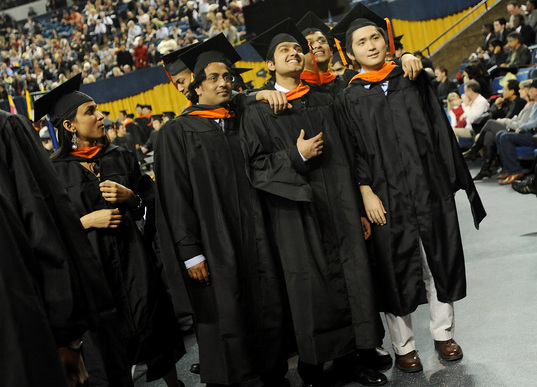
University of Michigan graduates pose for a photograph after walking on stage during commencement at Crisler Arena in December 2009.
Melanie Maxwell | AnnArbor.com
Thirty-nine percent of students attending public colleges in Michigan receive federal Pell Grants - the universal marker for need - but only 13 percent of those enrolled at U-M receive the grant, said Jennifer Engle, a report co-author and assistant director of higher education for The Education Trust.
Engle says such statistics show flagship public research institutions are turning their backs on populations they serve, favoring children of the elite over academically qualified low-income or minority students.
"Public universities were founded to provide that premier education experience in a cost accessible to the full range of students in their states," she said. "But what we see is that they are not living up to that part of their mission, to really be that center of excellence for the entire breadth of their state populations."
University of Michigan officials will respond to the report after reviewing it thoroughly, U-M spokesperson Kelly Cunningham said Friday in a written statement.
"We have recently received a copy of the Education Trust report, and want to give it thorough and serious consideration. Until then, we cannot discuss the report in depth. The report covers topics of great importance that are central to American higher education. At the University of Michigan, we work to make higher education accessible and to ensure that our students succeed."
Study authors said U-M also received low marks because the school's minority enrollment numbers aren't keeping pace with increasing numbers of under-represented minorities - blacks, Hispanics and Native Americans - in the state's population.
"The population of under-represented minority students within state of Michigan increased , but the percent of minority students enrolled at the University of Michigan remained about the same; they weren't keeping up with the trends in demographics in the state," said Mary Lynch, a co-author of the study and a higher education research and policy analyst for The Education Trust.
There is no mention in the study of Proposal 2, the measure approved by Michigan voters in 2006 that banned racial and gender preferences in government hiring and public university admissions.
Areas explored and compared among the 50 flagships included low-income and underrepresented minority student access, the relative success of students from those groups in earning a degree, and on the changes in those figures over time.
U-M received low marks, as did the University of Indiana Bloomington, in two key areas: in the category that measured overall success of minority and low-income student access and minority graduation rates, and in the category that measured progress in those areas. Authors analyzed data from 2004-2005 and compared it to data from 2007-2008 to measure progress.
The report also pointed out the University of Michigan is one of nine institutions studied that make financial aid pledges to the neediest students. U-M helps fully cover expenses of students with family incomes under $20,000 and no expected financial contribution.
Peter McPherson, who led Michigan State University for 11 years and now serves as president of the Association of Public and Land-Grant Universities, released a statement defending the universities.
Public universities have made great strides to expand funds for student aid, worked to increase graduation rates for all racial/ethic categories of students and increased the proportion of minority enrollment overall during the time studied, McPherson said.
Juliana Keeping covers higher education for AnnArbor.com. Reach her at julianakeeping@annarbor.com or 734-623-2528. Follow Juliana Keeping on Twitter
Comments
Milton Shift
Mon, Oct 25, 2010 : 9:52 a.m.
On the admissions application they ask if you intend to apply for financial aid. Always thought that meant they were looking to selectively admit wealthier students.
Mark
Wed, Jan 20, 2010 : 1:53 p.m.
The U of M is simply going where the money is! Why should we expect anything less,..?? And to echo a couple of other comments voiced here,.. who's going to stop them,..??
groland
Tue, Jan 19, 2010 : 9:44 a.m.
I am sorry, but my previous comments have been misrepresented by Trublu. First of all, I did not say low income students are unprepared, I said disadvantaged students are frequently unprepared. By disadvantaged I mean the quality of the elementary and high school education. If you are low income and attend Ann Arbor schools, than you have every opportunity to get great preparation for any college. I also do not focus on ACT scores, the most telling data are graduation rates. The point being that we do not help anyone if they fail to get a degree! What is better, to drop out of the UM or to get a degree from a school that may be more supportive and a better environment. Yes, we are competitive, we do care. Still it is difficult to nurture the unprepared when you have a class of 500 first year Chem, Bio. or Econ students. Lastly, to the poster who says we spend enough money per student already. That may be true on average but the money is unequally distributed. Here is the elephant in the room that no one wants to talk about - EDUCTION IS SUPPORTED PRIMARILY THROUGH PROPERTY TAXES. This is unique to the USA and it creates a lot of problems. It means the wealthy towns and suburbs have better schools. It provides incentives for people of means to abandon less affluent regions and creates the kid of urban flight we have seen in Detroit and other cities. The truth is, the best high school in the USA are as good as anywhere in the world, it is the average that suffers because of the inequities in how schools are funded and administered.
Alan Benard
Tue, Jan 19, 2010 : 8:57 a.m.
@Edward Vielmetti: The statistics presented in http://www.nationmaster.com/graph/edu_spe_per_pri_sch_stu-spending-per-primary-school-student are skewed. The three nations above the United States in pre-capita K-8 ed spending do not subsidize their employees health care and retirement systems. The western-European countries further down the table, and Japan, do. Very pertinent given the role these costs play in our own state's education budgets. Again, research....
David Briegel
Mon, Jan 18, 2010 : 8:14 p.m.
Hot Sam, Legacy is for any rich folks to get their semi literate offspring admitted. Like Bush! Affirmative action for the semi literate offspring of rich white guys. They will never "be made mute". Just ask how large a donation is required. They probably won't even tell us!
trublue
Mon, Jan 18, 2010 : 4:52 p.m.
In reply to Pattycakes who did not like my beating down the K-12 system. If the students are poorly prepared, and if you are a good teacher, give them an opportunity to make it up outside of regular class hours. If they do not take this opportunity fail them. The system often do not want teachers to fail students for financial reasons, so then it is the system at fault for having low expectations. I am aware of some of the people teaching math in the early grades. Some of them have no idea about what they are doing. I am stunned every once in a while when a student who I have taught and who barely passed a pre college math class comes up to me a year later and tells me "I am going to teach math in the early grades" What is even more stunning is that this student is better prepared than most who are currently teaching math at that level in the Detroit Public Schools. In deference to Pattycakes' argument, there a good teachers who pay for supplies out of their own pocket and who care about students and who make a difference at the K12 level but there are not nearly enough of them.
sbbuilder
Mon, Jan 18, 2010 : 3:23 p.m.
O.K. my bad. It looks like we're actually third, instead of second. A little extra perusing of that site also reveals that we are in the bottom fifth in terms of weeks spent per year in school. I'm sure there are all kinds of metrics you could use, but the fact remains that our educational system isn't working, especially compared to the rest of the world.
Hot Sam
Mon, Jan 18, 2010 : 2:43 p.m.
SB is on here... As described by a previous president, we suffer from the "soft bigotry of low expectations" There is nothing wrong with these children other than the fact that we treat them differently and don't demand results. Money is not the problem, it is the misuse of the funds.
sbbuilder
Mon, Jan 18, 2010 : 2:20 p.m.
peacegrad: May I suggest you do your research first. The US, as I've pointed out on other occasions on this board, is second in the world in per capita spending per pupil. We ARE (and have for decades) putting our money where our mouth is. The problem is is that no matter how much money we throw at education, we get a very poor return. It is a systemic failure that will not be solved by adding more money in the system. I'm not here to enunciate the problems, nor to offer solutions to education. I'm just pointing out that, to beat a dead horse deader, we can't look to money to solve this.
peacegrad
Mon, Jan 18, 2010 : 11:25 a.m.
I'm an (under-represented minority) grad student at UM, and also received my undergraduate education here, too. I was recruited by the university, as are many other students. I can say with great pleasure that UM does an EXCEPTIONAL job recruiting minorities (and Americans in general). The problem is, as the prof above states, the poor level of preparation many students have. I agree, that a more representative student base is desirable, but blaming the university is simply a declaration of ignorance of the University's efforts in this regard. People need to focus on 1.) the state's cut backs on education spending, 2.) the poor academic attitudes of many students, 3.) the poor attitudes of parents who don't know about or care about what it takes to get an education and its value for their kids, and 4.) the culture of hypocrisy towards education in the US. We worship (and pay for) pop culture and put its icons on a golden pedestal, and let our education system's budget atrophy, and our self-sacrificing heroes go unsung, under-paid, and unappreciated. Until the US changes its hypocritical values (ie, puts its money where its mouth it) how can we expect a better system, or expect struggling inner city youth to see the value in non-pop culture career paths?
Hot Sam
Mon, Jan 18, 2010 : 12:11 a.m.
Would you believe "made moot"?? so much for spell check...:-)
Hot Sam
Mon, Jan 18, 2010 : midnight
Dave asks.... """"Plubius, I assume you will be demanding an end to all legacy admissions. Correct?"""" Since affirmative action and other admission programs have been in place for over two generations now, the graduates of child bearing age are in a percentage balance. Other than a very small number of generation skipping examples, this "legacy" argument has been made mute.
Tom Joad
Sun, Jan 17, 2010 : 10:03 p.m.
UM has become a corporate conglomerate so far removed from the words chiseled in stone on the face of Angell Hall as to defy credulity.
KeepingItReal
Sun, Jan 17, 2010 : 9:59 p.m.
This is a very good and timely article on the public or not so public status of the University of Michigan. From my perspective, the University ceased to be a truly public University many, many years ago and it has nothing to do with the defeat of Proposal 2 or the fact that minorities (the code word for African Americans) cannot excel in its academic setting. Its all about economics. The annual cost to attend the U even for many well qualified Michigan students is prohibited. As the article pointed out, 39% of students attending Michigan Universities received a Pell grant, an indication that a student is low income. Only 13% of UM student population receives this form of financial aid which means 87% of the student attending the U financial background is such that he/she does not qualify for a Pell Grant. Many well deserving students are forced by economics to attend other public Universities or community colleges in the state that will accommodate them financially (there are many fine schools in Michigan where a student can get a very, very good education). This is not to take away from those students who do work to support themselves while in school. Yet, as tax payers of Michigan, we subsidize the education for individuals who can afford to house their student in high priced condos or provide other luxurious living arrangements, pricey cars, clothing, etc., while they are attending school here. And, don't forget, it is highly prestigious to bring in students from other cultures who also can afford the high cost of attending the U. For many low income youth of Ann Arbor or the state, the only time they will have a chance to visit the UM stadium is to clean it or as a blue chip athlete in which the University will make hundreds of thousands of dollars off but yet that student may not receive a degree (or in some cases one that is marketable even though it has the Michigan brand on it). However, when a grant opportunity becomes available to support research activity involving low-income citizens of the state, the U shows all types of interest in "engaging" these communities who meet the grant makers' "research criteria" for receiving the grant. Once the grant expires the "research" interest in the subject population fades until another grant opportunity comes along. I say all of this not to belittle the U because I happen to think that it is a fine university, but the above article raise some very legitimate points that I hope the U and the State of Michigan will give some serious discussion to and look for ways of engaging the a broader spectrum of its citizens in the years to come.
pattycakes
Sun, Jan 17, 2010 : 9:52 p.m.
I don't appreciate people bashing the k12 system for the lack of skills of incoming freshmen. Do we always have to descend into the blame game? When I teach eighth graders science concepts such as speed, I realize about 10% of my students are capable of consistently dividing two digit numbers by 1 or 2 digit numbers (distance of 22 m divided by 13 sec.). So I have to stop teaching science and start teaching math- 4-6th grade math! Then the kids get mad that we are studying math instead of science. Repeat this scenario over and over in other ways during a typical year. This is a system-wide problem. Kids from poor areas aren't getting the prep at home when they enter kindergarten, and it propagates forward. Early education is SO important! Please stop blaming the very teachers who are perhaps MOST committed. Perhaps you should be thanking these people paying far more out of their own pockets for basic classroom supplies (would you expect engineers to provide their own pencil, pens, chairs, markers, and copy machines?) than suburban teahcers, and who must deal with ridiculous roadblocks everyday...STOP THE BLAME GAME! Michigan has enough negativity circling around....
sbbuilder
Sun, Jan 17, 2010 : 8:54 p.m.
I wonder if anyone on staff at Annarborl.com has the nerve to have a sit-down interview with someone at the admissions office at the U? Wouldn't that clear up some of the speculation? I personally don't give a fig for 'underrepresented' groups. The utopian ideal of having every group perfectly represented at a public institution is nonsense in the extreme. Set the bar high, and admit those who can clear it.
nate
Sun, Jan 17, 2010 : 6:53 p.m.
What about Proposal 2? How can the same populace that votes away the University's ability to prefer students on account of their race complain that the University isn't admitting sufficient numbers of people who belong to a particular race? If we want the University to admit students based solely on their academic credentials, then the outcome will be one that favors financially stable non-minorities.
st.julian
Sun, Jan 17, 2010 : 5:49 p.m.
This is nonsense. Who has made the sancrosant determination that the educational mission is defined by the demographics of the state rather than academic achievement?
Kafkaland
Sun, Jan 17, 2010 : 5:15 p.m.
Craig, you precisely make my point: it's time for the State of Michigan to behave like a responsible business owner towards UM. To illustrate this point: imagine a popular, top-notch restaurant with excellent food, impeccable service, and a well-kept dining room. Then the owner demands that his friends and relatives (and he has many) pay only half price and have priority in seating, but will reimburse only half of the losses. When the manager complains, he is told to cut costs: buy cheaper ingredients, hire cheaper staff, and don't keep up the dining room. Now it's obvious what will happen: soon the fully-paying customers will notice and stay away, and even some of the half-fare friends, who are looking for a top quality dining experience, won't come any more, and the losses will be even larger. The once high-flying restaurant has been severely diminished in quality, and may fail altogether. And I certainly don't want to see UM go down that path. Do you?
David Briegel
Sun, Jan 17, 2010 : 5:13 p.m.
Plubius, I assume you will be demanding an end to all legacy admissions. Correct?
Craig Lounsbury
Sun, Jan 17, 2010 : 3:10 p.m.
Kafkaland @ "So, the univeristy is already subsidizing the state to the tune of..." The State of Michigan, more accurately we the people of the State of Michigan collectively own the University.
DougEFresh
Sun, Jan 17, 2010 : 2:31 p.m.
Is not the "public mission" of this public university also related to research? My experience of approaching U of M with a potentially life saving treatment was to be politely and quickly shown the door. It seems U of M is primarily interested in research partnerships with large international companies with plenty of money rather than local fledgling startups. I can't fault U of M for following the money except that as a public institution it should work more with local smaller companies with smaller pockets. The article's mention of selection of out of state students is just another part of U of M becoming less public research university and more private arm of international corporations.
trublue
Sun, Jan 17, 2010 : 12:17 p.m.
Groland. a faculty member has suggested in his comment that low income students are unprepared and therefore should not be accepted because they may not succeed. Low income minority students have already been victimized by the disgraceful K12 system they have engaged in. Such arguments from university faculty perpetuate this victimization. There are many who worship at the altar of ACT scores as the singular predominant measure for entry to college. High ACT score students unquestionably do well, but this does not mean low ACT score students who demonstrate potential should be excluded. There are programs at Wayne State (where I teach) where minority students with an ACT of 14 and 15 do well but such programs are not universally embraced by the faculty. It does not take a lot of faculty resources to help such students, it takes institutional commitment. One just needs caring imaginative teachers who can humanize the academic experience for such students. A case in point, I once taught math to a latina with an ACT score of 21 ( average for Wayne) and she set the curve on the University Math Placement exam blowing away all the high ACT ( ACT>29) Presidential Scholars and Honors students. I now have Arab students with low ACT scores of 15 and 16 who are getting A's in a math class that typically has under 5% students with A grades. I routinely have classes with almost all minority students where the average ACT score is 17 and where the success rate outpaces that for students with much higher ACT scores. It is really a matter of institutional will and an openness by the instructor to connect with such students in a respectful way. I am happy to support Proposal 2 as long as the playing field is level from birth until entry to college. People want to invoke fairness at college entry when they just might have had far more privileges up to that point than their less fortunate brethren. Why not start Proposal 2 at birth and make sure all educational and economic resources are equitably distributed?
Plubius
Sun, Jan 17, 2010 : 12:14 p.m.
What a crock. The purpose of a university, especially a leading one, is to educate the best students. Period. That UM is now, for the most part, only admitting academically qualified students is a step in the right direction. To admit under-qualified students serves no ones best interest - limited resources will be wasted bringing these students up to average and along the way, many will fail. There are numerous schools, not as academically rigorous as UM, when such students can excel. So, which is better: To fail at a first tier school or succeed at a second tier one? The answer should be obvious. Now, if we could only get rid of athletic 'scholarships'...
The Grinch
Sun, Jan 17, 2010 : 12:05 p.m.
jcj: are you implying that only UM administrators use logic and facts in this discussion and that the UM bashers don't know what they're talking about? I'm just sayin'.... that appears to be a fair conclusion from your post.
jcj
Sun, Jan 17, 2010 : 11:23 a.m.
I would guess that there are a couple high priced U of M employee comments proceeding this one!
Kafkaland
Sun, Jan 17, 2010 : 11 a.m.
Here is another number worth considering: UM receives a little over $300M from the state per year, but the tuition break that the university gives to in-state students is worth more than $400M. So, the univeristy is already subsidizing the state to the tune of hundered million dollars per year. And with the anticipated cut in state appropriations next year, this number is likely to double. In addition, the bar to admission is lower for in-state students than for out of state students. So just by setting a universal academic admissions standard for everyone, which willr esult in more out-of-state students, tuition revenue would increase substantially. So much for UM not doing enough for the state of Michigan... How about the state not doing enough for the University to justify all these breaks given to in-state students?
jcj
Sun, Jan 17, 2010 : 9:48 a.m.
"Engle says such statistics show flagship public research institutions are turning their backs on populations they serve, favoring children of the elite" If they accept more of us Non-elites who will make the big donations to the athletic (I use the term loosely)program. "So how many of you want to make up that gap through higher taxes?" A better question might be: How many of us that are footing the bill would like to see some restraint in the high end salaries at the University of Mediocrity.
Craig Lounsbury
Sun, Jan 17, 2010 : 9:39 a.m.
"Thirty-nine percent of students attending public colleges in Michigan receive federal Pell Grants - the universal marker for need - but only 13 percent of those enrolled at U-M receive the grant..." I would suggest that the University bean counters have figured out an alumnus who needed Pell Grants statistically writes much smaller checks to their Alma mater. With respect to the instate/ out of state ratios, I want to think I remember that several years ago the Board of Regents had to either put a cap on out of state students or at least publicly chastised the University for its large number of out of state students.
The Grinch
Sun, Jan 17, 2010 : 9:39 a.m.
Wolverine3360: Any idea what the applicant pool looks like? The number of qualified Michiganders and Americans who apply versus who are accepted? I agree that all qualified Michiganders and Americans who apply ought to get in before any non-citizen, but it is my sense that, esp. in the Engineereing Grad School, there are far fewer citizens who apply than there are slots. AnnArbor.com: might you do some investigative reporting and find out?
Wolverine3660
Sun, Jan 17, 2010 : 9:20 a.m.
I worry about the Graduate programs at U-M. In the hard sciences and at the Engineering School, the ranks of the graduate students ( who are getting tuition waivers and/or fellowships) are dominated by Chinese and other foreign students. If you ask faculty why that is the case, they usually says thatU-M's Departments are among the best in the entire world, and hence they accept only "qualified candidates". If asked, if as a State Institution, shouldnt they be accepting firsy in-state stdents,and then American students from the other 49 states, instead of recruiting Chinese students, they usually either not respond, or accuse the questioner of being an "anti-foreigner racist". This is another reason, why US citizens are falling behind in the sciences,and engineering fields. Our university faculty members are responsible for not recruiting, teaching and nurturing home grown talent.
Joel A. Levitt
Sun, Jan 17, 2010 : 8:57 a.m.
The UMs mission is to educate as many Michiganians as well as possible, but with limited resources it cannot educate all. So, it chooses to admit those who are likely to make the best use of their undergraduate education those with the highest high school grades or standardized test scores and those who have already demonstrated exceptional effort or creativity. What about out-of-state students? Accepting the numbers provided in bruno-unos comment, the average undergraduate tuition is $19,200, thus every 10 out-of-state students pay their own tuition and the tuition of 9 Michiganians, as well -- a clear contribution to the UMs mission. What about graduate students? They earn their keep by teaching and/or by supporting the work paid for by industrial and government grants. And, in doing so, they help to attract the superior faculty who can provide superior undergraduate education. We have every reason to be proud and supportive of the UM.
engGEEK1988
Sun, Jan 17, 2010 : 12:16 a.m.
No brainer!!! College tuition should not be a shocker to any parent! You have 18 years from when your kid is born to figure it out. Do research, figure out how much college will cost, save money, buy a MET or open a 529. Then you don't have to be dependent on policies at the universities your children decide to attend.
Alan Benard
Sun, Jan 17, 2010 : 12:08 a.m.
LOL Thanks be to God somebody said it. Every institution in Michigan is turning its back on the working class, and that includes the Democratic Party. The one institution which may be exempt around here may be Washtenaw Community College, but that is certainly due to self interest in federal tax credits for continuing education.Michigan has started the decent into being a mini third-world country, or should we say Mississippi North.
The Grinch
Sat, Jan 16, 2010 : 11:01 p.m.
Let's try to bring some facts and figures to bear here. In-state tuition at U of M is roughly $12,000 per year. Out of state tuition is roughly $36,000 per year, for a difference of $24,000 per student. (http://ro.umich.edu/tuition/full.php#Upper_Gen) The U of M's undergrad population is roughly 20,000, 30% of whom (6000) are from out of state. The University of Texas, by comparison, has 10% of its students from out of state. So, were the UM to adopt the UT's 10%, it would have only 2000 out of state students. If in state students replaced all of those out of state students, the university would lose roughly $96,000,000 in tuition revenue every year. So how many of you want to make up that gap through higher taxes? I didn't think so.
David Briegel
Sat, Jan 16, 2010 : 9:34 p.m.
And never a word about the one approved Affirmative Action. The semi-literate offspring of rich white guys (or any rich guy) is admitted without question! Just no minorities need apply. That would be unacceptable! And why don't the "leaders and the best" take these minorities under their wing and provide the extra tutoring and support required. That might be one small step towards proving you are indeed an educational institution! All that public money and huge endowments but underrepresented residents and minorities. Aren't we just the leaders and best? "Cut the State funding, call them private and send them a tax bill!" What a great idea! And then they can increase the salaries at the top even more!
voiceofreason
Sat, Jan 16, 2010 : 7:26 p.m.
Ann Arbor Resident, The nature of public education in those states was factored into my consideration. Hence, my usage of the words "many" and "most", not "all".
groland
Sat, Jan 16, 2010 : 7:25 p.m.
As a faculty member here, I can tell you that there is tremendous pressure to recruit underrepresented minorities to Michigan. The problem is that those students who are truly disadvantaged often do not have the preparation to succeed here. We need to improve the high schools and the college prep curriculum first. What is the point of accepting poorly prepared students if they do not graduate. The latest numbers show that 50% of african american students graduate after 4 years, compared to 76% for asians and 74% for white or unknowns. However, the numbers get better if you look at 6 year graduation rates. Still, these are the students we are accepting. It makes no sense to accept students who might be better served at less rigorous schools. They can always transfer if they really think that Michigan is going to serve them so much better.
Cash
Sat, Jan 16, 2010 : 7:19 p.m.
No surprise here. Yet no one will do a darned thing about it. The 3 most powerful schools...UM, MSU, and Wayne will continue to take the lion's share of state money for higher ed, while the smaller state schools educate the taxpayer's students.
Anonymous Due to Bigotry
Sat, Jan 16, 2010 : 7:17 p.m.
I don't think it's really possible for the U of M to match the demographics of the state. That strikes me as a completely bogus and unattainable metric. What's more important is how many in-state students there are vs. out-of-state students. There's also the problem of how many US citizens vs non-citizens are attending the school. I don't have anything against non-citizens, but it's a bit silly when US citizens start spending too much public money to educate the populations of China and India.
kmgeb2000
Sat, Jan 16, 2010 : 7:07 p.m.
Let see they don't really serve Michigan residents and they receive state money, and too boot don't pay taxes! This would be news if it had not been that way for at least the last few DECADES. How many State of Michigan "A" students couldn't get in? Not affirmative action, just out-of-state, out-of-country tuition$$$$$ Why accept a Michigan kid when you can go for the big money. Just call it what it is - one of the best private schools our money can support. Cut the State funding, call it private, and send them a TAX bill!
Ann Arbor Resident
Sat, Jan 16, 2010 : 6:34 p.m.
Voice of Reason: Please do some research before you make claims of Michigan's uniqueness in regards to public universities/colleges. In regards to the numbers of opportunities available in other states, I can quickly come up with other states that have an equal number or greater number of state sponsored higher education institutions: California (35 state universities and colleges), New York (30 universities/colleges, numerous community colleges), Texas ca. 50 state school campuses, some are independent, some are part of the 6 large university systems), Washington (6 universities, 34 community colleges/tech schools), North Carolina (16 universities and 19 colleges including Michigan's favorite, Appalachian State University), etc. etc.
voiceofreason
Sat, Jan 16, 2010 : 6 p.m.
The report is interesting, but the state of Michigan is different than many others in terms of higher education. The majority of states have only two or three public institutions for residents to attend, while I can think of seven large public institutions in Michigan off the top of my head. Being the most selective university in the entire system, it makes sense if demographics at the University of Michigan are not representative of the entire state. This does not mean a high quality education is unable to be obtained from a public institution in Michigan though. As Michigan residents, we are amazingly lucky to even have the opportunity to pay in-state tuition at a university of this caliber. I believe this report should examine public higher education on a statewide basis, not just school-by-school.
bedrog
Sat, Jan 16, 2010 : 5:15 p.m.
ive always supported some concept of "affirmative action", but at the same time recognize that "equal opportunity" is,and should be, different than "equal outcomes" if individual achievement is not to be stifled altogether. is admission to the UM, or any other academically elite institution, an opportunity or an outcome? this is the real question that needs to be addressed...and its not gonna be done by glib sloganeering form either side of the issue.
Subroutine
Sat, Jan 16, 2010 : 5:04 p.m.
"At the University of Michigan, we work to make higher education accessible..." Hilarious. Accessible to whom exactly?
DonB
Sat, Jan 16, 2010 : 4:47 p.m.
Wow. This is entirely unacceptable for the University of Michigan and it must step up and address the problem head on and with urgency.
scole
Sat, Jan 16, 2010 : 4:21 p.m.
Good article! I just have one small detail to point out. The school in Bloomington, Indiana is Indiana University, not "University of Indiana." It may seem small, but no one from Michigan would say "Michigan University." And I agree, these are two examples of "public" universities that are all but inaccessible to their resident populations. They do amazing research, but lack much in undergraduate education, at least when it comes to teaching individuals.