

U-M research shows longer CPR attempts may be needed
There might be a new attitude surrounding standard CPR practice, according to the University of Michigan Health System.
A new study done in part by U-M researchers shows some patients could benefit from longer resuscitation attempts.
While many practitioners are hesitant to perform longer attempts — 30 minutes or more — the research shows some patients only were able to resuscitated after 30 minutes or more, U-M said in a news release.
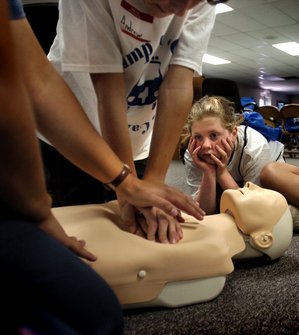
Jackson City Patriot file photo
“Our findings suggest an opportunity for improving care in this high-risk population. Overall, it may involve standardizing the time required for continuing resuscitation attempts prior to decisions regarding termination of efforts,” cardiologist Zachary D. Goldberg said in the release.
Goldberg is leading the study and works as an assistant professor at the University of Washington and also is a Robert Wood Johnson Foundation cardiology fellow at U-M.
U-M cardiologist and senior author of the study, Brahmajee K. Nallamothu, said while the study does show longer attempts should be considered, the research is only one piece of evidence and duration times will vary with each patient.
Comments
jns131
Thu, Sep 6, 2012 : 5:18 p.m.
But it all depends on how long the Red Cross says to keep going with CPR based on the size of the person. Some peter out after 5 minutes and some are like the energizer bunny. Thanks for making us aware to keep on going.
Ricebrnr
Wed, Sep 5, 2012 : 8:06 p.m.
OK this is in a hospital setting. How does this affect recent changes to CPR in the field, especially by trained Samaritans and especially considering "hands only" guidelines? http://www.heart.org/HEARTORG/CPRAndECC/HandsOnlyCPR/Hands-Only-CPR_UCM_440559_SubHomePage.jsp
clara
Wed, Sep 5, 2012 : 10:48 p.m.
It doesn't change anything. We still need people to recognize cardiac arrest, enter the EMS system and do CPR along with using an AED as soon as possible. "The 5 links in the adult Chain of Survival are • Immediate recognition of cardiac arrest and activation of the emergency response system • Early cardiopulmonary resuscitation (CPR) with an emphasis on chest compressions • Rapid defibrillation • Effective advanced life support • Integrated post-cardiac arrest care" http://www.heart.org/HEARTORG/CPRAndECC/WhatisCPR/ECCIntro/Chain-of-Survival_UCM_307516_Article.jsp
dotdash
Wed, Sep 5, 2012 : 6:12 p.m.
It would be nice if there were a link to the study, or at least a reference, so readers could follow up. Or maybe a link to the press release?
Cole Bertsos
Wed, Sep 5, 2012 : 6:17 p.m.
Hey dotdash, Thanks for the feedback! I'm happy to provide a link to the press release: http://www.uofmhealth.org/news/archive/201209/longer-cpr-attempts-might-benefit-some-patients-u-m-research Thanks for reading!